Written and updated by Ruqin
Last updated: May 22, 2026
Kashgar ( or Kashi 喀什) —once known as Shule (疏勒)—is a timeless gem on the ancient Silk Road. Walking through the alleys of its old town, I felt like I had stepped into a different era. The soft jingle of camel bells echoed in my mind, while vibrant facades and friendly smiles lit up every corner.
This city isn’t just where East meets West—it’s a living museum of culture, food, and stories. In this Kashgar travel guide, I’ll take you deep into its heart to discover the beauty, flavor, and mystery that make this place unforgettable.
1. The Best Time to Visit Kashgar: When the Silk Road Comes Alive
Kashgar has four distinct seasons. Each one feels like a movement in a Central Asian symphony—full of texture, rhythm, and soul. In this part of my Kashi travel guide, I’ll walk you through the seasons and help you find the perfect moment to visit this unforgettable city.
1) Spring and Autumn: Kashgar’s Golden Seasons
I first came to Kashgar in spring. The winter chill had just melted away. Mornings felt crisp. Afternoons were bathed in golden sunlight.
From April to June, the air is soft and fresh. Trees awaken, and wildflowers bloom even in the smallest cracks of old stone walls. One morning, I drove toward Tashkurgan. Along the road, clouds of white-pink apricot blossoms framed the snow-capped Pamirs. Villages seemed to float in a dream of color.
Later, I wandered the old alleys of Kashgar’s ancient town. Everything felt alive. Kids played in courtyards. Old men sipped tea and watched the world go by.
Spring also brings festivals. You’ll hear music on the breeze and see locals dancing in the squares. There’s something magical in the joy people share.
Then comes autumn—my second favorite. From September to October, the air turns dry and cool. Skies stretch forever, clear and impossibly blue.
In the Grand Bazaar, every stall overflows with fruit. Figs, pomegranates, Hami melons, and grapes sparkle in the sun. It smells like honey and spice.
Everywhere, color explodes. Mountains glow amber. Local homes shimmer in the golden light. Photographers, take note—this is your season.
2) Summer: For the Bold and the Curious
Kashgar in July and August is hot. Dry heat grips the city. But if you can handle the temperature, the rewards are real.
Up in the Pamirs, the weather shifts. It’s cool, breezy, and quiet. Perfect for hiking, stargazing, or just sitting by a sapphire-blue lake in silence.
Back in Kashgar, the nights come alive. After dark, locals pour into the streets. I sat under fairy lights, eating grilled lamb skewers and watching musicians play into the night.
It was 11 PM, and the city was just getting started.
3) Winter: A Secret Season Few Ever See
From December to February, Kashgar turns inward. It’s cold, yes. But it’s also still. Peaceful. Dreamlike.
I remember walking through the old town after a rare snowfall. Snowflakes clung to the mud-brick walls. The world had gone quiet. No crowds. No rush. Just soft footsteps and the faint sound of a dutar playing behind a wooden door.
Later, I warmed up in a tiny teahouse. Locals sat around the stove, sipping hot brick tea, telling stories. It felt like time had stopped.
Also, winter means deals. Flights and hotels are cheaper. And the slower pace? A blessing in disguise.
4) So, When Should You Visit?
If it’s your first time and you want the full experience—go in spring or autumn. If you’re chasing dramatic landscapes, golden light, and road-trip vibes—autumn is your moment.
Looking for something quiet, soulful, and a little off the beaten path? Try winter. It might surprise you. No matter when you come, Kashgar has a way of staying with you. This city doesn’t just impress—it lingers in your memory like a beautiful song.
2. Kashgar’s City Layout: A Living Symphony in Three Movements
Kashgar isn’t just a city—it’s a story layered across time. Its layout unfolds like a three-part symphony. Each movement holds a different rhythm, voice, and soul. Once you understand these zones, moving through Kashgar feels like traveling through centuries.

1) First Movement: The East Old City — Kashgar’s Beating Heart
This isn’t a tourist site. It’s the soul of Kashgar.
Centered around the east part of the Kashgar Old City (喀什古城东城), this area lies west of the Tuman River. Here, centuries-old homes form one of the world’s largest collections of traditional earthen buildings.
I wandered into a maze of sandy-yellow alleys. Children laughed. Copper clanged from workshops. And everywhere—life.
I got lost, of course. But locals say that’s part of the charm. Hexagon bricks mean “go ahead.” Rectangle bricks? Dead end.
I watched a baker slap dough onto a hot clay oven. Across the street, a weaver fed bright silk into an old loom. This isn’t staged—it’s real life, passed down for generations.
2) Second Movement: West Old City and The Central District — Where Old Meets New
This areas surround the Id Kah Mosque (艾提尕尔清真寺) – the west part of the old city (喀什古城西城) and People’s Square – the city central district. They are lively, walkable, and full of energy.
Id Kah’s golden gate stands tall. I stood there at dusk, watching the call to prayer echo through the square.
Shops, cafés, and busy markets fill the streets. This is where tradition and modern life blend effortlessly.
It’s also the transport hub—taxis, buses, everything connects here. In any Kashgar travel guide, this is your anchor point.
3) Third Movement: The New City — Kashgar’s Future
Finally, there’s the new district (East and North). Wide roads. High-rises. Shopping malls.
It’s clean, modern, and convenient—especially near the airport. After long journeys, I often stay here to recharge.
Though newer, this side of Kashgar still whispers stories. You just need to slow down and listen.
3. Arriving in Kashgar by Air: A Seamless Ride into the City
The moment my plane touched down at Kashgar’s Laining Airport, I felt it—this was the real beginning.

Kashi (Kashgar) greeted me with dry desert air and wide open skies. The airport sits just 10 kilometers north of the city center, yet the ride feels like a slow unfolding of stories. From wide, dusty roads to tree-lined streets and golden-brick homes—it’s a beautiful transition into the oasis life.
In this Kashgar travel guide, let me walk you through the best ways to get into town.
1) Taxi – The Easy, Direct Option
After collecting your bags, follow the taxi signs. You’ll find an organized queue just outside the terminal.
The ride to the city center—near Id Kah Mosque or People’s Square—takes about 20 to 30 minutes. It usually costs 40–50 RMB.
I always keep my hotel address in Chinese on my phone. That way, there’s no confusion. Make sure the driver uses the meter. Most do.
2) Ride-Share – Didi: Like Uber, But Local
If you’re comfortable using apps, Didi works great. Book through the app, then meet your driver at the pickup zone.
The price is similar to taxis, and sometimes even cheaper with coupons. It’s perfect if you prefer knowing the cost upfront.
3) Airport Shuttle – For Budget Travelers
You’ll see signs for airport buses outside the terminal. Most go to People’s Square.
It costs around 15–20 RMB and takes a bit longer—maybe 30 to 40 minutes. Great if you’re traveling light and staying nearby.
Final Tips for Foreign Travelers:
Keep some cash handy. Get a local SIM if you can. And smile—locals are kind, even if your Chinese is limited.
No matter how you choose to enter Kashgar, your journey is already part of the adventure.
4. Arriving by Train: Your Gateway into Kashgar City
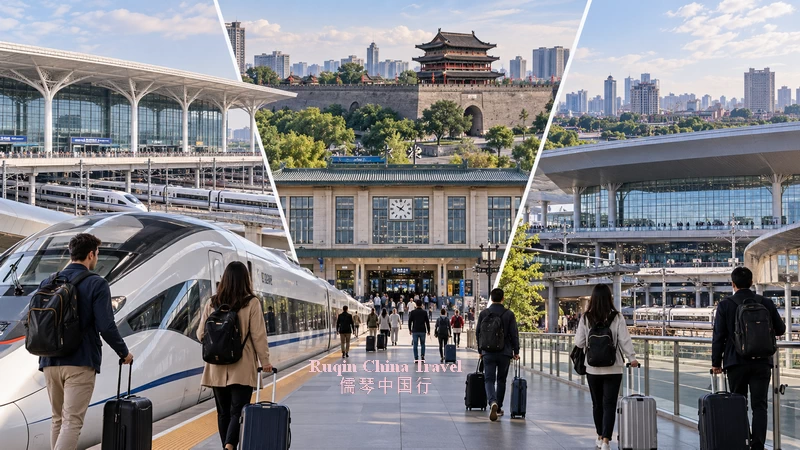
The moment my train eased into Kashgar Railway Station, I felt it—the city was calling. After hours rolling across vast desert landscapes, stepping off the train was like entering a different world.

The station itself blends clean, modern lines with intricate Uyghur arches and patterns. It’s subtle, but it sets the mood. Kashgar welcomes you not just with signs, but with soul.
Located in the eastern part of Kashgar City, the station sits about 6 kilometers from the heart—Id Kah Mosque, People’s Square, and the old town. The journey into town is quick, easy, and filled with little hints of what’s to come.
1) Taxi — Fast, Simple, and Direct
After exiting the station, I followed the clear signs to the taxi queue.
Staff guided the line, and within minutes I was on my way. The ride to the center costs around 20–30 RMB and takes just 15–20 minutes.
Wide roads make for a smooth drive—unless you hit the occasional downtown jam.
2) Bus — For the Curious and Cost-Conscious
Just outside the station is a hub of local buses. For only 2 RMB, you can hop on routes like Tourist Line 1 or Bus 20.
They wind through Kashgar’s neighborhoods, offering a peek into daily life. It takes longer—around 30 minutes—but it’s worth it for the views.
3) Ride-Share — Didi for App-Savvy Travelers
If you’ve used Didi before, it’s just as easy here. Book your ride, follow the pickup instructions, and go.
Same cost, same time—just a bit more app-friendly.
Kashgar Travel Guide Tip: Whether you’re rolling with luggage or just a backpack, Kashi City makes arriving simple. Just step out, breathe in, and let the city carry you forward.
5. Top 10 Places to Visit in Kashgar: A Journey into the Soul of the Silk Road
Kashgar isn’t just a stop—it’s a story that unfolds with every step. From ancient alleys to snow-capped peaks, every corner of this city whispers history, tradition, and quiet wonder. In this part of my Kashgar travel guide, I’ll take you through ten unforgettable places that shaped my journey here.
1. Kashgar Ancient City – A Living Labyrinth
📍 Address: The Kashgar Old City Scenic Area stretches south to Renmin Road, north to Seman Road and Yawage Road, west to Youmulake Xiehai’er Road, and east to the Tuman River sightseeing belt
🎫 Admission: Free
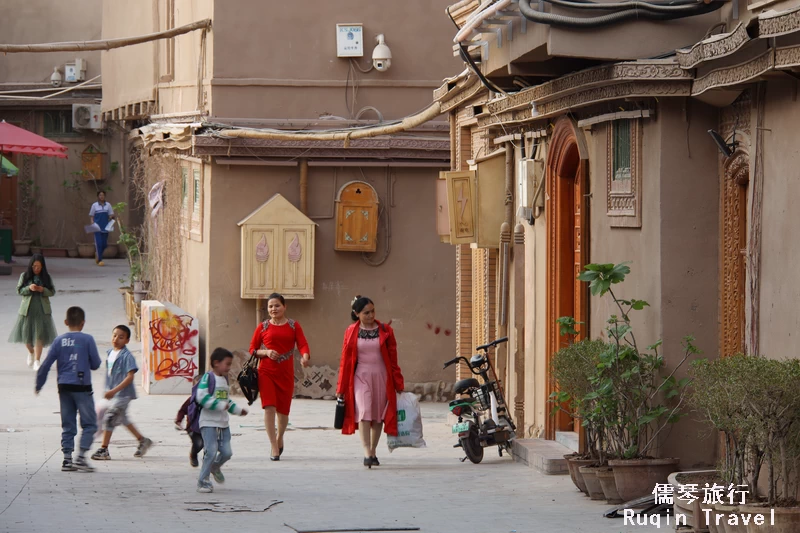
The Ancient City of Kashgar (喀什古城) isn’t just history—it’s alive. I wandered through its maze of sun-dried mud walls and colorful wooden doors, guided by the scent of baked naan and echoes of hammers on copper.
Children played near arched doorways. Elderly men chatted beneath crumbling walls. At every corner, life unfolded slowly and beautifully.
Some alleys were dead ends. Others opened to quiet courtyards. Look down—hexagon tiles mean go, rectangle ones mean stop. This wasn’t a museum. This was real. In this Kashgar travel guide, if I could recommend only one place—it would be here.
The Old City is where Kashgar speaks to you, not in words, but in feeling.
2. Id Kah Mosque – The Spiritual Heart of Kashgar
📍 Address: Jiefang North Road, Kashi City 喀什市解放北路
🎫 Admission: 45 RMB
In the west part of Kashgar Ancient City, I stood before a golden-yellow gate glowing under the sun. This was Id Kah Mosque(艾提尕尔清真寺)—massive, quiet, sacred. Its green dome shimmered above. Tall trees cast shadows over the courtyard.

Next, I stepped inside. The air felt cooler. Calmer. A few locals knelt in silent prayer. Meanwhile, I walked slowly, taking it all in. This mosque isn’t just a religious site—it’s the heartbeat of Kashgar.
If you want to understand this city’s rhythm, start here. Remember to dress respectfully. Visitors are welcome outside prayer times. And once inside, don’t rush. Just listen to the stillness. It speaks more than words ever could.
3) The Tomb of the Fragrant Concubine – Legend and Beauty
📍 Address: Haohan Township, Kashgar City 喀什市浩罕乡
🎫 Admission: 30 RMB
Just outside Kashgar, I visited a place wrapped in legend. Locals call it Xiangfei’s Tomb (香妃墓). Officially, it’s the Apak Khoja Mausoleum (阿帕克霍加墓).
First, I saw the domes—green-glazed tiles shimmered in the sun. White arches framed the entrance. It felt like stepping into a painting. They say the beloved concubine of Emperor Qianlong rests here.
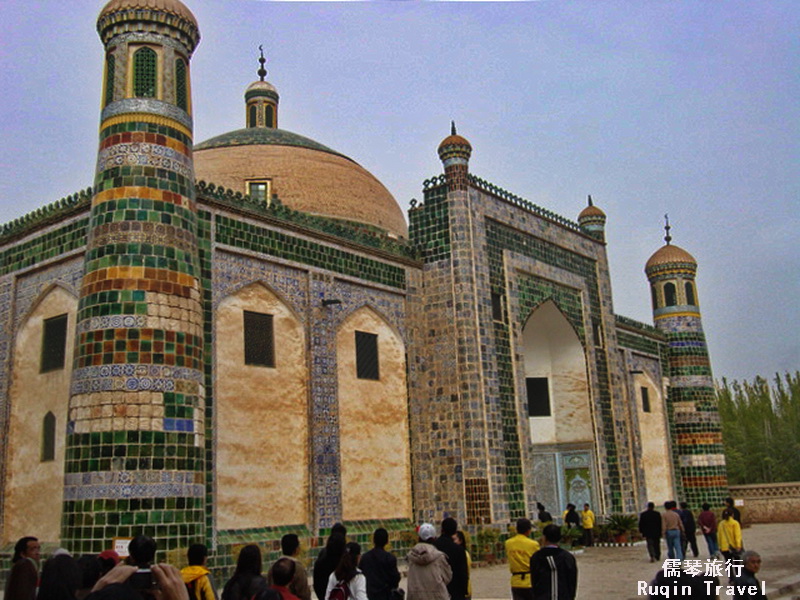
Maybe it’s true. Maybe not. But the story adds romance to the silence. Inside, the beauty of the architecture spoke louder than the legend. Meanwhile, birds chirped in the trees nearby. This spot blends Uyghur heritage with Islamic grace.
In every tile, every curve, you feel it—Kashgar’s quiet elegance and timeless mystery.
4) Gaotai Ancient Homes – A Cliffside Village Frozen in Time
📍 Address: Tuman Road, Kashgar 喀什市吐曼路
🎫 Admission: Free (some areas charge a small fee)
High above the streets of Kashgar, I wandered through the once-forgotten world of Gaotai Ancient Homes (高台民居). No one lives here now. The cliffside houses, once home to generations, had become unsafe.

However, after careful renovation, parts of this historic area have reopened. I walked through narrow alleys, past overhanging wooden balconies and sun-dried mud walls.
It felt like time had paused. Some homes seem to float above the hillside. Others lean into it, silent and strong. Though empty, these buildings still breathe the spirit of old Kashgar.
In this Kashgar Travel Guide, Gaotai remains one of the most striking reminders of the city’s ancient soul.
5) Kashgar Grand Bazaar – A Feast for the Senses
📍 Address: East bank of the Tuman River, northeast corner of Kashgar City
🎫 Admission: Free
The moment I stepped into the Kashgar Grand Bazaar (喀什大巴扎), my senses lit up. Spices hit me first—cumin, cinnamon, dried rose petals.

Next came the colors. Mountains of silk, handwoven carpets, and glinting copper bowls spilled from every stall.Voices echoed—sellers shouting, buyers bargaining, kids laughing.
This place isn’t just a market—it’s a living, breathing part of Kashgar City. I didn’t even need to buy anything. Just walking through the chaos felt like stepping into another world.
In this Kashgar travel guide, the bazaar stands out as the city’s wild, vibrant soul. Come hungry—for food, stories, and life itself.
6) Kashgar Livestock Market – Dust, Drama, and Raw Life
📍 Address: Northwest suburb of Kashgar City, beside National Road 314 喀什市西北郊(314国道旁)
🎫 Admission: Free
I arrived early, just as the sun rose over the outskirts of Kashgar. Dust swirled. Hooves stomped. Voices shouted over bleating sheep.
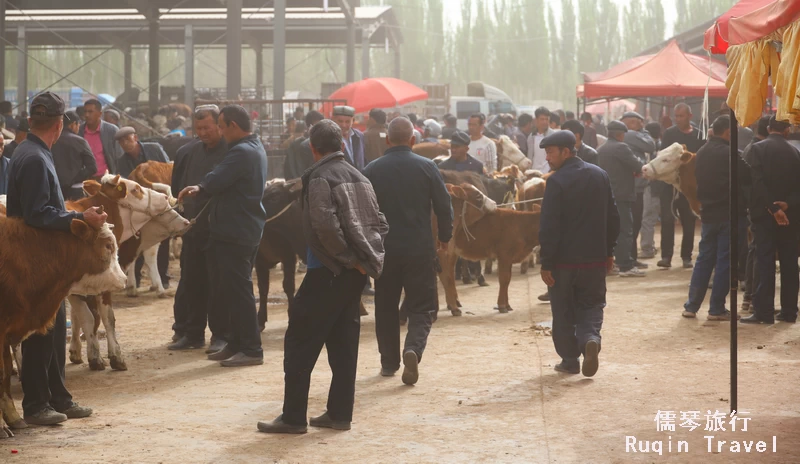
This wasn’t a show—it was real life. Only open on Sundays, the livestock market is one of the wildest places in Kashgar City. Thousands of animals—bulls, goats, sheep—wait for their fate.
Next, I watched men bargain through sleeves, using subtle hand signals. No words. Just eyes, nods, and ancient gestures. The smells, the noise, the energy—it overwhelmed me, in the best way.
If you’re drawn to grit and raw humanity, this is the place. It’s messy, alive, unforgettable.
7) Kashgar Museum – Time Travel Along the Silk Road
📍 Address: 19 Tawuguzi Road, Kashgar City 喀什市塔吾古孜路19号
🎫 Admission: Free (ID required for entry)
On a quiet afternoon in Kashgar, I stepped into its past. The museum felt cool and still, but the stories inside were alive.

First, I wandered through displays of Stone Age tools and Silk Road artifacts. Next came Buddhist statues, their features serene, worn by time.
In one room, I stood face-to-face with an ancient desert mummy—preserved for centuries. Meanwhile, Uyghur clothing, pottery, and maps filled the halls with color and life.
This wasn’t just a museum. It was a key to understanding Kashgar City—layered, diverse, and deeply rooted.If you crave context between adventures, this is the place to pause and connect the dots.
8) Donghu Park – Kashgar’s Modern Mirror
📍 Address: Renmin East Road, Kashgar City 喀什市人民东路
🎫 Admission: Free
After a day of wandering ancient streets, I craved something softer. So I followed the fading sun to Donghu Park (东湖公园).

Unlike the old quarters of Kashgar, this place felt fresh and modern. A calm lake stretched out in the center. Around it, people walked slowly, hand in hand. Children laughed near the Ferris wheel.
Above, the Kashgar TV Tower stood tall, catching the last golden light. Later, as the city lit up, reflections danced across the water. It was quiet. Peaceful. Unexpected.
If you want to see how locals unwind in Kashgar City, come here at dusk. Sometimes, the perfect end to a long day is just a gentle walk by a glowing lake.
9) Century-Old Teahouse – A Window into Everyday Kashgar
📍 Address: Wustangboyi Road, inside the Kashgar Old City Scenic Area 喀什市区中心古城景区内的乌斯塘博依路口
🎫 Admission: Free (pay for tea)
Inside the Kashgar Old City Scenic Area, I found a teahouse that felt like a time capsule. The building stood proudly on a street corner—two stories of carved wood and warm color.

Inside, the air was thick with the scent of tea and history.Locals lounged on raised kangs, sipping slowly, chatting softly.
Next, someone strummed a dambur, adding rhythm to the moment. Through the windows, I watched life move along the old streets below.
This wasn’t just a café. It was Kashgar’s living room. In any true Kashgar travel guide, this place deserves a quiet afternoon—just you, a hot cup, and a taste of Uyghur soul.
10) Uyghur Song & Dance – A Night of Color and Rhythm
📍 Address: Near Id Kah Square, Kashgar City (at venues like Kashgar Hotel)
🎫 Admission: 100–200 RMB (depends on seat and showtime)
One evening in Kashgar, I found myself swept into a whirlwind of music, motion, and joy. The lights dimmed. Drums beat. Then dancers burst onto the stage in shimmering silk.Their dresses spun like fire. Their smiles lit up the room. This wasn’t just entertainment—it was soul, centuries old.

Next came the Twelve Muqam (十二木卡姆) rhythms, deep and hypnotic. Meanwhile, my plate filled with local dishes. The show often includes a buffet dinner—flavors as rich as the dancing.
If you want one night that captures Kashgar’s heart, don’t miss this. In every spin and note, you’ll feel exactly why it belongs in any true Kashgar travel guide.
6. Getting Around Kashgar – How I Moved Between Past and Present
In Kashgar, transportation isn’t just about getting from A to B. It’s part of the experience—another way to feel the rhythm of the city. Kashgar is compact. Most major sights sit close together. But the right ride can still make your day smoother.
First, taxis.
They’re everywhere and easy to spot. Just raise your hand when you see the roof light on. A short ride across town? Usually 10 to 20 RMB. Fast, affordable, and air-conditioned—a lifesaver in the summer heat.
Still, I always show the driver my destination in Chinese. It helps avoid confusion. And yes—always ask to use the meter.
Then there’s Didi.
Think Uber, but for China. I used it often while writing this Kashgar travel guide. Book through the app, get a price upfront, and avoid the language barrier completely.
Just make sure you’ve got mobile data and a payment method set up.
Buses?
Cheap and very local. Only 1–2 RMB. I hopped on once just to people-watch.
But routes can be tricky for visitors, so I planned ahead using Baidu Maps.
One of my favorites? Bikes.
Shared bikes are perfect for the new parts of Kashgar—wide streets, lakeside parks, quiet afternoons.
However, don’t ride into the Old City. The alleys are narrow, and it’s better explored on foot anyway.
And speaking of walking…
That’s how I found the real Kashgar.
Wandering. Getting a little lost. Smiling at strangers.
This city opens up when you slow down. And your own two feet might just take you further than any taxi ever could.
7. Where to Stay in Kashgar – Finding Your Base in the Far West
In a place as layered as Kashgar, where you stay shapes how you experience the city. For this Kashgar travel guide, I tried different areas—and each one told a new story.
1. East Old City – Sleep in the Soul of Kashgar
This is where I felt closest to Kashgar’s heart. I stayed in a traditional Uyghur courtyard guesthouse, right inside the East Old City (喀什古城西城).
Each morning, I woke to the soft echo of prayer calls. Each evening, golden light spilled across clay walls. Locals smiled as I passed. I bought naan at the corner shop.
It felt like I belonged. Just a tip—some guesthouses are rustic. Bring earplugs. And travel light—cars can’t enter the narrow alleys. Still, for culture lovers, this is magic.
2) West Old City Center – Where Comfort Meets Convenience
Next, I moved closer to Id Kah Square (艾提尕尔广城). Big-name hotels, cafés, banks—all within walking distance.
From here, I could stroll to the East Old City, grab dinner, and be back in my room in minutes. The Kashgar Hotel (喀什噶尔饭店) was classic and reliable. Meanwhile, the Radisson Blu (喀什深业丽笙酒店) offered sleek comfort and excellent service.
Great for first-time visitors, families, or anyone wanting ease without giving up atmosphere.
3) New District – Clean, Quiet, and Modern
Finally, I spent a night near Wanda Plaza (喀什万达锦华酒店) in Kashgar’s east. The rooms were huge. The gym had a view. And the mall downstairs? A lifesaver.
However, it’s far from the old streets. You’ll need a taxi to get to the soul of Kashgar—but for modern comforts, it delivers.
8. Shopping in Kashgar – A Silk Road Treasure Hunt
Shopping in Kashgar isn’t just about buying things. It’s about stepping into the rhythm of trade that’s centuries old.
Spices fill the air. Dust swirls. Hammers ring out from workshops. And everywhere, someone’s calling out prices. It’s chaotic. It’s alive. And it’s magical.
What to Buy
First, the handwoven carpets. I watched a weaver knot one by hand—her fingers flying over rich wool and dye. Each one tells a story.
Next, I found Atlas silk (艾德莱斯绸)—shimmering, colorful, light as wind. You’ll see it as scarves, skirts, or fabric by the meter.
Then came the famous Yingjisha knives (英吉沙小刀). Crafted just outside Kashgar City, they’re beautiful—but remember, you can’t carry them home. Post them instead.
Meanwhile, I stocked up on dried fruit and spices—figs, almonds, saffron, cumin. My backpack smelled like a spice market for days.
Finally, I couldn’t resist a Uyghur doppa (embroidered hat 维吾尔族小花帽) and a tiny copper teapot. Each was made by hand. Each came with a story.
Where to Shop
The Grand Bazaar (喀什大巴扎) is wild and unforgettable. You’ll need hours to explore its food, fabric, and hardware zones.
For a quieter vibe, I wandered through the Old City craft streets (喀什古城手工艺品街). There, I met potters, woodworkers, and silk artists at work.
If you want something cleaner and more organized, the International Trade Market (中亚国际贸易市场) near downtown is ideal.
And on Sundays, for the bold—there’s the livestock market (周日牛羊大巴扎). You won’t buy souvenirs there. But you’ll buy memories.
A Few Tips: Always bargain, kindly. Smile often. And carry some cash, just in case. In Kashgar, the best things you bring home aren’t always in your suitcase.
9. Dining in Kashgar – A Bold, Beautiful Feast for the Senses
Food in Kashgar isn’t just delicious—it’s a reflection of the land, the people, and their nomadic roots. From smoky lamb skewers to chewy hand-pulled noodles, every bite tells a story.
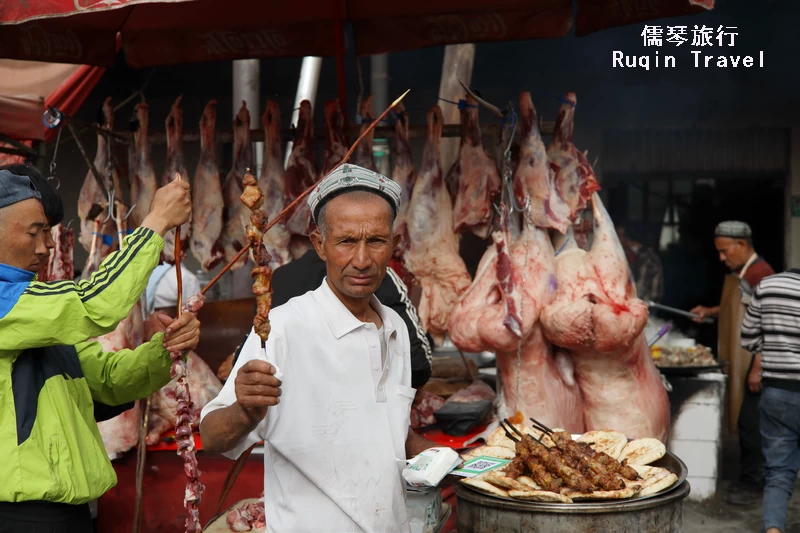
First, there’s lamb (羊肉)—the star of nearly every meal. It’s tender, flavorful, and surprisingly mild. Whether roasted in a clay pit or grilled on open coals, it’s always unforgettable.
Then comes naan (馕). In Kashgar City, you’ll hear a saying: “One can go a day without vegetables, but never without naan.” I watched bakers slap dough into deep tandoors. Seconds later, golden rounds emerged, hot and fragrant.
Next, I tried thick, tangy local yogurt (酸奶), often sweetened with raisins. It cooled the palate and soothed the soul. Don’t miss the fruit either—melons, figs, grapes. Sweetened by endless sun, they taste like candy grown on trees.
Must-Try Dishes
– Kawap 烤羊肉 (lamb skewers): Charred outside, juicy inside. Best enjoyed at night markets.
– Kao baozi 烤包子 (baked buns): Crisp shell, juicy lamb and onion inside. Eat them hot.
– Polo 手抓饭 (Uyghur pilaf): Rice cooked with lamb, carrots, and spices. Rich and comforting.
– Laghman 拉条子 (hand-pulled noodles): Thick noodles with stir-fried meat and veggies. Slurp generously.
– Gāngzi Ròu 缸子肉 Chunks of lamb go into an old enamel mug, sometimes chipped from years of use. A little water. A pinch of salt. Then, it’s set over hot coals and left to stew.
Where to Eat
Start at the Id Kah night market (艾提尕尔美食街 & 夜市). The smoke, music, and scent of spice are intoxicating.
For a slower pace, I loved tea at an old city teahouse—watching life pass while sipping sweet brick tea. Local hole-in-the-wall spots? Always the best meals of my trip.
So come hungry. In this Kashgar travel guide, every meal is a memory waiting to happen.
10. Nightlife in Kashgar – A Thousand-Year Song Beneath the Silk Road Sky
As the sun dipped behind the mud-brick rooftops of Kashgar, something shifted. The day’s dust settled. And the city—still ancient, still breathing—came alive again.
Night in Kashgar City is quiet, but never dull. It’s not about clubs or flashing lights. It’s about warmth, rhythm, and everyday magic.
First, a walk through the Old City.
Right after sunset, I wandered the maze-like alleys. Warm light glowed from carved wooden windows. Smoke curled from hidden courtyards.
Somewhere, I heard laughter. Somewhere else, the smell of fresh naan drifted on the breeze. It no longer felt like a tourist spot. It felt like someone’s home.
Then, I climbed up to the second floor of a century-old teahouse.
A soft rug beneath me. A pot of sweet tea in front of me.
Above, stars filled the desert sky. Below, the city lights twinkled.
Sometimes, an old man would strum a rawap, and everyone fell quiet, listening.
Later, I passed through Id Kah Square.
Locals gathered in the open space—talking, strolling, sometimes dancing.
During festivals, it felt like an open-air concert, with spontaneous music and joy.
For something more theatrical, I joined a dinner show at a local hotel.
The stage lit up with spinning skirts and brilliant smiles.
The Twelve Muqam played, and I forgot where I was—except I didn’t want to leave.
And of course, the night markets.
Smoke, spices, sizzling skewers. A plate of pilaf. A bowl of cold yogurt.
That’s Kashgar at night—soulful, spicy, and quietly unforgettable.
11. Kashgar Scenic Driving Routes – An Epic Journey Across the Pamirs and Beyond
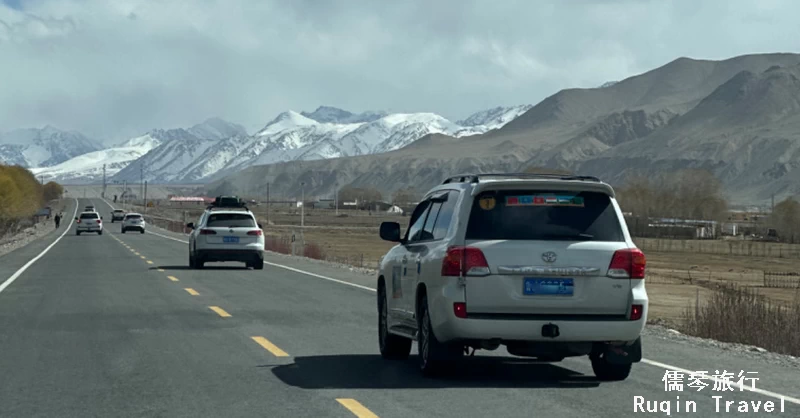
There are road trips, and then there are journeys that feel like crossing into a different world. This route from Kashgar to Tashkurgan, and onward to Khunjerab Port or the Wakhan Corridor, is one of those rare adventures that stays with you—etched in memory, layered with wind, sky, snow, and story.

It follows the legendary China-Pakistan Friendship Highway (G314), climbing into the heart of the Pamir Plateau, where borders blur and cultures converge. You don’t just drive this road. You feel it.
Route 1: Kashgar → Tashkurgan → Khunjerab Port / Wakhan Corridor
Total distance: ~426 km one way to Khunjerab Port (Hongqi Lafushankou 红其拉甫口岸)
Suggested duration: 3–4 days round trip
Road conditions: Fully paved, excellent surface. However, it’s high-altitude and mountainous—drive carefully and stay alert.
Day 1: Kashgar → Oytak Red Mountains → White Sand Lake → Karakul Lake → Tashkurgan
(Approx. 300 km / 6–7 hours driving)
We left Kashgar City early, just after sunrise. As we headed south, the landscape shifted quickly—civilization fading behind, raw nature rising ahead.
Oytak Red Mountains (奥依塔克红山) were our first shock of beauty. Suddenly, Mars-colored hills rose before us, with deep folds and fiery hues. I stepped out, just to feel the dry wind and silence. The photos didn’t do it justice.
Next, we reached White Sand Lake (白沙湖). One side glowed white like snow. The other reflected a sky-blue shimmer. It felt untouched, almost unreal.
But then came the moment I’ll never forget—Karakul Lake (喀拉库勒湖). Set at 3,600 meters, this jewel mirrored Muztagh Ata (慕士塔格峰), the “Father of Ice Mountains.” Its snowy peak (7,546 meters) loomed above the lake like a guardian.
The air was thin. The silence, thick. I stood still for minutes, overwhelmed. That night, we arrived in Tashkurgan (塔县), a remote, highland town where the Tajik people (塔吉克民族) live and smile with their whole faces.
We stayed in a simple guesthouse. The stars above? Brighter than any city skyline.
Day 2: Tashkurgan Deep Dive – Stone City, Golden Meadows, and the Panlong Highway
We started early, climbing to the Stone City Ruins (石头城遗址) just as sunlight touched the mountaintops.
This was once the capital of Puli Kingdom (蒲犁国都城), one of the ancient Western Regions. Now, it’s a skeleton of stones and towers, silent but not empty.
Next, we walked through Golden Grassland 金草滩 (Jin Caotan). The Tashkurgan River 塔什库尔干河meandered below us, its waters glinting silver. Cattle grazed in the valley. Kids waved from the distance.
And then—came the Panlong Ancient Road (盘龙古道). A true icon of modern Xinjiang, this road snakes like a black dragon through the mountains, with hundreds of switchbacks.
From the drone’s view? Pure poetry. Driving it? A bit nerve-wracking, but unforgettable. They say, “After Panlong, every road feels easy.” I believe it.
Day 3: Tashkurgan → Khunjerab Port/ Wakhan Corridor → Return
On our final day, we headed toward Khunjerab Port ( 红其拉甫口岸)—the highest border crossing in the world (4,733 meters).
The road stretched endlessly into the sky.Every curve brought sharper wind, deeper silence, and closer views of snow-capped peaks.
Important tip: Foreigners may need a border permit. Always confirm with local police in Kashgar before attempting this leg—rules can change.
If weather or policy prevents the drive to the pass, you can explore the nearby Wakhan Corridor (瓦罕走廊). This ancient passage once welcomed monks, merchants, and explorers like Xuanzang.
Now, it’s a stark, haunting valley that whispers of civilizations past. Whether we returned to Kashgar City that evening or overnighted again in Tashkurgan—honestly, I don’t remember.
But the feeling of standing so close to the edge of the world? That has never left me. This route, in every way, is a centerpiece of any true Kashgar scenic driving adventure. You won’t just see landscapes. You’ll feel them. In your bones. In your breath. In your heart.
Route 2: Kashgar → Shache → Hotan → Desert Highway
A Journey Across Sand and Soul in the Taklamakan
Not every road trip starts with a dream. But this one—leaving Kashgar, tracing the edge of the Taklamakan Desert, and crossing into its golden heart—felt like entering a fable.

This is one of the most iconic Kashgar Scenic Driving Routes. You travel deep into Southern Xinjiang, where oasis culture, Uyghur traditions, and raw desert beauty intertwine.

Total Distance
– ~1,500 km for the full loop (Kashgar → Hotan → Minfeng → Luntai → Kuqa → Kashgar)
– ~600 km if turning back at Hotan
Suggested Duration
– 4–5 days for a small loop
– 7–8 days for a full desert crossing
Road Conditions
Mostly smooth national highways. Desert highway is long, straight, but watch for strong crosswinds.
Day 1: Kashgar → Shache → Yecheng → Hotan
(Approx. 500 km / 7–8 hours)
We left Kashgar City at dawn. The early morning haze faded as the road stretched ahead, with the desert teasing the horizon.
Shache (莎车), once the capital of the Yarkand Khanate, was our first stop.
Its ancient charm felt different from Kashgar’s—quieter, more introspective. I wandered past the Shache King’s Tomb (莎车王陵) and the Jiaman Mosque (加满清真寺), soaking in the layers of Uyghur heritage.
Next came Yecheng (叶城), the symbolic start of the G219 Highway—the gateway to Tibet. We didn’t turn east this time, but even standing at that threshold stirred something wild inside me.
By evening, we reached Hotan (和田), a city famed for silk, carpets—and above all, jade. That night, I wandered through the Hotan Night Market (和田夜市), hypnotized by sizzling skewers, sugar-dusted yogurt dumplings, and the rhythm of Southern Xinjiang.
I tasted grilled eggs, pigeon skewers, and sticky rice yogurt bowls, under flickering lights and music echoing through the stalls.
Day 2: Exploring Hotan
After breakfast, we walked along the banks of the Yulong Kashgar River (玉龙喀什河), eyes scanning the gravel for hidden jade. I didn’t find treasure—but the search itself felt timeless.
Next, we visited a Hotan carpet workshop (和田地毯厂). Women sat cross-legged, weaving stories into silk and wool—thread by thread.
Then, we strolled through Tuan City Old Street (团城老街). It’s been rebuilt, yes—but the spirit of Uyghur life is still strong here. Men played chess beneath grapevines, while shopkeepers offered tea and laughter.
Day 3: Hotan → Minfeng → Taklamakan Desert Highway
This was the day. The road south narrowed. Villages thinned. And then—it happened. We crossed into the Taklamakan Desert Highway (塔克拉玛干沙漠公路), and suddenly, the world fell away.
Nothing but golden dunes and an endless strip of black asphalt, stretching forward like a ribbon to infinity. Windbreak grids lined the road—rows of hardy shrubs planted to hold back the sands.
It felt like driving through a living museum of survival. Every few kilometers, we’d stop. Just to stand in the silence. To hear nothing but the wind. We spent the night in a roadside inn near Luntai (轮台县)—small, quiet, and surrounded by stars.
Tips for Driving This Route
- Border Permits: Not required for this route unless you detour to Tashkurgan. For that, get a Border Permit (easily done in Kashgar).
- Altitude: No high-altitude zones on this route, unlike the Pamirs. But desert conditions can be harsh.
- Supplies: Fill up on gas at every opportunity. Desert stretches can go 200 km without a station. Stock water, snacks, and basic meds.
- Weather: Watch out for sandstorms and intense sun. Crosswinds on the desert highway are strong—keep both hands on the wheel.
- Cultural Respect: Always ask before photographing locals. Smile. Learn a few Uyghur greetings—it opens doors.
Two Roads: One to the Sky, One to the Sand
If the Pamir Highway is a journey toward the heavens, then the Taklamakan Route is a dive into Earth’s hidden core.
One climbs into snow and silence. The other drives straight into wind and fire. I took both. And they left different imprints on me. But this one—through sand, jade, and endless horizon—felt like a road to the soul of Xinjiang. And it all began in Kashgar.
12. Kashgar Travel Guide Essentials
When I first landed in Kashgar, I was enchanted—but also cautious. This city is different. Wondrous, yes, but layered, complex, deeply sacred.
As a foreign traveler, I quickly learned: knowing a few local customs made all the difference. So here it is—everything I learned the helpful way (and the hard way), shared for your smooth journey.
First: Respect the Culture, Always
This part can’t be overstated. Kashgar isn’t just a scenic stop—it’s a living, breathing center of Islamic culture in China.
Mosque Etiquette:
Yes, you can visit places like the Id Kah Mosque. But always take off your shoes. Women might be asked to wear a robe or scarf, provided at the door.
Dress modestly. No tank tops or shorts for anyone. Long pants, covered shoulders. It’s not just polite—it’s essential.
Inside, keep your voice low. Never walk in front of someone praying. I almost did—until an elder gently waved me aside. Lesson learned.
Everyday Encounters:
Photography? Ask first. Especially when it comes to local women or children. A smile and a polite gesture work wonders. If they say no, respect it.
Avoid mentioning or bringing pork, or alcohol, especially in restaurants or homes. It’s a sensitive topic.
When the adhan (call to prayer) echoes from the minarets five times a day, take a moment to pause. It’s beautiful—and deeply meaningful to those around you.
Next: Navigating the City Smartly
Kashgar Old City is a maze of beauty. It’s also literally a maze.
Want a local tip? Look at the tiles under your feet.
- Hexagonal tiles = This path leads somewhere.
- Rectangular tiles = Dead end.
This saved me so many times!
If you’re nervous about getting lost, go with a local guide. They not only know the routes, but share stories you’d never find online. My guide took me into a hidden courtyard where women were baking sesame-seed bread on clay walls. I still dream of that smell.
At night, stay on main roads unless you’re with someone. Not because it’s unsafe, but because getting lost in the dark here is really easy.
Planning a Trip to Tashkurgan or the Pamirs?
You’ll need a border permit.
This surprised me, too. Foreigners must have a Border Zone Permit to visit places like Tashkurgan, Khunjerab Pass, or the Wakhan Corridor.
You can’t apply individually. You’ll need to go with a registered local travel agency. Some hotels can help arrange it, but ask at least a few days ahead. Always double-check the latest rules—they change.
Health Tips (Especially for High Altitude Travel)
If you’re heading to the Pamir Plateau, prepare for altitude. Tashkurgan sits at 3,000+ meters. Some passes go beyond 4,000. I brought altitude pills (Diamox + Rhodiola), and I’m so glad I did.
Drink water. Don’t rush. Give your body time.
Sun protection is a must. I got burned in 20 minutes. Bring SPF 50+, sunglasses, a wide-brim hat, and a neck scarf.
Also, even in summer, nights get cold. A down jacket or windproof shell is non-negotiable.
Back in Kashgar City, the air is dry. Eat fruits. Hydrate often. Most local food is heavy on meat and carbs, so balance it out when you can.
Other Tips That Made My Trip Better
1. Time Zone Twist:
Kashgar follows Beijing Time (GMT+8), but locals live 2 hours later. Shops open late. Lunch is often at 2 p.m. Dinner? Sometimes not until 9. Plan accordingly.
2. Self-Driving Rules:
If you’re renting a car for a Kashgar scenic driving route, check your vehicle top to bottom. Gas up often. In the desert or mountains, stations are few and far between.
Always obey traffic rules—Xinjiang has many speed checks. And beware of crosswinds on the desert highway. They’re no joke.
3. Always Carry ID:
Police checkpoints are common. Keep your passport with you at all times. A phone photo is not enough.
4. Mobile Payments Rule:
Most places use WeChat Pay or Alipay. Foreign credit cards? Rarely accepted. If you don’t have a Chinese account, carry cash in RMB.
5. Know a Few Words:
A simple “Yakximusiz” (hello) or “Rehmet” (thank you) in Uyghur gets you smiles every time. Locals appreciate the effort deeply.
6. Shopping Etiquette:
Bargaining is expected—but do it with kindness. Start at 60-70% of the price. Walk away if needed, but do so respectfully.
Come With Curiosity, Leave With Stories
More than any travel tip, this is the heart of any Kashgar Travel Guide:
Respect deeply. Prepare wisely. Stay open. Kashgar will reward you with unforgettable moments—shared tea, spontaneous music, ancient silence, and warm smiles that transcend language.
It’s not just a destination. It’s a feeling. And it stays with you, long after the journey ends. Safe travels.
About the Author
Ruqin is the founder of Ruqintravel.com and has spent more than four decades working in China’s travel industry. Drawing on hands-on experience in cities like Beijing and Hangzhou, he personally researches and updates each guide to help international travelers navigate China with confidence.
Further Reading
Urumqi Travel Guide: Map, Scenic Routes, Highlights and Tips
The Best Kashgar Tour Itinerary – Ruqin China Travel
The Best China Silk Road Tour for First-Time Visitors
How to Visit Xinjiang, China – Ruqin China Travel