
Written and updated by Ruqin
Last updated: March 9, 2026
I arrived in Beijing on the high-speed train G182 from Hangzhou, a journey that takes just over five hours. The train slid quietly into Beijing South Railway Station in the late afternoon, as it often does — smooth, efficient, almost uneventful after such a long distance.
Whenever I come to Beijing, I like to wake early the next morning and walk or jog through the neighborhood before the city fully wakes up. The early hours reveal a different rhythm.
This time I was staying at the RoyalRae ZhongYiPengAo Hotel, near Gongzhufen, where western Chang’an Avenue meets the Third Ring Road. It is normally a very busy intersection during the day.
The next morning I went out for a jog just before sunrise.
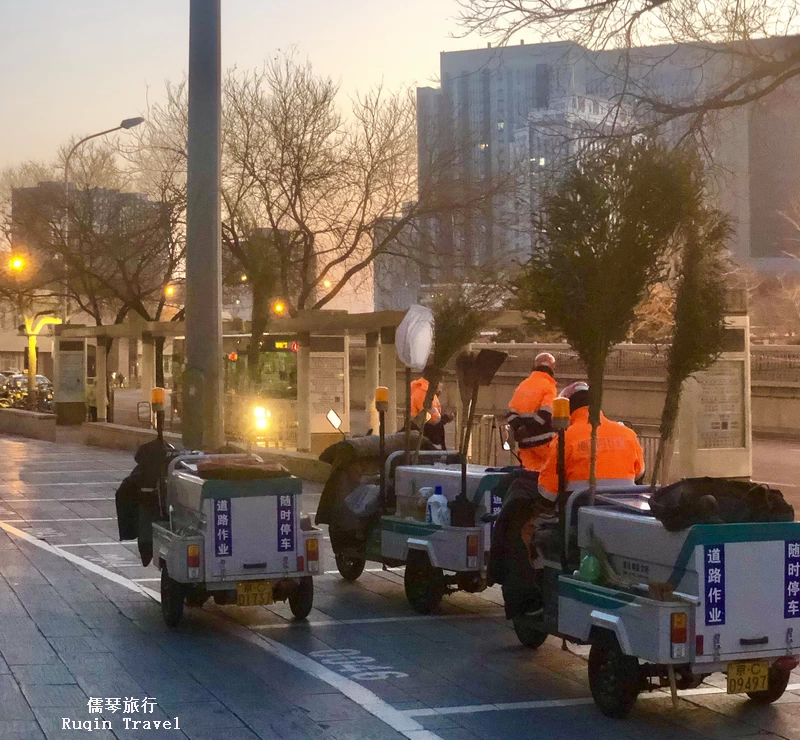
Street Cleaners clad in yellow uniforms, wrapping up their early shift.
Around 6:00 a.m., under a pale sky slowly shifting from night to morning, I noticed a group of street cleaners in bright yellow uniforms standing beside their carts. They had just finished sweeping the wide sidewalks around the intersection.
The scene caught my attention immediately.
At that hour, most people in the city were only beginning to wake up. Yet these workers had already completed several hours of work. The streets were already clean, the litter gone, the pavements neatly swept.
Watching them there quietly finishing their shift made me realize again how much of a city’s daily life happens before most of us step outside.
Their work is rarely noticed. But without it, Beijing would feel very different.
That brief moment during my morning jog became the starting point of a deeper curiosity about the people who keep the city clean every day.
A Morning Encounter at Gongzhufen
At the Gongzhufen intersection, I noticed a small group of street cleaners standing beside their carts.
They wore bright yellow uniforms that are easy to recognize anywhere in Beijing. Their shift had already been underway for hours.
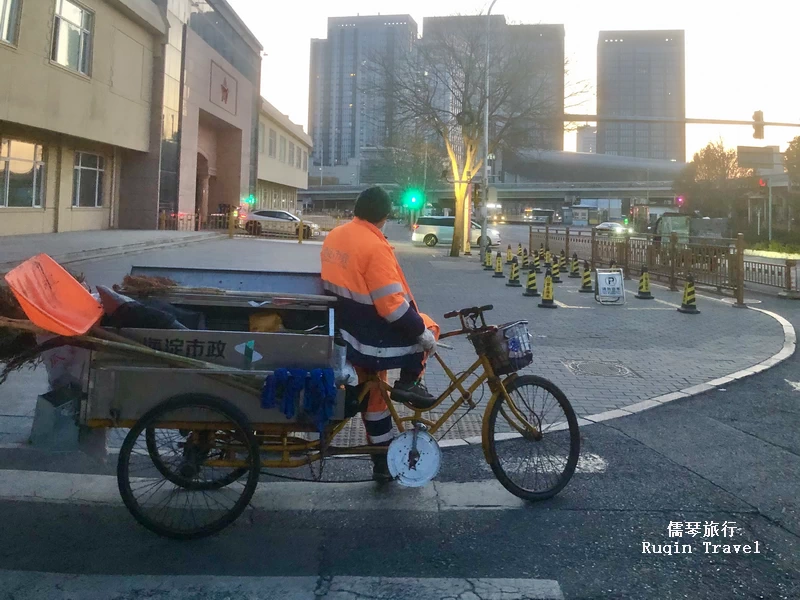
One of the men seemed to be the leader of the group. I greeted him and we began to talk. His surname was Zhong.
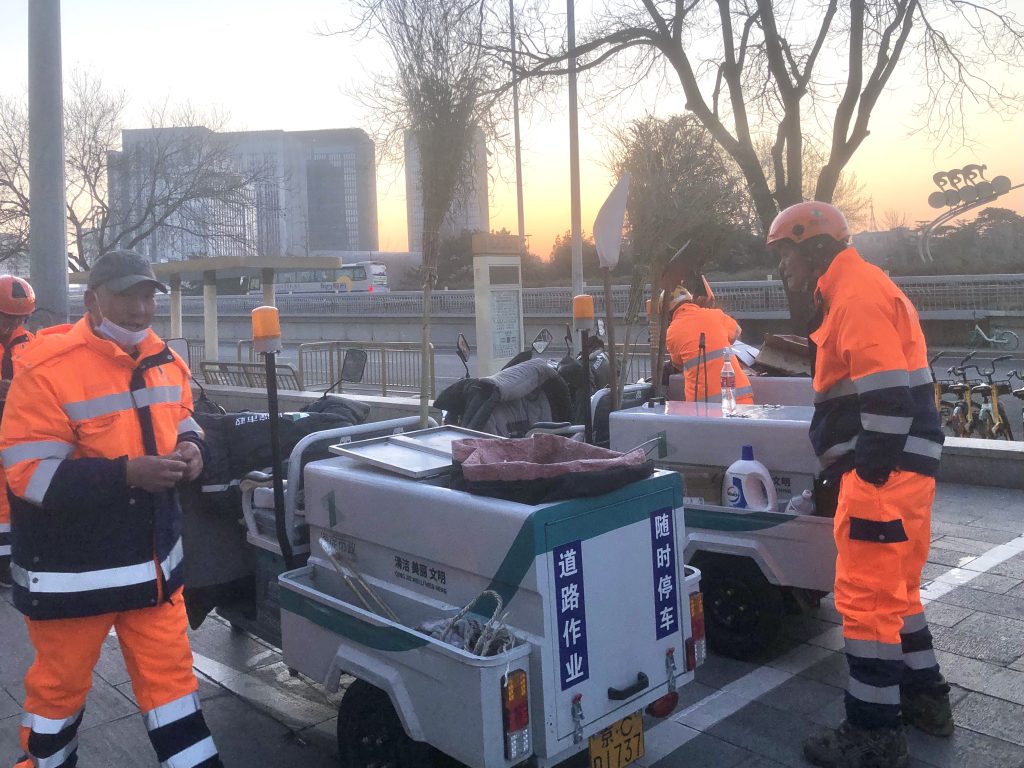
Mr. Zhong on the left
By that time the sidewalks and the wide traffic islands around the intersection were already spotless. The team had started work at 4:00 a.m., he told me, and some of them had left their dormitories as early as 3:30.
Each cleaner had the same simple tools: a small handcart, a shovel, and a long broom made from bamboo or sorghum stalks. I have seen these brooms many times across Chinese cities. They look almost old-fashioned, but they are remarkably effective on wide pavements.
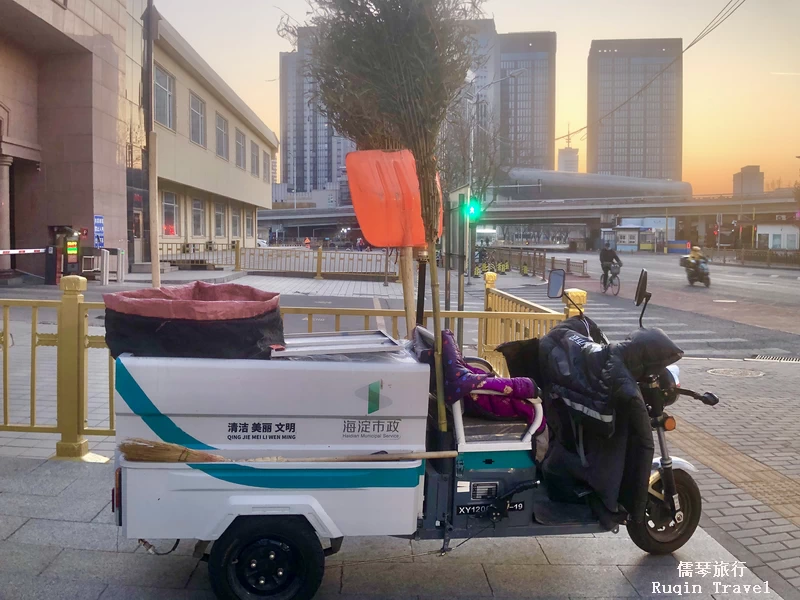
Equipped with a cart, a shovel and either a bamboo or sorghum broom.
Even at that early hour, the city was beginning to wake up. A few cyclists passed quietly. A bus stopped at the corner. Office workers hurried toward the subway entrance.
But the streets were already clean.
Standing there, watching the team finish their section of road, I was reminded how much work happens in Beijing long before most people step outside.
Mr. Zhong’s Story
Mr. Zhong told me he was from Luoyang in Henan Province.
Like many people working in city services, he had come to Beijing years earlier looking for steady work. Street cleaning may not sound glamorous, but in a large city it provides stable employment.
He said he earned about 3400 yuan a month at the time. Life in Beijing is never cheap, but he had learned how to manage.
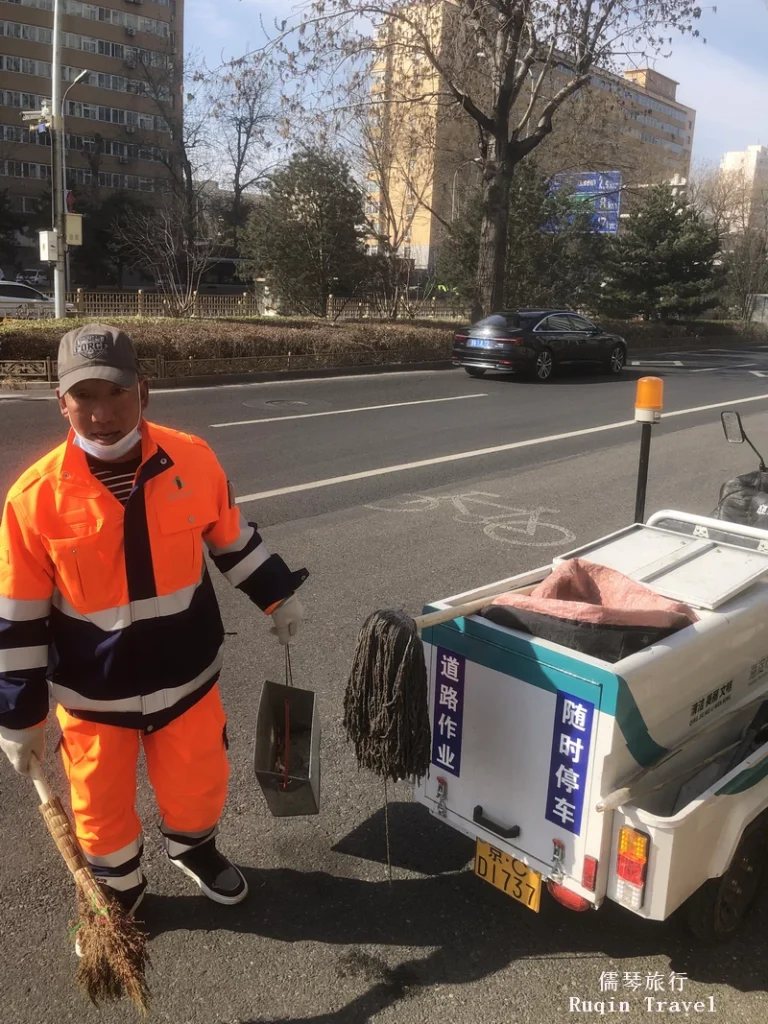
Meeting Mr. Zhong again
What struck me most was his calm attitude toward the job.
“It’s hard work,” he said, smiling slightly. “But someone has to do it.”
Then he told me something unexpected.
His twin sons also live in Beijing, but they followed a completely different path. Both work as kung fu coaches.
Luoyang is close to Shaolin Temple, one of the historic centers of Chinese martial arts, and the boys had trained there when they were young. Now they teach martial arts to children and fitness students in the city.
They earn much more than he does, Mr. Zhong said without any jealousy in his voice. In fact, he seemed proud.
Listening to him, I was reminded how Beijing gathers people from all over China. Even within one family, life in the city can take very different directions.
What Most Visitors Don’t Notice
Travelers often comment on how clean Beijing’s streets are, especially along the major avenues.
But very few people ever see the work behind it.
Most of the cleaning happens between 4:00 and 7:00 in the morning. By the time commuters arrive, the sidewalks have already been swept, the litter collected, and the roadside bins emptied.
Over the years I have watched these workers in many neighborhoods of Beijing. They move slowly but methodically, pushing their carts along long stretches of pavement.
There is no drama in the work. Just repetition and patience.
And yet the entire rhythm of the city depends on it.
What This Morning Clarified for Me
Standing at that intersection with Mr. Zhong, I realized again how much of a city’s life remains invisible.
Visitors see the monuments, the shopping streets, the museums, and the famous landmarks.
But a city also runs on quieter routines — the cleaners, the subway maintenance crews, the food delivery riders already on the road before dawn.
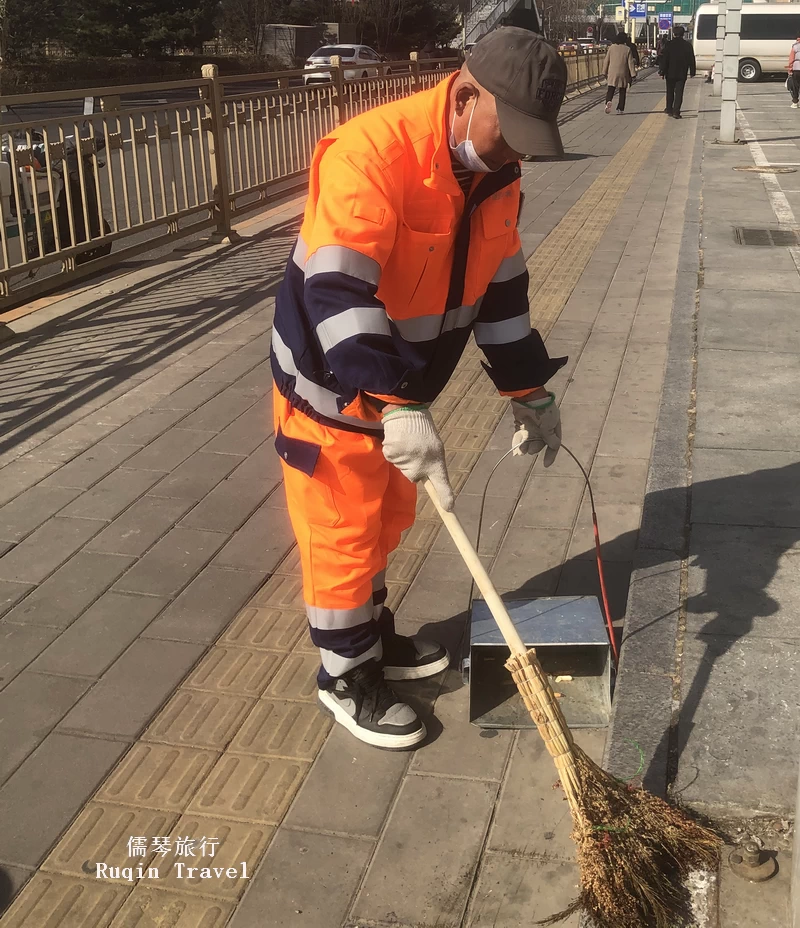
Mr. Zhong at work
Mr. Zhong and his team were finishing their section just as the morning traffic began to thicken.
Within half an hour, the intersection would be filled with buses, taxis, and commuters heading to work.
No one would know that a small group of workers had been there hours earlier preparing the streets for the day.
A Practical Observation
If you want to see the real rhythm of Beijing, wake up early.
Walk out around 5:30 or 6:00 in the morning. You will see a side of the city that most travelers miss.
Street cleaners finishing their rounds.
Vendors preparing breakfast stalls.
Retired residents already doing their morning exercises in small parks.
It is a quieter Beijing, but also a more honest one.
When I finished my jog that morning, Mr. Zhong and his team were already pushing their carts toward the next block. The sun was finally rising over the wide avenue.
By the time the city fully woke up, their work would already be done.
About the Author
Ruqin is the founder of Ruqintravel.com and has spent more than four decades working in China’s travel industry. Drawing on hands-on experience in cities like Beijing and Hangzhou, he personally researches and updates each guide to help international travelers navigate China with confidence.
Beijing City Walks: Routes, Maps & Essential Travel Tips
Beijing Hutong Walks: Routes, Maps & Local Tips
Beijing CBD Photo Walk — Jianguomen Bridge to Guomao Bridge
Riverside Walk from Liangma River to Solana
Beijing Second Ring Road Moat Greenway Walk
Qianmen Street Beijing: Map, Food, Shopping & Local Tips
Caochang Hutongs in Beijing: Maps, Routes, Top Sights & Tips
Sanlihe Park Beijing: Map, Highlights and Travel Tips