
Written and updated by Ruqin
Last updated: April 11, 2026
The Summer Palace in Beijing is no ordinary park. It’s a masterpiece—where shimmering lakes, rolling hills, ancient pavilions, and centuries of royal history come together in one breathtaking landscape.
But here’s the truth: as one of China’s top UNESCO World Heritage Sites, it can get very crowded.
That’s why knowing the best time to visit the Summer Palace makes all the difference.
I’ve been there more times than I can count—and along the way, I’ve discovered how to skip the crowds and find the quiet, story-filled corners that most people miss.
In this guide, I’ll share:
1. The most beautiful seasons to explore (and why each one is special)
2. The quietest hours of the day to soak in the peace
3. Smart ways to avoid crowds and tourist groups
Whether you’re dreaming of a sunrise walk along Kunming Lake or a peaceful sunset from the Tower of Buddhist Incense, this guide will help you discover the best time to visit the Summer Palace—and truly enjoy it.
1. The Best Season to Visit Summer Palace
You can visit the Summer Palace in any season—each one has its own kind of magic.
But if you asked me the best time to visit the Summer Palace, I’d say autumn, without hesitation. Think late October to early November. The air is crisp. The leaves turn gold. The crowds start to thin. It’s perfect.
Still, spring comes close.
1) Spring (March to May): Soft Blossoms & Green Beginnings
My first spring visit to the Summer Palace was unforgettable.

By late March, the peach and cherry blossoms begin to bloom. Magnolias follow soon after. I wandered along the Western Causeway (西堤), where pink petals fluttered in the breeze like something from an ink painting.
By mid-April, the willows are fully awake. Their long green branches dance over Kunming Lake. I rented a small boat and drifted past marble bridges and quiet pavilions. The water sparkled beneath the blue sky. It felt like time had slowed down.
But spring isn’t without its downsides.
Early April brings the Qingming Festival, and early May has May Labor Day. Both attract huge crowds. Tour buses line up. The serenity disappears fast.
And then there’s the occasional spring wind. A dry gust can bring Beijing’s infamous dust storms, so always check the forecast.
My tip? Visit in late April, once the blossoms peak but before the holiday crowds roll in. Go early in the morning or close to sunset. That’s when the palace feels most peaceful—like it’s yours alone.
2) Summer (June to August): Lotus Blooms & Lakeside Breezes
I’ll be honest—summer isn’t the easiest season, but it can be one of the most beautiful if you time it right.

I remember arriving at the Summer Palace one July morning, just after it opened at 6:30 a.m. The air was already warm, but still fresh. A light mist hovered over Kunming Lake. In the distance, pink and white lotuses floated like a dream.
If you’ve never seen the lotus bloom in China, you’re in for a treat. July and August are peak season. My favorite spot is Harmonious Interest Garden (Xiequyuan). It’s quieter than the main lake path, and the lotus pond there is pure poetry.
Trees offer shade across much of the grounds. I often duck into the covered walkways along the Long Corridor when the sun gets stronger. Still, summer in Beijing can be brutal—temperatures easily hit 35°C (95°F) by noon.
And the crowds? Summer school holidays mean tour groups, kids, and long lines—especially on weekends. I once made the mistake of coming at 11 a.m. in late July. Never again.
The best time to visit the Summer Palace in summer? Early morning, right when the gates open. Or come after 5 p.m. when the sun softens and golden light hits the pavilions. The crowds thin. The heat breaks. And if you’re lucky, the lake catches the sunset just right.
3) Autumn (September to November): Golden Leaves & Crystal Skies
If I could only visit the Summer Palace once in my life, I’d choose autumn.

There’s something magical about late October here. The heat is gone. The skies turn sharp blue. The air feels clean and crisp. It’s the kind of weather that makes you want to walk forever.
One morning, I entered through the north gate just after 8 a.m. The crowds hadn’t arrived yet. A golden blanket of ginkgo leaves covered the paths. The maple trees along the back hill (Hou Shan) glowed red under the morning sun.
I wandered slowly down the Long Corridor. Red, orange, and yellow leaves framed every archway. Artists had already set up to paint the scene. A couple sat quietly on a bench, sipping hot soy milk. It felt like a postcard come to life.
This—this—is the best time to visit the Summer Palace.
Just avoid Golden Week (October 1–7). I made that mistake once. I spent more time dodging selfie sticks than enjoying the view.
Instead, come in late October, on a weekday morning. You’ll find space to breathe, color to soak in, and silence between the footsteps. The palace feels ancient, calm, and alive all at once.
4) Winter (December to February): Frozen Silence & Golden Light
Winter at the Summer Palace feels like a well-kept secret.

Most people avoid Beijing’s cold months, but that’s exactly why I go. The crowds vanish. The lake freezes. Everything slows down.
One quiet January afternoon, I stood alone on the edge of Kunming Lake. The ice stretched out like a silver mirror. A soft snow had fallen the night before. Pines wore white caps. Stone bridges looked like brushstrokes from an old ink painting.
It was absolutely still. No voices. Just the soft crunch of snow under my boots. I’d never seen the Summer Palace so peaceful.
And then, there’s the golden light.
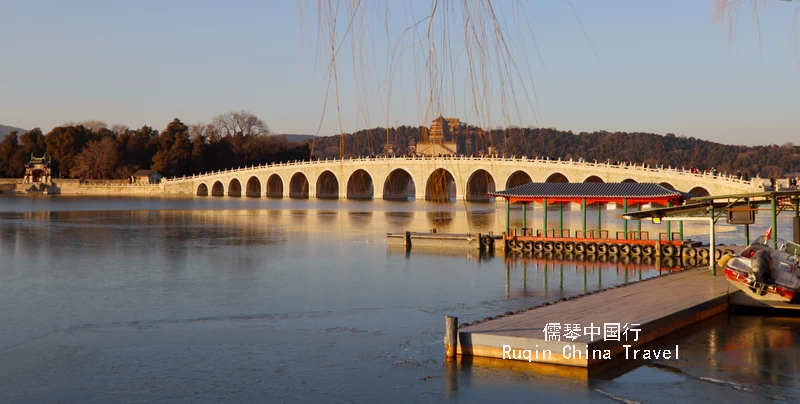
From late December to early January, the sun sets just right. At around 3:30 p.m., it lines up with the Seventeen-Arch Bridge, casting glowing rays through every arch. Locals call it “Jīnguāng Chuāndòng” (Golden Light Piercing the Bridge). I stood there in awe, camera in hand, as the arches lit up one by one.
Yes, it’s cold. Temperatures drop below -10°C (14°F). I bundled up in a thick down coat, scarf, and gloves. My toes still went numb. But it was worth every frozen step.
Summer Palace in winter? Right after a snowfall, or just before sunset in late December. You won’t find boats or outdoor tea stalls. But you will find a kind of quiet beauty that’s rare in Beijing.
2. Best Time of Day to Visit Summer Palace
I’ve visited the Summer Palace more times than I can count. But trust me—timing makes all the difference.
From around 9 a.m. to 4 p.m., it fills up fast. Tour buses arrive. School trips swarm. On weekends or holidays, it’s wall-to-wall people. But if you know when to go, the palace feels like another world.
Early Morning (6:30–8:30 a.m.): Peace, Light & Stillness
There’s something special about entering as the gates open.
I once got there just before 6:30. The sun was still low, casting soft gold across Kunming Lake. The water was still—like glass. I walked without speaking, barely seeing another person for the first hour.
Birdsong. Footsteps on stone. The quiet rustle of wind in the willows. It felt like the emperors had only just left.
This is the best time to visit the Summer Palace if you crave calm. But you’ll need to rise early. I always aim to reach the entrance by 6:00 a.m.—worth every yawn.
Late Afternoon (4:00 p.m. to Close): Sunset and Space to Breathe

Later in the day, the tour groups begin to fade.
By 4 p.m., the crowds thin. The air cools. The palace shifts into a different mood. I love climbing to the Tower of Buddhist Incense just before sunset. From there, you can watch the light melt into Kunming Lake. On clear evenings, the sky blushes pink and orange.
It’s a stunning end to any day.
In summer, you’ll have until around 7 p.m. to explore. In winter, plan ahead—closing time can be as early as 5 p.m..
🚫 Avoid This Window (10:00 a.m. – 3:00 p.m.): Peak Tourist Hours
If you go during this window—especially on weekends—be ready for lines, noise, and crowds.
I once made the mistake of arriving at 11 a.m. on a public holiday. I spent more time dodging umbrellas than admiring the views.
Unless you enjoy chaos, avoid mid-morning to mid-afternoon.
3. Practical Tips to Avoid the Crowds at the Summer Palace
I’ve learned this the hard way—nothing ruins the magic of the Summer Palace like a loud, shuffling tour group at your heels.
Thankfully, after many visits, I’ve found some simple tricks that help me stay one step ahead of the crowds. If you’re wondering how to experience the palace at its most peaceful, this part is for you.
1) Visit on a Weekday (Tuesday to Thursday)
Timing is everything. My quietest visits have always happened midweek—especially on Tuesdays and Wednesdays.
Avoid Mondays if you can. Many Beijing museums close that day, so tourists often flock here instead.
The worst times? Weekends and Chinese holidays like Spring Festival, May Day, and National Day. I once visited during Golden Week. Never again.
2) Skip the Main Gates—Use a Quiet Entrance Instead
Most visitors enter through East Palace Gate or North Gate. That’s where the tour buses unload—and trust me, you’ll feel it.
These days, I use the Xinjian Gongmen (New Palace Gate) or South Ruyi Gate instead. Both are close to Kunming Lake and much calmer.
Sometimes, I take the West Gate and head straight to the Western Causeway. It’s peaceful and stunning in any season.
3) Walk the Route in Reverse
Most people follow the same path: enter from the east, head to Ren Shou Hall, then along the Long Corridor to the Tower of Buddhist Incense.
That route gets jam-packed by 10 a.m.
Here’s what I do: I start at the Seventeen-Arch Bridge and wander toward Nanhu Island and the Western Causeway first. Fewer people, better light for photos, and it saves the big landmarks for later—when the crowds start to thin.
I usually visit the Tower of Buddhist Incense in the late afternoon. It’s quieter, cooler, and the view at sunset is unforgettable.
4) Buy Tickets Online in Advance
Nothing kills the mood like waiting in line for 40 minutes behind 200 people.
I always buy my tickets online the night before. The official site, WeChat mini-program, or platforms like Trip.com, Klook or Viator all work well.
Buy the combo ticket if you plan to visit the inner gardens or halls. That way, you won’t need to queue again inside. Just scan your passport or ID at the gate and walk right in.
5) Explore the Hidden Corners
Some of the Summer Palace’s most beautiful spots aren’t on the tourist maps.
One of my favorites is Harmonious Interest Garden (谐趣园 Xiequyuan). It’s small, quiet, and inspired by a garden in Wuxi. I’ve sat there for hours, just listening to the wind.
Or try Houhu ( 后湖 Rear Lake), near Suzhou Street. In autumn, the red leaves there are breathtaking.
When I want total quiet, I head to the Gengzhitu Area (耕织图景区). It’s away from the crowds and perfect for a slow, thoughtful walk.
With these tips, you’ll not only skip the stress—you’ll discover a deeper side of the Summer Palace, one most people never see.
4. How to Get to Summer Palace
No matter how many times I visit, getting to the Summer Palace always feels like part of the adventure.
Over the years, I’ve tried every option—subway, taxi, even public bus. Each has its own rhythm. Here’s what’s worked best for me, depending on the kind of visit I want.
Subway: The Easiest Way (And My Usual Choice)
Most days, I take the Beijing Subway Line 4 to Beigongmen Station. Just take Exit D, then walk five minutes. You’ll end up right at the North Gate, which is perfect for an early-morning entry.
If I’m heading to the quieter back areas like the Western Causeway or planning to walk toward Jade Spring Hill, I take the Xijiao Line to Summer Palace West Gate Station. Fewer people get off there, and the views feel untouched.
The subway is clean, cheap, and reliable. Honestly, it’s hard to beat.
Taxi or Ride Share: The Most Flexible Option
If I want to arrive right at opening time—especially for those magical sunrise visits—I’ll call a DiDi or taxi.
It drops me off right near the entrance. No transfers, no waiting. I’ve even watched the gates open with no one else around.
But there are trade-offs.
Weekend mornings often mean traffic jams near the palace, especially by 9 a.m. And if you drive yourself, be prepared for steep parking fees—¥20 to ¥40 a day isn’t unusual.
Still, for sunrise light and total freedom? It’s worth it.
Public Bus: Budget-Friendly and Surprisingly Scenic
When I have more time, I sometimes take the public bus—especially if I’m already in the area.
Routes like 332 or 584 go straight to the East Gate. There are also direct tourist lines from Qianmen or Xizhimen, which are great if you’re staying near central Beijing.
It’s by far the cheapest way to go. Just know it can be crowded during rush hour, and a bit slower than the subway or car.
But sometimes, watching Beijing wake up through a bus window is part of the charm.
Whether you want speed, flexibility, or simplicity, there’s always a way to get there stress-free. And with the right timing? You might just have a little piece of the Summer Palace all to yourself.
No matter when you go, the Summer Palace offers something unforgettable—misty mornings, golden sunsets, lotus blooms, or snowy stillness.
But with the right season, perfect timing, and a few insider tips, your visit can become something truly special.
So, if you’re wondering about the best time to visit the Summer Palace, now you know—it’s not just about the calendar. It’s about choosing the quiet moments when history, nature, and beauty all come alive.
I hope this guide helps you find your perfect time.
Happy exploring!
About the Author
Ruqin is the founder of Ruqintravel.com and has spent more than four decades working in China’s travel industry. Drawing on hands-on experience in cities like Beijing and Hangzhou, he personally researches and updates each guide to help international travelers navigate China with confidence.
Further Reading
Summer Palace Wheelchair Accessible Guide: Paths & Toilets
How to Visit Summer Palace: Tickets, Maps, Routes, Eating & Tips
How many entrances and exits to the Summer Palace
Summer Palace Fall Colors: Best Photo Spots for Autumn Foliage
Summer Palace Spring Blossoms: Map, Best Photo Spots & Tips