
Written and updated by Ruqin
Last updated: April 15, 2026
Planning a trip to China? One of the first things U.S. tourists ask is: Can U.S. tourists use credit cards in China? The short answer: sometimes—but not everywhere. Knowing how payments work can save you time and stress on the ground.
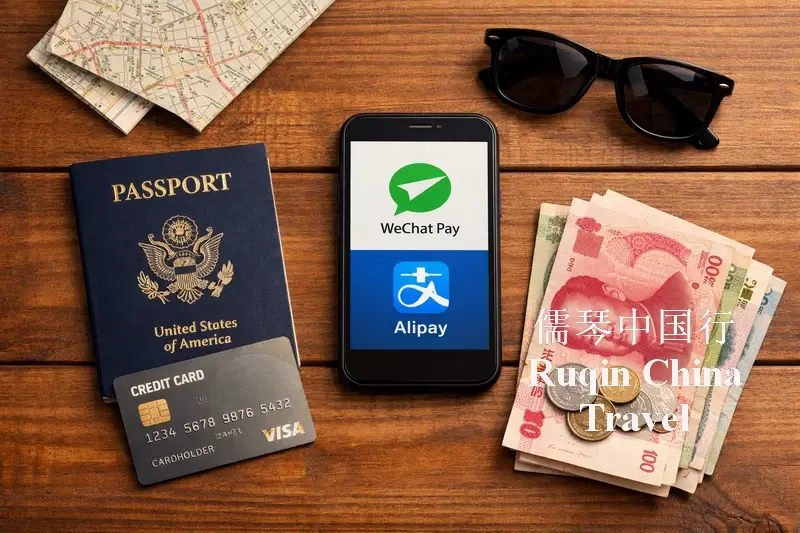
China is well into a cashless era. Mobile apps like WeChat Pay and Alipay dominate everyday transactions. This guide explains how American tourists can use credit cards, mobile payments, and what to expect when paying in China.
Quick Guide: Using Credit Cards, WeChat Pay & Alipay in China
Credit Cards: U.S. travelers can use Visa, Mastercard, and American Express in major hotels, upscale restaurants, and international chains, especially in big cities. However, acceptance is limited in smaller cities, street shops, taxis, and public transport.
WeChat Pay & Alipay: These are the most popular payment methods in China. Since 2023, they accept international credit cards (Visa, Mastercard, JCB), but fees and limits may apply.
Cash: It’s still a good idea to carry some RMB (especially bills under 100 yuan). You’ll need it for markets, street vendors, or remote areas.
Best Strategy: Use mobile payments as the primary method, keep your credit card handy, and carry cash for emergencies.
1.Can U.S. Tourists Use Credit Cards in China?
In China, you can use credit cards in many high-end locations and major tourist cities. However, you may face difficulties in smaller shops, rural areas, and some transportation services. Here’s what you need to know to pay smoothly.
Where You Can Use Your U.S. Credit Card
High-End Locations:
- 4-star and above hotels
- Major international shopping malls (e.g., Beijing SKP, Shanghai IFC)
- International brand stores and duty-free shops at airports.
Tourist Hotspots:
- Key shopping areas and tourist spots in Beijing, Shanghai, Guangzhou, Shenzhen, Chengdu, Xi’an, etc.
- Online bookings through Trip.com, airline websites, and international hotel apps usually work well.
Where You May Face Difficulties
- Smaller restaurants, convenience stores, and street food vendors
- Taxis, subways, and buses (some big cities’ subway machines may support international cards like jn Beijing, but not standard ones)
- Ticket counters, charter services, and tour group fees (usually require cash or mobile payments)
- Second- and third-tier cities, as well as rural areas.
Important Tips:
- Notify your bank: Contact your card issuer before your trip to set up travel notifications to prevent fraud alerts.
- Foreign transaction fees: Most credit cards charge 1-3% for foreign transactions. Opt for cards with no foreign fees (e.g., Capital One, certain Discover, Chase, and Amex cards).
- Chip & contactless payments: Most places use chip cards or contactless payments. Some older POS machines may not accept magnetic stripe cards.
- Signature and PIN: Some places may ask for a signature, and others may require a PIN. Keep your passport handy in case verification is needed.
2. Mobile Payments: WeChat Pay and Alipay
Why Set Up Mobile Payments?
In China, WeChat Pay and Alipay cover over 90% of daily transactions. From upscale restaurants to local markets, and taxis to bike shares, scanning QR codes for payments has become the norm. Without mobile payments, your trip may become less convenient.
How to Set Up WeChat Pay and Alipay for U.S. Travelers
Step 1: Download and Register
Download WeChat and Alipay from the App Store or Google Play.
Register using your U.S. phone number and complete basic identity verification.
Step 2: Link Your International Credit Card
Alipay:
- Go to “My” → “Bank Cards” → “Add Bank Card”
- Enter your Visa/MasterCard info to link.
WeChat Pay:
- Go to “Me” → “Services” → “Wallet” → “Bank Cards” → “Add Bank Card”
- Note: You need a verified Chinese bank card to enable payment. However, since 2023, TourPass allows U.S. tourists to link their international cards. Check the latest guide before departure.
Step 3: Top Up or Pay Directly
Once linked, some transactions allow direct payment using your credit card, settled at real-time exchange rates.
You can also buy prepaid electronic travel cards through third-party services like Viator and Trip.com to avoid single transaction limits.
Example Payment Scenarios
- Scan a merchant’s QR code → Enter the amount → Confirm payment.
- Show your payment QR code for merchants to scan (common in supermarkets, convenience stores).
- Pay through apps like DiDi (for taxis), Meituan (food delivery), or 12306 (train tickets).
3. Cash: Still an Important Backup Option for American Travelers
Legal Requirement
By law, businesses in China must accept RMB cash. However, some American tourists may find that street vendors refuse payment if they can’t provide change.
Recommended Amount
For each day of your trip, U.S. travelers should carry 300-500 RMB in small bills (20s, 10s, and 5s). This is helpful for smaller purchases.
How to Exchange Money
American travelers can exchange money in the U.S. at banks, or in China at airport counters and large hotels. Rates may not be the best.
However, the best option is to use your U.S. debit card at an ATM with UnionPay (e.g., China Merchants Bank, ICBC). The exchange rate is usually favorable, but be aware of cross-border ATM fees from your bank.
4. Safety and Convenience Tips for American Travelers
Protect Against Fraud
When using your credit card, keep it in sight. For small merchants, American tourists should prioritize mobile payments.
Enable Two-Factor Authentication
Set strong passwords for WeChat and Alipay. Use fingerprint or gesture lock for added security.
Network Connectivity
Ensure your phone has internet access. You can buy a local SIM card in China or activate international roaming. Without it, you won’t be able to use mobile payments.
Backup Plan
In addition to major cards, consider carrying a Discover card. It partners with UnionPay, and works on some UnionPay POS machines. However, coverage is limited, so don’t rely on it as your main payment method.
5. Frequently Asked Questions for American Tourists
Q1: Will my U.S. phone receive verification texts from WeChat/Alipay?
Yes, but you must complete registration and linking before your trip. Make sure international roaming is activated to receive verification texts.
Q2: What if my credit card fails to pay through WeChat/Alipay?
- Check if you’ve exceeded your transaction limits.
- Contact your bank to see if the transaction is blocked.
- Try linking another credit card.
- Alternatively, use cash or swipe your physical card.
Q3: Should I use WeChat or Alipay to scan the merchant’s QR code?
Both apps usually work. Use either app’s “Scan” feature. If one fails, try the other.
Q4: Do I need to exchange a lot of RMB before my trip?
No. Withdraw a small amount (around 1000 RMB) from an ATM first. More is available as needed. Major cities have plenty of ATMs with English interfaces.
Q5: Can I use mobile payments for tips?
China doesn’t have a strong tipping culture. However, for high-end hotels or tour guides, cash is still preferred for tips.
Q6: How do I pay at small craft stalls or temple donation boxes?
Most of these places only accept cash, especially small bills. Be sure to bring some on hand.
6. Pre-Trip Checklist for American Travelers
- Confirm your credit card is set for international transactions and has no risk of being blocked.
- Carry at least two credit cards with no foreign transaction fees (one primary, one backup).
- Download WeChat and Alipay, complete registration, and link your credit card.
- Bring a small amount of RMB cash, preferably in small denominations.
- Inform your bank of your travel dates (if required).
- Save your credit card’s international customer service number (both digitally and in print).
- Check if your
We wish you a smooth and enjoyable trip to China! As China continues to open up, the payment landscape keeps improving.
By preparing with mobile payments, cash, and credit cards, American tourists can easily handle most situations. Enjoy your exploration in China!
About the Author
Ruqin is the founder of Ruqintravel.com and has spent more than four decades working in China’s travel industry. Drawing on hands-on experience in cities like Beijing and Hangzhou, he personally researches and updates each guide to help international travelers navigate China with confidence.
Further Reading
Do Americans Need a Visa for China? Application Tips & FAQs
Safety in China for U.S. Citizens: What to Know Before You Go
3 Things American Drivers Need to Know Before Driving In China