Written and updated by Ruqin
Last updated: May 22, 2026
Welcome to Yinchuan – the hidden gem of Northwest China! Known as the “Jiangnan beyond the Great Wall,” Yinchuan is the capital of Ningxia Hui Autonomous Region. It’s where the golden sands of the Tengger Desert meet the green embrace of the Yellow River.
In this Yinchuan Travel Guide, I’ll take you beyond the surface—into old alleys, Hui villages, and desert horizons. Whether you’re chasing history, nature, or local eats, Yinchuan promises unexpected wonders at every turn. So pack light, stay curious, and let the adventure begin!
1. When to Visit Yinchuan: Seasons, Sunshine, and Surprises
Yinchuan’s climate surprised me from the start. It’s dry, sunny, and full of contrasts. One morning, I wore a coat. By noon, I needed only a T-shirt. Locals joke, “wear fur in the morning, silk by noon.” And honestly, they’re not wrong.
In this Yinchuan Travel Guide, I’ll share when to come and what to expect. Spring (April to May) is my favorite. The air feels fresh, blossoms fill the parks, and temperatures stay between 10°C and 25°C. It’s perfect for wandering or picnicking by the Yellow River.
Then comes autumn (September to October). The sky opens wide, the harvest sweetens the markets, and the desert glows gold. With highs around 22°C, it’s the golden hour—for your camera and your soul.
Summer (June to August) can get hot, but it’s a dry heat. It’s also the best time for desert adventures. Just bring sunscreen and drink plenty of water.
Meanwhile, winter (November to March) turns Yinchuan quiet. It’s cold, sometimes snowy, but peaceful. Museums feel cozier. The Hui teahouses glow warmer.
Whenever you come, Yinchuan has its rhythm. You just need to find yours.
2.Where to Stay in Yinchuan: A Local’s Guide to the Best Districts
One of the first things I loved about Yinchuan was how easy it is to explore. The city feels compact yet full of life. Each district offers something different, and in this Yinchuan Travel Guide, I’ll walk you through the best areas to stay in Yinchuan—based on your travel style, of course.

1) Xingqing District – Yinchuan’s Historic Heart
I started my journey in Xingqing District (兴庆区), the old soul of the city. Streets here are shaded by tall trees, and everything feels lived-in, local, and full of stories. This is where Yinchuan breathes its history.
In the mornings, I’d hear vendors calling out near the markets. In the evenings, I’d stroll along Gulou Pedestrian Street (鼓楼步行街), a bustling pedestrian road lined with shops, snack stalls, and neon lights. Not far away, the Drum Tower (鼓楼 ) and Yuhuang Pavilion (玉皇阁) stand quietly, reminding you that this city has centuries behind it.

But what really stole my heart? Jingde Night Market (敬德街夜市) and Gulou Night Markets. They are just a short walk from the main road and absolutely packed with sizzling skewers, spicy noodles, and sweet pastries. The locals gather here after dark—families, students, and shopkeepers—all laughing, bargaining, and eating late into the night.
If you want culture, charm, and convenience, stay near the Drum Tower. You’ll find everything from budget hostels to boutique hotels, all within walking distance of the action. For travelers eager to experience real Yinchuan life, this is the place.
2) Jinfeng District – Yinchuan’s Modern Face
Next, I headed west to Jinfeng District (金凤区), a complete contrast to Xingqing. This is Yinchuan’s CBD, its administrative center, and it feels like stepping into a new city. Wide roads, towering glass buildings, and polished plazas define the vibe here.
I stayed near Yinchuan Railway Station (银川火车站), which made coming and going a breeze. The Jianfa Dayuecheng Mall (建发大阅城) in Jinfeng District, is a huge complex with restaurants, shops, a cinema, and even an indoor ice rink. If you’re like me and occasionally crave a Starbucks or a familiar global chain, this is where you’ll find it.

However, it’s not all business and concrete. Yuehai National Wetland Park (阅海国家湿地公园) is right here too—a quiet, green oasis where I took slow walks by the lake and watched herons skimming the water at dusk.
For travelers who prefer modern comforts, business amenities, and easy transportation, Jinfeng District (金凤区) is ideal. Most hotels here are mid-range to upscale, with sleek designs and great service. It’s perfect if you want both convenience and a touch of luxury.
3) Xixia District – The Gateway to Ancient Echoes
Finally, I found myself in Xixia District (西夏区), the city’s western edge and its most historic gateway. This area gets its name from the Western Xia Dynasty, which once ruled this land—and left behind some of its most mysterious tombs.
The vibe here is youthful yet steeped in memory. With Ningxia University nearby, the streets feel lively, full of students, cafés, and bookstores. I loved the energy—it’s academic, creative, and grounded in history.

But the real draw? Huaiyuan Night Market (怀远夜市). Compared to the more central ones, it felt even more local, more vibrant. There, I tasted Hui-style lamb skewers grilled over open flames and sesame pancakes stuffed with beef. The smells alone were unforgettable.
Xixia District is also the best base for day trips. From here, it’s a short ride to the hauntingly beautiful Western Xia Tombs (西夏王陵) or the film-worthy Zhenbeibao Western Film Studio (镇北堡西部影城), where desert meets old movie sets.
For travelers like me who want to dive deep into history but still enjoy a lively neighborhood, staying near Huaiyuan Night Market (怀远夜市) is a perfect balance. Plus, accommodation here tends to be more affordable—great value for curious explorers.
In summary, It just depends on what kind of traveler you are. Culture lover? Go for Xingqing. Business or comfort-focused? Jinfeng is your match. History buff or night market hunter? Xixia won’t let you down.
3. Arriving in Yinchuan by Air: First Impressions from the Sky
My first glimpse of Yinchuan came through the plane window—golden fields, winding rivers, and mountains in the distance. I landed at Yinchuan Hedong International Airport (INC), a small but efficient hub located about 25 kilometers east of the city center.

The airport sits in Lingwu, technically outside Yinchuan City, but getting downtown was easy. First, I followed the signs for the airport shuttle bus—honestly, it’s the most convenient and budget-friendly choice. The signs were clear, even in English. Within minutes, I was on a clean, air-conditioned bus heading toward the city. Most lines stop at key locations like Xigang Aviation Hotel (near the Drum Tower) and the Yinchuan Railway Station. The ride took about 50 minutes and cost just 25 yuan.
However, if you’re carrying heavy luggage or arriving late at night, a taxi or rideshare might suit you better. I tried DiDi, China’s version of Uber, and it worked smoothly. From the airport to downtown Yinchuan, the ride took around 40 minutes and cost roughly 100 yuan.
Whether you go by bus or car, that first ride into Yinchuan City sets the tone. It’s calm, spacious, and full of promise.
4. Arriving in Yinchuan City by Train: A Smooth Start
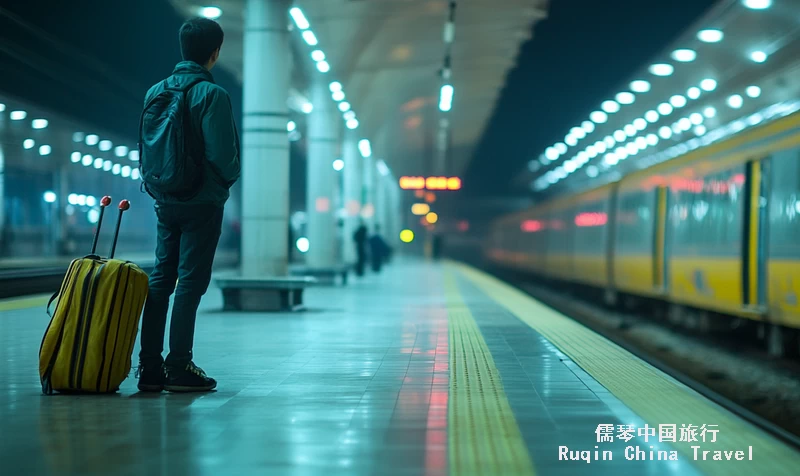
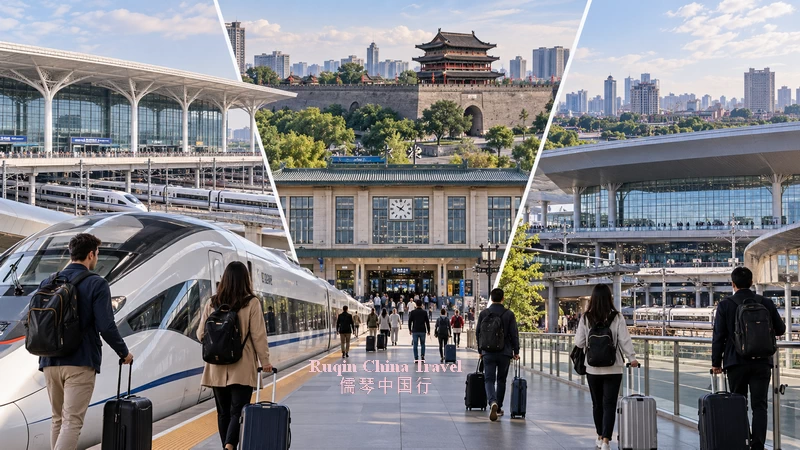
I arrived at Yinchuan Railway Station, the city’s main rail hub tucked in the heart of Jinfeng District. Clean, modern, and well-organized, it made my first steps into the city surprisingly easy.

Located just 8 to 10 kilometers from downtown—think Drum Tower or Xinhua Street—it only takes 20 to 30 minutes to reach the center.
First, I noticed the bus hub right outside the station plaza. Dozens of local routes fan out across Yinchuan City. The ride costs just 1 or 2 yuan. It’s cheap, but not ideal with big luggage.
Instead, I grabbed a DiDi ride. Within minutes, I was cruising toward the old city, and the fare stayed under 30 yuan.
Meanwhile, another great option is the BRT Line 1. It runs through the city like a spine—fast, reliable, and air-conditioned. If you’re traveling light, it’s a fantastic way to dive straight into the rhythm of Yinchuan.
5. Yinchuan City Walks: A One-Day Journey Through Time, Taste, and Local Life
If I had only one day in Yinchuan, this would be it. In this Yinchuan Travel Guide, I’ve mapped out my favorite City Walk—a full-day adventure from serene parks and ancient towers to museum treasures and sizzling night markets.
The route blends walking, cycling, and the occasional taxi. It’s not about rushing. It’s about savoring every layer of Yinchuan—old and new, quiet and vibrant.
1) Haibao Park | 08:30 – 10:00 | Yinchuan’s Tranquil Morning Start
I began my day at Haibao Park (海宝公园), a green sanctuary wrapped around a lake, often called Yinchuan’s “Little Jiangnan.” Morning here feels sacred. Locals walk slowly under willow trees. The air smells like dew and earth.

The star of the park is the Haibao Pagoda, a tall, elegant Buddhist tower. It’s free to admire up close, but I recommend climbing it. From the top, I saw all of Yinchuan City stretch out beneath me—misty rooftops, distant hills, and sun on water.
I walked to Jiukong Bridge (九孔桥), camera in hand. If you want that postcard shot of the pagoda’s perfect reflection, this is the spot. With birds skimming the lake and early light touching the surface, it felt like a painting.
🚌 Next: Take a 12-minute taxi ride (about 4.5 km) to Drum Tower.
2) Drum Tower & Yuhuang Pavilion | 10:00 – 12:00 | Where Old Yinchuan Lives On
Next, I stepped into the historic heart of Yinchuan. The Drum Tower (鼓楼) and Yuhuang Pavilion (玉皇阁)—both Ming and Qing-style buildings—stand proudly in the center. These aren’t museum pieces. They’re living landmarks, surrounded by shops, families, and street life.

Wandering down Gulou Pedestrian Street (鼓楼步行街), , I felt time blur. Old bricks and neon signs. Silk shops beside bubble tea stalls. I stopped often—sometimes to people-watch, sometimes to snack.
Walk around the Drum Tower and Yuhuang Pavilion area
While exploring the Drum Tower and Yuhuang Pavilion area, don’t miss two quiet but powerful places that reflect Yinchuan’s spiritual past—Chengtian Temple Pagoda and Nanguan Mosque. Both are within a short walk or quick taxi ride, and well worth your time.
First, just southwest of the main crossroads, I spotted a tall brick pagoda rising behind a striking red wall. This is the Chengtian Temple Pagoda (承天寺塔)—peaceful, proud, and full of stories.

Originally built in 1050 AD, during the Western Xia Dynasty, the pagoda has endured earthquakes, fires, and war. What stands today is the result of careful reconstructions. It reaches 63.5 meters high, with 11 octagonal levels stacked in classic pavilion style. As I circled its base, the quiet hum of history felt almost audible.

Next, I continued on to the Nanguan Mosque (南关清真寺)—either a 20-minute walk or a 5-minute cab ride. Located at the intersection of Changcheng Road and South Yuhuangge Street, this mosque is the heart of Yinchuan’s Hui Muslim community.
Originally built in the late Ming Dynasty, the current structure was rebuilt in 1980, covering over 2,000 square meters. Its domes and minarets blend traditional Chinese architecture with Islamic design—simple, elegant, and welcoming.
Lunchtime came fast, and the smells were impossible to ignore. I followed a local’s tip and sat down at Xianhelou (仙鹤楼), a time-honored restaurant. Their lamb dumplings were juicy, fragrant, and just the right amount of gamey.
🚶 Next: Walk 20–25 minutes (or take a 10-minute taxi) to Zhongshan Park.
3) Zhongshan Park | 12:00 – 14:00 | A Window into Local Life
After a heavy meal, I needed a break. Zhongshan Park (中山公园) offered just that. Locals love it—and I quickly understood why.
Here, old men played chess under pine trees. A group of aunties danced in perfect sync to pop music. Kids rode paddleboats across the small lake, laughing as ducks floated by.

Hidden among the greenery, I stumbled upon ruins of a Western Xia-era city wall (西夏古城墙遗址)—half-forgotten but quietly powerful. History hides in plain sight in Yinchuan.
For 30 yuan, I rented a boat and drifted on the lake. It was peaceful and slightly silly, but that’s the point. Slow down. Let the city come to you.
🚖 Next: Taxi to the Ningxia Museum (about 20 minutes, 8 km).
4) Ningxia Museum | 14:00 – 16:00 | The Soul of the Region
Every place has a story. To understand Yinchuan, I went to the Ningxia Museum (宁夏博物馆)—a modern, beautifully designed space with deep roots.
Admission is free, but be sure to reserve ahead on their official WeChat. It’s worth the five-minute tech effort.
I walked straight into history. From ancient nomadic artifacts to gleaming Tang-era sculptures, the exhibits walk you through thousands of years of culture.

My favorite pieces? The gilded Western Xia bronze ox (西夏鎏金铜牛)—oddly cute and full of personality—and the Hu Xuan Dance tomb gate (唐代石刻胡旋舞墓门), which captures a dancer mid-spin in stone.
Don’t skip the Ningxia General History Hall. It’s well-curated, immersive, and a great crash course in regional heritage.
🚖 Next: Taxi 10 minutes (3 km) to Tanglai Canal Cultural Corridor.
5) Tanglai Canal Ride | 16:30 – 17:30 | Pedaling Through Time
Next came my favorite stretch—cycling beside the ancient Tanglai Canal (唐徕渠文化长廊).
I rented a shared bike near Ximen Bridge (西门桥) and cruised northward for about 3 km toward Phoenix Stele (凤凰碑). The path was shaded, quiet, and surprisingly lush.

This canal has flowed for over 2,000 years, irrigating Yinchuan’s fields and feeding its people. As I pedaled, old willows rustled in the breeze. A heron flew overhead. It was peaceful, timeless, and utterly local.
🚖 Next: After the ride, hop in a taxi for a 20-minute drive (8 km) to Lanshan Park.
6) Lanshan Park | 18:00 – 19:30 | Sunset from the “Roman Theater”
As golden hour approached, I reached Lanshan Park (览山公园)—a well-known gem, just on the east shore of Yuehai National Wetland Park . Climbing the steps, I suddenly stood in front of a vast, Roman-style amphitheater built into the hillside. It was unexpected—and stunning.

From here, the view stretched west to the Helan Mountains (贺兰山). I found a seat, pulled out my thermos of tea, and waited.

By 7:00 PM, the sky flared orange. The sun dipped slowly behind the peaks, setting Yinchuan aglow. Cameras clicked. A couple held hands in silence.
This was the magic moment.
🚖 Next: Taxi 30 minutes (12 km) to Huaiyuan Night Market. DiDi recommended.
7) Huaiyuan Night Market | 20:00 – 22:00 | A Feast to End the Day
When night falls in Yinchuan, head to Huaiyuan Night Market (怀远夜市). You’ll smell it before you see it.
Crowds buzzed, grills smoked, and vendors shouted out specials. It was chaotic—and perfect.
With just 30 yuan, I ate like royalty. First, a bag of chewy, spicy Nu’ermai spicy strips (奴尔麦辣条)—handmade right in front of me. Then, a hot crispy potato pancake (only 3 yuan). Finally, I washed it all down with a sweet, slightly tart cup of Tianpei milk tea (甜胚子奶茶), made from fermented barley and fresh milk. A true Ningxia flavor.

Of course, there’s more. Lamb skewers, beef pies, grilled eggs… you’ll want to come hungry. And just like that, my day in Yinchuan came to a close—full of sights, tastes, stories, and surprises. In this Yinchuan Travel Guide, this City Walk was the heart of it all. When you’re ready, lace up your shoes. Yinchuan is waiting.
6. Yinchuan Side Trips: Epic Journeys Beyond the City Walls
In every great adventure, there comes a moment when the city begins to whisper, “Go further.” That’s exactly what happened to me in Yinchuan.
In this Yinchuan Travel Guide, I’ve already shared the charm of the city center, but now—let’s zoom out. Because half of Yinchuan’s magic isn’t in its streets. It’s out there, scattered across the desert, mountains, and ancient plains.

These are the Yinchuan Side Trips that completely transformed my journey—each one filled with legends, silence, sunsets, and soul.
1) Helan Mountain Rock Art | A Gallery from the Dawn of Time
You don’t just see these ancient Helan Mountain Rock Paintings (贺兰山岩画) —you feel them. Tucked into the wild canyons of the Helan Mountains (贺兰山), more than 6,000 prehistoric rock carvings are etched into stone.

Hunting scenes. Totems. Rituals. These aren’t just pictures. They’re whispers from a forgotten world.
Just beside the carvings, ucked inside the Helankou Rock Art Scenic Area, I stumbled upon something unexpected—China’s first large-scale museum dedicated entirely to rock art.

The Yinchuan World Rock Art Museum isn’t just about ancient carvings. It’s a window into the shared human story etched into stone across continents.
Inside, the museum unfolds through eight immersive zones, including a grand entrance hall, central exhibition space, and a dedicated World Rock Art Gallery. I wandered from region to region, discovering over 546 stunning rock art pieces representing 31 countries and regions.
Some exhibits are delicate rubbings, others massive original stone carvings. Each one felt like a whisper from another time—whether from the sands of Africa or the caves of Europe.
If you’re already heading to see the Helan Mountain petroglyphs, don’t skip this museum. It adds a powerful global perspective—and makes you realize that, across time and space, we’re not so different after all.
🚌 Distance from Yinchuan City: 50 km northwest | Travel time: ~1 hour
🎫 Ticket: Around ¥70
2) Western Xia Tombs | A Lost Empire in the Dust
Imagine pyramids—not in Egypt, but rising from the Gobi. That’s what the Western Xia Imperial Tombs (西夏王陵) felt like. They’re often called the “Pyramids of the East”—and the name fits.

There are 9 royal tombs and over 250 satellite graves, scattered across a windswept plain. It’s vast, eerie, and deeply moving.
The Western Xia Museum nearby is a must. Inside, I saw the Gilded Bronze Ox, one of China’s national treasures. Then I stepped into the 4D cinema, where the dynasty’s rise and fall unfolded around me in sound and sand.
Want to cover more ground? Rent a bike or hop on the electric shuttle—it’s worth it.
🚌 Distance: 35 km west of Yinchuan City | Travel time: 40–50 mins
🎫 Ticket: Around ¥95 (includes sightseeing vehicle)
3) Shapotou | Where Desert Meets River in a Grand Collision
Few places left me speechless like Shapotou (沙坡头). Here, the vast Tengger Desert (腾格里沙漠) rushes up to meet the mighty Yellow River—and the result is pure cinematic magic.
The dunes rise like mountains. The river winds like silk. And the light? Unreal.

I rode a camel into the sand sea, slid down a 100-meter-high dune (yes, screaming is allowed), and floated gently downriver on a sheepskin raft—a traditional craft that’s both strange and beautiful.
Later, I camped under the stars. No noise. No lights. Just sand, stars, and stories around a fire.
🚌 Distance: ~200 km southwest of Yinchuan City (in Zhongwei)
⏱ Travel time: 2–2.5 hours
🎫 Ticket: Around ¥80 (activities extra)
4) Tengger Desert Camps | Into the Wild Heart of the Sands
If Shapotou is the intro, then the Tengger Desert Camps (腾格里沙漠营地) are the deep dive.
I stayed at a glamping-style camp tucked far into the dunes. By day, I chased sunsets across waves of golden sand. At night, I lay back on a blanket, watching the Milky Way spill across the sky.

We grilled lamb by the fire, sipped hot milk tea, and listened to the wind hum across the dunes. I even spotted a sand lizard scurrying past my tent—wild, curious, and completely at home.
Note: these camps are popular and often fully booked. Plan ahead.
🚌 Distance: Deeper into the desert from Shapotou/Zhongwei
🎫 Cost: Varies by package (includes lodging, meals, and activities)
5) Zhenbeibao Western Film Studio | A Movie Set Turned Memory Lane
If you’ve ever seen “A Chinese Odyssey”, you’ve seen Zhenbeibao Western Film Studio (镇北堡西部影城). This sprawling film set is where dreams were shot in dust and golden light.

Wandering through its mud-walled towns, I felt like an extra in an epic. You can rent costumes—yes, including Zixia Fairy’s purple robe—and relive your favorite scenes atop the old city walls.

The set includes three zones: Qing City, Ming City, and Old Yinchuan Street—each one packed with drama, detail, and dreamlike energy. Also set recreating a 1960s Cultural Revolution-era scene—frozen in time at Zhenbeibao Western Film Studio.
🚌 Distance: 35 km northwest of Yinchuan City | Travel time: 40–50 mins
🎫 Ticket: Around ¥80
6) Sand Lake (Shahu) | Where Desert Kisses Water
Half desert, half lake—Sand Lake (沙湖 ) is an ecological miracle. Here, golden dunes hug a shimmering wetland full of reeds and birds.
I boarded a slow boat that glided through tunnels of green. Egrets took flight. Cormorants dove into the water. It felt like entering another world.

Afterward, I climbed a sand dune and tried sand sledding, then stood at the crest and looked back. One direction—desert. The other—marshland. Rarely do two worlds coexist so beautifully.
🚌 Distance: 56 km north of Yinchuan City (in Pingluo, Shizuishan)
⏱ Travel time: ~1 hour
🎫 Ticket: Around ¥120 (includes large boat ride)
7) Shuidonggou Site | Ancient Secrets and Desert Adventures Combined
Just 25 kilometers east of Yinchuan City, near the border with Inner Mongolia, I found one of the region’s most unexpected gems—Shuidonggou (水洞沟). On the surface, it looks like a leisure park, but beneath its sand and stone lies over 30,000 years of history.
Shuidonggou is China’s earliest known Paleolithic site. Archaeologists discovered tools like bone needles and scrapers here, revealing how ancient humans once lived, hunted, and survived in this vast northwest wilderness.

Inside the Shuidonggou Site Museum (水洞沟遗址博物馆), I stepped back in time. Using immersive lighting, surround sound, and even a 270-degree panorama, the museum recreates early human life with stunning realism. I could almost feel the firelight and hear the rustling of prehistoric camps. And best of all—it’s free to enter.
But that’s just the beginning.
Next, I ventured into the Cangbing Tunnels (藏兵洞), a complex underground military system built in the Ming Dynasty. With its hidden grain stores, water wells, and traps, this ancient tunnel network is the most complete example of subterranean warfare architecture in China.

Then, I climbed onto the Ming Dynasty Great Wall(明城墙)—a rugged, earthen version of the iconic wall, far less crowded than Beijing’s. In one easy step, I crossed from Ningxia into Inner Mongolia. Surreal.
For fun, the site offers camel rides, horse carts, and even boating. It’s part archaeological park, part desert playground.
🎫 Ticket: Around ¥60 (includes transport experiences)
📍 Travel time from Yinchuan: ~40 minutes by car
In short, Shuidonggou surprised me. It’s where history meets imagination—and where every corner hides a story worth discovering.
Tips for Planning Your Yinchuan Side Trips
- 🚗 Self-driving or hiring a private car is the best way to explore. Flexible, efficient, and scenic.
- 🗺️ Group popular spots together: You can do Helan Mountain Rock Art, Western Xia Tombs, and Zhenbeibao Film Studio in a single day.
- 🏜️ For Shapotou + Tengger Desert Camps, plan 1–2 full days. Stay overnight in Zhongwei for a slower pace.
- 🍷 Wine + road trip lovers should drive Route 56 and build in a few tastings. It’s China like you’ve never tasted before.
7. Getting Around Yinchuan: Easy, Affordable, and Surprisingly Fun
One thing I loved about Yinchuan? Getting around was a breeze. The city feels just the right size—big enough to explore, but never overwhelming.
First, I tried the public buses. They run frequently, cover almost everywhere, and cost just 1–2 yuan. I paid with WeChat’s transit QR code—quick and cash-free.
Next, I hopped on the BRT (Bus Rapid Transit). These sleek buses glide down dedicated lanes, zipping between old streets and modern zones. They’re fast, reliable, and a local favorite.

When I was short on time (or just tired), I grabbed a DiDi. It’s China’s version of Uber, and it works great in Yinchuan. No language stress—just tap and ride.
I also tried shared bikes. Perfect for short rides through parks or side streets. Just scan and go.
And yes, taxis are still around. Just make sure they use the meter.
In short, Yinchuan makes it easy to move—and even easier to explore. This Yinchuan Travel Guide wouldn’t be complete without saying: don’t worry about transport—it’s part of the fun.
鼓楼周边:可以找到一些售卖贺兰石雕刻和枸杞的专卖店。
8. Souvenirs from Yinchuan: A Taste of Northwest China to Take Home
Every time I travel, I search for something real to bring back. Not just souvenirs—but stories I can hold. In Yinchuan, I found plenty.
First, I picked up goji berries (枸杞). These ruby-red gems are Ningxia’s pride. Sweet, sun-dried, and packed with goodness, they make a perfect gift—or midnight snack.
Next, I fell for Helan stone carvings. This unique, smoky-black stone turns into beautiful inkstones and sculptures. Each one feels timeless and elegant.
Then came the Eight Treasures Tea (八宝茶). I tried a cup at a Hui teahouse and was instantly hooked. It blends dried fruits, green tea, rock sugar, and even rose petals. Sweet, soothing, and full of flavor.
For something cozy, I couldn’t resist the Tan sheep wool products (滩羊皮). Light, soft, and incredibly warm—they’re perfect for winter back home.
Shopping in Yinchuan is easy. I strolled through Gulou Pedestrian Street (鼓楼步行街) for local shops and snacks. Then, I explored Jianfa Dayuecheng (建发大阅城), a massive modern mall with everything under one roof.
For specialty gifts, check around the Drum Tower area—you’ll find authentic Helan stone and premium goji.
In this Yinchuan Travel Guide, don’t skip the shopping. These treasures carry the spirit of the Northwest.
9. Flavors of Yinchuan: A Halal Food Journey You’ll Never Forget
In every city I visit, I follow my nose—and in Yinchuan, it led me straight into some of the richest, most comforting dishes I’ve ever tasted. This Yinchuan Travel Guide wouldn’t be complete without a proper dive into the food scene.
Here, halal cuisine reigns supreme. Influenced by the Hui Muslim community and desert life, Yinchuan’s food is hearty, honest, and deeply satisfying.
First, I tried the iconic shou zhua yang rou (手抓羊肉)—tender lamb, simply boiled and served with salt and garlic. It melted in my mouth. The flavor? Pure, earthy, unforgettable.
Next came a bold breakfast: hui yang za sui (烩羊杂碎)—a spicy stew of lamb tripe, lung, and noodles. It’s fiery, peppery, and beloved by locals.
Then, cuo mian (搓面)—hand-rolled noodles in a rich lamb broth. The chew of the noodles, the warmth of the soup—it was everything I needed on a cool evening.
I also had qingzheng yang gao rou (清蒸羊羔肉), delicate and silky. Steaming preserved the original flavor, no heavy spices—just pure lamb.
Craving spice? Order la huhu (辣糊糊), Yinchuan’s version of mala tang. It’s thick, bold, and totally addictive.
To wash it all down, a glass of sweet, floral Eight Treasures Tea (八宝茶) did the trick. It calms the heat, refreshes the body, and carries centuries of Silk Road tradition.
For the best bites, head to Jingde Night Market (敬德街夜市) and Gulou Night Market (鼓楼夜市). It’s busy, loud, and full of sizzling skewers. Or try Huaiyuan Night Market (怀远夜市) near the university—where students and locals gather every night, laughing over lamb kebabs and milk tea.
In Yinchuan, food isn’t just a meal. It’s memory, culture, and connection—served one bowl at a time.
10. Essential Tips for Visiting Yinchuan: What I Learned Along the Way
Traveling through Yinchuan, I quickly realized: it’s not just about where you go, but how you go. A little cultural awareness makes the journey smoother—and so much more meaningful.
First, respect matters here. Yinchuan has a large Hui Muslim community. That means no pork at most local eateries, and if you visit a mosque, wear modest clothing. A scarf or long sleeves go a long way.
Next, sun protection is key. The skies are mostly clear, and the UV rays hit hard. I always carried sunscreen, sunglasses, lip balm, and hydrating lotion. Trust me, your skin will thank you.
When heading into the desert, pack extra shoe covers. Sand gets into everything. And at night, temperatures drop fast—bring a warm layer or two if you’re staying out under the stars.
Planning to visit a museum? Don’t go on Monday—most are closed. I learned that the hard way. Mobile payment apps like WeChat and Alipay work everywhere, but I still kept a little cash, just in case.
Language isn’t a barrier—Mandarin works just fine. And if you toss in a cheerful “Nǐ hǎo” or “Xièxie,” locals will smile even brighter.
In this Yinchuan Travel Guide, my best advice? Go slow. Stay open. And always carry water.
About the Author
Ruqin is the founder of Ruqintravel.com and has spent more than four decades working in China’s travel industry. Drawing on hands-on experience in cities like Beijing and Hangzhou, he personally researches and updates each guide to help international travelers navigate China with confidence.
Further Reading
Alxa League (Alashan), Inner Mongolia: A Visitor Guide
Plan a Trip to Badain Jaran Desert – Your Ultimate Guide
Lanzhou Travel Guide: Map, Highlights and Travel Tips
Urumqi Travel Guide: Map, Scenic Routes, Highlights and Tips
Lhasa Travel Guide: Map, Highlights and Travel Tips