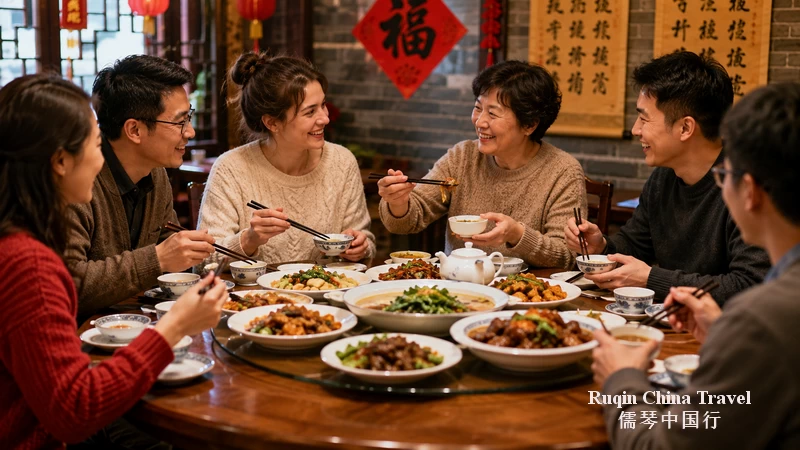
Written and updated by Ruqin
Last updated: May 22, 2026
I still remember my first morning in Shanghai—jet lagged, standing by the Bund, watching the skyline slowly wake up across the Huangpu River. This Shanghai Travel Guide comes from moments like that. The city feels layered: colonial facades behind you, glass towers ahead, and a rhythm that’s both fast and strangely reflective.
If it’s your first time in China, Shanghai is where things start to make sense. I’ll walk you through it the way I do with friends—where to go, how to move around, what’s actually worth your time, and how to enjoy the city without feeling overwhelmed.
1. Best Time to Visit Shanghai Through the Seasons
Before I set foot in Shanghai, I kept wondering—when is the best time to visit Shanghai? The answer, as I soon discovered, depends on the kind of experience you’re after. Shanghai, resting on China’s eastern coast, lives under a classic subtropical monsoon climate. In other words—four bold, vivid seasons, each with its own rhythm and charm.
Let me take you through the seasons, like flipping through the pages of a travel-worn journal. I’ve lived them all—and each brought a different side of the city to life.
Spring (March to May): Blossoms, Breezes, and Quiet Romance
Spring in Shanghai is my personal favorite. It feels like the city is slowly stretching after a long winter nap. In March, the air still carries a chill, with average temperatures around 10°C. But by May, it warms to a lovely 20°C and sometimes even more.
Mornings and evenings stay crisp, though. So I always bring a light jacket or a cardigan—layering is key here. Locals call it “onion-style dressing,” and it saved me more than once.
Spring rain is gentle but persistent. Think of it as a soft drizzle rather than a downpour. It adds a dreamy glaze to the stone alleys and temple courtyards. I never leave my hotel without a compact umbrella tucked in my bag.
Meanwhile, the city explodes in color. Cherry blossoms and magnolias bloom in parks like Gucun Park 顾村公园 and the Shanghai Botanical Garden .上海植物园 Walking under their petals feels like stepping into a painting. And the scent—floral, fresh, fleeting—is unforgettable.
Pro tip: Avoid early May if you can. China’s Labor Day holiday draws huge domestic crowds, and popular spots like the Bund or Yu Garden can get packed.
Summer (June to August): Bold, Sweaty, Unapologetically Alive
Let me be honest—Shanghai in summer is not for the faint-hearted. July and August hit hard, with temperatures soaring between 28°C and 35°C. Add in the humidity, and it sometimes feels like you’re swimming through the air. One local joked it was like living in a steam room—and they weren’t wrong.
June brings the Meiyu, or “plum rain” season. For about three weeks, the sky sulks with constant drizzle. Clothes never dry properly. Even snacks in my backpack felt damp. It’s not pretty, but it’s part of Shanghai’s summer soul.
After the rains, come the thunderous afternoon storms. I’d step into a museum or cafe to wait them out. The Shanghai Museum 博物馆 and Power Station of Art 美术馆 became my hideouts more than once.
Outfit-wise, I stuck to the lightest, breeziest clothes I owned. Cotton tees, linen shorts, and flowy dresses were lifesavers. Anything quick-dry was a blessing. Don’t forget sunscreen—SPF 50 or higher—and a good sunhat. The UV is brutal.
That said, Shanghai’s summer nights are magic. I’d stroll the Huangpu riverside promenade after dark, cooled by the breeze and lit by neon. There’s energy in the air—electric, sweaty, and wonderfully alive.
Autumn (September to November): Crisp Air, Golden Light, Absolute Bliss
If I had to name the best time to visit Shanghai, autumn would win. No contest. After the heavy summer fades, September arrives like a deep, calming breath. The air turns dry and cool. By October, temperatures settle around 20°C. Come November, it drops to a brisk 15°C—perfect for scarves and strolls.

The sky opens up. I’m talking deep blue, postcard-perfect days. Rain is rare, clouds are few. Every corner of the city seems made for walking.
I loved layering cozy sweaters with lightweight jackets. Nothing too bulky—just enough to enjoy the chill without sweating under the sun. Again, onion-style dressing saved me.
This is when I fell in love with Shanghai’s plane tree-lined avenues. Fuxing Road 复兴西路, Hengshan Road 衡山路, and the French Concession neighborhoods glow with amber and gold. I’d spend hours walking with a coffee in hand, leaves crunching beneath my feet.
For unbeatable views, I headed to the Shanghai World Financial Center’s sky deck 环球金融中心 on a clear day. The city stretched forever—crisp, glinting, alive.
Heads-up: Early October brings China’s National Day holiday. It’s another travel peak, so book your stays well in advance.
Winter (December to February): Quiet Streets, Steamy Dumplings, and a Hidden Peace
Winter in Shanghai is a quiet poem. It’s not snowy, and it doesn’t bite like the northern cities. But it’s damp—bone-deep damp. Average temperatures hover between 3°C and 8°C, but the humidity makes it feel colder. Locals call it “wet cold,” and now I understand why.
Snow is rare, though sometimes the city surprises you with a flurry or two. More often, you’ll find gray skies and chilled fingers. Still, I found it oddly peaceful. The tourist crowds thin out. You get the temples, museums, and tea houses almost to yourself.
I bundled up in a heavy down coat, wool sweater, scarf, and gloves. Don’t forget warm, grippy shoes—those sidewalks can get slick. Once I dressed the part, I was good to go.
Chinese New Year (usually in late January or early February) transformed the city. Red lanterns appeared overnight. Firecrackers echoed from alleyways. Local markets burst with color and warmth. However, many family-run shops close for the holidays—something to keep in mind.
Indoor attractions, from dumpling joints to art galleries, became my winter sanctuaries. And nothing beats warming up with a steaming bowl of xiaolongbao in the middle of a cold, gray afternoon.
So, When Is the Best Time to Visit Shanghai?
After living through every season, here’s my take. Spring (April to May) and Autumn (late September to November) offer the best balance—mild weather, open skies, and blooming or golden scenery. If you’re looking for the perfect window, this is it.
But honestly? Every season shows you a different face of Shanghai.
Summer is tough, yes—but it’s vibrant, loud, and unforgettable. Winter may chill your bones, but it also soothes your soul with stillness and slow travel moments. As this Shanghai Travel Guide shows, there’s no wrong time to explore this incredible city. You just need to pack right—and stay curious.
No matter when you come, Shanghai will meet you with open arms—and a story waiting to unfold.
2. Where to Stay in Shanghai
When I first arrived in Shanghai, I quickly learned one truth—choosing where to stay in Shanghai shapes your entire experience. This city is like a painter’s palette, each district brushed with its own color, rhythm, and charm. From glittering skyscrapers to quiet, tree-lined streets, every corner tells a different story.

In this Shanghai Travel Guide, let me walk you through the best places to stay in Shanghai—not just where to sleep, but where to feel the pulse of the city.
1) Huangpu District 黄浦区 – Classic Shanghai, Timeless Landmarks
Huangpu District (黄浦区) is where Shanghai’s heart beats loudest. Every postcard scene you’ve ever seen? It probably came from here. This district blends the old soul of Shanghai with the gleam of modern China. When I stayed here, I felt like I was living inside the city’s memory.

First, there’s the Bund—a masterpiece of global architecture. At sunset, when the lights of Pudong sparkle across the Huangpu River, I often found myself speechless. Next, Nanjing East Road bursts with life—historic shops beside sleek malls, echoing with chatter and laughter late into the night.
Meanwhile, Yu Garden and Chenghuangmiao Temple offer a slower rhythm. I’d wander through stone pathways, taste steaming soup dumplings, and imagine the city centuries ago. Just a short walk away sits People’s Square, surrounded by the Shanghai Museum and Grand Theatre, adding cultural depth to this buzzing area.
Getting around is easy. Huangpu connects to almost everything—metro lines converge at People’s Square, and you can reach major stations and airports within minutes.
For stays, I recommend the Bund or Nanjing East Road area. Hotels range from lavish riverfront icons like the Fairmont Peace Hotel to cozy boutique options tucked in side streets. For first-time visitors, this is the best introduction to Shanghai’s energy and elegance.
2) Pudong New Area 浦东新区– The Futuristic Face of Shanghai
Across the river lies a different Shanghai—the one that reaches for the sky. Pudong District (浦东新区) is sleek, modern, and full of ambition. Here, the skyline feels almost unreal, especially when seen from the Lujiazui district, home to the Oriental Pearl Tower, Jin Mao Tower, Shanghai Tower, and World Financial Center.

When I first looked down from the 118th floor of Shanghai Tower, the whole city stretched beneath me like a glowing map. It’s breathtaking.
Pudong also holds the city’s Pudong International Airport, making it ideal if you’re flying in or out early. You can even ride the futuristic Maglev Train, which glides at 430 km/h—it’s an adventure in itself!
Century Avenue connects it all—lined with parks, performance halls, and wide, sunlit boulevards. The area feels more spacious, calmer than old Shanghai, though sometimes a bit too polished.
For stays, Lujiazui 陆家嘴 is perfect for business travelers or anyone craving luxury. Think panoramic skyline views right from your bed. For better value and easier commutes, I loved the Century Avenue area 世纪大道—great metro access and slightly gentler prices.
3) Jing’an District 静安寺– Chic, Stylish, and Effortlessly Cool
If Huangpu District 静安寺 is Shanghai’s heritage and Pudong its future, Jing’an is the city’s mood. It’s stylish but grounded—where historic temples sit beside designer stores, and every café looks Instagram-ready.
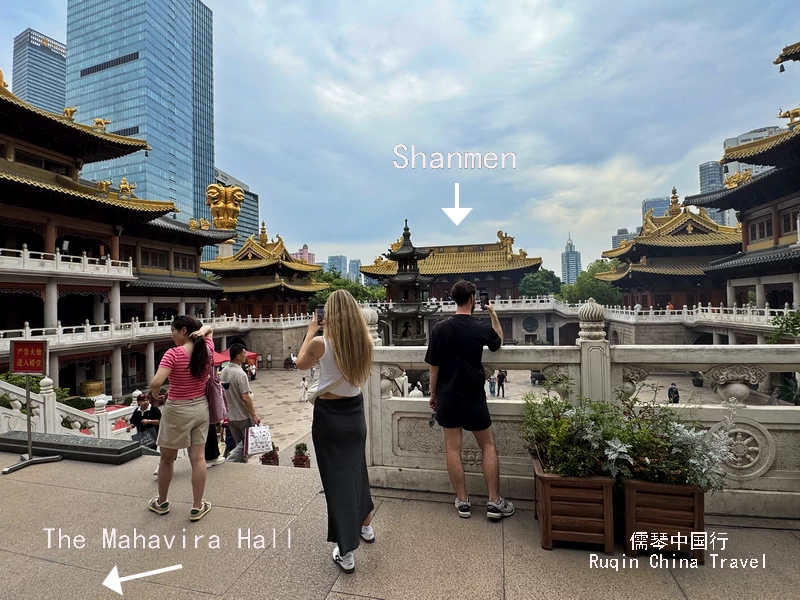
At the center stands Jing’an Temple, golden and grand, surrounded by skyscrapers. The contrast feels surreal every time I see it. A few blocks away, West Nanjing Road hums with energy. It’s a playground for shoppers, with malls like Plaza 66 and CITIC Square overflowing with luxury brands.
Yet, just behind the glitz, I found a softer side. Locals call it the “JuFuChang” area “巨富长”街区—short for Julu 巨鹿路, Fumin 富民路, and Changle Roads 长乐路 . These leafy lanes are lined with art studios, boutique shops, and cozy bistros. I spent lazy afternoons sipping coffee, watching cyclists glide past under the plane trees.
Jing’an also offers great connections—close to Hongqiao Airport and Shanghai Railway Station, with Line 2 whisking you anywhere you need to go.
For accommodation, I recommend staying near Jing’an Temple or West Nanjing Road if you love shopping, dining, and nightlife. Or, for something more personal, choose a boutique hotel in the JuFuChang area “巨富长”街区—it’s where modern Shanghai whispers softly through every street corner.
4) Xuhui District – Romantic, Artistic, and Deeply Shanghai
Whenever I crave quiet beauty, I head to Xuhui District 徐汇区. This district is where Shanghai slows down and shows its artistic soul. Plane trees form green tunnels over historic streets, and old villas tell stories of poets, diplomats, and dreamers.
The Hengshan–Fuxing Road area —known as the Hengfu Historic Zone 衡复风貌区—is a living museum of old Shanghai charm. I’d stroll down Wukang Road 武康路, admiring the Art Deco buildings and former consulates, each with ivy-covered walls. It feels like stepping into another century.

Then comes Xujiahui, lively and convenient. With its grand cathedral, film museum, and sprawling shopping centers, it’s the commercial heart of Xuhui. In contrast, the West Bund area offers a modern twist—art museums, galleries, and riverfront views that glow at sunset.
Xuhui connects easily to both Hongqiao and Pudong airports via the metro. You can also reach Shanghai South Railway Station directly from here.
If you’re a romantic traveler, stay in a boutique villa hotel near Wukang Road or Hengshan Road. Every morning feels like a scene from an old movie. For comfort and convenience, Xujiahui is ideal—great transit, endless food, and shopping at your doorstep.
5) Other Neighborhoods Worth Knowing
Shanghai doesn’t end there. Beyond the main districts, I’ve found gems tucked across the city.
Hongkou District 虹口区 and Yangpu 杨浦区, just north of the Bund, carry more local life. Walk through Tilanqiao’s Jewish Quarter and pass by Shanghai Jewish Refugees Musuem or sip coffee along University Road—it’s young, creative, and full of surprises.

In Changning District 长宁区, around the Hongqiao area, you’ll meet many Japanese and Korean expats. The Gubei neighborhood 古北地区 is known for its authentic international cuisine and quiet streets. Meanwhile, Zhongshan Park offers shopping and quick airport access.
For something more offbeat, Putuo District 普陀区 feels like a secret. Along the Suzhou Creek, I found riverside trails and the new Suhe Bay Art District 苏河湾艺术区, still peaceful and fresh.
Best Places to Stay in Shanghai
So, where should you stay? Here’s my personal take after exploring every corner:
- First-time visitors: Choose Huangpu District (The Bund or Nanjing East Road). It’s classic, convenient, and bursting with character.
- Business travelers or skyline lovers: Go for Pudong (Lujiazui)—modern comfort meets unforgettable views.
- Fashion seekers and foodies: Jing’an is your match—urban chic with authentic energy.
- Romantics and culture lovers: Pick Xuhui (Hengshan or Wukang Road)—elegant, slow-paced, and deeply local.
Each district feels like its own little world. In this Shanghai Travel Guide, I’ve learned that choosing where to stay in Shanghai isn’t just about hotels—it’s about choosing the story you want to live.
Whichever neighborhood you choose, I hope you wake up every morning to the hum of this incredible city—ready to explore, discover, and fall in love with Shanghai all over again.
3. How to Get to Shanghai
Before I ever walked the Bund or wandered the lanes of the French Concession, I had to answer one essential question: How do I get to Shanghai?
As one of the most connected cities in Asia, Shanghai makes arrival surprisingly smooth—whether you’re flying across oceans, gliding in on high-speed rail, or sailing on a cruise ship. In this section of my Shanghai Travel Guide, I’ll share everything I learned about getting into the city, from the sky, land, or sea.
Flying into Shanghai – Two Airports, Two Experiences
Shanghai has two major airports—Pudong (PVG) and Hongqiao (SHA). Which one you choose will shape your arrival.
1) Pudong International Airport (PVG) – East Side, International Gateway
I landed here on my first trip. Located about 40 km east of downtown, Pudong is the city’s main international airport, though it also handles some domestic flights.

How to Get to the City from Pudong:
- Maglev Train (Fastest & Fun!):
I couldn’t resist this one. The maglev glides from Pudong to Longyang Road in just 8 minutes, hitting 430 km/h. I was glued to the speed display the whole time. Tickets cost ¥50, and from Longyang, I transferred to metro Line 2 to reach the city.
Hours: 6:45 AM – 9:40 PM. - Metro Line 2 (Most Affordable):
This is the main artery into the city. The full journey to areas like Nanjing East Road or Jing’an Temple takes around 60–70 minutes and costs just ¥8–9.
Important tip: At Guanglan Road 广兰路站, I had to switch trains because the train format changes from 8 cars to 4. Easy, but worth knowing. - Airport Buses (Convenient with Luggage):
I took one to Jing’an Temple once—spacious seats, not crowded, and pretty relaxed. Tickets cost ¥20–30, and rides take 60–90 minutes, depending on traffic. - Taxi (Most Comfortable):
If you have jet lag or heavy bags, this is the way. To People’s Square, it took about 50 minutes, and cost me around ¥180. At night, expect a slight surcharge.
2) Hongqiao International Airport (SHA) – West Side, Domestic Hub

On my second visit, I arrived at Hongqiao. It’s just 18 km from downtown and handles mostly domestic and short-haul international flights (like from Tokyo, Seoul, or Taipei).
Getting Downtown from Hongqiao:
- Metro (Best Option):
Lines 2 and 10 run right from the terminals. Within 20–30 minutes, I was sipping coffee near Xintiandi. Tickets cost around ¥5–6. - Taxi:
I took a cab once from Hongqiao to Xujiahui, and it was a smooth 30-minute ride. Fare: about ¥60.
Quick Tip:
If you’re flying in from another Chinese city (or connecting), Hongqiao is incredibly convenient. The airport is also connected to the Hongqiao Railway Station, which makes transfers a breeze.
Arriving by Cruise – The City by Sea
Though I’ve only done it once, arriving by cruise felt cinematic—like floating into a futuristic skyline. Shanghai has two main cruise terminals:
1) Shanghai Port International Cruise Terminal (North Bund) 上海邮轮码头(北外滩)
Located in Hongkou District, just minutes from the Bund. This is the most traveler-friendly option.

- I took Metro Line 12 at International Cruise Terminal Station and got to the Bund, and walked 5 minutes to my hotel.
- A taxi to Nanjing East Road took less than 10 minutes.
2) Wusongkou (Baoshan) Cruise Terminal 上海吴淞口国际邮轮码头
Shanghai Wusongkou International Cruise Terminal is located in the Paotaiwan waters along the Yangtze River shoreline in Baoshan District, Shanghai. It sits at the confluence of three rivers—the Yangtze River, the Huangpu River, and the Wenzaobang River—and connects to the East China Sea to the east.

- Taxis or shuttle buses are your best bet. Expect 40–50 minutes to reach downtown.
- It’s best to confirm your docking terminal before you arrive. North Bund is much easier for travelers.
Coming by Train – The Land Route Into Shanghai
China’s high-speed trains are incredible—and Shanghai is one of the major hubs. The city has four main train stations, each with a different vibe and function.
1) Hongqiao Railway Station 上海虹桥火车站 – The King of Connections
This station blew me away. Clean, organized, and futuristic. Almost all high-speed trains (Gaotie) from Beijing, Hangzhou, Nanjing, and other major cities stop here.

- It’s linked directly to Hongqiao Airport, so if you’re flying out, it’s a perfect combo.
- I reached the city via Metro Lines 2 or 10 in about 30 minutes.
2) Shanghai Railway Station上海站 (a.k.a. “New Station”“新客站”) – Classic and Central
This one sits closer to the city center, in Jing’an District. It handles both high-speed and regular trains, including overnight sleepers.

- It’s connected to Metro Lines 1, 3, and 4.
- I once reached the Bund in under 15 minutes by cab.
Tip: Always double-check if your ticket says “Shanghai” or “Shanghai Hongqiao”—they’re different stations!
3) Shanghai South Railway Station 上海南站 – Southern Gateway
Located in Xuhui District, this one handles trains to Southern and Southwestern China. If you’re arriving from places like Guangzhou or Guiyang, you may come through here.

- Metro Lines 1, 3, and 15 serve this station.
- From here, I easily reached the West Bund Art District.
4) Shanghai West Railway Station – The Quiet One
This station in Putuo District handles some passing high-speed trains. Not as useful for tourists, but good to know.
- I used Metro Line 11 to get here quickly.
Final Tips on Arriving in Shanghai
- Best for International Arrivals: Pudong Airport (PVG)
- Best for Domestic Travel: Hongqiao Airport or Hongqiao Railway Station
- Best for Cruise Travelers: North Bund Cruise Terminal
- Easiest Metro Access: Almost every arrival point connects directly to the metro system.
No matter how you get here—by plane, train, or ship—Shanghai welcomes you with open arms and open possibilities. And once you’ve arrived, the real journey begins.
I hope this Shanghai Travel Guide helps you plan a smooth arrival. Getting to Shanghai might be the first step—but trust me, it won’t be the last memory.
4. How to Get Around in Shanghai
One of the first things I noticed after arriving? Shanghai moves fast. Not just in its pace of life, but in how people move through it. Sleek metro trains, colorful buses, ferries gliding across the Huangpu River—everywhere I turned, something was in motion.
This city doesn’t just have transportation. It has transportation with personality. And as I quickly found out, knowing how to get around in Shanghai is essential to truly enjoying it.
The Shanghai Metro
Let’s start with the metro—because once you ride it, you’ll probably never want to take anything else. It’s clean, fast, and honestly, kind of fun.
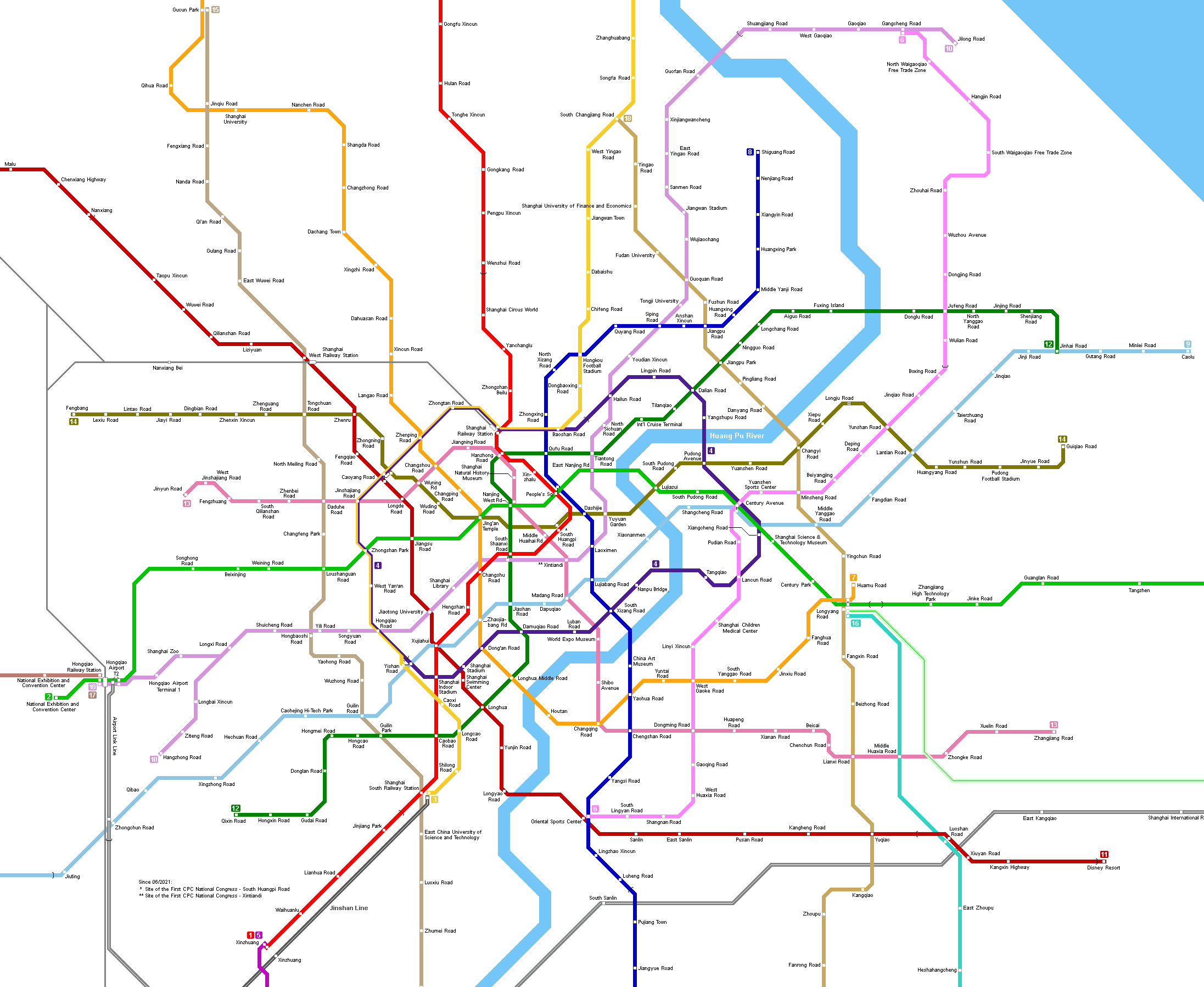
As of November 2025, Shanghai’s metro is the longest in the world, with:
- 21 lines
- 518 stations
- 898 kilometers of track
Trains usually run from 5:30 AM to 11:30 PM, and fares range from ¥3 to ¥10, depending on how far you travel.
I usually used:
- Single-use tickets (from machines, English available)
- A reloadable Shanghai Transportation Card (¥20 deposit)
- Or, easiest of all, the Metro Daduhui App—scan, ride, done.
Must-Know Metro Lines for Travelers
Line 1 (Red Line) – The North-South Classic
This is Shanghai’s first metro line and still one of the most important. I used it often.
- Shanghai Railway Station – For high-speed train arrivals
- People’s Square – Where I’d pop up to visit museums or walk down Nanjing Road
- South Huangpi Road – The entrance to Xintiandi and the site of China’s First Communist Party Congress
- Shaanxi South Road – For trendy shops and Huaihai Road
- Xujiahui – My go-to spot for shopping malls and a quiet cathedral
- Shanghai South Railway Station
Line 2 (Green Line) – From Airport to Skyline
This is the city’s east-west backbone, and honestly, a lifesaver.
- Hongqiao Terminal 2 + Railway Station – My gateway from domestic flights and trains
- Jing’an Temple – Where tradition meets luxury malls
- Nanjing East Road – The heart of Shanghai’s shopping strip
- Lujiazui – For skyscraper selfies: Shanghai Tower, Oriental Pearl, and more
- Pudong Airport – A direct line into the city
Line 10 (Light Blue Line) – Culture Line
This line felt made for me. It weaves through charming, old, cultural corners.
- Shanghai Library – Peaceful study vibes
- Xintiandi – For architecture, food, and nightlife
- Yuyuan Garden – Where I always ended up craving dumplings
- Nanjing East Road – Again, but from a different angle
- Tiantong Road – For the Shanghai Postal Museum and Suzhou Creek views
Line 14 (Olive Green Line) – Tech Meets Travel
This driverless line is the newest and most futuristic. Sleek, smooth, and a little sci-fi.
- Jing’an Temple – Yes, again. A major hub
- Site of the First National Congress – Revolutionary history, right at your feet
- Yuyuan Garden and Lujiazui – Perfect for cross-city exploring
Buses – A Window Into Local Life
If the metro is Shanghai’s bloodstream, then the buses are its nerves—reaching into every little corner.
- Most routes cost ¥1–2, air-conditioned buses cost ¥2
- Pay by coin, transport card, or phone scan
- Night buses run until late (check the Shanghai Bus App)
- Tourist sightseeing buses circle major attractions—great for relaxed sightseeing
Tip: Red-numbered buses mean rush hour service. They’re fast but packed!
Taxis & Ride-Hailing – For Comfort on the Go
I used taxis when I was tired, carrying bags, or just wanted to go door-to-door.
- Taxis are usually mint green or light blue
- Starting fare: ¥14 (day) or ¥18 (night) for the first 3 km
- Hail one on the street or at designated stands
But honestly? I mostly used ride-hailing apps. They’re just easier.
- Didi, Caocao, and T3 are the top platforms
- Order with the app, see the fare, no language barrier
- Often, ride shares had promos—some days were cheaper than the metro
Pro tip: At airports and stations, follow the signs to official pick-up zones.
Shared Bikes – Ride Like a Local
Some of my favorite Shanghai memories were on two wheels.
You’ll spot them everywhere—blue, yellow, green. Pick your color:
- Hello Bike (Blue)
- Meituan Bike (Yellow)
- Qingju Bike (Green)
I used WeChat or Alipay to scan and unlock them. Some required a deposit, but many had credit-based “no deposit” options.
Average cost: ¥1.5 per 30 minutes
Best times to ride?
- From metro stations to your hotel
- Along the Suzhou Creek or Huangpu River trails
- Exploring quiet plane tree-lined streets in Xuhui or Jing’an
Huangpu River Ferries – The City’s Most Charming Ride
When I needed a breather, I’d hop on a ferry. For ¥3, I got a floating view of the city.
Ferry lines I loved:
- Dongjin Line – From Jinling East Road to Dongchang Road. A front-row seat to the skyline.
- Dongfu Line – For a peaceful morning ride
- Taigong Line – Between quieter northern docks
You can bring your bike too. Just pay ¥3.5.
My favorite time to ride? Just before sunset, watching the Bund light up, wind in my face. Magical.
Final Tips – Move Like a Local, See Like a Traveler
- Best combo: Metro + Shared Bike. Fast + flexible.
- Best views: Ferry + walking. Slow down and take it in.
- Best comfort: Ride-hailing or taxis—especially in rain or heat.
Want to save money?
- Get the metro 1-day pass (¥18) or 3-day pass (¥45)
- With multiple people, ride-hailing may be cheaper than metro
- Transfers using a transport card come with discounts
Language help?
- All metro signs have English
- Most bus signs do not—use a translation app
- Taxis? Show them your destination in Chinese characters
Shanghai’s transit is like the city itself—layered, intelligent, and full of stories. Whether I was flying down metro tunnels or floating across the river, I always felt connected. Every ride was a piece of the city revealing itself.
This part of the Shanghai Travel Guide isn’t just about logistics. It’s about moving with the rhythm of a place that never really stops—and letting that rhythm carry you, effortlessly, from moment to moment.
5. Top 10 Things to Do in Shanghai
Shanghai never stops performing. Every day here feels like a scene from a dazzling, ever-changing stage play. From the glimmer of futuristic towers to the whisper of ancient alleyways, the city holds its magic in layers. And if you’re wondering where to begin? This is it—my Top 10 Attractions in Shanghai, handpicked from my own unforgettable days in the city.
Each one tells a different story. Each one left a mark on me. Let’s dive in.
1) The Bund – Where Old Meets Dazzling New
The Bund is Shanghai’s icon, its heartbeat. Standing on the west bank of the Huangpu River, I faced a tale of two cities. One side, the “Gallery of World Architecture”—52 grand colonial buildings, each whispering history. On the other, the neon-glowing skyline of Lujiazui, a symbol of modern China.

I always came at twilight. That’s when the lights turned on, and the magic began. For more information, check out my complete guide – How to Visit the Bund in Shanghai.
- Admission: Free
- Address: Zhongshan East 1st Road, Huangpu District
- How to get there: Metro Line 2 or 10 to Nanjing East Road, Exit 2 or 6, then walk 10 minutes
2) Oriental Pearl Tower
Some say it’s no longer the tallest. I say it still steals the show. With its futuristic pink spheres and striking silhouette, the Oriental Pearl remains Shanghai’s signature landmark.
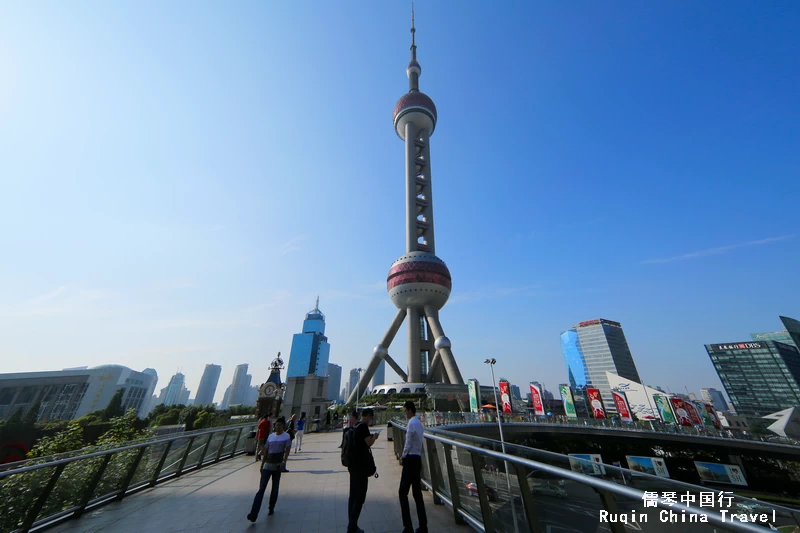
I rode the elevator to the top. At 351 meters, the city sprawled beneath me. Walking across the glass observation deck made my heart race—in the best way.
- Admission: ¥199–220 (book online early!)
- Address: No.1 Century Avenue, Pudong
- How to get there: Metro Line 2 to Lujiazui, Exit 1, 5-minute walk
3) Lujiazui – Skyscrapers and Skyline Dreams
Directly across from the Bund, Lujiazui is a forest of glass and steel. I wandered beneath the shadows of Shanghai Tower, Jin Mao, and SWFC, each taller and bolder than the next.
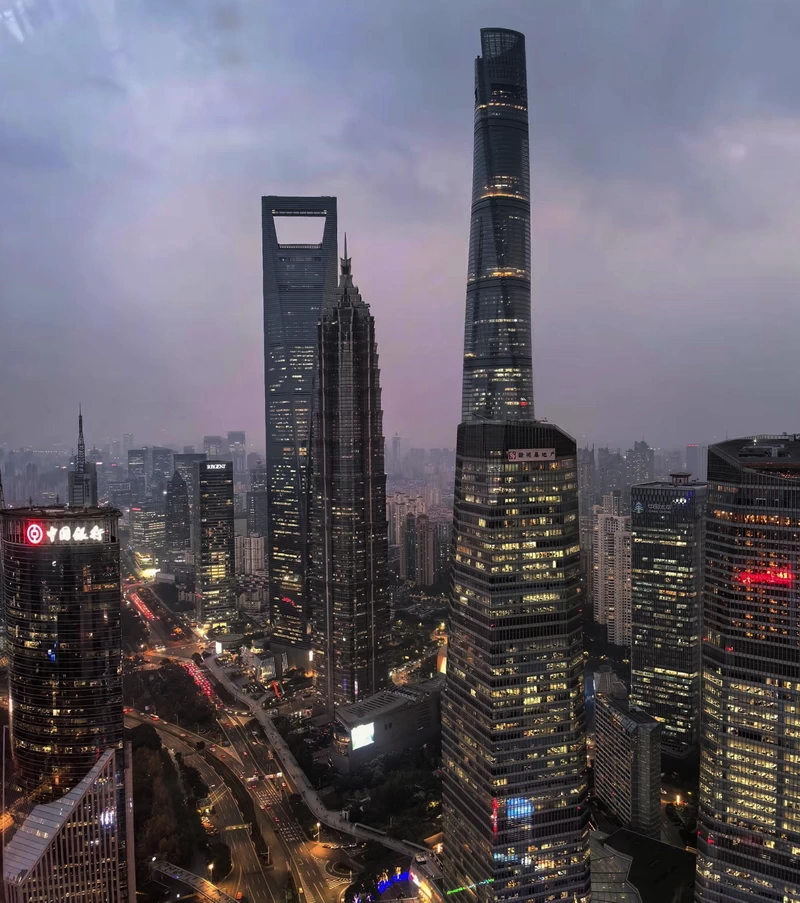
I skipped the elevators one day and simply walked the pedestrian skywalk. Floating above the streets, I felt swallowed by the future.
- Admission: Area is free, observation decks from ¥180+( Shanghai Tower)
- Address: Pudong New Area
- How to get there: Metro Line 2 to Lujiazui
4) Yuyuan Garden & City God Temple
If you crave history and detail, come here. Yuyuan Garden is a maze of pavilions, koi ponds, and stone bridges, echoing the Ming Dynasty.
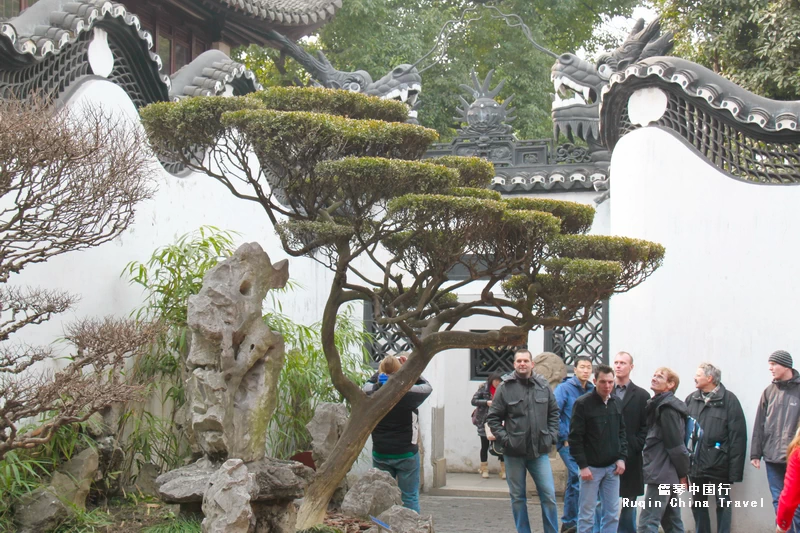
Right next door, the City God Temple Bazaar bursts with life. I nibbled on xiaolongbao, bought handmade trinkets, and soaked in the hum of old Shanghai.
- Admission: ¥30 (off-season), ¥40 (peak)
- Address: Fuyou Road, Huangpu District
- How to get there: Metro Line 10 to Yuyuan Garden, Exit 1
5) Jing’an Temple
Jing’an Temple took my breath away. Surrounded by skyscrapers and luxury malls, its golden roof gleamed like a lantern in the city’s core.
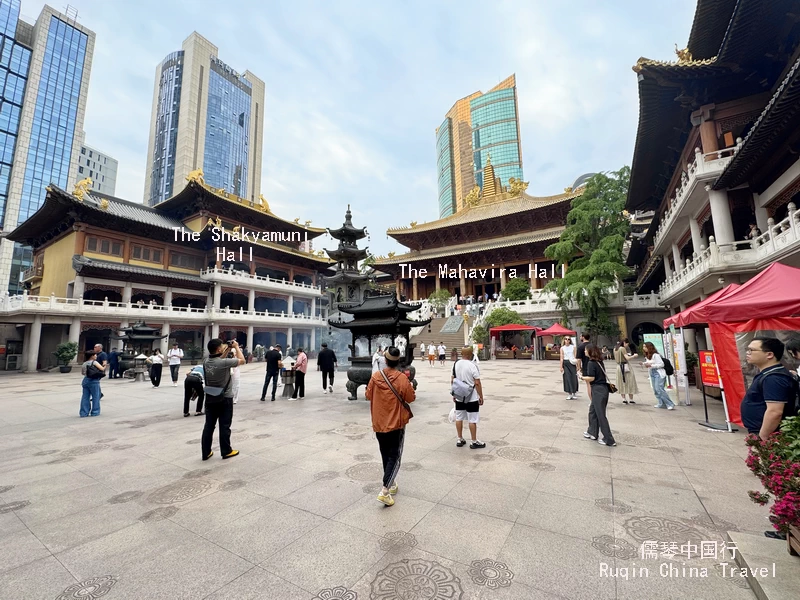
Inside, the scent of incense curled into the air. Monks chanted quietly. The contrast between silence and speed made it one of my favorite spots to pause.
- Admission: ¥50
- Address: 1686 Nanjing West Road, Jing’an District
- How to get there: Metro Line 2 or 7 to Jing’an Temple
6) Nanjing Road Pedestrian Street
This is the soul of Shanghai shopping. From People’s Square to The Bund, Nanjing Road glows with lights, energy, and history.
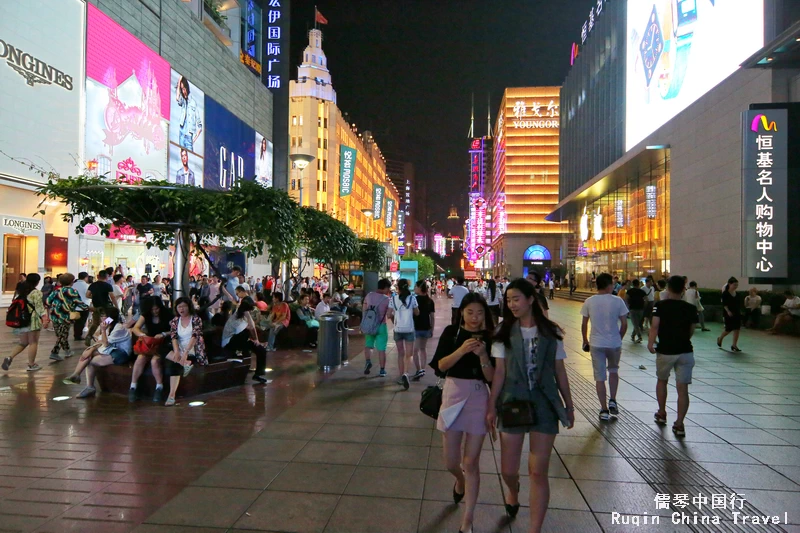
On one side, century-old shops selling mooncakes and silk. On the other, mega malls and LED screens. It’s chaotic, but in the most delightful way.
- Admission: Free
- Address: Nanjing East Road, Huangpu District
- How to get there: Metro Lines 1/2/8 to People’s Square, or Line 2/10 to Nanjing East Road
7) Shanghai Museum
Tucked in People’s Square, this museum was my escape on rainy afternoons. It holds over 120,000 relics, including stunning bronze vessels, porcelain, calligraphy, and jade.
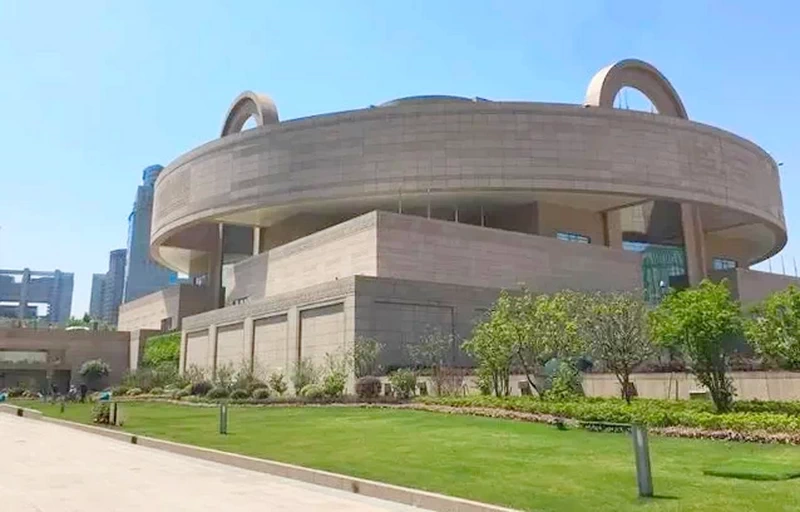
What struck me most wasn’t just the artifacts—it was how well they were displayed. Each exhibit told a story, quiet and powerful.
- Admission: Free (reserve in advance on the official WeChat)
- Address: 201 People’s Avenue, Huangpu District
- How to get there: Metro Lines 1/2/8 to People’s Square
8) Wukang Road
Sometimes, the best sightseeing is just a quiet stroll. Wukang Road, in Xuhui District, felt like stepping into a 1930s film. Lined with plane trees and French-style villas, it’s poetic and peaceful.
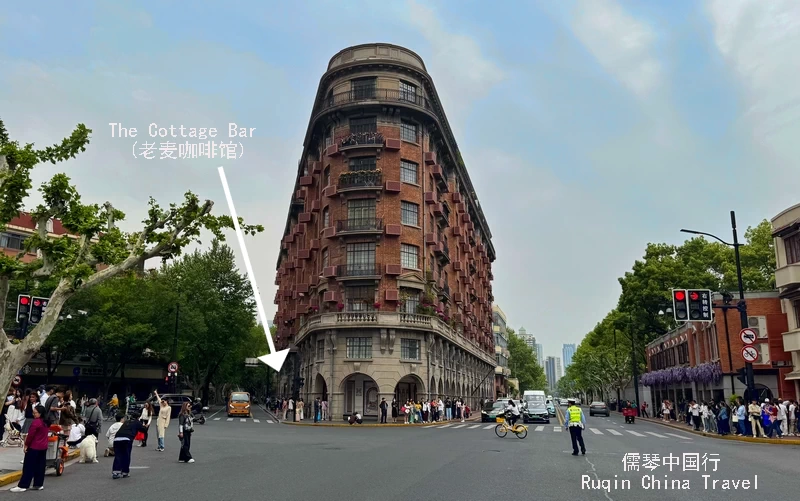
The Wukang Mansion, shaped like a ship’s prow, is the photo spot. But I loved the little cafés and vintage shops even more. I’d grab a latte and just wander.
- Admission: Free
- Address: Wukang Road, Xuhui District
- How to get there: Metro Line 10 or 11 to Jiaotong University, 5-minute walk
9) Zhujiajiao Ancient Town
Need a break from the skyscrapers? I took a day trip to Zhujiajiao, a water town west of the city. Picture stone bridges, canal boats, and cobbled lanes.
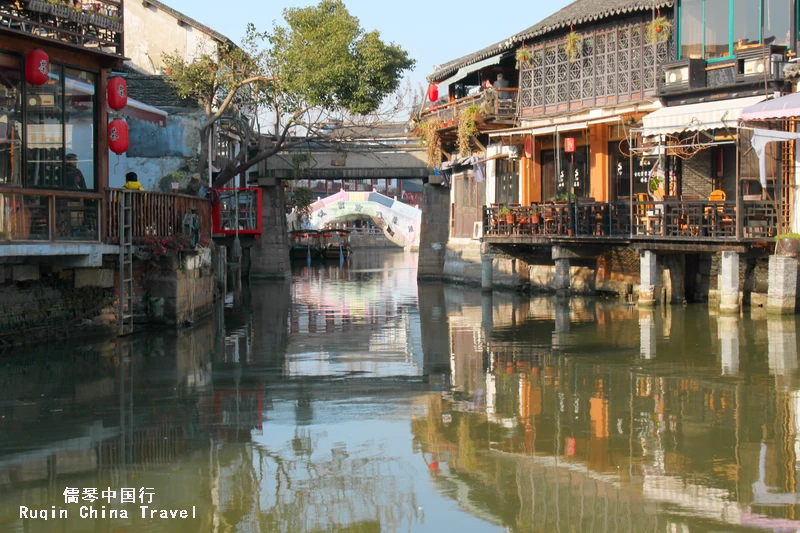
- Admission: Town is free; scenic combo ticket ~¥60
- Address: Zhujiajiao, Qingpu District
- How to get there: Metro Line 17 to Zhujiajiao, then walk or take Bus 1510
10) ERA – Intersection of Time Acrobatic Show
I didn’t expect to be blown away. But ERA isn’t just a show—it’s a heart-pounding fusion of acrobatics, theater, and tech wizardry.

- Admission: ¥280–880 (varies by seat)
- Address: 2266 Gonghexin Road, Jing’an District
- How to get there: Metro Line 1 to Shanghai Circus World, Exit 3
These Top 10 Things to Do in Shanghai only scratch the surface, but they’re where I fell in love with this city. They helped me see her—from glamorous high-rises to ancient stone bridges, from quiet incense temples to flashing neon nights.
6. Huangpu River Night Cruise
Shanghai doesn’t sleep—it glows. By day, the city is impressive. But at night? It becomes something else entirely. The skyline sparkles. The Bund glows golden. And the Huangpu River reflects it all like a ribbon of liquid light.
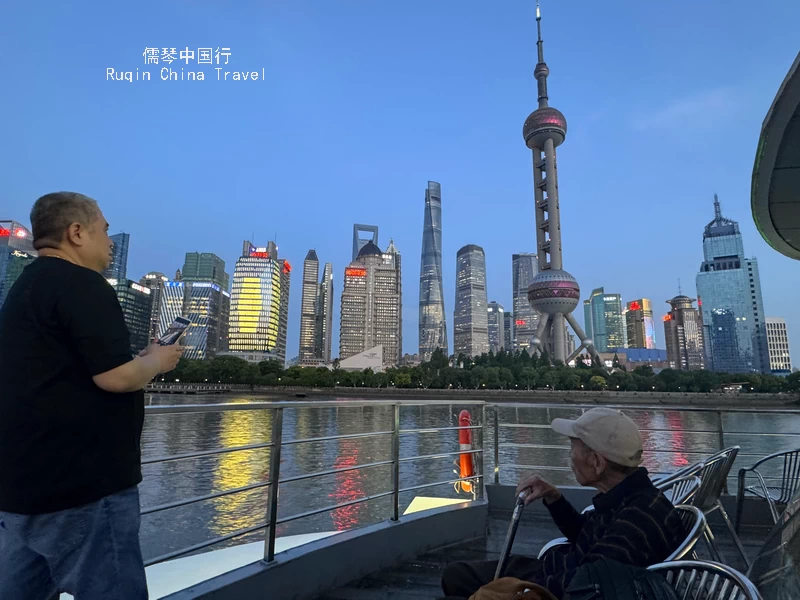
One of the most unforgettable things I’ve done here was take a Huangpu River Night Cruise. If there’s one moment where you feel the soul of the city, it’s gliding through it at night. This part of the Shanghai Travel Guide is for that exact experience.
Shiliupu Pier – Where the Dream Begins
Your cruise starts here, at Shiliupu Pier, the city’s busiest and most iconic departure point for night cruises.
- Address: No. 551 Zhongshan East 2nd Road, Huangpu District
- By metro:
- Take Line 9 to Xiaonanmen Station, Exit 3, then walk 15 minutes
- Or Line 10 to Yuyuan Garden, Exit 1, then walk 20 minutes through the charming old streets
- By taxi or ride-hailing: Just type “Shiliupu Pier” — most drivers know it instantly
Best Time for the Huangpu River Night Cruise
Recommended boarding time: Between 6:30 PM and 8:30 PM
Here’s why this window is magic:
- Blue Hour Beauty: Just after sunset (around 6:00–6:30 PM), the sky turns a deep, rich blue. Meanwhile, city lights slowly begin to glow. The mix is surreal—a favorite among photographers.
- Lighting Spectacle: By 7:00 PM, the buildings along both the Bund and Lujiazui switch on. Light shows begin. Reflections shimmer on the river. It’s Shanghai at her most enchanting.
- Less Wind, More Glow: The early evening air is calmer, and if you’re cruising in cooler months (say, March at 10°C or November at 15°C), you’ll still feel comfortable with a light jacket.
What Kind of Cruise Should You Choose?
There are two main types of boats. I’ve tried both—and honestly, you can’t go wrong. But each offers a different vibe.
1) Large Luxury Sightseeing Boats
These are your classic big cruise ships. Spacious, multi-deck, smooth sailing.
You’ll get both indoor seating (heated in winter, air-conditioned in summer) and open-air decks for photos.
Some favorites:
- “Captain No. 1”船长号”
- “Shengrung” 盛融号
Best for: First-timers, families, comfort seekers.
2) Boutique or Glass-Roof Boats
These smaller boats feel more intimate. Some even have transparent domes (like the “Crystal Princess”)—a romantic way to sail beneath the stars.
A few even offer dinner or drinks, making it perfect for dates or celebrations.
Best for: Couples, photographers, or anyone looking for a special experience.
How Much Does a Night Cruise Cost?
Prices vary based on the type of boat and what’s included.
- Basic sightseeing ticket:
¥128–160 per person for a 45–60 minute ride - With meals or drinks:
¥200–400+ per person - VIP/private cabins:
Starts at ¥500 per person and can go higher
Tip: Book onsite or online through Ctrip, Meituan, or the pier’s official channels. I usually found small discounts and better seat choices that way.
How Often Do Cruises Depart?
During peak evening hours (from 7:00 PM to 9:00 PM), cruises leave every 20–30 minutes.
Each cruise lasts about 45 minutes to 1 hour, depending on the route.
Make sure to arrive 30 minutes early. That gives you time to collect tickets, pass security, and grab a prime spot on the deck.
The Classic Night Cruise Route
The route itself is simple—but stunning.
Southbound
First, your boat drifts past Old Shanghai, where low rooftops and the Nanpu Bridge hint at the city’s roots.
Northbound (Highlight Reel!)
Then comes the moment. Your boat turns north, slipping between two worlds.
- On the west, the Bund’s colonial buildings stand tall—Regal. Elegant. Timeless.
- On the east, Lujiazui’s skyscrapers glitter with LED art and futuristic flair.
This is where Shanghai’s soul shows itself. A dialogue between past and future, glowing in the same mirror-like river.
You’ll float past:
- Oriental Pearl Tower
- Jin Mao Tower
- Shanghai Tower
- World Financial Center
- Waibaidu Bridge—lit with golden light like a fairytale crossing
Finally, near Yangpu Bridge, your boat turns back.
Personal Tips for the Best Night Cruise Experience
- Bring a light jacket, even in summer. The river breeze can surprise you.
- Charge your phone and camera—I took more photos than I ever expected.
- Head straight to the top deck if you want the best views.
- Don’t rush to leave when it ends. Linger on the dock, soak in the skyline a little longer.
Of all the memories I made in this city, the Huangpu River Night Cruise stands among the most vivid. It’s not just sightseeing—it’s feeling Shanghai wrap itself around you, lit by a thousand lights.
Whether it’s your first night or your last, let the river carry you. Let the skyline dazzle you. Let the moment stay with you. And that, my friend, is the Shanghai I came to know—full of contrast, full of light, full of life. Welcome aboard.
7. Shanghai City Walk
Some cities beg you to wander. Shanghai invites you to fall in love. One of my favorite ways to explore this city? A full-day Shanghai City Walk that stitches together history, romance, and sky-high wonder—all connected by the city’s smooth, stress-free metro. I designed this one-day route to minimize walking fatigue while maximizing the magic.

So lace up your comfiest shoes, grab your metro card, and follow me through a day that flows from cathedrals to coffee, dumplings to dazzles of neon. Let’s start at sunrise, in one of my favorite corners of old-meets-new Shanghai.
Stop 1: Xujiahui Cathedral & Xujiahui Library – Sacred Beauty & Quiet Bookshelves
District: Xuhui
Best season tip: In spring (15–20°C), the cathedral’s garden is full of flowers. Perfect for photos.
I began my day in Xujiahui District 徐汇区, a neighborhood where the soul of old Shanghai quietly lingers beneath the buzz. The St. Ignatius Cathedral 徐家汇天主教堂, with its twin Gothic towers, stood proud against the morning sky. Inside, soft stained glass lit up the pews—it felt calm, almost cinematic.

Right across the street, the Xujiahui Library 徐家汇书院 welcomed me in with its sleek design and gentle hush. Its rooftop balcony gave me a perfect view back at the cathedral.
If you have extra time, I recommend the Shanghai Film Museum 上海电影博物馆 nearby—it’s full of golden-age movie nostalgia.
- Entrance: Free (cathedral may require advance reservation)
- Address: No. 158 Puxi Road, Xuhui District
- Metro: Xujiahui Station, Lines 1/9/11
- Suggested time: 1 hour
Next stop: Take Metro Line 11 toward Disney Resort, get off at Jiaotong University, Exit 7, then walk 10 minutes.
Stop 2: Wukang Mansion & Wukang Road
District: Xuhui
Best season tip: In autumn (18–25°C), fallen leaves dance down the sidewalks. Pure poetry.
As soon as I stepped out, Wukang Mansion 武康大楼 loomed into view—majestic, ship-like, and totally photogenic. This place is one of the most popular photo spots in the city, and it’s not hard to see why.

Then I turned the corner onto Wukang Road 武康路. The whole street felt like a dream—lined with sycamore trees and early 20th-century villas. I ducked into tiny cafés, browsed local boutiques, and soaked in that quiet, literary air Shanghai does so well.
This stretch of road captures the city’s softer, artsier side.
- Entrance: Free
- Address: No. 1850 Huaihai Middle Road
- Metro: Jiaotong University, Line 10/11
- Suggested time: 1.5 hours
Next stop: Walk to Jiaotong University Station or Shanghai Library Station, take Line 10 toward Hongqiao, get off at Yuyuan Garden Station. Total ride: 20–25 minutes.
Stop 3: Yuyuan Garden & City God Temple
District: Huangpu
Best season tip: Winter (5–10°C) with fewer crowds and piping-hot street snacks.
I stepped off the metro and it felt like time had rewound. Gone were the art cafés—here, ancient rooftops and red lanterns swung in the breeze. The Yuyuan Garden, built in the Ming Dynasty, was a maze of archways, koi ponds, and elegant courtyards.
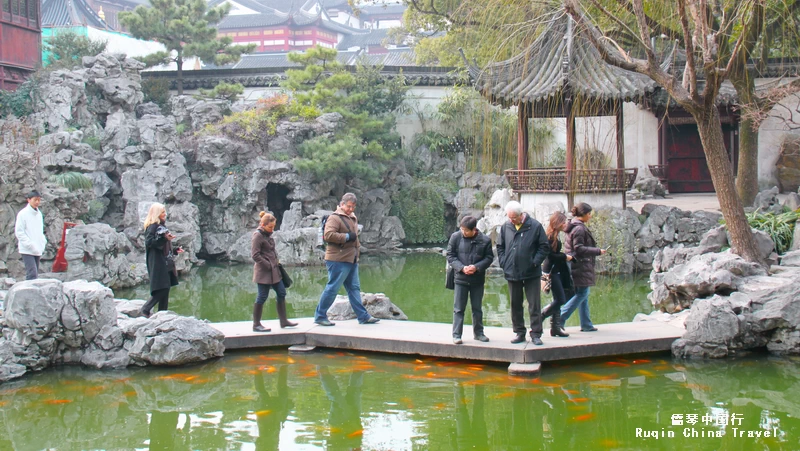
Next door, City God Temple buzzed with life. Steam rose from baskets of xiao long bao, the air thick with the scent of soy, sesame, and sugar. I grabbed a seat at Nanxiang Steamed Bun Restaurant, where the dumplings were warm and soul-soothing.
This was my lunch stop—and it never disappoints.
- Yuyuan Garden Entrance: ¥30–40 (depending on season)
- City God Temple: Free (temple hall ticket ¥10)
- Address: No. 427 Fuyou Road
- Metro: Yuyuan Garden Station, Line 10
- Suggested time: 2 hours (including lunch)
Next stop: From Yuyuan Garden, hop on Line 14 at Yuyuan Station, head toward Guiqiao Road, and exit at Lujiazui—just 2 stops, around 10 minutes.
Stop 4: Lujiazui – Skyscraper Jungle & Skyline Glory
District: Pudong
Best season tip: Summer evenings (28–32°C), catch sunset before lights come on.
When I emerged from Lujiazui Station, I tilted my head back—way back. The “Shanghai Trio” stared back at me:

- Jin Mao Tower (the one that looks like a syringe)
- Shanghai World Financial Center (the bottle opener)
- Shanghai Tower (China’s tallest, shaped like a spiral egg beater)
I wandered to the Lujiazui Central Green, a small park surrounded by giants. It’s the best place to capture the skyline from ground level. Then, I ducked into IFC Mall to cool off and grab a drink.
- Entrance: Free (skydeck access ¥180+; this walk skips it)
- Address: Lujiazui Finance and Trade Zone, Pudong
- Metro: Lujiazui Station, Line 2/14
- Suggested time: 1 hour
Next stop: Time for something special. Walk 10 minutes to Dongchang Ferry Terminal 东昌路渡口, then hop on the Dongjin Ferry Line to Jinling East Road.
- Fare: Just ¥2!
- Duration: 10 minutes across the river
- Bonus: Sunset views on the water? Absolutely priceless.
Stop 5: The Bund at Night
District: Huangpu
Best season tip: Year-round, but especially spring or fall for that crisp evening air (15–22°C)
Stepping off the ferry, I found myself at The Bund—right at the golden hour. Lights flickered on. Domes, spires, columns—all glowing against the navy sky. Across the water, Pudong’s towers lit up like circuit boards in a sci-fi film.

The walk along the river felt cinematic. Everyone—tourists, locals, couples, photographers—paused to soak in the same view. I snapped photos until my battery screamed for help.
- Entrance: Free
- Address: Zhongshan East 1st Road, Huangpu
- Suggested time: 1 hour
Next stop: Walk west into the glow of the next destination. It’s only 10 minutes away.
Final Stop: Nanjing Road Pedestrian Street
District: Huangpu
Best season tip: Late summer nights (27–30°C) feel electric with crowds and lights.
If The Bund is Shanghai’s soul, Nanjing Road is its voice. Bright, busy, and absolutely buzzing.
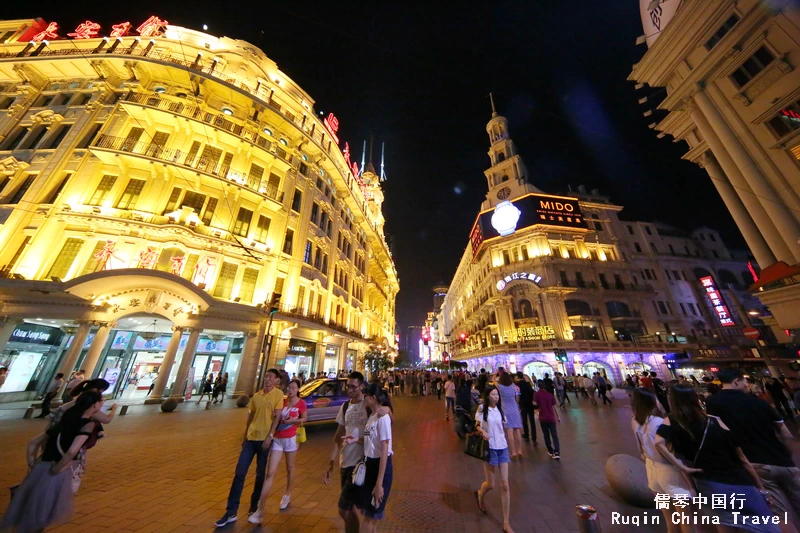
I wandered into shops, bought quirky souvenirs, and stood under neon signs flashing in pink, gold, and sapphire blue. Street performers played music, and people posed in front of glowing storefronts. It felt like Times Square and a Chinese market had a baby.
Dinner? So many options. I grabbed noodles from a local chain and people-watched until my feet gave out.
- Entrance: Free
- Address: Nanjing East Road, from Henan Middle Road to People’s Square
- Metro: End your day at People’s Square Station, Lines 1/2/8
- Suggested time: As long as you want
Final Shanghai City Walk Tips
- Wear super comfy shoes—you’ll thank yourself at hour five.
- Bring a power bank—photos, maps, translation apps all drain battery fast.
- Set up Shanghai’s transit QR code on WeChat or Alipay before you go.
- Time it right—leave Lujiazui by 6:30 PM to catch the skyline light-up from The Bund.
If you ever asked me where to find the soul of Jiangnan—the gentle, poetic land south of the Yangtze—I’d hand you a train ticket from Shanghai and whisper, “Go to Suzhou. Then glide into Zhouzhuang.”
This Shanghai Travel Guide chapter is for the dreamers, the slow travelers, the lovers of misty canals and garden stones. In just two days, you’ll journey from Shanghai’s neon skyline to Suzhou’s ancient elegance and finally to the water-veined poetry of Zhouzhuang. Let’s go.
Day 1: From Shanghai to Suzhou – Classical Gardens & Quiet Canals
Morning: Shanghai → Suzhou – Fast, Easy, Scenic
Distance: 100 km
Best travel option: High-speed train
- From: Shanghai Hongqiao Station or Shanghai Railway Station
- To: Suzhou Railway Station
- Duration: 25–35 minutes
- Fare: ¥35–¥40
- Bonus: Trains leave every 10–15 minutes!
I left early. The train glided out of Shanghai like silk through fingers, cutting through rising mist and rice paddies. In no time, Suzhou appeared—quieter, greener, wrapped in stories.
Tip: Avoid buses or driving. Suzhou’s old town can be a maze of traffic and tight alleys. The train is faster, cheaper, and far less stressful.
Midday: Hotel Check-In & Suzhou First Impressions
From Suzhou Station, I grabbed a taxi and headed into the heart of town. Luggage stowed, camera charged—I was ready to explore.
Where I stayed (and loved):
- Luxury: Park Hyatt Suzhou – serene views over Jinji Lake
- Boutique: Wenlv Huajian·Shantang Renjia – an old house reborn on Shantang Street, perfect for slow mornings
- Budget & central: Morning Maple Hotel, Guanqian Street – clean, cozy, and a walk from everything
Afternoon: The Art of Stillness at the Humble Administrator’s Garden (拙政园)
The moment I stepped into the Humble Administrator’s Garden 拙政园 I slowed down. Everything demanded quiet attention—arched bridges, lotus ponds, weeping willows, and the sound of bamboo rustling in the wind.
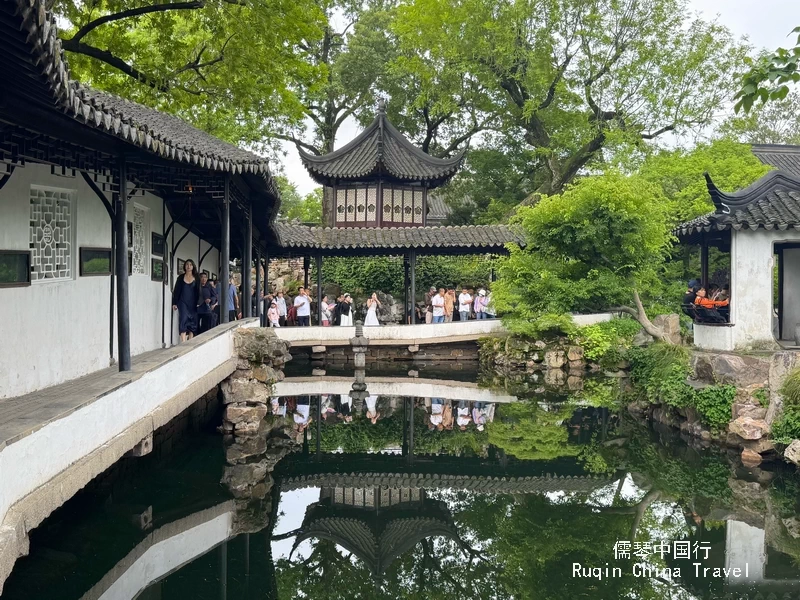
Built in the Ming dynasty, this garden isn’t just famous—it’s a UNESCO World Heritage Site and a masterclass in traditional Chinese landscaping.
Every corner revealed a scene. Every stone had meaning. And yes, I got lost. Happily.
- Entrance: ¥80 (peak), ¥70 (off-season)
- Address: No. 178 Dongbei Street, Gusu District
- Getting there: From Guanqian Street, a quick 10–15 min taxi ride
- Time needed: 1.5 hours
Evening: Strolling Down Peaceful Pingjiang Road
By sunset, I found myself walking along the narrow stone path of Pingjiang Road 平江路, with lanterns flickering over quiet canals. Unlike the more commercial Shantang Street, Pingjiang is gentler, full of old homes, teahouses, and soft footsteps.
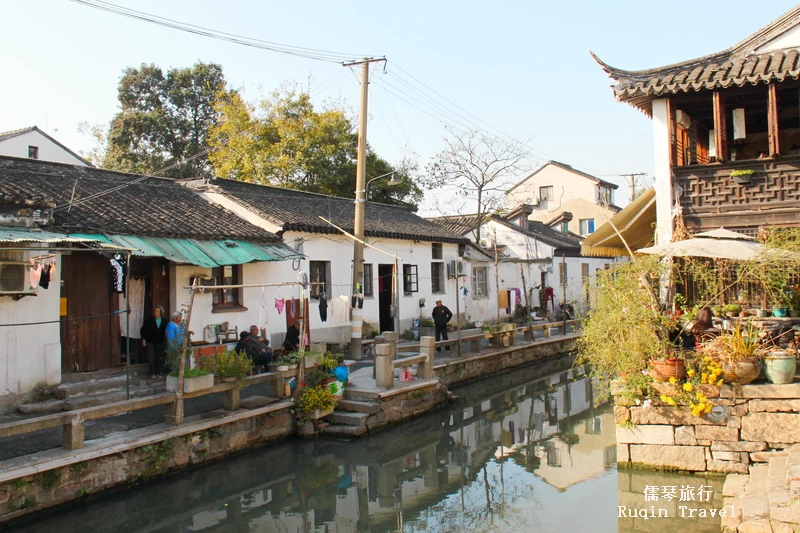
I browsed calligraphy shops, sipped bi luo chun green tea, and listened to the soft tones of Suzhou Pingtan评弹 floating from a riverside stage.
- Entrance: Free
- Address: Pingjiang Road, Gusu District
- Time needed: 1.5–2 hours
If you’re lucky, you might catch a hand-rowed boat gliding past with a singing oarswoman. I did. I paused. I smiled.
Dinner in Suzhou – Flavors of the Water City
I didn’t leave without indulging in Suzhou’s best dishes.
What I ordered:
- Squirrel Mandarin Fish (松鼠鳜鱼) – crispy, sweet-sour, and sculpted like art
- Bi Luo Shrimp 碧螺虾仁– light, fresh, and seasonal
- Ao Zao Noodles 奥灶面– dark broth, bright flavor
- Sweet rice congee 糖粥– slow and soothing
Where I ate:
- Songhelou 松鹤楼– centuries old and still flawless
- De Yue Lou 得月楼– local classic
- Lao Suzhou Cha Jiulou 老苏州茶酒楼– more rustic, loved by locals
A Quick Night Walk on Shantang Street
After dinner, I made a short detour to Shantang Street 山塘街. Red lanterns shimmered over the canal, reflecting off wooden boats. It felt touristy but still beautiful—and a great way to end the day.
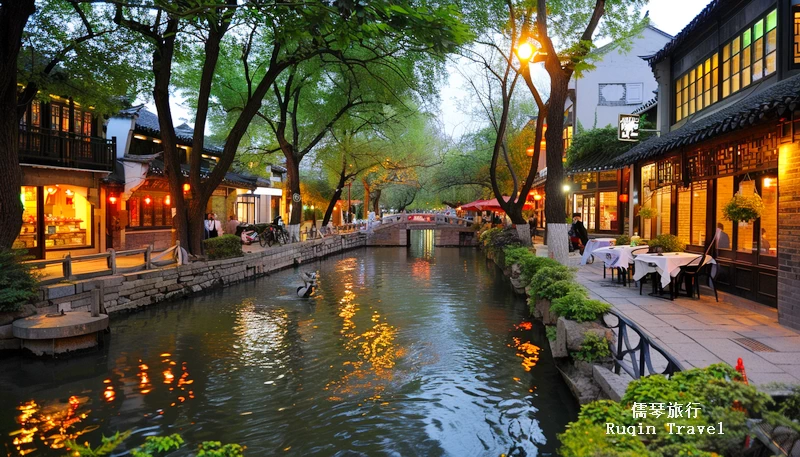
Then I headed back to the hotel, already dreaming of water towns.
Day 2: Suzhou → Zhouzhuang – China’s First Water Town
Morning: Journey to Zhouzhuang
I left early to make the most of the day.
Distance: Around 50 km
Travel options:
- Tourist Bus: From Suzhou North Bus Station, direct to Zhouzhuang (~1.5 hours)
- Chartered car: If traveling in a group (2–4 people), this is the most flexible
- Tip: Some hotels arrange private transfers—worth asking!
Arriving in Zhouzhuang – Where Time Slows
Zhouzhuang felt like a painting. Winding alleys. Stone bridges. Gentle canals framed by whitewashed homes and black-tiled roofs. Every turn was a photo, every sound a poem.
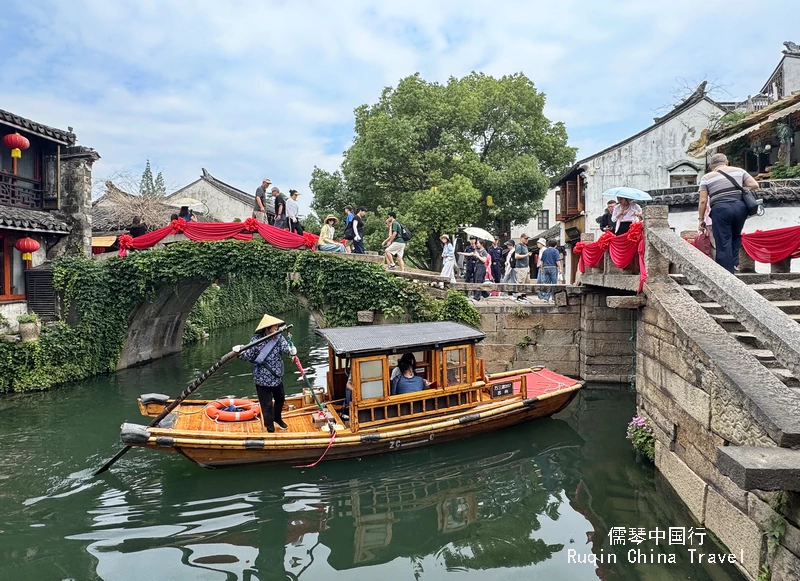
Known as “China’s First Water Town,” Zhouzhuang is beautifully preserved and deeply atmospheric.
Don’t miss:
- Rowboat ride – float through stone archways as a singing guide rows and hums
- Twin Bridges (Shuangqiao) – the town’s most famous postcard scene
- Shen House & Zhang House – mansions of Suzhou’s old elites, filled with carvings and creaky charm
- Entrance: Around ¥60 for a combined ticket
- Address: Zhouzhuang Town, Kunshan, Jiangsu
- Time needed: 3–4 hours
Lunch by the Water – Simple & Soulful
I found a table by the canal and ordered:
- Wan San Pig Trotter – Zhouzhuang’s signature, braised until melt-in-mouth
- Sesame oil cakes
- Grandma’s Tea – herbal and homemade
The river glistened. Time stood still.
Afternoon: Wander, Shop, and Say Goodbye
After lunch, I wandered through side streets, bought a paper fan, and visited the Zhouzhuang Museum. I climbed the Fu’an Bridge, the town’s highest, and watched boats pass beneath.
By mid-afternoon, it was time to leave.
Return to Shanghai
Best way back:
Direct Tourist Bus: Zhouzhuang Bus Station → Shanghai Long-Distance Bus Terminal or Hongqiao West Bus Station
- Duration: 1.5–2 hours
- Fastest route (with more steps):
- Bus to Kunshan South Station → High-speed train to Shanghai Hongqiao
- Slightly complex, but quicker if timed well
Back in Shanghai – Ending the Journey
As the city lights came back into view, I felt full. Not just from the food—but from the memories.
This 2-day escape from Shanghai had given me everything:
- The quiet stillness of Suzhou gardens
- The warm lantern glow of Pingjiang Road
- The slow, rocking rhythm of a Zhouzhuang rowboat
Final Tips for Your 2-Day Side Trip
- Buy tickets early – especially for gardens and water towns on holidays
- Wear walkable shoes – stone streets are no joke
- Travel light – a daypack is all you need
- Charge your camera – you will not stop taking photos
- Stay overnight in Suzhou, not Zhouzhuang, for easier returns
Whether you’re a history buff, a photographer, or just a traveler in need of beauty, this Shanghai Side Trip will give you that and more.
In just 48 hours, you’ll cross centuries and styles, from shining skylines to garden bridges and water reflections. That’s the magic of Jiangnan. And it’s only one train ride away.
9. Shanghai Food – Best Shanghai Food for Your Taste Buds
I arrived in Shanghai hungry—and I left full of stories. In this chapter of the Shanghai Travel Guide, I want to share the best Shanghai food I discovered: from rich banquet dishes to street‑snacks you’ll crave for weeks.
1) Classic Benbang Dishes – Big Plates, Big Flavor
These are the dishes you’ll find on family tables and at grand banquets. They tell the story of local cooking, rooted in tradition and Shanghai’s own style.
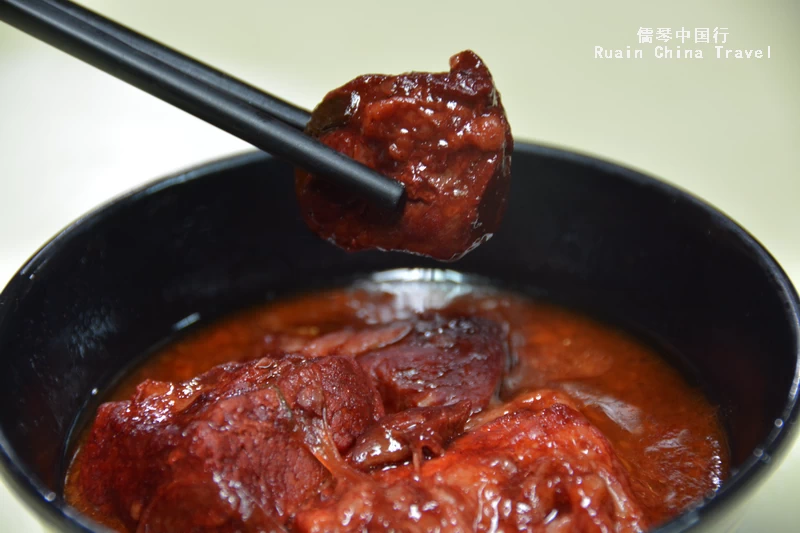
红烧肉 (Red‑Braised Pork)
This is the dish that says “Shanghai” with every bite. I sat down and ordered it without hesitation. Slow‑braised belly pork, glazed like amber, the fat melted into the lean meat. Sweet meets salty, soft meets firm. Truly unforgettable.
八宝鸭 (Eight Treasure Duck)
For a special occasion I tried this one. A whole duck deboned and stuffed with glutinous rice, lotus seeds, ham, shrimp, bamboo shoots—you name it. Then steamed and sometimes fried or braised. The result? Layers of texture and flavor.
腌笃鲜 (Salted Pork, Spring Bamboo Shoot & Fresh Meat Soup)
In spring I found this comforting bowl. Salted pork, fresh meat, crisp spring bamboo cook together until the broth turns milky. It feels like home in a bowl.
油爆河虾 (Oil‑Explosion River Shrimps)
Late one evening I ordered this dish along with a local beer. Tiny fresh river shrimps flash‑fried in hot oil, then tossed with seasoning. Shells crisp, meat tender—perfect as a shared dish or appetizer.
松鼠桂鱼 (Squirrel Mandarin Fish)
Sourced from nearby waters, this dish shows how Shanghai also borrows and adapts. The fish is cut with a decorative “flower” knife pattern, fried, then drenched in hot sweet‑sour sauce. Crunchy outside, soft inside, and that visual? Stunning.
These dishes reflect what scholars call benbangcai—local cuisine of Shanghai. It uses soy sauce, sugar, and plenty of oil to create deep color, rich taste and subtle sweetness.
2) Street & Snack Favorites – Bite‑Sized Joys
Next, I walked the lanes and sampled the food of the everyday. Shanghai’s snacks are part of the rhythm of the city.
生煎包 (Pan‑fried Pork Buns)
One morning I found myself at a busy stall. The buns sizzle in a flat pan, bottoms crisped golden, tops sprinkled with sesame. The key moment: you lift it, open a “window,” sip the hot soup inside, then bite in. A ritual.

上海三鲜馄饨 (Shanghai Three‑Fresh Wonton Soup)
In a small alley café I tucked into this: large wontons stuffed with pork, shrimp, mushrooms, a light clear broth, egg‑ribbons, seaweed, scallions. Comfort food at its finest.
3) Sweets & Gifts – Gentle, Elegant Endings
Because yes, you should always save room for dessert in Shanghai.
梨膏糖 (Pear Syrup Candy)
I found these at the market near Yuyuan. Made from pear juice, honey, and herbs like fritillaria. Clear, slightly medicinal, sweet but not cloying. Used to soothe throats—now a delightful souvenir.
高桥松饼 (Gaoqiao Crisp Cakes)
In Pudong’s Gaoqiao area I discovered these layered puff cakes. Hundreds of flakey layers inside, filled with bean‑paste or jujube paste. Crisp, light, addictive.
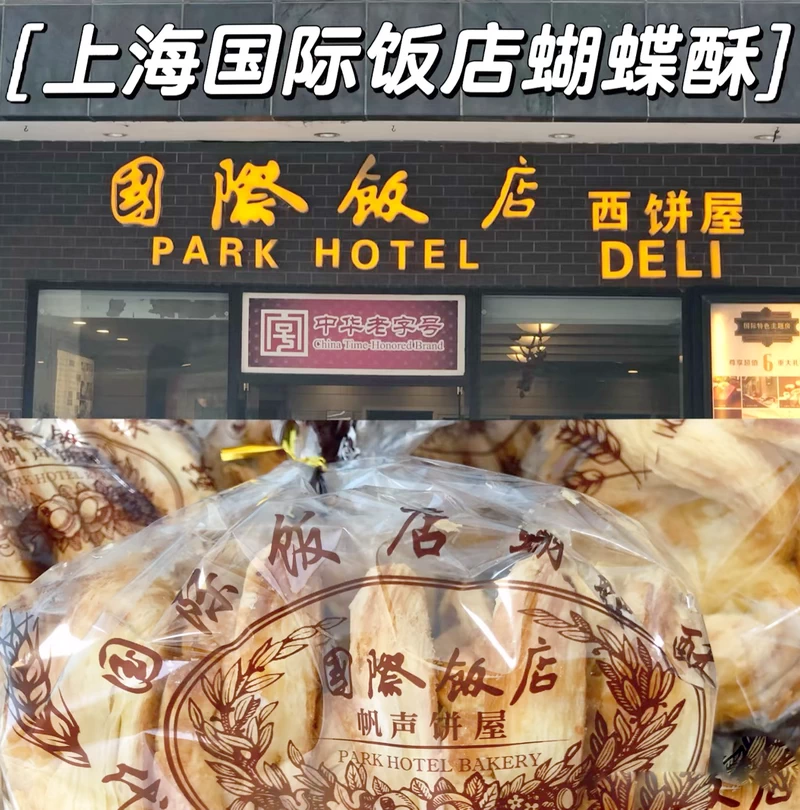
蝴蝶酥 (Butterfly Pastry)
I tasted this in a high‑end hotel pastry shop. Shaped like a butterfly, golden brown, sugar‑crisped, buttery inside. A perfect tea‑time treat.
Local Food Tips for the Traveler
- Explore Yunnan South Road and Huanghe Road – historical foodie streets. But be selective: even popular markets can disappoint.
- Don’t fear small, humble restaurants filled with local diners. These often serve the best.
- If you’re walking through Huangpu, Jing’an, Xuhui, sample snacks in side alleys.
- Try the sweet‑savory balance typical of Shanghai food (sugar + soy) instead of expecting heavy spice.
So when you eat, let your senses follow the story: the city’s migrations, its rivers, its gardens, its rise to global city. Each bite in Shanghai speaks of place.
In this Shanghai Travel Guide, I hope your meals become memories—not just fuel. Taste boldly. Explore widely. And let Shanghai feed you stories.
10. What to Buy in Shanghai – Best Gifts from Shanghai to Take Home
Whenever I travel, I love finding objects that carry memories. In this part of my Shanghai Travel Guide, I want to show you what to buy in Shanghai—those gifts, souvenirs and keepsakes that truly reflect the city. From timeless crafts to modern design finds, these are the best gifts from Shanghai to remember your “魔都” adventure.
Must‑Buy List: From Traditional to Trendy
1) Classic Heritage Goods (Perfect for older friends or family)
- Silk Products – Shanghai is long linked to silk. I found scarves, silk pajamas, elegant handkerchiefs printed with ink‑flower or geometric patterns. Always timeless.
- Where: Brands like Shanghai Story and Ziqi are found in major shopping areas.
- Old‑brand Pastries & Candies – I delighted in browsing the boxes of these treats.
- Butterfly Pastry from a big hotel bakery: crisp, buttery, golden.
- Gaoqiao Crisp Cake from Pudong: hundreds of dough layers, bean‑paste inside.
- Pear Syrup Candy from Yuyuan: sweet, slightly medicinal, unforgettable.
- Where: The Yuyuan Mall area is a perfect stop for all these.
- Shanghai Brand Watches – I saw vintage‑style models with “上海” on the dial. Retro, nostalgic, and surprisingly stylish today.
- Where: Look at stores along Nanjing East Road or in major department stores.
2) Artsy & Elegant (For yourself or artsy friends)
- “Big White Rabbit” Candy Series – I found not just candy, but lip‑balm, hand‑cream, tote bags with the cute rabbit. A fun twist on nostalgia.
- Where: TIANZI FANG, Yuyuan’s creative shops, or rabbit‑brand stores.
- Design & Cultural Creatives – I went into the museum gift shop and found stationery inspired by Shanghai architecture, building‑shaped fridge magnets, chic notebooks with Bund sketches.
- Where: The Shanghai Museum Art Store, boutique shops around Wukang Road, creative stalls in Yuyuan.
- Xiangyunsha Silk – I discovered this special luxury silk fabric in small boutiques. Wears beautifully. Feels gentle. Has understated high‑end vibe.
- Where: Boutique stores in TIANZI FANG or specialty flag‑ship shops.
3) Trendy & Shanghai‑Chic (For friends who like style & statement)
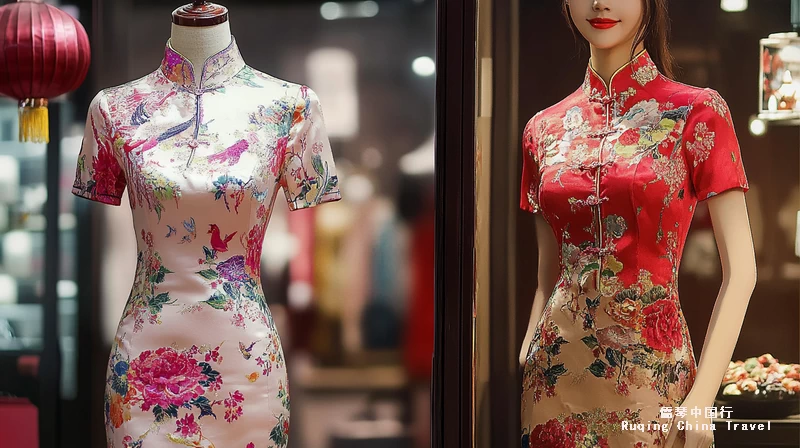
- Custom Qipao – Shanghai is often considered the home of the qipao. I visited a bespoke shop and tried on one. It felt elegant, unique.
- Choose silk or xiangyunsha.
- Where: Tailor shops around Changle Road / Maoming South Road; or the artsy lane‑blocks of TIANZI FANG.
- Shanghai‑themed Fragrances & Candles – One of my favorite finds: scents named “Wutong Shadow”, “White Magnolia”, “Bund Dawn”. I felt they captured the city’s essence.
- Where: Concept stores near Anfu Road / Wukang Road or designer boutiques.
Where to Shop: Best Areas & What to Expect
- Yuyuan Mall (豫园商城) – If you want tradition, old‑shops, nostalgia and dozens of gift stations in one place. I spent a full afternoon here shopping.
- TIANZI FANG / Anfu Road / Wukang Road – For creative design, boutique finds, relaxed vibe. I wandered here and found things I never would have online.
- Nanjing West Road (南京西路) – Luxury shopping factor: major department stores, high‑end silk, qipao ateliers, designer showrooms.
Shopping‑Tips I Learned in Shanghai
- In Yuyuan, on street‑shops you can negotiate a little. I tried and it worked.
- For food‑souvenirs: check expiry dates, packaging integrity.
- Choose gifts that match the recipient’s style—not just “because it’s from Shanghai.” The memories you carry will mean more than the logo on the bag.
Let your shopping be more than souvenirs. Let it become treasure troves of stories. When I hold that butterfly pastry box, I remember neon lights and laughter. When I wear the silk scarf, I feel the Wutong trees of old Shanghai.
I hope these suggestions from my travel‑diary help you bring home something truly meaningful. Happy shopping—and may each gift whisper “我在上海” every time you look at it.
Thank you for joining me on this journey through my Shanghai Travel Guide. From glittering skylines to quiet gardens, from street snacks to timeless souvenirs, Shanghai is a city that lingers in your senses long after you’ve left.
I hope this Shanghai Travel Guide helps you uncover not just places, but moments—those little sparks that turn a trip into a story worth telling. Until next time, may your memories of the “Pearl of the Orient” stay warm and unforgettable.
About the Author
Ruqin is the founder of Ruqintravel.com and has spent more than four decades working in China’s travel industry. Drawing on hands-on experience in cities like Beijing and Hangzhou, he personally researches and updates each guide to help international travelers navigate China with confidence.
Further Reading
Shanghai French Concession: Maps, Walking Routes & Travel Tips
What to Buy in Shanghai – Best Gifts from Shanghai
Top 10 Must Try Foods in Shanghai: A Visitor Guide
Oriental Pearl Tower Shanghai: Tickets, Highlights & Travel Tips
How to Visit the Bund in Shanghai: Top Things to Do, Map & Tips
How to Visit Zhujiajiao Water Town: Tickets, Things to Do & Tips
How to Visit Yu Garden in Shanghai: Tickets, Hours & Travel Tips
How to Visit Nanjing Road: Map, Shopping, Food, Hotels & Tips
Shanghai Huangpu River Cruise: Tickets, Routes and Travel Tips
Shanghai Acrobatic Show Tickets: A Visitor’s Guide
Shanghai People’s Square: Metro, Attractions, Hotels & Travel Tips
Shanghai Museum: Tickets, Transport, Highlights & Tips
Jing’an Temple: 1,700 Years of Zen in the Heart of Shanghai
How to Book Shanghai Attraction Tickets : All You Need to Know