
Written and updated by Ruqin
Last updated: October 18, 2026
Shanghai Museum (上海博物馆) is one of China’s leading museums of art and history. Its collections include ancient bronzes, ceramics, jade, paintings, calligraphy, sculpture, and many other treasures.
However, there is one important change that international travelers should understand before visiting.
Shanghai Museum now operates two main buildings: Shanghai Museum on People’s Square (上海博物馆人民广场馆) and Shanghai Museum East (上海博物馆东馆).
They are in different parts of the city. They also have different exhibitions, opening days, and admission arrangements.
Since July 2026, the People’s Square building has been dedicated to a major exhibition on ancient American civilizations. Visitors interested in the museum’s traditional Chinese art collections should instead go to Shanghai Museum East in Pudong.
In this guide, I’ll explain how to choose the right building, use the location and metro map, arrange tickets, and plan a comfortable museum visit.
1. Shanghai Museum: Two Buildings Location & Metro Map
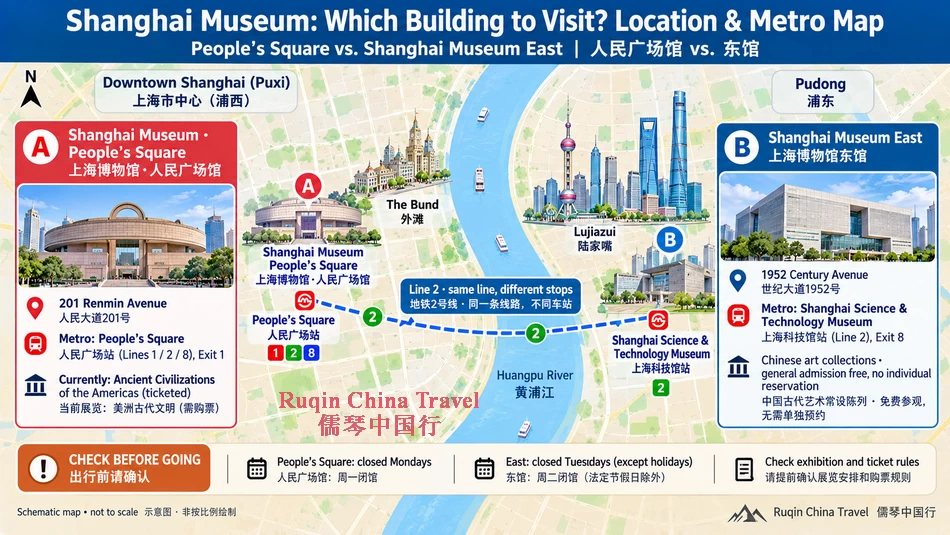
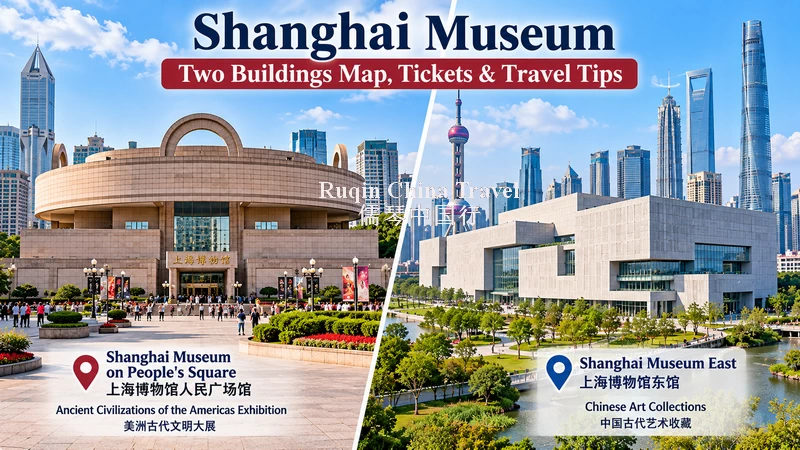
The new Shanghai Museum Two Buildings Location & Metro Map
The map shows the two museum buildings on opposite sides of the Huangpu River (黄浦江).
The People’s Square building is in Puxi (浦西), the historic central part of Shanghai. It is convenient for travelers staying near Nanjing Road, People’s Square, and the Bund.
Shanghai Museum East is in Pudong (浦东), farther east along Century Avenue. This is where you should go if your main interest is Chinese art and historical collections.
Both buildings can be reached using Shanghai Metro Line 2, although you will get off at different stations.
Here is a quick comparison:
| People’s Square Building | Shanghai Museum East | |
|---|---|---|
| Chinese name | 上海博物馆人民广场馆 | 上海博物馆东馆 |
| Address | 201 Renmin Avenue | 1952 Century Avenue |
| Main attraction | Ancient Civilizations of the Americas exhibition | Chinese art collections and special exhibitions |
| Admission | Paid exhibition ticket | Free general admission |
| Regular opening | 9:00 AM–5:00 PM | 10:00 AM–6:00 PM |
| Last entry | 3:00 PM | 5:00 PM |
| Regular closing day | Monday | Tuesday |
| Nearest metro | People’s Square, Lines 1, 2, 8 | Shanghai Science & Technology Museum, Line 2 |
National holidays and special exhibitions may affect these arrangements.
Ruqin’s advice: Decide what you want to see before choosing a museum building. Do not simply search for “Shanghai Museum” and follow the first navigation result.
2. A Brief History of Shanghai Museum
Shanghai Museum was founded in 1952 and has developed into one of China’s important institutions for preserving and displaying ancient art.
Its best-known building opened on People’s Square in 1996.
The architecture is distinctive. Its round roof and square base draw inspiration from traditional Chinese ideas of heaven and earth. The overall appearance also recalls an ancient bronze ritual vessel known as a ding (鼎).
For many years, this was the building where visitors explored the museum’s famous collections of bronzes, ceramics, paintings, calligraphy, jade, and furniture.
The opening of Shanghai Museum East changed the visitor experience.
Rather than concentrating everything in one downtown building, the museum now has a much larger exhibition space in Pudong, allowing more of its collections to be displayed.
For first-time visitors, this is good news. There is more to see, but it also means that choosing the correct location has become an essential part of planning.
3. Shanghai Museum on People’s Square: Exhibitions, Tickets & Hours
Shanghai Museum on People’s Square (上海博物馆人民广场馆)
Address: 201 Renmin Avenue (人民大道201号), Huangpu District.
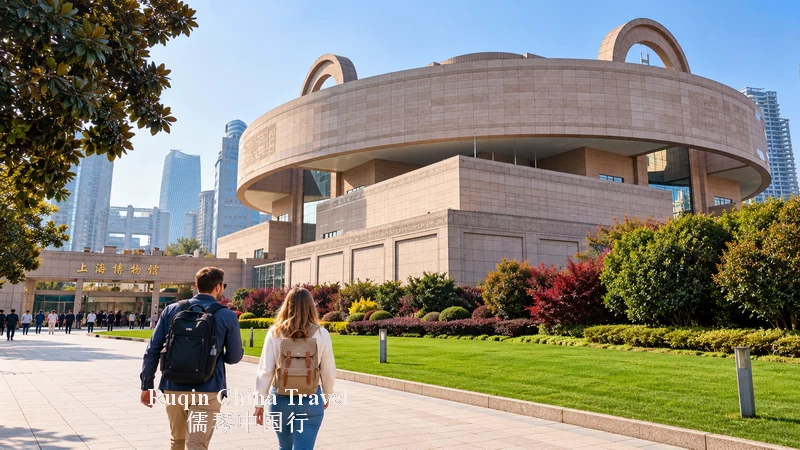
Shanghai Museum on People’s Square
The People’s Square building remains one of Shanghai’s recognizable cultural landmarks.
However, its current exhibition program is different from the traditional permanent-gallery experience described in older travel guides.
What Can You See Here?
From July 9, 2026, to November 14, 2027, the building is hosting On Top of the World Tree: Ancient Civilizations of the Americas (世界树之巅:美洲古代文明大展).
The exhibition occupies three floors and brings together nearly 3,000 artifacts from Mexico and Peru.
It introduces ancient civilizations including the Olmec, Maya, Aztec, and Inca, with objects illustrating religion, craftsmanship, daily life, and cultural traditions.
During this exhibition period, the People’s Square building does not display its usual Chinese art collections or other exhibitions.
If you are particularly interested in ancient American history, this is an excellent opportunity. However, if you have come to Shanghai to see Chinese bronzes and ceramics, I recommend visiting the East Building instead.
Opening Hours
Regular daytime opening hours are:
- Tuesday to Sunday: 9:00 AM–5:00 PM
- Last entry: 3:00 PM
- Closed Mondays, except national holidays
Special evening sessions may extend opening hours to 9:00 PM, with last entry at 7:00 PM. Check the museum’s announcements rather than assuming evening admission is available every day.
Tickets and Reservations
Unlike the regular free-admission arrangement that many travelers remember, the current Americas exhibition requires a paid ticket.
Published ticket categories include standard admission and concession tickets. Prices depend on the selected ticket type and session.
International visitors can purchase tickets through Trip.com. The museum also provides ticketing through its official WeChat mini program.
When booking, check the exhibition name, date, admission session, and visitor details carefully.
Bring your original passport or other accepted identity document used for the booking.
Which Entrance Should You Use?
Individual visitors enter through the South Gate on Wusheng Road (武胜路).
This is worth checking before arrival because the museum’s street address is on Renmin Avenue, while the public admission entrance is on the southern side.
4. How to Get to Shanghai Museum on People’s Square
The metro is usually the easiest choice.
Take Shanghai Metro Line 1, Line 2, or Line 8 to People’s Square Station (人民广场站).
Use Exit 1, then follow the pedestrian route toward Shanghai Museum. Allow approximately 10 minutes for walking and orientation, depending on your starting point inside the station.
People’s Square Station is large and can be busy. Follow the signs carefully rather than choosing an exit at random.
If you prefer a taxi or DiDi, show the driver:
上海博物馆人民广场馆 — 人民大道201号
You can also add 武胜路南门, meaning the South Gate on Wusheng Road.
The downtown location makes this museum easy to combine with People’s Square, Nanjing Road, or a visit to the Bund.
5. Shanghai Museum East: The Main Destination for Chinese Art
Shanghai Museum East (上海博物馆东馆)
Address: 1952 Century Avenue (世纪大道1952号), Pudong New Area.
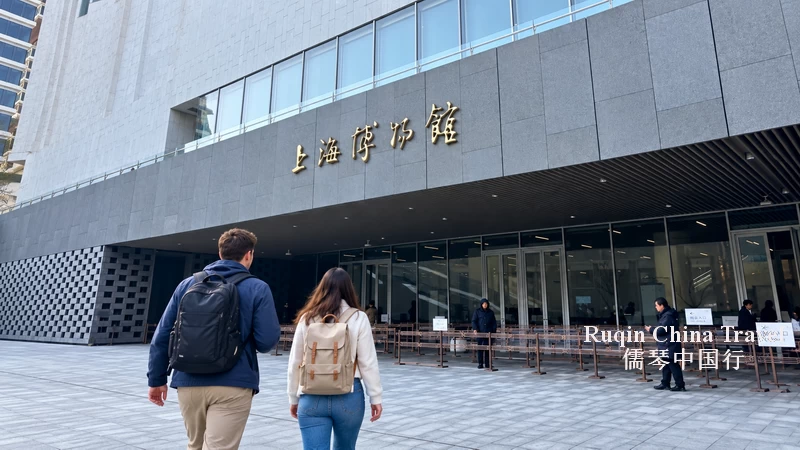
Shanghai Museum East
Shanghai Museum East is the building I recommend to most first-time international travelers interested in China’s artistic heritage.
It contains extensive permanent galleries, modern exhibition spaces, and special exhibitions.
The building is spacious, so you can explore the collections at a comfortable pace rather than moving quickly from one room to another.
Opening Hours
Regular opening hours are:
- Wednesday to Monday: 10:00 AM–6:00 PM
- Last entry: 5:00 PM
- Closed Tuesdays, except national holidays
Notice that the two museum buildings have different regular closing days.
If you are planning a museum visit on Monday or Tuesday, this distinction is especially important.
Admission and Reservations
General admission to Shanghai Museum East is free.
Individual visitors currently do not need an advance reservation for the main museum galleries.
Bring your original valid identity document, such as your passport, and complete the security check before entering.
Some special exhibitions and interactive areas, including the Digital Gallery and The Curio-City, may require separate reservations.
I recommend checking the museum’s official website before leaving your hotel, particularly during weekends and national holidays.
Finding the Correct Entrance
Individual visitors should use the B1 East Gate (地下一层东门) near Dingxiang Road (丁香路).
Reserved groups use a different entrance at the North Gate on the first floor.
This distinction can save unnecessary walking around the building.
6. How to Get to Shanghai Museum East
Take Shanghai Metro Line 2 to Shanghai Science & Technology Museum Station (上海科技馆站).
Use Exit 8 and follow the walking route toward Shanghai Museum East.
Allow around 10–15 minutes for the walk, depending on your pace and the entrance you use.
The museum is in Pudong, so it may take longer to reach from hotels around the Bund or People’s Square than the downtown museum.
However, Metro Line 2 provides a convenient connection across the city.
If you are traveling with older family members, young children, or heavy bags, a taxi or DiDi may be more comfortable.
Show the driver:
上海博物馆东馆 — 世纪大道1952号
For individual admission, you can also specify:
东门(地下一层,近丁香路)
This means the East Gate on basement level one, near Dingxiang Road.
7. Best Collections to See at Shanghai Museum East
The museum’s Chinese art collections cover several thousand years of history.
If you have only three or four hours, I recommend choosing a few galleries rather than trying to see everything.
Ancient Chinese Bronzes
The Ancient Chinese Bronze Gallery is one of the museum’s major highlights.

The ancient bronze ding vessel
Bronze vessels played important roles in ritual ceremonies during the Shang and Zhou dynasties.
Look for ding vessels, wine containers, and objects decorated with intricate animal motifs.
Some pieces are remarkable not only for their age but also for the complexity of their casting.
Ancient Chinese Ceramics
China’s ceramic traditions developed over many centuries, from early pottery to refined porcelain.
The ceramics galleries introduce different periods, kilns, and decorative techniques.
Look for the subtle glazes of Song dynasty ceramics, the colorful pottery of the Tang dynasty, and later blue-and-white porcelain.
If you are interested in Chinese craftsmanship, this is one of the most rewarding sections.
Chinese Painting and Calligraphy
Traditional Chinese painting often emphasizes landscapes, brushwork, and the relationship between people and nature.
Calligraphy is equally important in Chinese art.
Even if you cannot read Chinese characters, you can appreciate the movement, rhythm, and balance of the brushstrokes.
These galleries are particularly interesting for visitors who want to understand Chinese artistic ideas rather than simply admire individual objects.
Ancient Chinese Jade
Jade has been valued in China for thousands of years.
The collection includes ceremonial objects, ornaments, and beautifully carved pieces.
Some objects are small, so take your time looking at the details.
Buddhist Sculpture
The sculpture galleries include Buddhist figures and other works that reflect changing religious and artistic traditions.
Notice the differences in facial expressions, clothing, posture, and carving styles.
These details help explain how Buddhist art developed across different regions and dynasties.
Chinese Seals, Coins and Traditional Craftsmanship
The museum also displays seals, historical currency, and decorative arts.
Seals were used to indicate identity and authority, while coins reveal changes in trade and economic life.
You may also find exhibitions devoted to traditional craftsmanship, including the arts of the Jiangnan region.
Ming and Qing Furniture
Shanghai Museum is also known for its fine collection of traditional Chinese furniture.
Ming and Qing furniture is admired for its proportions, joinery, woodwork, and elegant design.
However, gallery locations can change. Check the current exhibition directory before visiting rather than assuming every collection is displayed at the East Building.
8. A Practical Three-to-Four-Hour Museum Route
Shanghai Museum East is large enough to occupy most of a day.
However, three to four hours can still provide a rewarding introduction.
Here is the route I suggest for first-time visitors.
First hour: Ancient bronzes and sculpture
Begin with two of the museum’s most important collections. Take your time with the major objects and read the English labels where available.
Second hour: Jade, painting and calligraphy
These galleries provide a different perspective on Chinese art, from ceremonial objects to brushwork and personal expression.
Third hour: Ceramics
Spend time exploring how Chinese pottery and porcelain changed across dynasties.
Final 30–60 minutes: Coins, seals or a special exhibition
Choose according to your interests and energy level.
You do not need to follow this order exactly. Gallery openings, temporary exhibitions, and visitor flow may affect the best route.
For families with children or senior travelers, I would reduce the number of galleries and include a rest break.
The goal is to enjoy the collections, not to finish every exhibition room.
9. Traveling Between the Two Shanghai Museum Buildings
If you want to visit both museums, Metro Line 2 is a practical choice.
From People’s Square Station, take an eastbound train toward Pudong.
Get off at Shanghai Science & Technology Museum Station and walk to Shanghai Museum East.
Allow approximately 30–45 minutes for the complete transfer, including walking and station navigation.
A taxi or DiDi is another option, although traffic across the Huangpu River can affect journey times.
I do not recommend walking between the two buildings. They are in separate parts of Shanghai.
If you want to visit both in one day, consider starting at the People’s Square building in the morning and continuing to the East Building afterward.
However, this arrangement can be tiring, especially if you want to explore the exhibitions properly.
For travelers with a strong interest in museums, visiting them on separate days is more comfortable.
10. Practical Tips for International Visitors
Choose the building before booking. The two museums have different exhibitions and admission rules. Always check the complete Chinese name.
Bring your original passport. Museums may require an original identity document for entry verification, even when general admission is free.
Check the closing day. People’s Square is normally closed Monday; Shanghai Museum East is normally closed Tuesday.
Avoid arriving near last entry. A large museum deserves more than a quick visit. I recommend arriving in the morning or early afternoon.
Allow extra time for security. Security checks are required, and queues may be longer during holidays.
Use the English information available. Look for English gallery labels and ask about audio guides or other interpretation services at the information desk.
Travel light. Large suitcases are inconvenient in museums. Check current storage facilities and luggage restrictions before arriving.
Follow photography signs. Photography rules may differ between permanent galleries and special exhibitions. Avoid flash where prohibited.
Bring a light layer. Museum interiors can feel cool because of air conditioning.
Check temporary exhibitions. Special exhibitions may be ticketed, require reservations, or temporarily affect access to certain galleries.
11. Attractions Near the Two Museums
Near the People’s Square Building
People’s Square (人民广场) is a convenient starting point for exploring central Shanghai.
After your museum visit, you can walk around the square and continue toward Nanjing Road (南京路), one of the city’s best-known shopping streets.
The Shanghai Urban Planning Exhibition Center and Shanghai Grand Theatre are also nearby.
If you still have time, continue toward the Bund (外滩) for views across the Huangpu River.
This combination works well for travelers who want a mix of culture, shopping, and city sightseeing.
Near Shanghai Museum East
Shanghai Museum East is in Pudong, where you can combine a museum visit with other attractions.
Century Park (世纪公园) is a good choice if you want some outdoor time after several hours indoors.
You can also continue by metro or taxi toward Lujiazui (陆家嘴), Shanghai’s modern financial district.
Here you will find the Oriental Pearl Tower, Shanghai Tower, and views of the city’s modern skyline.
For a relaxed day, I recommend visiting the museum first and leaving other attractions until later.
12. Frequently Asked Questions
Is Shanghai Museum free?
General admission to Shanghai Museum East is currently free for individual visitors.
However, the People’s Square building requires a paid ticket during the Ancient Civilizations of the Americas exhibition, scheduled through November 14, 2027.
Special exhibitions and interactive experiences may have separate rules.
Which Shanghai Museum is better for first-time visitors?
If you want to see traditional Chinese art, I recommend Shanghai Museum East.
If you are specifically interested in the current Americas exhibition, visit the People’s Square building.
Do I need to book Shanghai Museum in advance?
For Shanghai Museum East’s regular galleries, individual visitors currently do not need reservations.
For the ticketed Americas exhibition at People’s Square, advance ticket purchase is required.
Always check current arrangements before visiting.
How much time should I allow?
Allow at least three to four hours for Shanghai Museum East.
For the People’s Square exhibition, allow approximately two to three hours or more, depending on your interest.
Can I visit both buildings in one day?
Yes, but it can be a long day.
If you prefer a relaxed visit, I recommend choosing one building or visiting the two on separate days.
Is Shanghai Museum East suitable for senior travelers?
Yes, it is a modern museum with facilities designed for large numbers of visitors.
However, the building is spacious, and a full visit involves considerable walking and standing.
I recommend choosing a few galleries, taking regular breaks, and avoiding an overly ambitious schedule.
13. Ruqin’s Final Advice
Shanghai Museum remains one of the best places to learn about art and history in China.
However, the opening of Shanghai Museum East and the changing exhibition program at People’s Square have made advance planning more important.
For most international travelers interested in Chinese bronzes, ceramics, jade, painting, and calligraphy, Shanghai Museum East is now the better choice.
If you want to see the Ancient Civilizations of the Americas exhibition, choose the People’s Square building and arrange your ticket before visiting.
Use the location map to identify the correct building, save its Chinese name, and check the latest opening hours and admission arrangements.
A little preparation will help you spend more time enjoying the collections and less time finding your way around Shanghai.
You May Also Like
- Shanghai Travel Guide: Map, Itineraries, Top Attractions and Tips
- How to Visit Nanjing Road: Map, Shopping, Food, Hotels & Tips
- How to Visit the Bund in Shanghai
- Shanghai People’s Square: Metro, Attractions, Hotels & Travel Tips
Official visitor information: Shanghai Museum