

Written and updated by Ruqin
Last updated: May 22, 2026
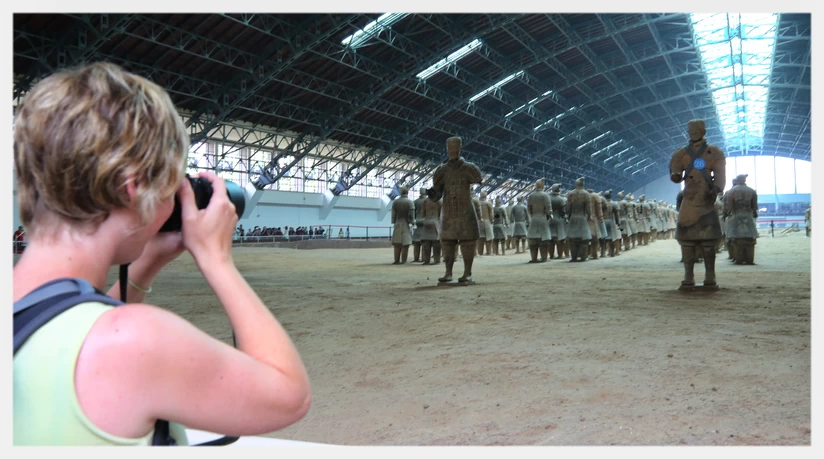
The first time I stood in front of the Terracotta Army, I didn’t expect the scale to hit me so quickly. You walk into what looks like a simple hangar—and then suddenly, rows of life-sized soldiers stretch out in silence. That moment stayed with me, and it’s exactly why I put together this “How to Visit the Terracotta Warriors” guide.
If you’re planning your trip to Xi’an, I’ll walk you through what actually matters—tickets, timing, and how to experience the Terracotta Army without feeling rushed or overwhelmed.
1. Why Visit the Terracotta Warriors
The first time I visited the Terracotta Army, I expected something impressive—but not something that would quietly stay with me for years. Standing above Pit 1, looking down at those endless rows, I realized this wasn’t just a historical site. It felt personal, almost like stepping into someone’s vision of eternity.
Back in 1974, local farmers digging a well uncovered what would become one of the most extraordinary archaeological finds of the 20th century. What they revealed was astonishing—thousands of life-sized warriors, horses, and chariots buried for over two thousand years. And even now, what surprises most people is this: no two faces are exactly the same.
Visiting here goes beyond ticking off a landmark—it’s about slowing down and really seeing what’s in front of you. Here’s why it’s worth your time:
Connect with History – From the 3rd century BCE, this site gives you a direct, almost tangible link to the beginnings of imperial China.
Admire the Detail – Up close, the craftsmanship stands out—the folds of armor, the expressions, even the hairstyles feel intentional.
Experience Ancient Culture – The entire army reflects beliefs about power, protection, and what comes after life.
Whether you come for the history or simple curiosity, the Terracotta Army tends to leave a deeper impression than most travelers expect.
2. Best Time to Visit Terracotta Warriors
The first time I visited the Terracotta Army, I went on a busy weekend without thinking much about timing—and I immediately noticed the difference. The pits were still incredible, but the crowds made it harder to slow down and really take it in. Since then, I’ve learned that when you go shapes the entire experience.
Spring (March to May) is one of the most comfortable times to visit. The weather feels easy, not too hot or cold, and the crowds are still manageable—ideal if you want space to move and time to pause inside the museum halls.
Autumn (September to November) is just as good, if not better. The air is clearer, the pace feels calmer, and it’s much easier to enjoy the Terracotta Army without being rushed along by tour groups.
The museum is open year-round and mostly indoors, but timing still matters. Try to avoid weekends and major holidays like Labor Day and National Day, when visitor numbers surge. A weekday morning visit usually feels much more relaxed.
Winter (December to February) is the quietest season. It does get cold, but if you dress well, you’ll likely have more space and a more personal experience with the site.
3. How to Get to Terracotta Warriors from Xi’an
The Terracotta Warriors are about 40 km (25 miles) northeast of downtown Xi’an. Luckily, getting there is easy—and there are a few routes to suit every type of traveler.
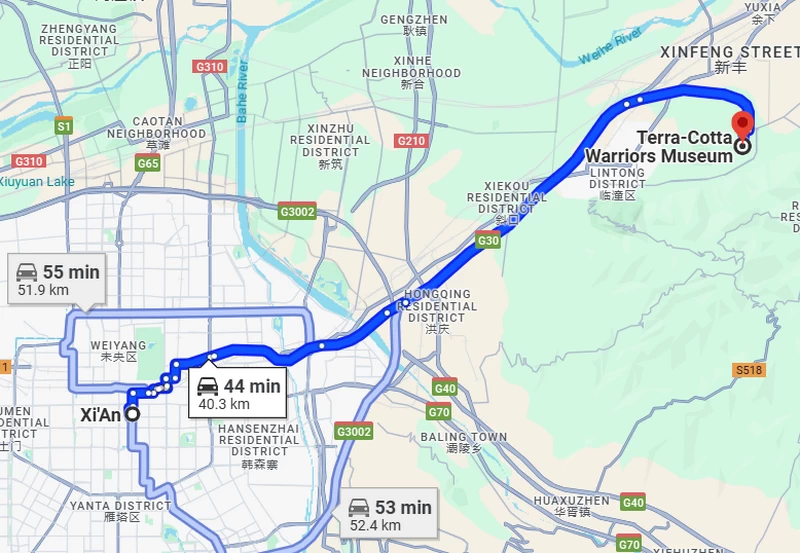
Here’s a quick breakdown of the best ways to reach the site:
1) Train + Taxi or Didi (≈50 minutes)
Take a local train from Xi’an Railway Station to Lintong Station (临潼火车站). It takes about 20 minutes and costs 5–10 yuan.
Once you arrive, grab a Didi or taxi straight to the museum. The ride takes 10 minutes and costs around 20 yuan.
2) Metro + Bus (≈1.5 hours)
From Zhonglou (Bell Tower) Metro Station, take Line 6, transfer to Line 9, and get off at Huaqingchi Station (华清池). Metro fare is 7 yuan.
Then, hop on Bus 602 or 613 to the Terracotta Warriors (25 minutes, 2–5 yuan). Bus 613 runs frequently.
3) Direct Tourist Bus (≈1 hour)
Buy your ticket online or at the departure points (30 yuan). Buses leave from:
- Vienna Hotel (Giant Wild Goose Pagoda branch) 维也纳大酒店大雁塔店
- Near Yisu Grand Theatre (near the Bell Tower) 钟楼附近
- Xi’an City Library (市图书馆)
- Sajin Bridge Metro Exit (洒金桥地铁口).
These buses take you straight to the museum—no transfers!
4) Taxi or Ride-Hailing Apps (≈1–1.5 hours)
Want to skip the hassle? Didi and regular taxis are great options. Expect to pay around 150 yuan, plus a 20 yuan toll.
For ultimate flexibility, hire a private car through your hotel or a local travel service. It’s ideal if you want to combine your visit with other sites like Huaqing Palace or Mount Li.
4. How Much Time Do You Need at the Terracotta Army?
Before diving into the museum, take a step back—how many days do you have in Xi’an? While the Terracotta Warriors are the city’s crown jewel, you’ll want time for other highlights like the Ancient Xi’an City Wall or Muslim Quarter. ⏳
Your visit length to the warriors depends on your pace and interest level. Here’s how to plan it right:
1) Suggested Visit Durations
- Quick Look (2 hours) – Perfect if you’re short on time. Focus on Pits 1 and 2, take some photos, and soak in the scale.
- Standard Visit (3–4 hours) – Ideal for most travelers. You’ll explore Pits 1, 2, and 3, plus have time for the indoor exhibitions.
- Deep Dive (Half day or more) – For history buffs who want to understand every detail—from the emperor’s legacy to the sculpting techniques.
2) Time by Pit (Approximate Guide)
- Pit 1 – The most iconic and largest. Spend about 1 hour here.
- Pit 2 – Smaller, but shows different army formations. 30 minutes is enough.
- Pit 3 – Believed to be the command center. Allot 20 minutes for a quick look.
- Exhibition Halls – Displays of weapons, restoration tools, and short films. Budget 30 minutes.
3) Touring Tips
- Morning visits tend to be quieter—arrive early to beat the crowds.
- Don’t rush Pit 1—it’s the wow moment of the entire complex.
- For a deeper experience, consider an English-speaking guide or audio guide on-site.
Give yourself time to absorb the scale, story, and artistry of this 2,000-year-old wonder. It’s not just a museum—it’s a portal into the heart of ancient China.
5. How to Buy Your Terracotta Warriors Tickets
The Terracotta Warriors Museum requires advance online ticket booking, either through their official website or WeChat account. Check opening hours and plan to arrive early for a leisurely visit.
Opening Hours and Entrance Fees
Ticket Selling Hours:
8:30 – 17:00 (March 16 – Nov 15)
8:30 – 16:30 (Nov 16 – March 15)
Opening Hours
8:30 – 18:00 (March 16 – Nov 15)
8:30 – 17:30 (Nov 16 – March 15)
Entrance Fees
RMB 120 ( all year round) /person
The ticket also includes the entrance to Qin Shihuang’ Mausoleum.
Note:
1) the Terracotta Warriors Museum is open all year round – 365 days every year! Children under the height of 1.2m are free of charge.
2) Don’t confuse the Terracotta Army Museum with Qin Shihuang’s Mausoleum. Your ticket includes entrance to both, but the mausoleum is less excavated, not much to see.
How to Book your Ticket to Terracotta Army
1) Book your ticket through the museum’s official Terracotta Army Ticketing Page.
2) Through the Viator ( Easiest for English users ):
👉 Book your Terracotta Army Admission Ticket – Optional Guide Service via Viator
3) Booking Phone Number: 029-81399127
Note: There is a cap for the number of visitors during holidays. But basically, you won’t have any problem buying your tickets if you avoid visiting the site during National Holiday (Oct 01 -07).
6. How to Visit Terracotta Warriors
While planning a Trip to Terracotta Army, you should know visiting the Terracotta Warriors can be overwhelming due to its size and popularity.
Firstly, arriving early helps you avoid the crowds and enjoy a more peaceful experience. The site opens at 8:30 AM, so aim to arrive by then.
Kindly Reminder:
It is a long walk from the main entrance to the three pits site! If you don’t have strong legs, you may pay small money to take an electric car from the museum to get there.
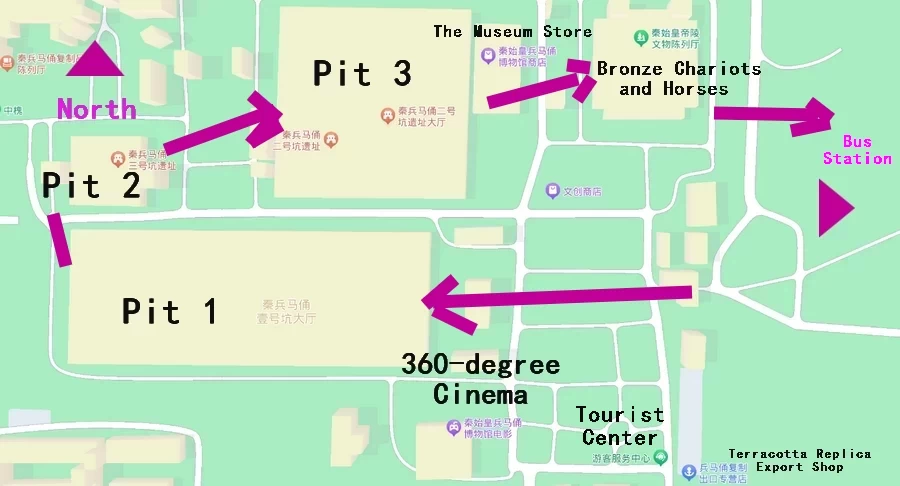
The Terracotta Warriors are divided into three pits. Start with Pit 1, which is the largest and the most impressive. Then move on to Pits 2 and 3, which have fewer crowds.
Start with Pit 1
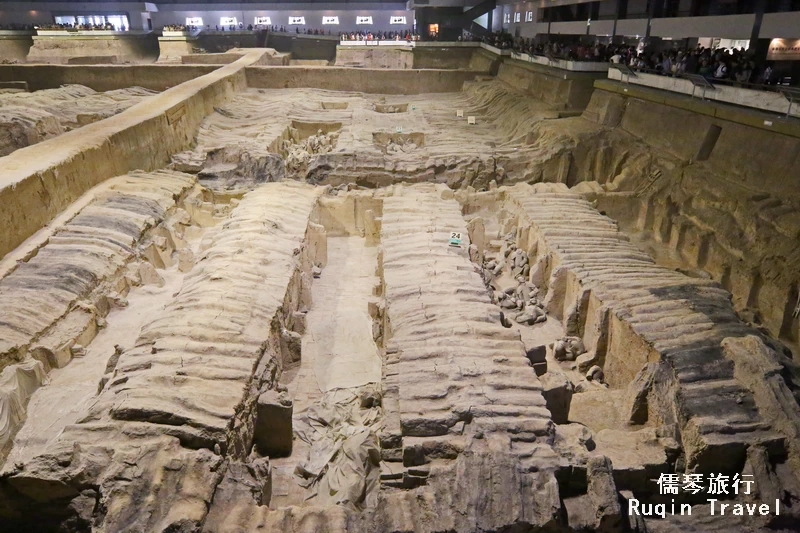
Most visitors begin their visit with Pit 1, the largest and most impressive pit. Once inside, you’ll see rows of life-sized terracotta soldiers, chariots, and horses.
Pit 1 is the largest and most impressive of the three pits at the Terracotta Warriors site. It houses over 6,000 life-sized soldiers, horses, and chariots arranged in battle formation.
Discovered first in 1974, it covers an area of 14,260 square meters. The warriors face east, ready to protect Emperor Qin Shi Huang in the afterlife.
Each figure is uniquely crafted with detailed expressions and armor. This pit provides a breathtaking view of the sheer scale and organization of the ancient army. Visitors can walk along raised walkways to get a closer look at the rows of warriors.
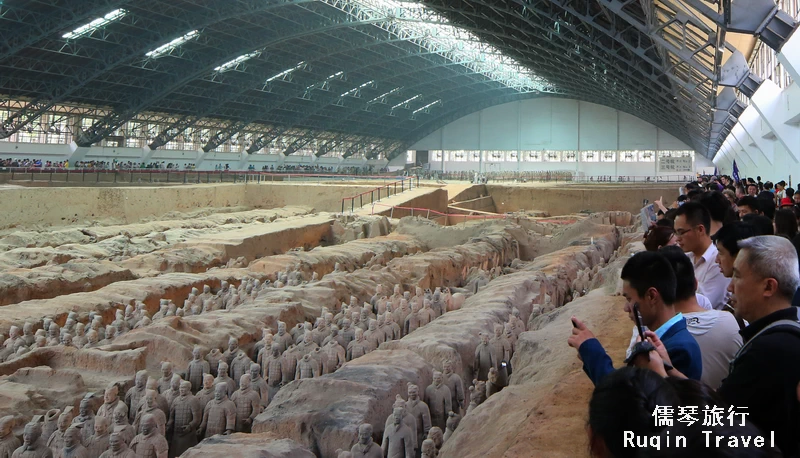
Pit 1 at the Terracotta Warriors
Proceed to Pit 2
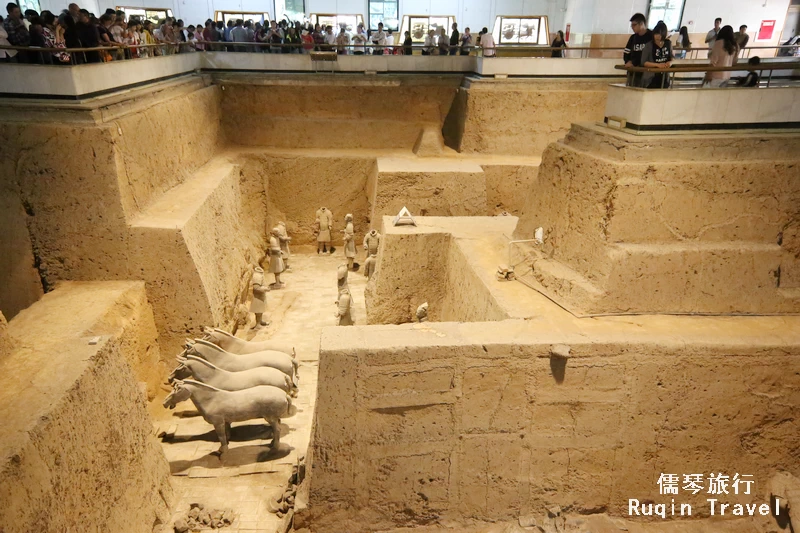
After exploring Pit 1, proceed to Pit 2. Pit 2 is smaller but equally fascinating. It contains a variety of military units, including archers, cavalry, and infantry.
This pit offers a more diverse display of the Qin army’s different tactical formations. Covering about 6,000 square meters, Pit 2 was discovered in 1976. The figures in this pit are more intricately arranged, showcasing the strategic and combat skills of the ancient army.
Visitors can see figures in action poses, holding weapons, and preparing for battle. This pit also features some of the best-preserved artifacts, including bronze weapons and tools.
Pit 2 at Terracotta Army
Pit 3
Pit 3 is the smallest and serves as the command center of the Terracotta Army. Covering an area of 520 square meters, it was discovered in 1976.
This pit contains high-ranking officers and war chariots. Unlike the other pits, Pit 3 has fewer figures, with only about 68 warriors. However, it holds great significance due to its strategic role.
The arrangement suggests it was used for military planning and command. Visitors can observe the detailed features of the officers, their uniforms, and their unique positions. Pit 3 provides insight into the hierarchical structure and command system of the ancient army.
Pit 3 at the Terracotta Warriors
The Average Height of the Terracotta Warriors
The average height of the Terracotta Warriors is about 1.8 meters (5.9 feet). However, the heights vary slightly to reflect the rank and role of each figure. Higher-ranking officers are generally taller than the soldiers, adding to the realism of the army.
Visit the Exhibition Halls (Bronze Chariots and Horses)
In addition to the three main pits, the Terracotta Army Museum features several exhibition halls. These halls house various artifacts, including bronze weapons, ancient pottery, and other archaeological discoveries. Take your time to explore these halls and learn more about the history and significance of the site.
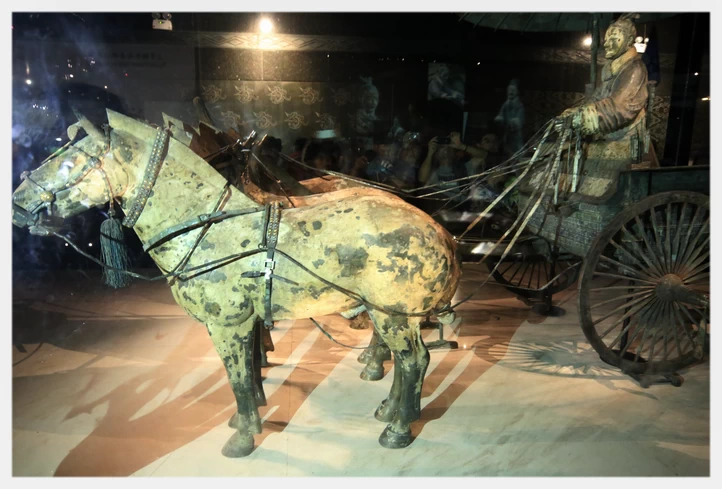
The Bronze Horse and Chariots at the Museum
The most important is that there are two world-famous bronze chariots and horses whose sizes are about a half of that of real chariots and horses. So the official name of the museum is called Terracotta Warriors and Horses Museum.
A 360-degree cinema
The site offers additional attractions and activities, such as a 360-degree cinema that presents the history and discovery of the Terracotta Warriors.
The movie -360 degrees, the background film, is in English and very cool, which takes about 15 minutes long. It gives some background to what you see with your own eyes.
Guided Tours and Audio Guides
Guided tours and audio guides are available at the Terracotta Warriors site. They provide detailed information about the history, significance, and unique features of the site.
Opting for a guided tour can enhance your understanding and appreciation of this incredible archaeological wonder.
Shopping for Souvenirs
There are several souvenir shops at the Terracotta Warriors Museum. Popular items include miniature terracotta figures, books, postcards, and traditional Chinese crafts. Make sure to buy from reputable shops to ensure the quality and authenticity of the items.
Preservation Efforts
You will see the Terracotta Warriors preserving efforts is still going on. Exposure to air and light can cause deterioration. Therefore, significant efforts are made to protect and conserve these ancient artifacts. Advanced technologies are used to stabilize the figures and prevent further damage.
7. Wheelchair users Visiting the Terracotta Warriors
Wheelchair users visiting the Terracotta Warriors will find several facilities to ensure an accessible and comfortable experience. The Museum of the Terracotta Warriors and Horses of Qin Shi Huang offers free wheelchair rentals at the Tourist Service Center.
Additionally, the site features multiple accessible restrooms and ramps for easy navigation. Volunteers are available periodically for assistance, and staff at the service center can provide further support and information.
The museum’s layout is designed to accommodate wheelchair users, allowing them to explore the pits and exhibition halls with ease.
8. Service Facilities at the Museum
Good news—your visit to the Terracotta Warriors won’t just be fascinating, it’ll be comfortable, too. Whether you’re traveling with kids, carrying luggage, or just need a quiet bench to catch your breath, the museum has you covered. Here’s a quick guide to the essential facilities on-site:
1) Parking at the Terracotta Army
Driving to the site? There’s a large Terracotta Warriors Parking Lot near Qinling North Road in Lintong District.
- Price: 20 RMB per entry
- Capacity: Around 500 spaces—ample for most days
2) Mobile Charging & Power Outlets
Out of battery? Head to the the Terracotta Warriors Tourist Service Center, where you’ll find convenient charging stations. It’s a great place to power up while you plan your next move.
2) Luggage Storage
Don’t want to drag your bags around the pits? No problem. There’s a luggage storage point just east of the ticketing center. Prices vary, so ask the on-site staff for details.
3) Tour Guide Services
Want a deeper understanding of what you’re seeing? At the the Terracotta Army Tourist Center, you can rent an electronic guide or book a professional interpreter.
- Languages: Chinese, English, Japanese
- Bonus: Volunteers often offer free help, and there’s a free public announcement system.
4) Stroller & Wheelchair Rental
Traveling with little ones or someone who needs a bit more support? Strollers and wheelchairs are available for free at the Terracotta Warriors Tourist Service Center. No booking needed—just ask!
5) Restrooms at the Terracotta Warriors Museum
Clean, clearly marked restrooms are located throughout the museum.
In total: 5 restrooms inside the museum + 5 more in nearby Lishan Garden.
Follow the signs or ask a staff member if needed.
6) Smoking Areas
Smoking is not allowed inside the exhibition halls—but there are designated smoking areas dotted around the scenic zone.
7) ATM Access at the Terracotta Army
Need cash? There’s an ATM just to the right of the main entrance, near the Tourist Service Center.
8) Dining Options at the Terracotta Warriors
You’ll find cafés and quick bites inside the scenic area. That said, options are limited and prices are on the higher side.
Pro Tip: Bring light snacks or sandwiches—but avoid anything smelly (out of respect for fellow visitors).
9) Drinking Water
Bring an empty bottle! There are free drinking water stations inside where you can refill as needed.
10) Vending Machines & Convenience Stores
Craving a cold drink or snack? Vending machines and a few small convenience stores are located near the entrance and inside the the Terracotta Warriors area.
11) Rest Areas
Feeling tired? Take a break on one of the many benches between the exhibition halls at the the Terracotta Warriors. A larger, shaded rest area is also available near the main entrance.
The Terracotta Warriors experience isn’t just about ancient history—it’s designed with modern traveler comfort in mind. Enjoy your visit knowing the essentials are all within reach!
Frequently Asked Questions
Q: How many Terracotta Warriors are there?
A: Archaeologists estimate there are over 8,000 life-sized Terracotta Warriors, along with hundreds of chariots and horses. Most are still buried, but thousands have been excavated and are on display in Pit 1, the largest and most impressive hall. Each warrior is unique, with distinct facial features, hairstyles, and uniforms—a true marvel of ancient craftsmanship!
Q: Can I buy Terracotta Warriors tickets on arrival?
A: You can, especially in off-season, but there’s a daily limit of 65,000 tickets and a cap of 13,700 visitors at a time. So buying online ahead of time is strongly recommended to avoid sold-out afternoons.
Q: Do I need a Terracotta Army paper ticket or is passport scan enough?
A: Foreign visitors may need to exchange their online reservation (with passport) for a paper ticket at the ticket office before entering.
Q: When is the best time to visit Terracotta Warriors to avoid crowds?
A: Visit on a weekday, especially early morning before 10:00 AM or around lunchtime when groups break. Avoid Chinese public holidays like Labour Day, Golden Week, and National Day when crowds peak. The best months are March to May and September to early November for pleasant weather and manageable crowds.
Q: How long should I allocate at the Terracotta Warriors?
A:2–2.5 hours for a standard visit
3 hours if using a guided tour or audio guide
For full experience, including mausoleum and walking time, budget up to 5–6 hours including transport.
Q: Are there language support tools onsite?
A: English signage is limited at the Terracotta Army. You can hire a guide (~¥150) or rent an English audio guide (~¥40) to understand exhibits better.
Q: Can I take photos or use a tripod in the exhibition hall at Terracotta Warriors?
A: Photography is allowed without flash, but tripods are prohibited. Climbing into pits for selfies is strictly forbidden, and guard rails are always enforced.
Q: Is the site wheelchair‑friendly?
A: Yes—the Terracotta Warriors Museum pathways are mostly flat. Wheelchairs are available for rent onsite. Facilities include ramps and accessible restrooms. For best service, inform the museum or your tour provider in advance.
Q: What should I wear and bring at the Terracotta Warriors?
A: It’s a large outdoor/indoor site—wear comfortable walking shoes, bring a hat, sunscreen or light jacket depending on the season. Summer can be hot and cold-season mornings chilly.
Q: Can I combine the Terracotta Army visit with other nearby attractions?
A: Absolutely! Consider adding Huaqing Pool, Lishan Garden, or the Mausoleum park on the same day using the free shuttle. For more historic context or a broader itinerary, you might stay multiple days in Xi’an.
Q: Is it worth hiring a guide or audio guide?
A: Definitely. A local guide or audio guide at the Terracotta Army brings the story of Emperor Qin, the artistry, and archaeological background to life—far more enriching than touring solo.
By the time I leave the museum, I always find myself turning back for one last look. There’s something about the silence of those rows that stays with you. That’s really what “How to Visit the Terracotta Warriors” comes down to—not just logistics, but giving yourself the space to feel the place.
Arrive early, go on a weekday if you can, and don’t rush through Pit 1. Wear comfortable shoes, bring water, and move at your own pace. The Terracotta Army isn’t something to check off—it’s something to take in slowly, and remember long after you leave Xi’an.
About the Author
Ruqin is the founder of Ruqintravel.com and has spent more than four decades working in China’s travel industry. Drawing on hands-on experience in cities like Beijing and Hangzhou, he personally researches and updates each guide to help international travelers navigate China with confidence.
Further Reading
Best Time to Visit Xi’an: Weather, Sights, Festivals & Tips
Where to Stay in Xi’an: Areas, Hotels, Maps and Attractions
How to Use the Xi’an Subway: A Guide for First-Time Travelers
What to Buy in Xi’an: Best Gifts from Xi’an
How to Visit the Terracotta Warriors: Tickets, Map, Highlights & Tips
Bell & Drum Towers, Xi’an: What to See, Tickets & Travel Tips
How to Visit Shaanxi History Museum – A Complete Guide
How to Visit Huaqing Pool in Xi’an: Map, Tickets, Show and Tips
How to Visit Big Wild Goose Pagoda in Xi’an: A Complete Guide
How to Visit Xi’an City Wall: Map, Tickets, South Gate & Travel Tips
How to Visit Muslim Quarter Xi’an: Map, Top Foods and Travel Tips
How to Visit Great Mosque of Xi’an: Map, Hours, Tour & Travel Tips





















Thanks for this very comprensive guide.
If we are visiting on a Saturday Mid-End August, is it better to arrive after 1300hrs to avoid crowds or is still advise to arrive in the morning?
Also if we visit in the afternoon, how about we start with the Museum > Pit-2 > Pit-3 and End with the Pit-1 ?
Dear DC,
Thank you for your message, and I’m glad you found the guide helpful!
Regarding your visit to the Terracotta Warriors on a Saturday in mid to late August, we generally recommend arriving as early as possible in the morning. This is particularly important during the summer vacation period, when many domestic tourists—especially families with children—flock to the site. Early arrival helps you beat the peak crowds that tend to build up as the day progresses.
That said, visiting after 13:00 is still a feasible option. If you choose to go in the afternoon, your suggested route—starting with the Museum, then Pit 2, Pit 3, and ending with Pit 1—is a smart way to avoid the biggest crowds, since Pit 1 is the most popular and often the busiest.
Just keep in mind that Saturdays are usually quite busy overall, so it’s best to be prepared for some level of crowding no matter what time you go.
Wishing you a wonderful experience at the Terracotta Warriors!
Warm regards,
Ruqin China Travel