
Written and updated by Ruqin
Last updated: July 14, 2026
Planning your first trip to China? How exciting! China is a fascinating destination—rich in history, incredibly diverse, and full of unforgettable experiences. But for many first-time visitors, the biggest surprises are not the famous landmarks or the food—it’s the little practical things that can catch you off guard.
To help you travel with more confidence, here are 10 common mistakes first-time travelers make in China—and how to avoid them.
1. Not Booking Major Attractions in Advance
Many travelers assume they can simply buy tickets at the entrance. In China, that’s not always the case.
Popular attractions such as Tiananmen Square, museums, and some historical sites often require advance booking, especially during weekends and holidays.
A useful exception is the Forbidden City in Beijing. International visitors can often purchase tickets on-site using their passport, so advance booking is usually not necessary. Still, arriving early is always a good idea.
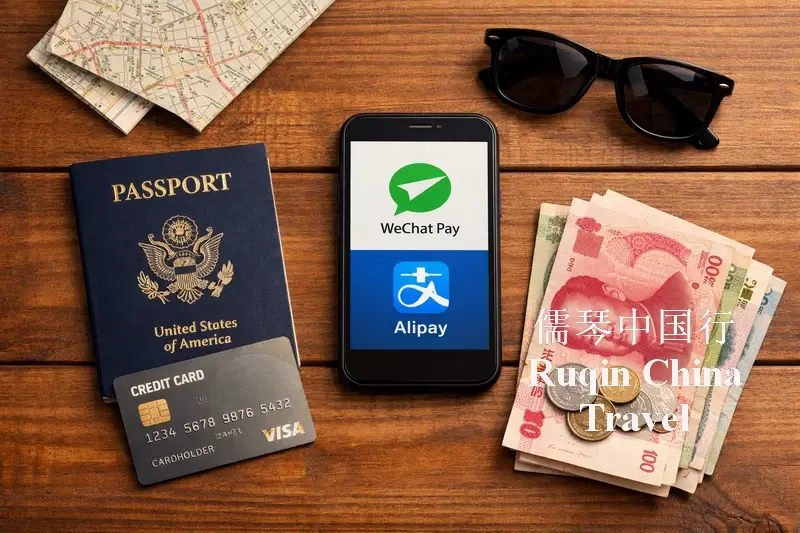
2. Arriving Without Setting Up Alipay or WeChat Pay
China is one of the most mobile-payment-based countries in the world.
You’ll notice very quickly that almost everything—from restaurants and taxis to small street vendors—uses QR code payment.
Before your trip, I strongly recommend setting up:
- Alipay
- WeChat Pay
Both now work with many international bank cards.
Cash is still accepted legally in China, but in daily travel it’s much easier to pay by phone. If you prefer carrying cash, bring small bills such as ¥10 or ¥20 for convenience.
3. Taking Unofficial Taxis at Airports or Train Stations
After arriving at an airport or railway station, you may be approached by drivers offering a ride. My advice is simple: politely decline.
Instead, use the official taxi queue or book a ride through DiDi. It is safer, usually cheaper, and much easier.
DiDi works very much like Uber and is widely used throughout China.
4. Waiting Until the Last Minute to Buy High-Speed Train Tickets
China’s high-speed trains are fast, comfortable, and one of the best ways to travel between cities.
But tickets can sell out quickly—especially on weekends, public holidays, and popular routes such as Beijing–Xi’an or Shanghai–Hangzhou.
Whenever possible, book your train tickets 3 to 7 days in advance. During Chinese holidays, even earlier is better. Booking your train tickets through trip.com or 12306.cn/en.
5. Only Saving Your Hotel Name in English
This is a small detail—but an important one.
Before leaving your hotel each day, save the hotel name and address in Chinese characters on your phone.
Many taxi drivers may not recognize the English hotel name, even for international brands. But once they see the Chinese address, everything becomes easy.
A screenshot can save a lot of confusion later.
6. Leaving Your Passport at the Hotel
In many countries travelers lock their passport in the hotel safe. In China, it’s often better to carry it with you.
Your passport may be needed for:
- entering major attractions
- boarding high-speed trains
- identity verification
- hotel check-in
- shopping tax refund paperwork
Your passport often acts as both your ID and your travel ticket while traveling around China.
7. Forgetting to Carry Tissues or Toilet Paper
This is one of the most practical China travel tips.
Many public restrooms in China do not provide toilet paper. Some also do not have paper towels.
I always recommend carrying:
- pocket tissues
- wet wipes
- hand sanitizer
You’ll be glad you packed them.
8. Not Preparing Your eSIM Before Arrival
Having internet access immediately after landing makes travel in China much easier.
You’ll likely need your phone right away for:
- maps
- ride-hailing
- translation
- messaging
- payments
Installing an eSIM before departure is one of the easiest ways to stay connected from the moment you arrive. Suggesting that you just purchase an eSM from trip.com.
9. Forgetting to Download a VPN Before Entering China
If you regularly use Google, Gmail, Instagram, WhatsApp, Facebook, or YouTube, this is important.
Some international websites and apps are not always easily accessible in mainland China.
If you plan to use these services, download and set up your VPN before arriving in China, not after. Suggest downloading ZoogVPN.
It’s much easier to prepare it before departure.
10. Downloading Too Many Apps
Many first-time visitors download several separate apps before arriving—and later realize they only use one or two.
To keep things simple, I recommend using the DiDi mini-app inside Alipay or WeChat instead of installing the standalone DiDi app.
That way your payment and transport are all in one place.
Less hassle, fewer apps, smoother travel.
Your first trip to China will likely feel different from traveling elsewhere—and that’s part of the adventure.
A little preparation before you arrive can make your trip far smoother and more enjoyable. Once your payments are set up, your train tickets are booked, and your phone is ready to go, traveling around China becomes surprisingly easy.
China is modern, fast-moving, welcoming, and endlessly rewarding to explore.
I hope these tips help you avoid a few common travel mistakes—and enjoy every moment of your first China journey.
Have a wonderful trip, and welcome to China!
— Ruqin China Travel
About the Author
Ruqin is the founder of Ruqintravel.com and has spent more than four decades working in China’s travel industry. Drawing on hands-on experience in cities like Beijing and Hangzhou, he personally researches and updates each guide to help international travelers navigate China with confidence.
Further Reading
10 Common Mistakes to Avoid on Your First Trip to Beijing
7 Common Mistakes to Avoid on Your First Trip to Shanghai
9 Common Mistakes to Avoid on Your First Trip to Xi’an
How to Access the Internet in China: VPNs, SIMs, Wi-Fi & Firewall
Essential Mandarin Phrases for Travelers in China
How to Use Alipay or WeChat Pay in China: A Travel Guide
Chinese Laws and Regulations: A Foreigner’s Guide
How to Spot Fake Chinese Money: Simple Tips for Tourists