
Written by Ruqin
August 02, 2026
You are walking around Beijing. Suddenly, you feel unwell.
Maybe you have a high fever.
Maybe your stomach hurts badly.
Maybe you have difficulty breathing after several days of pollution or dusty weather.
At that moment, many foreign visitors start to worry.
Can I see a doctor in Beijing?
Will the doctor speak English?
Which hospital accepts foreign patients?
Do I need a Chinese friend to help me?
These questions are common. I have heard them many times from international travelers visiting China.
The good news is that Beijing has a modern healthcare system. Many hospitals and international clinics regularly treat foreign visitors. Doctors here handle everything from simple illnesses to complex medical conditions.
However, choosing the right place matters.
A public hospital may offer excellent doctors and advanced treatment. Meanwhile, an international clinic may provide smoother English communication and a more familiar experience.
Therefore, before you travel to Beijing, it helps to understand your options.
In this How to See a Doctor in Beijing guide, I will show you how foreign visitors can find medical help in Beijing, choose the right hospital, use local appointment systems, and prepare for unexpected health problems during their trip.
1. Understanding Healthcare System in Beijing
When foreign visitors need medical help in Beijing, they usually have two main choices:
Public hospitals and international clinics or private hospitals.
Both options can treat foreigners. However, they offer very different experiences.
The right choice depends on your situation, your budget, and how much English support you need.
Option 1: Public Hospitals (公立医院)
Public hospitals are the first choice for many serious medical problems.
They handle:
- Major illnesses
- Specialist consultations
- Complex medical conditions
- Emergency treatment
Beijing has some of the best public hospitals in China.
For example, Peking Union Medical College Hospital (北京协和医院) is famous for difficult cases and specialist care. Many patients from across China come here for diagnosis and treatment.
China-Japan Friendship Hospital (中日友好医院) also has strong medical departments and years of experience treating international patients.
For families traveling with children, Beijing Children’s Hospital (北京儿童医院) is one of the leading choices.
The biggest advantage of public hospitals is their medical quality.
You will find:
- Experienced doctors
- Advanced medical equipment
- Complete specialist departments
- Much lower costs compared with international hospitals
However, public hospitals also have some challenges.
First, they can be crowded.
Many local residents visit these hospitals every day. Therefore, waiting times can be long, especially at famous hospitals.
Second, the registration process may feel unfamiliar.
Chinese hospitals usually require real-name registration. You need to provide your passport information before seeing a doctor.
Meanwhile, English service is not always available in every department.
Some doctors speak English. However, many nurses and registration staff may communicate mainly in Chinese.
Therefore, if you choose a public hospital, prepare your documents carefully. A translation app or a Chinese-speaking friend can also make the process much easier.
Option 2: International Clinics and Private Hospitals
For many foreign travelers, international clinics provide a smoother experience.
They are especially suitable if you want:
- English-speaking doctors and staff
- Faster appointments
- A more familiar medical environment
- Help with international insurance
Beijing has several international medical providers.
Beijing United Family Hospital (北京和睦家医院) is one of the most popular choices among expatriates and international visitors.
Raffles Hospital Beijing also provides international medical services with English support.
The biggest advantage is convenience.
You can usually:
- Book appointments online
- Communicate in English
- Receive clearer explanations
- Arrange insurance payments more easily
Some international hospitals can also work directly with international insurance companies. This can save time when you need treatment.
However, convenience comes at a higher price.
International hospitals usually charge much more than public hospitals.
For a simple consultation, the cost may be acceptable for many travelers. However, for long-term treatment or major medical procedures, expenses can increase quickly.
Which One Should You Choose?
In general:
If you have a serious medical problem or need a specialist, a top public hospital may be the better choice.
If you need English communication, quick service, or insurance assistance, an international clinic may be more comfortable.
Meanwhile, for emergencies, do not spend too much time comparing options.
Go to the nearest hospital emergency department (急诊 jí zhěn) or call 120 for ambulance service.
The most important thing is to get the right help at the right time.
3. Best Hospitals in Beijing for Foreign Visitors
Beijing has hundreds of hospitals.
However, not every hospital is convenient for foreign visitors.
Some hospitals have excellent doctors but limited English support. Others provide international services but charge higher fees.
Therefore, choosing the right hospital can save you time and stress.
Below are some of the hospitals that are more suitable for international travelers.
1) Peking Union Medical College Hospital (北京协和医院)
If you have a serious or complicated medical problem, Peking Union Medical College Hospital is often one of the first names people recommend.
It is one of China’s most respected hospitals.
Many patients visit here for:
- Complex diseases
- Specialist consultations
- Difficult diagnoses
- Serious medical conditions
The hospital has strong specialist departments. Doctors here handle many challenging cases from across China.
For example, if a patient needs a second opinion for an unclear diagnosis, this hospital is often considered a top choice.
However, foreign visitors should know a few things before going.
First, registration can be challenging.
The hospital is very popular. Many local patients also come here, so appointments can fill quickly.
Second, English service varies by department.
Some doctors and staff can communicate in English. However, you should not expect every counter and department to provide fluent English service.
Therefore, prepare your passport, medical information, and translation tools before your visit.
2) China-Japan Friendship Hospital (中日友好医院)
China-Japan Friendship Hospital is another good choice for foreign visitors.
The hospital has many years of experience treating international patients.
It is especially known for:
- Respiratory problems
- Specialist treatment
- International medical services
This can be helpful for travelers who develop breathing problems after spending several days in Beijing.
For example, some visitors may experience throat irritation, coughing, or breathing discomfort because of dry weather, dust, or air pollution.
The hospital also has a convenient location in northeastern Beijing.
Meanwhile, compared with some smaller hospitals, it is easier for foreign visitors to find departments that understand international patients.
3) Beijing United Family Hospital (北京和睦家医院)
For many foreign travelers and expatriates, Beijing United Family Hospital is one of the most familiar medical choices.
Unlike large public hospitals, it focuses more on international healthcare services.
It is especially suitable for:
- English-speaking medical care
- Families traveling with children
- Travelers using international insurance
The biggest advantage is communication.
You can usually explain your symptoms in English. Doctors and staff can also explain treatment options more clearly.
In addition, the hospital provides a more familiar experience for international visitors.
You can make appointments more easily. The environment feels closer to private hospitals in many Western countries.
However, the cost is usually much higher than public hospitals.
Therefore, many travelers use it for convenience, especially when language is a concern.
4) Raffles Hospital Beijing
Raffles Hospital Beijing is another international healthcare option in the city.
It is designed for patients who prefer private medical services.
It is a good choice for:
- Foreign travelers
- English communication
- International healthcare experience
The hospital provides medical services with an international approach.
For visitors who feel nervous about navigating a Chinese public hospital, this type of clinic can make the process much easier.
You can usually:
- Book appointments in advance
- Communicate in English
- Receive clearer instructions
- Discuss insurance arrangements
Again, the main trade-off is cost.
Private international hospitals offer convenience and comfort, but they usually charge more.
My Advice for Foreign Visitors
If you need a doctor in Beijing, do not choose a hospital only because it looks famous.
Think about your situation.
For a complicated illness or specialist treatment, choose a top public hospital such as Peking Union Medical College Hospital.
For respiratory problems or international medical support, China-Japan Friendship Hospital can be a good option.
For English communication and a smoother experience, choose Beijing United Family Hospital or Raffles Hospital Beijing.
The most important thing is simple:
Choose the hospital that matches your needs.
4. How to Make an Appointment at a Public Hospital
Visiting a public hospital in Beijing may feel unfamiliar at first.
In many countries, you simply walk into a clinic, explain your symptoms, and wait for a doctor.
However, most large hospitals in Beijing use a registration system.
You usually need to make an appointment before seeing a doctor.
For foreign visitors, the easiest way is to use the Jingtong Mini Program (京通小程序) through WeChat or Alipay.
Method 1: Use the Jingtong Mini Program (京通小程序)
The process is quite simple.
First, open WeChat or Alipay on your phone.
Then:
- Search for “Jingtong” (京通)
- Open the mini program
- Tap “En” to switch to English
- Select “Hospital Appointment”
- Choose your hospital
- Select the department you need
- Register with your passport information
- Choose an available appointment time
After confirmation, keep your appointment information on your phone.
You may need to show it when you arrive at the hospital.
Choose the Right Department
This step can confuse first-time visitors.
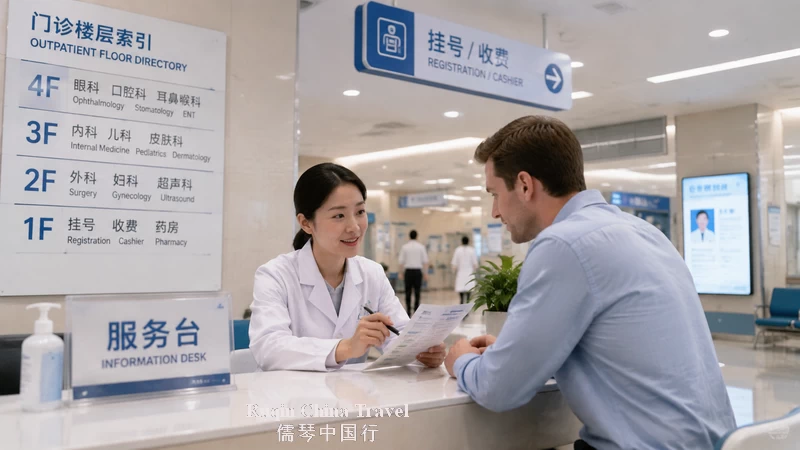
Chinese hospitals usually divide medical services into many departments.
For example:
- Fever, cough, or breathing problems → Respiratory Department (呼吸科)
- Stomach problems → Gastroenterology Department (消化科)
- Skin problems → Dermatology Department (皮肤科)
- Children’s illnesses → Pediatrics Department (儿科)
If you are not sure, you can choose the general outpatient department or ask hospital staff for help.
Meanwhile, a translation app can make communication much easier.
What to Bring to the Hospital
Before leaving your hotel, prepare your documents.
Always bring:
✓ Passport
✓ Visa information
✓ Travel insurance information
✓ Previous medical records (if available)
✓ A list of medicines you are taking
Your passport is especially important.
Chinese hospitals use real-name registration. Therefore, your identity information must match your medical record.
If you have previous test results or medical reports, bring them too.
They can help doctors understand your situation faster.
Arrival Tips: Give Yourself Extra Time
Do not arrive at the last minute.
Public hospitals in Beijing can be busy, especially famous hospitals like Peking Union Medical College Hospital.
It is better to arrive early.
After you arrive, you may need to:
- Confirm your registration
- Pay the consultation fee
- Find the correct building and department
- Wait for your number to be called
Most hospitals use an electronic queue system.
You do not need to stand in line all the time.
Instead, watch the screen and wait for your number.
A Few Practical Tips from My Experience
First, save your hospital information before you arrive.
Large hospitals in Beijing can have several buildings. Finding the right department may take time.
Second, keep your phone charged.
You may need your phone for:
- Appointment information
- Translation apps
- Mobile payment
Finally, do not worry if the process feels different from your home country.
Once you understand the basic steps, visiting a public hospital in Beijing becomes much easier.
The key is simple:
Prepare your documents, arrive early, and choose the right department.
5. Health Insurance for China Trips
Before traveling to Beijing, many visitors ask the same question:
Do I really need travel insurance?
My answer is simple:
Yes, you should have it.
China’s medical costs are generally reasonable compared with many Western countries.
A normal doctor visit may not cost much. Many medicines are also affordable.
However, unexpected situations can become expensive.
For example:
- Emergency treatment
- Hospital stays
- Surgery
- Medical evacuation
These costs can increase quickly.
A serious accident or illness can also affect your travel plans. Therefore, good travel insurance gives you extra protection and peace of mind.
Check Your Insurance Before You Travel
Do not wait until you need medical help.
Before leaving for China, check your insurance policy carefully.
Make sure it covers:
✓ Mainland China
Some travel insurance plans only cover certain regions.
✓ Hospital treatment
Check whether doctor visits, tests, medicine, and hospital stays are included.
✓ Emergency evacuation
This is especially important for serious medical conditions that require transportation to another location.
✓ Direct billing
Some insurance companies can communicate directly with hospitals. This means you may not need to pay the full amount first and request reimbursement later.
Keep Your Insurance Information Handy
When you are traveling, keep your insurance details easy to find.
I recommend saving:
✓ Insurance policy number
✓ Emergency contact phone number
✓ Digital copy of your insurance documents
You can store them:
- On your phone
- In your email
- In cloud storage
Also, keep a paper copy if possible.
If an emergency happens, you may not have time to search through your luggage.
A Practical Tip for Foreign Visitors
Many international hospitals in Beijing are familiar with overseas insurance.
However, public hospitals usually follow local payment procedures.
Therefore, always understand how your insurance works before you arrive.
If you choose an international clinic, ask whether they can provide direct billing.
If you visit a public hospital, keep all receipts and medical documents. You may need them later for reimbursement.
A little preparation before your trip can save you a lot of trouble.
Medical problems are never part of a perfect holiday plan.
However, with proper insurance and preparation, you can handle unexpected situations with much more confidence.
6. Common Health Problems for Visitors in Beijing
Beijing is an exciting city to explore.
However, the city environment may feel different from what you are used to.
The weather changes quickly. The air can become dry. The food can be unfamiliar. Summers can also become extremely hot.
Most visitors enjoy their trip without major health problems.
Still, knowing the common issues can help you prepare better.
1) Air Pollution and Respiratory Problems
Beijing’s air quality has improved significantly over the years.
However, some visitors may still feel uncomfortable, especially during certain seasons.
You may experience:
- Dry throat
- Cough
- Eye irritation
- Shortness of breath
These symptoms are more common during:
- Winter heating season
- Dusty weather
- Sandstorm days
Some travelers notice these problems after spending several days outdoors.
For example, walking on the Great Wall, exploring hutongs, or visiting large outdoor attractions can expose you to dry air and dust.
Usually, these symptoms are temporary.
However, if you already have asthma or respiratory problems, prepare before your trip.
Tips:
- Check air quality apps before outdoor activities
- Wear a good-quality mask on poor air days
- Drink enough water
- Reduce intense outdoor exercise during severe pollution
Meanwhile, do not let air quality concerns stop you from enjoying Beijing.
On clear days, the city offers beautiful views and comfortable weather.
2) Stomach Problems
Food is one of the highlights of traveling in Beijing.
From Peking duck to noodles, dumplings, and street snacks, the city offers endless choices.
However, some visitors experience stomach problems because their bodies need time to adjust.
Common causes include:
- Different food habits
- Spicy food
- Unfamiliar ingredients
- Street food hygiene
- Changes in drinking habits
For example, a traveler who suddenly eats very spicy food, large amounts of meat, or unfamiliar dishes may experience stomach discomfort.
This does not mean Chinese food is unsafe.
It simply means your body may need time to adapt.
Tips:
- Choose busy restaurants with many local customers
- Wash your hands frequently
- Avoid eating too much unfamiliar food at once
- Drink enough water
- Eat smaller portions when trying new dishes
A good approach is simple:
Try local food, but take it slowly.
3) Heat and Dehydration
Beijing summers can be very hot.
From June to August, temperatures often rise above 30°C (86°F).
Meanwhile, many popular attractions require a lot of walking.
The Forbidden City, Temple of Heaven, Summer Palace, and the Great Wall can all become tiring under strong sunlight.
Heat-related problems usually happen because visitors walk too long without enough rest.
Remember:
- Carry water with you
- Avoid long outdoor activities around midday
- Take breaks indoors
- Wear light and comfortable clothing
- Use sunscreen when needed
For example, if you visit the Great Wall in summer, start early in the morning.
You will avoid the strongest heat and enjoy a more comfortable experience.
7. How to Stay Healthy During Your Beijing Trip
A good Beijing trip does not only depend on where you go.
It also depends on how well you take care of yourself.
Many visitors try to see everything in a few days.
They wake up early.
They walk for hours.
They visit several attractions every day.
However, this can quickly make you tired.
A little preparation and a few simple habits can help you enjoy Beijing more comfortably.
Before You Arrive: Prepare in Advance
Before your flight to Beijing, spend a few minutes preparing your health information.
First, arrange travel insurance.
You may never need it. However, having coverage gives you peace of mind if something unexpected happens.
Next, prepare your personal medicines.
If you take regular medication, bring enough for your entire trip. Keep the original packaging if possible.
Also, prepare:
✓ Medical history
If you have important medical conditions, keep a short English summary. This can help doctors understand your situation faster.
✓ Emergency contacts
Save your family contact, insurance company, and embassy information on your phone.
✓ Important documents
Keep digital copies of your passport, insurance policy, and medical records.
A few minutes of preparation before your trip can save you a lot of trouble later.
During Your Stay: Simple Habits Make a Difference
Once you arrive in Beijing, small daily habits can protect your health.
Get Enough Sleep
Beijing offers endless things to see.
However, do not push yourself too hard.
A tired body is more likely to get sick.
Try to keep a regular sleep schedule, especially during your first few days.
Drink Water Regularly
Beijing’s climate is often dry, especially in autumn and winter.
Meanwhile, sightseeing usually involves a lot of walking.
Carry a bottle of water with you.
Drink regularly, even when you do not feel extremely thirsty.
Wash Your Hands Frequently
Travelers touch many things every day:
- Subway handrails
- Ticket machines
- Restaurant tables
- Public facilities
Therefore, washing your hands regularly is a simple but effective habit.
Hand sanitizer can also be useful when you are outside.
Dress According to the Weather
Beijing has four very different seasons.
Winter can be cold and dry.
Summer can be hot and humid.
Spring may bring dust and changing temperatures.
Therefore, check the weather forecast and dress accordingly.
A light jacket, comfortable shoes, and weather protection can make your sightseeing much easier.
Do Not Over-plan Your Itinerary
This is one of the most common mistakes I see among foreign visitors.
Beijing is huge.
The distance between attractions can be longer than you expect.
A busy schedule may look exciting on paper. However, it can leave you exhausted.
Instead:
- Leave some free time
- Take breaks during sightseeing
- Enjoy one area slowly
For example, spend a morning exploring the Forbidden City area. Then relax in a nearby café or park in the afternoon.
Travel is not a race.
When you feel healthy and relaxed, you will enjoy Beijing much more.
A Healthy Traveler Enjoys More
Staying healthy in Beijing does not require complicated preparation.
Most of the time, simple habits are enough.
Prepare before you arrive.
Listen to your body during your trip.
Slow down when you need to.
Then you can focus on what brought you to Beijing in the first place:
Discovering the history, culture, and everyday life of this amazing city.
8. Useful Chinese Medical Phrases
When you visit a hospital in Beijing, language can sometimes become the biggest challenge.
Many doctors in international hospitals speak English. However, in public hospitals, some registration staff, nurses, or departments may mainly use Chinese.
Therefore, learning a few simple medical phrases can make your visit much easier.
You do not need to speak perfect Chinese.
Just a few key sentences can help you explain your situation and get the right assistance.
| English | Chinese | Pronunciation |
|---|---|---|
| I need a doctor | 我需要看医生 | Wǒ xūyào kàn yīshēng |
| I feel sick | 我不舒服 | Wǒ bù shūfu |
| I have a fever | 我发烧了 | Wǒ fāshāo le |
| My stomach hurts | 我肚子疼 | Wǒ dùzi téng |
| I need emergency help | 我需要急救 | Wǒ xūyào jíjiù |
| Do you speak English? | 你会说英语吗? | Nǐ huì shuō Yīngyǔ ma? |
A Few Practical Tips
First, save these phrases on your phone before your trip.
You can show them directly to hospital staff if you cannot explain your symptoms.
Next, use a translation app when needed.
Apps such as translation tools on your phone can help you communicate basic information, especially during registration.
Meanwhile, try to describe your symptoms clearly.
For example:
- When did the problem start?
- Where does it hurt?
- How serious is the discomfort?
- What medicine have you taken?
Doctors can make better decisions when they understand your situation.
Remember: Do Not Feel Embarrassed
Many foreign visitors worry about making mistakes when speaking Chinese.
However, most hospital staff understand that international travelers may need help.
A simple greeting, a few medical phrases, and a patient attitude can make communication much smoother.
After all, getting medical help is not about speaking perfect Chinese.
It is about making sure the doctor understands what you need.
9. Frequently Asked Questions (FAQ)
Can foreigners visit ordinary hospitals in Beijing?
Yes. Foreign visitors can visit many public hospitals. However, English support varies.
Which Beijing hospital is best for foreigners?
It depends on your situation.
- Complex illness → Peking Union Medical College Hospital
- English service → Beijing United Family Hospital
- Emergency → nearest major hospital emergency department
Can I use travel insurance in Beijing hospitals?
Yes, but policies differ. Contact your insurer before treatment.
Do Beijing hospitals accept credit cards?
Many international hospitals do. Public hospitals may have different payment methods.
Can my hotel help me find a doctor?
Yes. Many international hotels can arrange:
- Hospital visits
- Translation assistance
- Transportation
Getting sick during a trip is stressful.
However, Beijing has excellent medical resources.
The key is knowing your options:
- Public hospitals for advanced treatment
- International clinics for English service
- 120 for emergencies
With a little preparation, you can handle unexpected health problems and continue enjoying your Beijing journey.
About the Author
Ruqin is the founder of Ruqintravel.com and has spent more than four decades working in China’s travel industry. Drawing on hands-on experience in cities like Beijing and Hangzhou, he personally researches and updates each guide to help international travelers navigate China with confidence.
Further Reading
10 Common Mistakes to Avoid on Your First Trip to Beijing
Beijing Scams: How Tourists Can Avoid Them
Beijing Hutong Rickshaw Scams: Prices, Tricks & How to Avoid
Beijing Taxi Scams: How to Spot Them + What to Do Instead
Beijing Travel Complaints Guide for Foreign Visitors: What to Do