
Written by Ruqin
August 02, 2026
Shanghai is a city of contrasts.
On one side, you have the modern skyline of Lujiazui.
On the other side, you have quiet lanes, old neighborhoods, and small local shops.
The city feels exciting everywhere you go.
However, even during a wonderful trip, health problems can happen.
Maybe you catch a cold after a long flight.
Maybe you have a stomach problem after trying too many local dishes.
Maybe you suddenly need medical help while exploring the city.
Many foreign visitors worry:
Where should I go?
Can I see a doctor in Shanghai?
Will the hospital accept foreigners?
Can doctors speak English?
The good news is that seeing a doctor in Shanghai is not as difficult as many travelers imagine.
The city has many excellent hospitals and international clinics. They provide medical services for both local residents and foreign visitors.
In this How to See a Doctor in Shanghai guide, I will share practical information about how foreigners can find medical help in Shanghai, choose the right hospital, prepare before visiting, and handle unexpected health problems during their journey.
I hope this guide gives you more confidence and helps you stay calm when you need medical care in Shanghai.
1. First, Stay Calm: Choose the Right Medical Option in Shanghai
When you need medical help in Shanghai, do not panic.
The city offers several choices.
Think of them as three different keys. Each key opens a different door.
The right choice depends on your situation.
Are you dealing with a small health problem?
Do you need a specialist?
Do you prefer an English-speaking medical environment?
Once you understand the options, seeing a doctor in Shanghai becomes much easier.
Option 1: Community Health Service Centers (社区卫生服务中心)
The Most Local and Convenient Choice
If you only have a minor problem, a community health service center can be a good option.
For example:
- A common cold
- Mild stomach problems
- Simple infections
- Routine health checks
Many foreign visitors overlook these local clinics.
However, Shanghai’s community health centers have improved a lot in recent years.
Many of them now have modern equipment, including:
- Ultrasound (B-ultrasound)
- CT scans
- Basic laboratory testing
Some centers also provide bilingual signs and guidance.
The process is simple.
Bring your passport. Then you can register, see a doctor, and collect medicine, just like local residents.
In some neighborhoods, Shanghai has even introduced smart healthcare services.
For example, some community clinics use technology to deliver medicine to patients’ homes.
It sounds futuristic. However, these services are already becoming part of everyday life in Shanghai.
For a small health problem, you do not always need to travel across the city to a famous hospital.
Sometimes, the closest community health center is the smartest choice.
Option 2: International Departments of Public Tertiary Hospitals (公立三甲医院国际部)
The Choice for Top Medical Expertise
If your condition is more complicated, or if you need a specialist, consider the international department of a major public hospital.
Shanghai has some of the best public hospitals in China.
These hospitals bring together:
- Experienced specialists
- Advanced medical equipment
- Strong research capabilities
Many doctors are leaders in their fields.
For example:
- Huashan Hospital is famous for dermatology and neurosurgery.
- Ruijin Hospital is well known for endocrinology and blood diseases.
- Zhongshan Hospital has strong departments in heart and liver surgery.
These hospitals treat both Chinese patients and international visitors.
The international department provides a smoother experience.
You usually find:
- A more comfortable environment
- English-speaking assistance
- More convenient appointment services
Meanwhile, you still receive the medical expertise of a top public hospital.
For serious illnesses, this combination of technology, experience, and specialist care is often the biggest advantage.
Option 3: International Private Hospitals
A More Familiar Medical Experience
Some travelers prefer a medical experience similar to what they know at home.
In that case, international private hospitals may be the best choice.
These hospitals focus on convenience and comfort.
Usually, you can expect:
- Appointment-based visits
- Shorter waiting times
- English-speaking doctors and nurses
- Private consultation rooms
- More attention to personal privacy
Hospitals such as Jiahui International Hospital, Parkway Shanghai Hospital, and Beijing United Family Hospital (with services in Shanghai through international healthcare networks) are popular among expatriates and international visitors.
The experience feels closer to many Western-style medical systems.
You make an appointment.
You meet the doctor.
You discuss your condition calmly.
However, convenience comes with a higher price.
International private hospitals usually cost more than public hospitals.
Therefore, they are often the preferred choice for travelers who value English communication, comfort, and efficiency.
2. Which Hospital Should You Choose? My Recommended Hospitals in Shanghai
Shanghai has many excellent hospitals.
However, for foreign visitors, choosing a hospital is not only about medical quality.
You also need to consider:
- English communication
- Appointment convenience
- Hospital environment
- Your specific health problem
Based on my years of experience helping international travelers in China, I usually recommend the following hospitals.
1) The “Pearls” of Shanghai Public Hospitals
Public hospitals are where you find some of the strongest medical specialists in Shanghai.
They may feel busier than private hospitals.
However, their medical expertise is often outstanding.
For serious or complicated conditions, they are worth considering.
Fudan University Affiliated Huashan Hospital International Medical Center
(复旦大学附属华山医院国际医疗中心)
📍 Address: 493 Huashan Road, Jing’an District
Huashan Hospital is one of Shanghai’s most famous medical institutions.
It is especially well known for:
- Dermatology
- Neurosurgery
- Infectious diseases
Its dermatology department is considered one of the best in China.
Its neurosurgery department is also among the country’s top choices.
The international medical center follows the famous “Huashan Model.”
This means you receive more personalized service.
A dedicated team helps guide you through the process.
For foreign visitors, this can make a big difference.
You do not need to figure out every step by yourself.
The outpatient registration fee is usually around RMB 800–1,200.
📞 Appointment: 95169 or 021-96567576
📧 Email: hwmc@huashan.org.cn
Shanghai Jiao Tong University School of Medicine Affiliated Ruijin Hospital International Medical Department
(上海交通大学医学院附属瑞金医院国际医疗部)
📍 Address: 197 Ruijin Second Road, Huangpu District
Ruijin Hospital has a long history and a strong reputation.
It is especially famous for:
- Endocrinology
- Hematology
- Burn treatment
The hospital recently upgraded its international medical facilities.
Therefore, the environment feels newer and more comfortable.
For visitors who need specialist care, Ruijin can be an excellent choice.
The outpatient registration fee is usually around RMB 600–800.
📞 Appointment: 021-64678970
Fudan University Affiliated Zhongshan Hospital International Medical Department
(复旦大学附属中山医院国际医疗部)
Zhongshan Hospital is another top medical choice in Shanghai.
Its international medical department is located on the 6th and 7th floors of Building 21.
The hospital is especially strong in:
- Heart disease treatment
- Liver surgery
- General surgery
One advantage is its independent pharmacy.
For some patients, this makes obtaining certain imported original-brand medicines easier.
The consultation fee varies depending on the doctor and service.
Usually, it ranges from RMB 600 to 3,000.
2) The “Three Leading Choices” Among International Private Hospitals
If you prefer a more familiar medical experience, international private hospitals may suit you better.
They focus on:
- English communication
- Comfort
- Privacy
- Appointment-based service
They are especially popular among expatriates and international travelers.
Shanghai Jiahui International Hospital
(上海嘉会国际医院)
📍 Address: 689 Guiping Road, Xuhui District
Jiahui is one of Shanghai’s most international hospitals.
Many foreign residents know this hospital well.
About one-quarter of its doctors are foreign physicians.
The hospital provides:
- Multilingual services
- International-style medical care
- 24-hour emergency services
For travelers who feel nervous about visiting a Chinese hospital, Jiahui offers a smoother experience.
You can communicate more easily.
You can also expect a more familiar hospital environment.
📞 Appointment: 400-868-3000
Parkway Shanghai Hospital
(百汇医疗 Parkway Shanghai)
Parkway is part of IHH Healthcare, one of the world’s largest private healthcare groups.
It operates several medical centers in Shanghai.
The New Bund or Xintiandi locations are popular choices among international residents.
Its doctors include:
- Foreign physicians
- Doctors with overseas medical experience
The biggest advantage is communication.
Many patients choose Parkway because they can explain their symptoms comfortably in English.
The consultation fee is usually around RMB 1,300–2,000.
📞 24-hour appointment: 400-819-6622
Shanghai United Family Hospital
(上海和睦家医院)
United Family is another well-known international hospital brand in China.
Shanghai has two locations:
- Changning
- Pudong
It follows a Western-style healthcare model.
Many foreign families and expatriates choose it for:
- Family healthcare
- Children’s medical services
- English communication
The hospital provides multilingual support.
However, you usually need to make an appointment before visiting.
3. How to Make an Appointment: A Few Simple Steps
Once you decide which hospital to visit, the next step is making an appointment.
For international departments and private hospitals, you usually need to book in advance.
Unlike some small clinics where you can simply walk in, most international medical services in Shanghai use an appointment system.
The good news is that the process is quite simple.
You can usually book in three ways:
- WeChat official account
- Phone appointment
- On-site or email appointment
Method 1: WeChat Official Account (Most Convenient)
For most travelers, WeChat is the easiest option.
Almost every major hospital in Shanghai has its own official WeChat account.
First, open WeChat.
Then:
- Search the hospital’s official account
- Follow the account
- Find the appointment menu
- Select “Appointment” (预约就诊)
- Choose the department and available time
- Complete the registration information
For example, you can search official accounts such as:
- Fudan University Affiliated Huashan Hospital (复旦大学附属华山医院)
- Ruijin Hospital International Medical Center (瑞金医院国际医疗中心)
The exact menu names may be slightly different.
However, the process is usually similar.
Method 2: Phone Appointment
If you prefer speaking with someone, calling is also a good choice.
Simply contact the international department directly.
This method is especially useful if:
- You are not familiar with WeChat
- You have special medical needs
- You need help choosing the right department
- You want to confirm insurance arrangements
Before calling, prepare some basic information:
- Your name
- Passport details
- Your symptoms
- Preferred appointment date
A short phone conversation can often solve questions faster.
Method 3: On-site or Email Appointment
You can also make an appointment in person.
Some hospitals have an international medical reception desk.
You can visit the outpatient building and ask the staff for help.
Meanwhile, some international departments accept email appointments.
This can be useful if you want to explain your situation in detail before arriving.
4. The Whole Medical Visit: A Guided Journey
Once you make an appointment, the next step is simple.
Bring your passport and go to the hospital.
For many foreign visitors, the first visit to a Chinese hospital feels unfamiliar.
However, international departments in Shanghai usually provide clear guidance.
The whole process is often smoother than you expect.
Step 1: Arrival and Registration
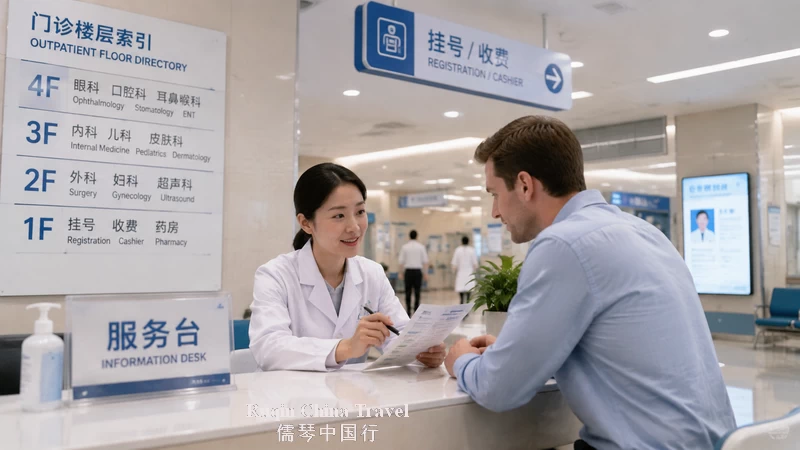
When you arrive at the international medical department, go to the reception desk first.
Then show:
- Your passport
- Appointment information
- Insurance details (if needed)
The staff will check your information and guide you to the next step.
Meanwhile, do not worry if you cannot find the right place.
Large hospitals in Shanghai can have several buildings.
The reception staff can help you find the correct department.
Step 2: Create Your Medical Record and Register
If this is your first visit, the hospital will create a personal medical record for you.
The staff will usually collect basic information, including:
- Your name
- Passport details
- Contact information
- Medical history
After registration, you will receive your patient information.
From then on, the hospital can keep your medical records for future visits.
Step 3: Wait and See the Doctor
After registration, you can relax in the waiting area.
Unlike crowded general outpatient departments, international departments usually offer a quieter environment.
Then, the nurse will call your name or guide you to the consultation room.
During the consultation, the doctor will ask about:
- Your symptoms
- When the problem started
- Your medical history
- Any medicine you are taking
Most international departments have English-speaking doctors or staff.
Therefore, communication is usually much easier.
Step 4: Tests and Treatment
If the doctor needs more information, you may need additional tests.
For example:
- Blood tests
- Ultrasound
- CT scans
- Other medical examinations
The good news is that international departments often provide a smoother process.
In many cases, they can arrange appointments through a faster channel.
You usually do not need to navigate the hospital by yourself.
Instead, staff members will guide you.
Step 5: Collect Medicine and Leave the Hospital
After the doctor finishes the consultation, you can collect your medicine.
Many international departments have their own pharmacies.
Therefore, you can usually pick up your medication without walking to another part of the hospital.
Before leaving, remember to keep:
- Medical reports
- Test results
- Payment receipts
- Prescription information
These documents may be useful if you need follow-up care or insurance reimbursement later.
5. How to Pay Medical Bills: Self-Payment and Insurance
After seeing the doctor, the next question is usually:
How do I pay?
For foreign visitors, the payment process in Shanghai is quite straightforward.
However, the method depends on whether you pay by yourself or use international health insurance.
Option 1: Self-Payment
Most international departments and private hospitals require self-payment.
This means you pay the medical fees first.
Then, if your insurance allows reimbursement, you can submit the documents later.
The cost varies depending on the hospital, doctor, and treatment.
Usually:
- Registration fees range from several hundred to over one thousand RMB
- Tests and treatments have additional costs
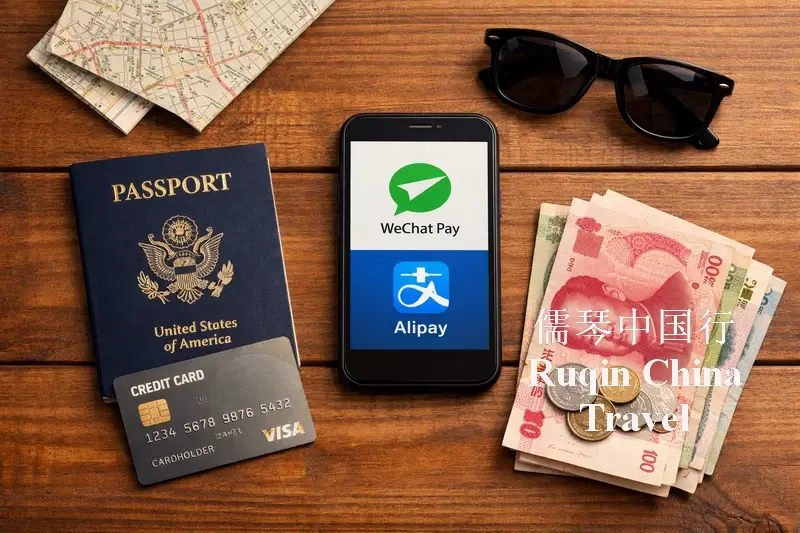
Before visiting the hospital, prepare a payment method that works in China.
You can use:
- Cash
- Visa or Mastercard
- Alipay
- WeChat Pay
Mobile payment is very common in Shanghai.
Therefore, setting up Alipay or WeChat Pay before your trip can make many daily payments easier, including medical expenses.
Option 2: Direct Billing with International Health Insurance
For travelers with international medical insurance, direct billing is the most convenient option.
Many international hospitals in Shanghai cooperate with major global insurance companies.
With direct billing, the process is much easier.
You simply:
- Show your insurance card or policy information
- Receive medical treatment
- Sign the necessary documents
Then, the hospital communicates directly with your insurance company.
You do not need to pay the full amount first.
This can save time and reduce stress, especially for expensive treatments.
Check Your Insurance Before You Visit
Before going to the hospital, contact your insurance company.
Confirm:
- Whether the hospital is inside the direct billing network
- Whether your treatment is covered
- Whether you need pre-authorization
This small step can prevent unexpected problems later.
For example, some travelers arrive at an international hospital expecting direct billing. However, their insurance company has not approved the hospital yet.
A quick confirmation before your visit can avoid this situation.
6. What to Do in an Emergency?
Most health problems during a trip are not emergencies.
However, unexpected situations can happen.
A serious accident, severe allergic reaction, chest pain, or sudden health problem requires quick action.
In these moments, remember one important number:
120 — China’s emergency ambulance service.
Option 1: Call 120 for an Ambulance
If you cannot travel by yourself, call 120.
The operator will ask for basic information.
Prepare:
- Your exact location
- Your symptoms
- Your contact number
Try to speak slowly and clearly.
If you are staying at a hotel, ask the hotel staff to help.
They can explain your location in Chinese and communicate with the ambulance team.
Meanwhile, keep your passport and important medical information nearby.
Option 2: Go Directly to the Emergency Department (急诊)
For some urgent situations, you can go directly to a hospital’s emergency department.
In China, the emergency department is called:
急诊 (jí zhěn)
You can take a taxi or use a ride-hailing app such as DiDi.
Then go to the nearest major hospital with an emergency department.
Do not spend too much time comparing hospitals during a serious emergency.
The nearest suitable hospital is usually the best choice.
International Emergency Care Options
For foreign visitors who prefer English communication, international hospitals can provide a more familiar experience.
For example, Shanghai Jiahui International Hospital offers 24-hour emergency services.
The staff can provide multilingual support, which can make communication easier during stressful moments.
However, in a life-threatening situation, speed matters most.
Choose the fastest way to receive medical help.
Ruqin’s Practical Advice
After living and working with international travelers in China for many years, I have learned one thing:
There is no single “best” hospital.
The best choice depends on your situation.
If you only have a small health problem, start with a community health service center.
It is convenient.
It costs less.
It also gives you a chance to experience everyday healthcare in Shanghai.
For more serious conditions, choose the international department of a top public hospital.
Hospitals like Huashan, Ruijin, and Zhongshan have excellent specialists and advanced medical technology.
When you need expert diagnosis or complex treatment, their medical strength matters most.
Meanwhile, if you value comfort, privacy, and English communication, consider an international private hospital.
These hospitals offer a smoother experience.
You can book appointments easily.
You can communicate in English.
You can receive more personalized service.
However, the cost is usually higher.
Check Your Insurance Before You Need It
This is one step many travelers forget.
Before visiting a hospital, contact your insurance company or the hospital directly.
Confirm:
- What treatment your insurance covers
- Whether the hospital is included in the network
- Whether direct billing is available
A simple phone call before treatment can save you time and stress later.
Travel with Confidence
Shanghai is a modern city.
It is also a warm and welcoming city.
Most visitors come here to enjoy the skyline, food, culture, and local life.
Medical problems are never part of the plan.
However, with the right preparation, you do not need to worry too much.
I hope this How to See a Doctor in Shanghai guide helps you feel more confident when you need medical care in Shanghai.
Take care of yourself.
Travel at your own pace.
Stay healthy along the way.
After all, a safe journey and good health are more important than anything else.
About the Author
Ruqin is the founder of Ruqintravel.com and has spent more than four decades working in China’s travel industry. Drawing on hands-on experience in cities like Beijing and Hangzhou, he personally researches and updates each guide to help international travelers navigate China with confidence.
Further Reading
Health and Medical Care in China: A Foreigner’s Guide
Common Mistakes to Avoid on Your First Trip to Shanghai
Shanghai Travel Complaints Guide for Foreign Visitors: What to Do
Top 4 Tourist Traps in Shanghai: Attractions, Food & Shopping