
Written and updated by Ruqin
October 9, 2026
A headache, stomach problem, allergy, or minor cold can interrupt a Beijing trip without becoming a medical emergency. The difficulty for international visitors is often not finding a pharmacy. It is explaining the problem clearly and knowing whether the medicine requires a Chinese prescription.
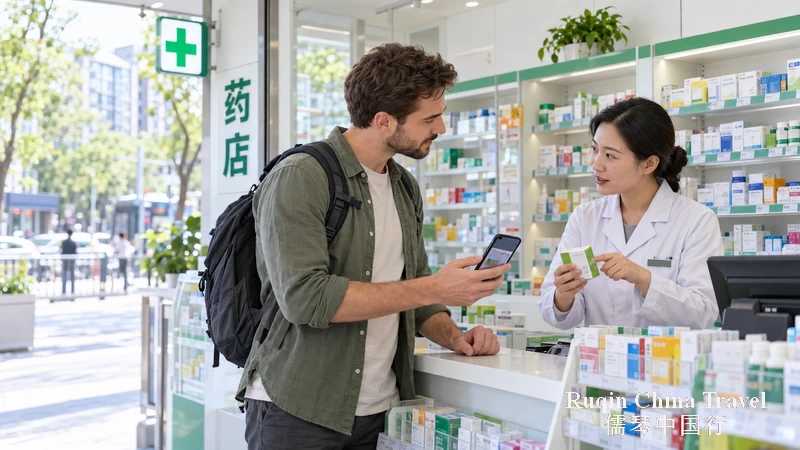
The short answer is simple: look for a licensed pharmacy marked 药店 (yàodiàn), show the pharmacist the active ingredient or a photograph of your usual medicine, and ask whether it is sold over the counter. If it requires a prescription, or if your symptoms are serious, go to a clinic or hospital instead of trying several shops.
What a Beijing Pharmacy Can—and Cannot—Do
Beijing has many neighborhood pharmacies, including branches near residential areas, shopping streets, hospitals, and transport hubs. They commonly sell non-prescription medicine, masks, thermometers, bandages, disinfectant, and other basic health supplies.
China separates medicines into prescription and non-prescription categories. A licensed pharmacist can help you locate an over-the-counter product and explain the label, but a pharmacy is not a substitute for a medical examination.
Do not expect staff to diagnose chest pain, a serious infection, breathing difficulty, a severe allergic reaction, or an injury. For an emergency, call 120 or go directly to a hospital emergency department.
How to Recognize a Pharmacy
The most useful Chinese word is:
药店 — yàodiàn — pharmacy or drugstore
You may also see 大药房 (dà yàofáng), meaning a larger pharmacy. A green cross is common, although signs and branding vary.
Use a current map app and search for 药店, not only the English word “pharmacy.” Chinese-language results are usually more complete. Check the distance, opening hours, and recent reviews before walking there, especially late at night.
Some shops advertise long or 24-hour service, but do not assume every branch of the same chain keeps identical hours. Telephone first or ask your hotel reception to confirm.
Bring the Active Ingredient, Not Just the Brand Name
A familiar overseas brand may be unavailable in China or sold under a completely different name. The most useful information is the medicine’s generic or active ingredient, strength, and dosage form.
Before visiting the pharmacy, prepare:
- The active ingredient in English
- A clear photograph of the original package
- The strength, such as 200 mg or 10 mg
- Whether it is a tablet, capsule, cream, spray, or liquid
- Your allergies and important medical conditions
- A list of other medicines you currently take
Do not simply ask for “strong cold medicine” or “something for pain.” Combination products may contain several ingredients, and two products can duplicate the same ingredient. This is particularly easy to miss with cold, fever, and pain medicines.
If possible, use your translation app to translate the ingredient and instructions, then ask the pharmacist to confirm. Keep the original label visible rather than relying on a translated brand name alone.
Over-the-Counter and Prescription Medicine
Some basic medicines are available without a prescription, while antibiotics and many other drugs require one. The exact status depends on the medicine, formulation, and current regulations.
Do not assume that a prescription written overseas will automatically be accepted at a Beijing pharmacy. If you need prescription medicine during your trip, the practical route is usually to consult a licensed doctor in Beijing and obtain a locally usable prescription.
Hospitals can dispense medicine through their own pharmacies. Chinese regulations also allow patients to choose a licensed retail pharmacy with an appropriate prescription, although availability varies by shop.
If one pharmacy refuses to sell a prescription product, do not keep visiting different branches in the hope that someone will ignore the rule. Ask where you can see a doctor instead.
A Simple Step-by-Step Pharmacy Visit
1. Choose a Licensed Shop
Use your map app to find a proper pharmacy. A larger branch may have a wider selection and more staff, but a small neighborhood pharmacy can be adequate for simple items.
2. Show the Medicine Information
Present the active ingredient, package photograph, and strength. If you are asking about a symptom rather than replacing a known product, explain how long it has lasted and whether you have allergies.
3. Confirm What You Are Buying
Before paying, check:
- Active ingredients
- Strength and dosage form
- Expiration date
- Recommended dose
- Important warnings
- Whether the medicine causes drowsiness
- Whether it conflicts with your current medicine
Do not identify a product only by package color. Similar boxes can contain different formulations.
4. Keep the Box and Receipt
Retain the packaging, instruction leaflet, and receipt. The box helps a doctor identify what you have taken if your condition does not improve.
Useful Chinese Phrases
You do not need fluent Mandarin, but a few prepared sentences help.
附近有药店吗?
Fùjìn yǒu yàodiàn ma?
Is there a pharmacy nearby?
我需要含有这种成分的药。
Wǒ xūyào hányǒu zhè zhǒng chéngfèn de yào.
I need medicine containing this ingredient.
这是处方药吗?
Zhè shì chǔfāng yào ma?
Is this a prescription medicine?
这个药怎么吃?
Zhège yào zěnme chī?
How should I take this medicine?
我对这种药过敏。
Wǒ duì zhè zhǒng yào guòmǐn.
I am allergic to this medicine.
吃了会困吗?
Chī le huì kùn ma?
Will it make me drowsy?
Keep the Chinese text on your phone so the pharmacist can read it. Spoken pronunciation does not need to be perfect.
Payment and Language
Most city pharmacies accept Alipay and WeChat Pay. Many also accept cash, but payment arrangements can differ by branch. Carry a second payment method rather than depending on one app.
English-speaking staff are not guaranteed. Hotel reception can write down the pharmacy name, telephone a branch, or explain a simple request. A translation app is usually enough for buying bandages or replacing a familiar OTC ingredient, but it is not a safe tool for diagnosing a complicated problem.
If you need detailed medical advice in English, use an international clinic or one of Beijing’s hospitals with international medical services. Beijing’s official Medical Guide for Foreigners lists major providers and explains appointment and payment procedures.
When to Stop Self-Treating
Minor symptoms sometimes improve with rest and appropriate OTC medicine. However, travel fatigue can make people wait too long before seeking proper care.
Get medical help promptly for:
- Trouble breathing, chest pain, fainting, or confusion
- A severe allergic reaction or swelling of the face or throat
- Heavy bleeding or a significant injury
- Persistent high fever
- Severe or worsening abdominal pain
- Repeated vomiting or signs of dehydration
- Symptoms that worsen after taking medicine
- A condition involving a baby, frail older traveler, pregnancy, or a serious chronic illness
For urgent but non-life-threatening problems, your hotel may help you contact a nearby clinic. For a medical emergency, call 120. Keep your passport, insurance details, current medicine list, and emergency contact information together.
If You Run Out of Regular Prescription Medicine
Do not wait until the final dose. Contact your travel insurer, treating doctor, and a Beijing medical provider as early as possible.
Bring the original package and a copy of your prescription or doctor’s letter. The Beijing doctor still needs to decide whether the medicine can be prescribed locally and whether an equivalent product is suitable. Some overseas medicines may have a different name, formulation, or availability in China.
Never buy prescription drugs from an unlicensed seller, social-media contact, market stall, or stranger. China regulates both physical and online medicine sales, and certain controlled medicines cannot be sold online.
Prepare Before Your Beijing Trip
The easiest pharmacy visit is often the one you avoid. Pack enough regular medicine for the trip, plus a reasonable delay. Keep essential medicine in your hand luggage rather than checked baggage.
Use original labeled containers. Carry copies of prescriptions and a doctor’s letter for important or controlled medicine. Rules for narcotic and psychotropic medicines are stricter, so confirm them through an official Chinese embassy, customs, or drug-regulatory source before departure.
How to Buy Medicine Online
Once you are in Beijing, you can also order medicine through JD Health (京东健康) or Meituan Medicine (美团买药) with your WeChat App. These platforms are particularly convenient when you are unwell, the nearest pharmacy is far away, or you prefer delivery to your hotel.
- JD Health (京东健康): Offers both standard delivery and rapid delivery from participating local pharmacies. It can be useful when searching for a particular active ingredient or an international brand. However, the medicine-ordering service is mainly in Chinese, so international visitors may need a translation app or help from the hotel reception. Some orders may arrive in around 30 minutes
- Meituan Medicine (美团买药): Connects users with nearby pharmacies and is useful for urgent everyday needs. In central Beijing, some orders may arrive in around 30 minutes. The actual delivery time depends on your location, the pharmacy’s opening hours, medicine availability, and traffic.
Both platforms sell over-the-counter medicine. Some prescription medicines are also available, but you cannot simply add them to your basket and pay. The platform normally asks for real-name information and directs you to an online medical consultation. A qualified doctor must review your condition and issue an electronic prescription before the pharmacy can dispense the medicine.
I have personally bought prescription medicine through JD Health. It cost more than the same medicine prescribed by a hospital and paid for partly through Beijing medical insurance. However, the convenience was considerable: the medicine arrived in about 30 minutes.
A hospital visit may require advance registration, travel in both directions, and time spent waiting. Online delivery can therefore be a practical alternative for a familiar condition or a repeat prescription. It should not replace an in-person examination when symptoms are new, severe, worsening, or difficult to explain.
Before ordering, check the active ingredient, strength, dosage, pharmacy name, expiration date, delivery address, and estimated arrival time. Ask your hotel whether it accepts medicine deliveries and make sure the courier has a local telephone number or another reliable way to contact you.
How to Avoid Counterfeit Medicine
Counterfeit medicine is unlikely when you use a licensed hospital pharmacy or a reputable retail pharmacy in Beijing. However, it is still sensible to check what you are buying.
Follow these three basic rules:
1. Buy Only from Licensed Pharmacies and Trusted Platforms
Use a hospital pharmacy, a licensed neighborhood pharmacy, or a recognised platform such as JD Health or Meituan Medicine. When ordering online, check that the seller is a licensed pharmacy rather than an unknown third-party shop.
Avoid buying medicine from market stalls, social-media contacts, street sellers, or individuals who claim to offer imported drugs at a special price.
2. Check the Packaging Carefully
Before taking the medicine, inspect:
- The product name and active ingredient
- The manufacturer
- The production batch number
- The expiration date
- The medicine approval number
- Any security seal or traceability code
- Whether the inner and outer packaging appear intact
Do not accept a box that has been opened, damaged, relabelled, or separated from its instruction leaflet. Keep the receipt in case you need to return the product or report a problem.
3. Be Suspicious of Unusually Low Prices
A price far below the normal market level should make you cautious, especially for imported, specialist, or prescription medicine. A cheap offer is not worth the risk when the product’s origin is unclear.
If the packaging or seller makes you uncomfortable, do not take the medicine. Ask a licensed pharmacist to check it, or buy a replacement through a hospital or another reputable pharmacy.
Can You Take Medicine Bought in China Home?
In most cases, you can take medicine purchased in Beijing back to your home country. However, you must follow both Chinese customs rules and the import regulations of your destination country.
As a general rule:
- Carry only a reasonable quantity for your personal use.
- Keep the medicine in its original, clearly labelled packaging.
- Keep the receipt and any Chinese prescription or medical document.
- Do not divide tablets into unmarked bags or containers.
- Check every active ingredient before leaving China.
Some countries allow visitors to carry a 30- to 90-day supply of regular medicine, but this is not a universal rule. The permitted amount depends on your destination, the medicine, and whether it contains a controlled ingredient.
Pay particular attention to cold and allergy medicines. Ingredients such as pseudoephedrine may be restricted, controlled, or require declaration in your home country, even when the medicine was legally purchased in China.
Chinese herbal medicine also needs care. Dried plants, seeds, roots, powders, animal-derived ingredients, and products containing protected species may be restricted by customs or agricultural quarantine rules. Some items must be declared, while others may not be allowed into the country at all.
Before buying medicine to take home, check the customs or drug-regulatory website of your destination country. If you are uncertain, declare the medicine on arrival and let the customs officer decide. It is better to spend a few minutes explaining it than to risk confiscation or a customs penalty.
Ruqin’s Practical Advice
For a minor problem, start with a licensed neighborhood pharmacy and communicate through the active ingredient, strength, and package photograph. Check the label carefully and avoid taking two combination products with overlapping ingredients.
If you need antibiotics, controlled medicine, or a replacement for an important prescription, plan on seeing a doctor. A pharmacy can sell and explain medicine, but it cannot safely solve every health problem.
Most importantly, judge your condition rather than your sightseeing schedule. Missing one attraction is far better than allowing a manageable illness to become an emergency.
Once you are in Beijing, you can also order medicine through JD Health (京东健康) or Meituan Medicine (美团买药). Online delivery is also a practical alternative for a familiar condition or a repeat prescription.
Further Reading
How to See a Doctor in Beijing: A Foreigner’s Guide
Food Allergies in Beijing: A Safer Dining Guide
Health and Safety Tips for Beijing Visitors
Health and Medical Care in China: A Foreigner’s Guide
Useful and Emergency Numbers in China: A Foreigner’s Guide
Smoke-Free Travel in Beijing: Hotels, Dining & Transport