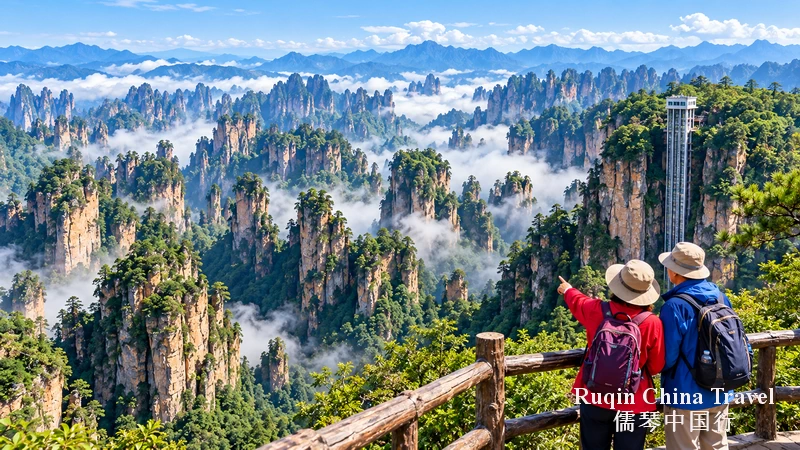

Zhangjiajie National Forest Park is famous for its towering sandstone pillars, deep valleys and mountain viewpoints. However, getting around the park can be confusing, especially for first-time visitors. There are several entrances, different shuttle bus routes, cableways and the famous Bailong Elevator.
If you’re staying in Wulingyuan (武陵源), I recommend starting at Wulingyuan East Gate (武陵源东门). This entrance provides convenient access to Tianzi Mountain (天子山) and Yuanjiajie (袁家界), two of the park’s most popular sightseeing areas.
My suggested route is simple: take the Tianzi Mountain Cableway up, travel across the mountaintop by shuttle bus, explore Yuanjiajie, and descend by Bailong Elevator. You then return to East Gate by park shuttle.
Allow a full day for this route. Although the cableway and elevator save considerable climbing, you will still need to walk between viewpoints and occasionally change shuttle buses.
1. Zhangjiajie National Forest Park East Gate Route Map
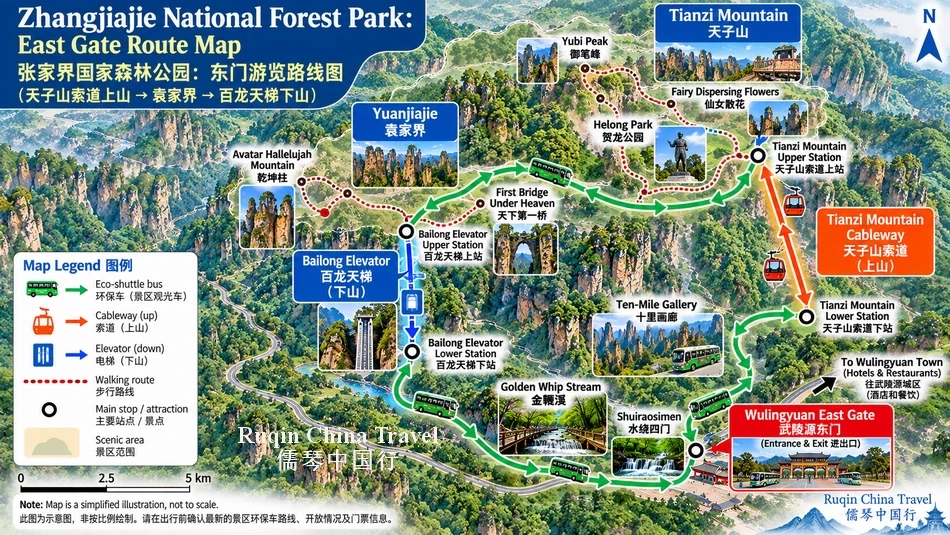
Zhangjiajie National Forest Park East Gate Route Map — showing the geographical locations of the main sightseeing areas.
The map shows how the main attractions are connected. Tianzi Mountain lies in the northeastern part of the scenic area, while Yuanjiajie is farther west. Bailong Elevator connects the Yuanjiajie plateau with the valley below.
The route uses two different transport levels. The lower valley shuttles connect East Gate with the cableway and elevator stations. The upper mountain shuttles connect Tianzi Mountain with Yuanjiajie.
Understanding this difference makes navigating the park much easier.
2. Start at Wulingyuan East Gate
Wulingyuan East Gate is also commonly called the Wulingyuan Sign Gate (武陵源标志门). It is close to many hotels and restaurants in Wulingyuan town.
I suggest arriving early, preferably near the beginning of your reserved entry period. This gives you more time for sightseeing and reduces the risk of getting caught in afternoon queues.
After passing the entrance checks, look for the eco-shuttle buses serving Tianzi Mountain Cableway Lower Station (天子山索道下站).
The East Gate has different shuttle directions. Do not simply board the first bus you see. Check the destination sign or show the Chinese station name to a staff member.
The internal shuttle buses are generally included with the appropriate park transport ticket, but cableway and elevator rides may require separate tickets.
Ruqin’s Tip: Before leaving your hotel, save both route maps on your phone. Mobile reception is not always reliable in the mountain valleys, and a screenshot is useful when asking for directions.
3. Take the Tianzi Mountain Cableway Up
The Tianzi Mountain Cableway (天子山索道) takes visitors from the lower valley to the upper mountain area.
The ride takes roughly 8–10 minutes. As the cable car climbs, you begin to see the sandstone pillars rising above the forest. On a clear day, the views become more impressive as you approach the upper station.
After leaving the cableway, follow the signs and shuttle arrangements toward Helong Park (贺龙公园).
Helong Park is one of the main sightseeing areas on Tianzi Mountain. Several viewpoints are located nearby, including:
- Yubi Peak (御笔峰): A group of slender sandstone peaks resembling traditional writing brushes.
- Fairy Dispersing Flowers (仙女散花): A distinctive rock formation surrounded by smaller pillars.
- Helong Park (贺龙公园): A convenient starting point for exploring the nearby viewpoints.
Allow around 1–1.5 hours here, depending on visibility, crowds and your walking pace.
The viewpoints involve paved paths, steps and occasional slopes. You do not need to explore every side path to enjoy the scenery.
4. Travel from Tianzi Mountain to Yuanjiajie
After visiting Tianzi Mountain, continue toward Yuanjiajie (袁家界) using the upper-mountain eco-shuttle network.
This is the section that often confuses first-time visitors.
The shuttle route follows winding mountain roads, and some services require a transfer around the Yangjiajie (杨家界) area. The exact arrangement can vary with park operations.
Allow roughly 40–60 minutes for the journey, including possible waiting or transfers.
At each shuttle stop, check the destination before boarding. The Chinese name 袁家界 is particularly useful.
Do not get off at Yangjiajie unless you intend to explore that area. Yangjiajie has its own scenic trails, and some involve steep steps and longer walks.
For a comfortable one-day itinerary, I would concentrate on Tianzi Mountain and Yuanjiajie rather than trying to cover every scenic area.
5. Explore Yuanjiajie: The Avatar Mountains
Yuanjiajie is one of the highlights of Zhangjiajie National Forest Park.
Unlike the broad mountain panoramas around Tianzi Mountain, Yuanjiajie brings you closer to the tall, narrow sandstone pillars.
The main sightseeing route connects several famous viewpoints.
Avatar Hallelujah Mountain (乾坤柱) is one of the best-known rock formations. The isolated sandstone pillar became internationally famous through its association with the floating mountains in the film Avatar.
First Bridge Under Heaven (天下第一桥) is another major attraction. It is a natural stone bridge connecting two sections of the mountain.
You can also enjoy views across the surrounding valleys from several observation platforms.
Allow approximately 1.5–2 hours to explore Yuanjiajie at a relaxed pace.
The paths are generally well developed, but expect steps, narrow sections and crowds around the most popular viewpoints.
If you enjoy photography, leave enough time to wait for people to move away from the viewing platforms. Mist can also change the scenery quickly, sometimes revealing the peaks after only a few minutes.
6. Take Bailong Elevator Down to the Valley
After exploring Yuanjiajie, follow the signs toward Bailong Elevator Upper Station (百龙天梯上站).
You may need a short shuttle connection or walk, depending on where you finish your sightseeing route.
Bailong Elevator is built against a steep cliff and connects the upper mountain area with the valley below.
The elevator ride takes approximately 88 seconds. Part of the journey passes through the mountain, while the exposed section offers views of the surrounding sandstone cliffs.
For this itinerary, take the elevator down, not up.
Once you reach the lower station, follow the signs to the eco-shuttle boarding area.
The return journey toward Wulingyuan East Gate may involve a connection through the Shuiraosimen (水绕四门) area. Ask staff which bus serves East Gate before boarding.
I recommend beginning your descent with plenty of time remaining before the final shuttle departures.
7. East Gate Route Schematic: Follow the Transport Connections
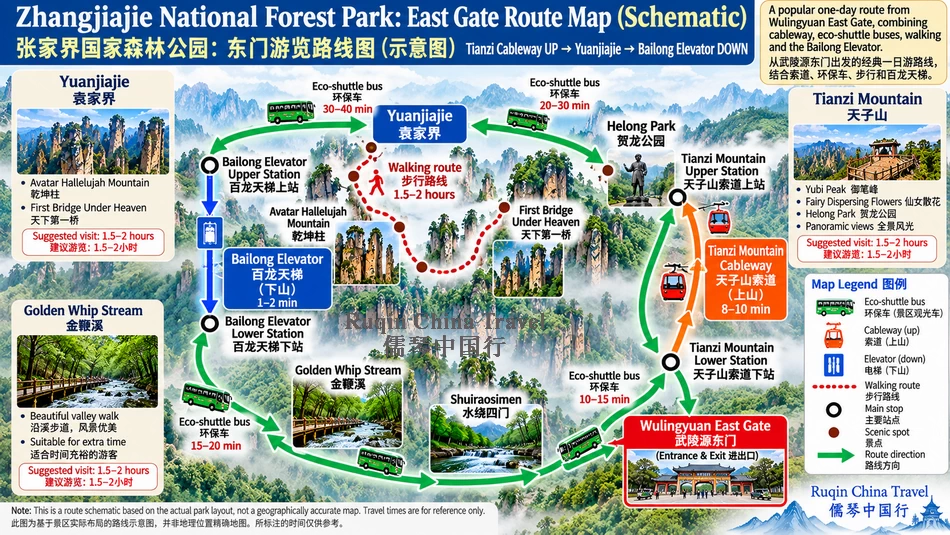
Zhangjiajie National Forest Park East Gate Route Map (Schematic) — follow the shuttle, cableway, walking and elevator connections in sightseeing order. Not to scale.
This second map is different from the geographical map above.
It focuses on the order of travel, making it easier to understand when to use a shuttle bus, when to walk and when to take the cableway or elevator.
Follow the arrows in this order:
East Gate → Tianzi Mountain Cableway (up) → Helong Park → Yuanjiajie → Bailong Elevator (down) → East Gate.
Keep the schematic handy during your visit, especially when changing buses.
8. Tickets, Costs and Time Planning
The national forest park entrance ticket and its internal shuttle transport are often sold together, while Tianzi Mountain Cableway and Bailong Elevator are usually charged separately unless your selected package includes them.
Check the exact ticket description before paying. In particular, confirm the entrance, reserved time, shuttle access and direction of any included cableway or elevator rides.
For the complete circuit, allow approximately 6–8 hours, with extra time during busy periods.
A practical schedule is to spend the morning on Tianzi Mountain, travel to Yuanjiajie around midday, and visit the Yuanjiajie viewpoints before descending by Bailong Elevator.
Bring your passport or the identification used for booking. Keep your ticket confirmation accessible throughout the day.
9. Should You Add Golden Whip Stream or Ten-Mile Gallery?
Golden Whip Stream (金鞭溪) is a beautiful valley walk beneath the sandstone pillars. However, the full walking route takes several hours.
I would not combine the complete Golden Whip Stream walk with this East Gate circuit unless you are prepared for a long day.
Ten-Mile Gallery (十里画廊) is another popular attraction in the lower scenic area. It can be reached through the park’s shuttle network, but visiting it properly also requires additional time.
If you have two days, consider spending one day on Tianzi Mountain and Yuanjiajie, then using the second day for the lower valley attractions.
This gives you more time to enjoy the scenery without rushing between transport connections.
10. Ruqin’s Practical Tips
Check the weather. Low clouds and mist can hide the mountain viewpoints. However, light mist can also create beautiful scenery between the sandstone pillars.
Wear comfortable walking shoes. Even with cableways and shuttle buses, this route includes steps, slopes and extended walking.
Bring water and a light snack. Food is available in some sightseeing areas, but choices can be limited and prices may be higher than in town.
Avoid unnecessary return tickets. You do not need a round-trip Tianzi Mountain Cableway ticket if you intend to descend by Bailong Elevator.
Check the last transport departures. Cableways, elevators and shuttle services have operating schedules that may change with the season, weather or maintenance.
Keep the route flexible. If one area is crowded or covered in thick fog, ask park staff about alternative connections rather than trying to follow the map at all costs.
Travel Notes from Ruqin
For first-time visitors staying in Wulingyuan, the East Gate circuit is a practical way to see two of Zhangjiajie’s most impressive mountain areas in one day.
Going up by Tianzi Mountain Cableway and down by Bailong Elevator avoids repeating the same vertical transport route. The eco-shuttle buses connect the major sightseeing areas, while short walks take you to the viewpoints.
My advice is to start early, follow the shuttle destination signs carefully, and allow enough time for both Tianzi Mountain and Yuanjiajie.
Most importantly, use the geographical map to understand where the attractions are, and the route schematic to follow the journey step by step.
Further Reading
Where to Stay in Zhangjiajie: City or Wulingyuan?
Zhangjiajie With or Without a Guide: Practical Advice
Zhangjiajie Luggage Storage: A Practical Arrival and Departure Guide
Zhangjiajie in Rain and Fog: How to Plan Your Visit
Zhangjiajie for Senior Travelers: An Easier Two-Day Park Route
How to Visit Zhangjiajie National Forest Park: Map, Tickets & Tips
How to Book Zhangjiajie Attraction Tickets: All You Need to Know