
Written and updated by Ruqin
October 10, 2026
Beijing Capital International Airport and Beijing Daxing International Airport serve the same city, but they are on opposite sides of it. Capital Airport lies northeast of central Beijing, while Daxing lies far to the south.
If your itinerary requires a change between them, treat it as a separate journey across Beijing—not as an ordinary airport connection. You may need to enter China, collect your baggage, travel roughly 70 to 80 kilometres by road, check in again, and pass through security and immigration.
My short answer is simple: allow at least eight hours for a self-managed international connection, and more if the tickets are separate, you have checked baggage, or either flight is late. A connection under six hours is too risky for most travelers.
First Check the Airport Codes
Beijing has two main international airports:
- PEK — Beijing Capital International Airport (北京首都国际机场)
- PKX — Beijing Daxing International Airport (北京大兴国际机场)
The metropolitan code BJS can refer to Beijing generally. It does not tell you which airport your flight uses. Check the individual flight segments for PEK or PKX before buying the ticket.
At Capital Airport, also confirm whether you need Terminal 2 or Terminal 3. They are separate terminals, and reaching the correct check-in area takes additional time.
The Best Transfer Options
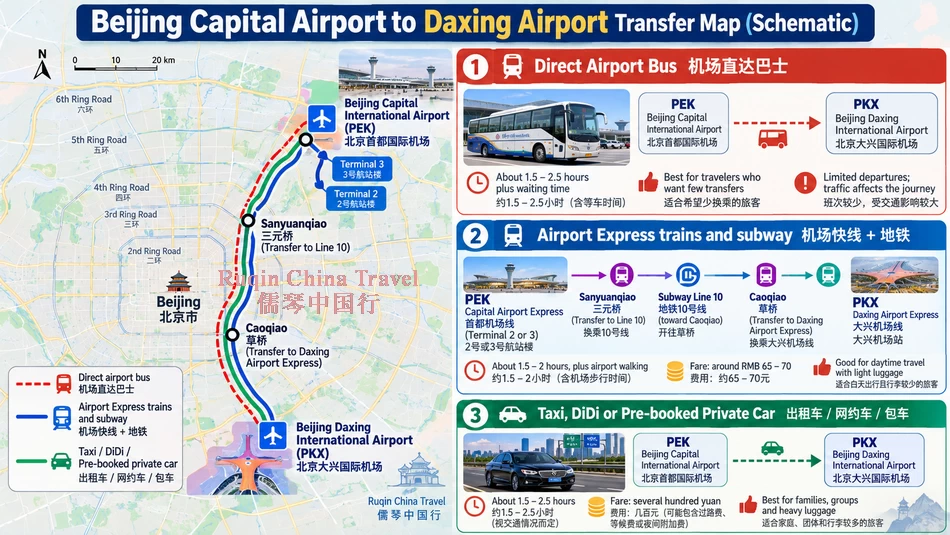
Beijing Capital Airport to Daxing Airport Transfer Map
| Option | Typical planning time | Best for | Main limitation |
|---|---|---|---|
| Direct airport bus | About 1.5–2.5 hours, plus waiting | Travelers who want few transfers | Limited departures; traffic affects the journey |
| Airport Express trains and subway | About 1.5–2 hours, plus airport walking | Daytime travel with light luggage | Two transfers and long station corridors |
| Taxi or DiDi | About 1.5–2.5 hours | Families, groups, and heavy luggage | Traffic and a fare of several hundred yuan |
| Pre-booked private car | Similar to a taxi | Late arrivals or travelers wanting a waiting driver | Usually the most expensive option |
These are planning ranges, not guarantees. Rush-hour traffic, queues at immigration, baggage delays, and waiting for the next bus or train can add substantial time.
Option 1: Direct Airport Bus
Capital Airport’s official transport information lists an airport-bus route serving Daxing Airport. When its departure time suits your flight, this is the simplest public-transport option because you do not need to carry bags through subway interchanges.
The weakness is frequency. This is not a turn-up-and-go metro service, and schedules can change. A missed departure may leave you waiting too long for a tight connection.
After landing, go to the official airport-bus counter and ask for the next service to the other airport. Show the Chinese airport name to avoid confusion:
- 去北京大兴国际机场 — To Beijing Daxing International Airport (Tel: 010 – 81698565)
- 去北京首都国际机场 — To Beijing Capital International Airport (Tel: 010 – 64378900 )
Before buying the ticket, confirm the departure time, boarding point, destination terminal, and expected journey time. If the wait is long, compare it with the rail route or take a car.
Ticket Price
The bus uses a distance-based fare system. The reference fare is around RMB 65 person, although the actual price may vary. Check the fare displayed at the airport bus counter before buying your ticket.
Operating Hours and Departing Points:
The published operating hours differ depending on your direction of travel:
- Daxing Airport Gate 20 → Gate 1 on Level 1 at T3 Capital Airport: First departure at 6:00 AM; last departure at 7:00 PM.
- Gate 1 on Level 1 at T3 Capital Airport→ Daxing Airport Gate 20: First departure at 7:00 AM; last departure at 9:00 PM.
These are reference operating hours, not a guarantee of frequent departures. Always check the latest timetable, as schedules may change.
Main Stops Along the Route
The listed stops include:
- Daxing International Airport (北京大兴国际机场)
- North of Shilihe Bridge (十里河桥北)
- North of Panjiayuan Bridge (潘家园桥北)
- North of Shuangjing Bridge (双井桥北)
- Langjiayuan (郎家园)
- East Gate of Chaoyang Park (朝阳公园东门)
- Beijing Chaoyang Railway Station (北京朝阳站)
- Capital International Airport (首都国际机场)
Important: The Airport Bus Only Stops at Capital Airport Terminal 3
If you’re taking the direct airport bus from Beijing Daxing International Airport (PKX) to Beijing Capital International Airport (PEK), remember that the bus terminates at Terminal 3 (T3).
If your flight departs from Terminal 2 (T2), you will need to make an additional transfer.
After arriving at T3, follow these steps:
- Go down to Level 1 of Terminal 3.
- Find Gate 7, where you can board the free inter-terminal shuttle bus.
- Take the shuttle bus from T3 to T2. The ride takes approximately 15 minutes.
- Shuttle buses generally run every 10 minutes, although waiting times may vary.
Option 2: Airport Express Trains and Subway
Rail is normally the most predictable daytime option because it avoids road congestion. However, it involves two interchanges and is tiring with large suitcases.
From Capital Airport to Daxing Airport
- Take the Capital Airport Express from Terminal 2 or Terminal 3.
- Leave the train at Sanyuanqiao (三元桥).
- Transfer to Subway Line 10 toward Caoqiao.
- At Caoqiao (草桥), transfer to the Daxing Airport Express.
- Leave the train at Daxing Airport (大兴机场).
The total fare is approximately RMB 65 per person when using standard-class airport express trains.
You will need to change trains twice: first at Sanyuanqiao (三元桥) and then at Caoqiao (草桥).
Here is the estimated fare breakdown:
- Capital Airport Express (首都机场线): RMB 25
Take the Capital Airport Express from Terminal 2 or Terminal 3 to Sanyuanqiao Station. The line charges a flat fare of RMB 25, regardless of the distance traveled. - Subway Line 10 (地铁10号线): Around RMB 4
At Sanyuanqiao, transfer to Subway Line 10 and travel to Caoqiao Station. This section uses Beijing’s standard distance-based subway fare system. - Daxing Airport Express (大兴机场线): RMB 35
At Caoqiao, transfer to the Daxing Airport Express and continue to Daxing International Airport. A standard-class single ticket costs RMB 35, while a business-class ticket costs RMB 50.
Estimated Total Fare: RMB 64 (approximately RMB 65)
From Daxing Airport to Capital Airport
Reverse the route: take the Daxing Airport Express to Caoqiao, Line 10 to Sanyuanqiao, then the Capital Airport Express to the correct PEK terminal.
The dedicated airport trains are fast, but the full journey is not. You must walk between platforms, pass station security, wait for trains, and manage luggage through crowded areas. I would allow around two hours from airport station to airport station, then add terminal walking and check-in time.
The combined fare is usually around RMB 65–70, including both airport express lines and the ordinary subway section. Recheck current prices and operating hours before travel. The trains do not run all night.
Capital Airport Express: Operating Hours
The Capital Airport Express (首都机场线) connects Beijing Capital International Airport with the city’s subway network.
If you’re transferring to Daxing Airport, take the train from Terminal 2 or Terminal 3 and get off at Sanyuanqiao (三元桥), where you can change to Subway Line 10.
The scheduled operating hours from Capital Airport are:
- Terminal 3 (T3): 6:22 AM – 10:52 PM
- Terminal 2 (T2): 6:36 AM – 11:10 PM
- Train frequency: Approximately every 10 minutes.
These are reference departure times. Always check the latest timetable displayed at the airport station, especially if you’re arriving late in the evening.
Daxing Airport Express: Operating Hours
The Daxing Airport Express (大兴机场线) connects Caoqiao Station (草桥) with Beijing Daxing International Airport (大兴国际机场).
For travelers transferring from Capital Airport, this is the final rail section of the journey.
The scheduled operating hours are:
- Caoqiao → Daxing Airport: 5:30 AM – 10:30 PM. The first departure was moved earlier to 5:30 AM on September 26, 2025.
- Daxing Airport → Caoqiao: 5:58 AM – 10:57 PM under the regular timetable.
- Train frequency: Approximately every 9–10 minutes during peak hours and every 15 minutes later in the evening.
During major holidays or busy travel periods, the Daxing Airport Express may extend its operating hours, sometimes until midnight or 1:00 AM the following morning. However, these extensions are not guaranteed.
Important: Ticket sales and entry checks may close five minutes before the last train. I recommend arriving at the station at least 10 minutes before departure.
Option 3: Taxi, DiDi, or Private Car
A direct car is the easiest choice with children, several suitcases, limited mobility, or a late arrival. It also removes the physical effort of two rail transfers.
A taxi or DiDi ride typically costs around RMB 200–300, excluding expressway tolls.
The actual fare depends on the type of vehicle, time of day, traffic conditions and route taken. Expressway tolls are usually charged separately, so the final cost may be higher.
Use the official taxi queue or the designated ride-hailing pickup area. Do not accept an unsolicited ride from someone approaching you in the arrivals hall. For DiDi or another licensed platform, check the number plate before entering the vehicle.
The journey commonly takes 90 minutes to two and a half hours, depending on traffic. Allow longer during weekday rush hours, holiday peaks, bad weather, or road incidents. The fare is normally several hundred yuan and may include tolls, waiting charges, or a night surcharge.
If booking a private transfer, send the provider your flight number, arrival terminal, destination airport, onward flight time, passenger count, and number of large bags. Confirm that the vehicle has enough luggage space.
You May Need to Enter China
An airport change normally requires you to leave the restricted international transit area. In practical terms, this can mean:
- Completing immigration or temporary-entry procedures
- Collecting checked baggage
- Passing customs
- Traveling across Beijing
- Checking in at the second airport
- Passing security and outbound immigration again
Do not assume that the 24-hour transit rule automatically permits you to leave the restricted area. Travelers who need to change airports must be eligible to enter China and may need temporary entry permission. The immigration authority at the arrival airport makes the decision.
If you plan to use China’s 240-hour visa-free transit policy, check that your nationality, ports, onward ticket, and route meet all current conditions. The usual transit pattern requires travel from one country or region, through China, to a different third country or region.
Ask the airline before departure whether your baggage will be checked through. With separate tickets, expect to collect and recheck it unless the airlines explicitly confirm otherwise.
How Much Connection Time Is Sensible?
| Time between scheduled flights | Practical assessment |
|---|---|
| Under 6 hours | Do not plan an independent airport change |
| 6–8 hours | High risk; only favorable daytime conditions leave a workable margin |
| 8–12 hours | Usually workable with proper entry documents and no major delay |
| Overnight | Safest for a late arrival or early onward flight |
Eight hours is not a promise. It is a cautious minimum for many self-managed international transfers. Add more time if you have separate tickets, several bags, children, limited mobility, an arrival during rush hour, or a flight you cannot afford to miss.
For an onward international flight, I would aim to reach the departure airport at least three hours before takeoff. For a domestic flight, follow the airline’s current check-in deadline and still keep a generous buffer.
If both flights are on one protected ticket, ask the airline what assistance it provides if the inbound flight is late. If you bought separate tickets, the second airline may treat a missed departure as your responsibility.
Late-Night and Early-Morning Transfers
The rail route is unsuitable after the last airport express trains have departed. The direct airport bus may also have limited hours.
For a late-night airport change, use an official taxi, a ride-hailing platform, or a pre-booked car. If the onward flight leaves early the next morning, consider transferring in the evening and staying near the departure airport. This is usually calmer than crossing Beijing before dawn.
Keep the onward airport name and terminal in Chinese on your phone. Also save your flight number, airline contact details, and hotel or transfer confirmation offline.
Practical Advice for Luggage and Mobility
The rail route is manageable with one wheeled suitcase, but it is not effortless. Sanyuanqiao and Caoqiao are working transport hubs, not simple airport corridors. Expect walking, elevators, security screening, and possible crowds.
For families, older travelers, wheelchair users, or anyone carrying several large bags, a direct vehicle is usually worth the extra cost. Arrange airport assistance separately with the airline; a driver cannot meet you inside immigration or take responsibility for airline check-in.
Carry passports, medicines, valuables, chargers, and onward-flight documents in your cabin bag. Keep enough phone battery for navigation, payment, and communication with the driver.
If Your Incoming Flight Is Delayed
Recalculate immediately. Do not continue with the original plan simply because it looked possible before departure.
Contact the onward airline or booking agent, check the second flight’s check-in deadline, and choose the fastest realistic transfer. If the margin has disappeared, ask about rebooking before setting out across the city.
For separate tickets, document the delay and keep receipts, but do not assume the onward airline will cover a missed flight. Travel insurance may help only if the policy includes this type of self-transfer.
Ruqin’s Practical Advice
For most daytime travelers with light luggage, the Airport Express–Line 10–Airport Express route offers the best balance of cost and predictability. If a direct airport bus leaves soon, it is easier physically. With heavy bags, children, limited mobility, or a nighttime arrival, I would choose a licensed taxi or pre-booked car.
More importantly, do not save money by buying an unrealistically short connection between PEK and PKX. Eight hours is a sensible starting point; an overnight stay is better when flight times are awkward. The right choice depends less on the fastest advertised journey and more on how much buffer you have after immigration, baggage, check-in, and security.
You Might Also Like:
How Many Airports in Beijing: A Real Traveler’s Guide
How to Get from Beijing Capital Airport to Beijing City Centre
How to Get from Beijing Daxing Airport to Beijing
Beijing Airport Transfers for Families and Large Luggage
Beijing Airport Layover: City Centre or Great Wall
Beijing Subway with Luggage: A Practical Travel Guide
Arriving at Beijing Airport: Arrival Card and Visa-Free Transit Guide