
Words by Ruqin · September 14, 2026
Beijing’s subway is usually the fastest way to cross the city. However, a journey that feels easy with a small backpack can become tiring with two large suitcases.
You can take ordinary travel luggage onto the Beijing subway. The real questions are whether you can lift it, manage the security check, find a suitable entrance, and handle long transfers during crowded periods.
For one traveler with one wheeled suitcase, the subway is often practical. For families, older travelers, or anyone carrying several heavy bags, a taxi or DiDi may be the calmer choice.
Luggage Is Allowed on the Beijing Subway
Beijing’s official passenger guidance allows personal belongings within stated limits. An item should not exceed 30 kilograms in weight, 1.8 metres in length, or 0.5 metres in width or height.
An ordinary suitcase normally falls within these limits. However, the subway is designed for passengers rather than airport-style luggage handling. There are no luggage trolleys, check-in counters, or baggage attendants.
You must control your luggage throughout the journey. Keep it beside you on platforms and hold it firmly when the train starts or stops.
Every Bag Must Pass Through Security
Every Beijing subway entrance has a security checkpoint. Put suitcases, backpacks, shopping bags, and other belongings through the X-ray machine before entering the paid area.
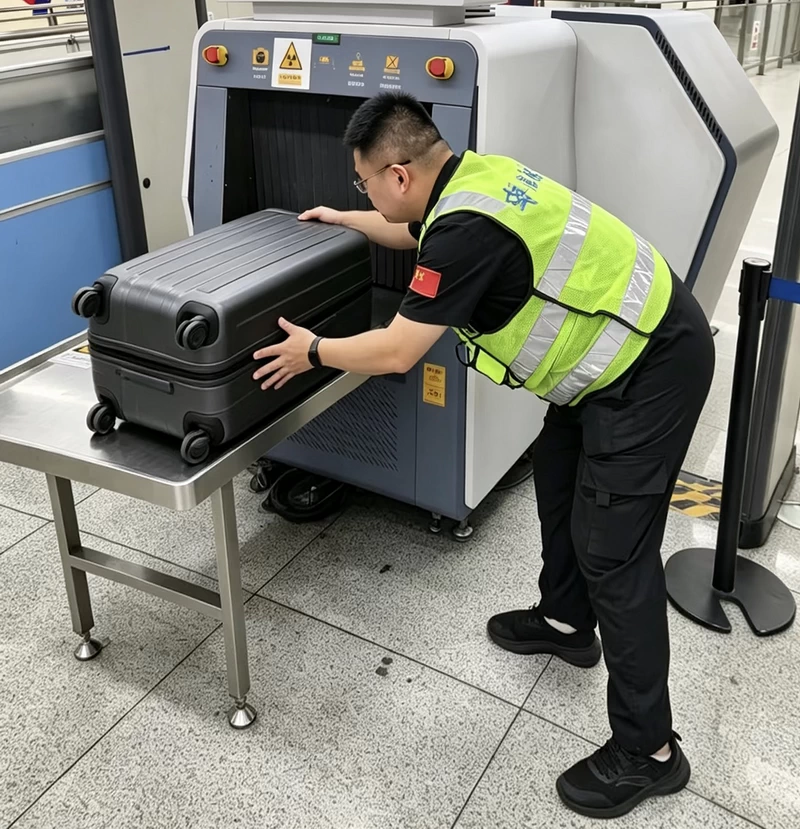
Every Bag Must Pass Through Security
This process is normally quick. Still, a large case takes more effort. You may need to lift it onto the belt and collect it promptly at the other end.
Security staff may ask to inspect liquids, sprays, tools, batteries, or other questionable items. Keep these near the top of your bag instead of burying them beneath your clothes.
Water and ordinary drinks are usually allowed, although staff may ask you to take a sip or place the container in a liquid scanner. Flammable liquids and certain pressurised products are restricted.
Allow several extra minutes for security. At a railway station or busy central station, the queue can grow quickly.
The Hardest Part Is Often the Station, Not the Train
Visitors sometimes judge a subway journey only by the number of stops. In Beijing, the walking inside the stations can matter just as much.
A transfer may involve long corridors, several escalators, stairs, and a change of level. Some stations sit beneath large road intersections. Reaching the correct exit can add another ten minutes.
Therefore, compare routes by more than journey time. A route with one direct line may be easier than a slightly faster route with two transfers.
Older Subway Lines May Involve More Stairs
Beijing’s earliest subway lines were built before modern accessibility standards. Therefore, some older stations and entrances have fewer elevators and escalators than newer parts of the network.
Lines 1 and 2 deserve particular attention. At some stations, you may need to use stairs when entering, leaving, or changing lines. An elevator may exist at one entrance but not at the entrance closest to your hotel.
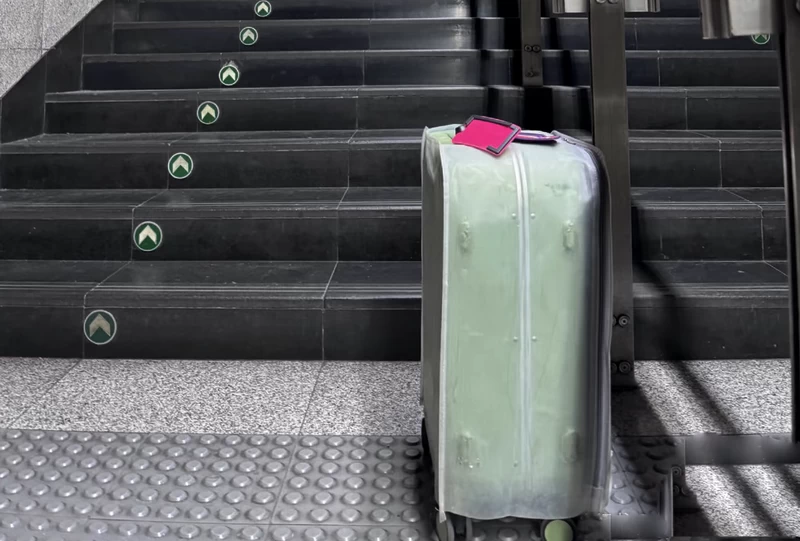
You may need to use stairs when entering, leaving, or changing lines in some stations at Line 1 and 2 in Beijing
Line 2 can be especially awkward because it serves several busy transport hubs. These include Beijing Railway Station, Dongzhimen, Xizhimen, and Xuanwumen. A route that looks simple on the map may still involve stairs and long underground corridors.
Parts of Line 1 also retain older station layouts. Although accessibility facilities have improved, you should not assume that every entrance provides a continuous step-free route from the street to the platform. Beijing has upgraded accessibility assistance across the network, but some older stations still rely on staff-operated equipment rather than ordinary passenger elevators.
Before traveling, check the facilities at your departure, transfer, and arrival stations. The official Beijing Subway station directory lists station entrances and some facility information. You can also ask station staff which entrance has an elevator.
If you have several heavy suitcases, a baby stroller, or limited mobility, take a taxi or DiDi when the route depends heavily on Lines 1 or 2. It may cost more, but it can save considerable lifting, walking, and searching for the correct entrance.
I recommend this careful wording rather than saying that almost every Line 2 station has no elevator. The real problem is inconsistent step-free access between particular entrances, station halls, platforms, and transfer passages.
Check the Exit Before You Travel
Large stations may have entrances on several sides of a major road. The wrong exit can leave you hundreds of metres from your hotel or railway-station entrance.
Check the exit letter in a current map app before boarding. If you need an elevator, look at the official Beijing Subway station information or ask station staff which exit has step-free access.
Do not assume every street entrance has an elevator or escalator. A station may have step-free access, but only through one particular entrance.
The following sentence can help:
请问,直梯在哪里?
Qǐngwèn, zhítī zài nǎli?
“Excuse me, where is the elevator?”
In Beijing subway signs, 直梯 means elevator. 扶梯 means escalator.
Some Stations in the old subway lines like Line 1 and Line 2 have no elevators. If you have large suitcases, it’s harder for you.
Subway Connections at Beijing’s Railway Stations
Several Beijing railway stations connect directly with the subway. Even so, these are large transport complexes rather than simple street stations.
| Railway station | Subway connection | Practical luggage note |
|---|---|---|
| Beijing Railway Station | Line 2 | Central and convenient, but entrances and security areas can become crowded |
| Beijing South Railway Station | Lines 4 and 14 | Direct indoor connection, although the station has several levels |
| Beijing West Railway Station | Lines 7 and 9 | Large underground complex; follow railway signs rather than only the subway exit |
| Beijing North Railway Station | Lines 2, 4 and 13 at Xizhimen | Convenient on the map, but Xizhimen involves considerable walking |
| Beijing Fengtai Railway Station | Lines 10 and 16 | Integrated connection, but allow time to understand the station layout |
| Qinghe Railway Station | Lines 13 and Changping Line | Modern connection; still leave a buffer when carrying large bags |
Before leaving your hotel, check the full railway-station name in both English and Chinese. Beijing Railway Station, Beijing South, Beijing West, and Beijing North are different places.
If you have a train to catch, do not calculate your departure from the hotel too tightly. Add time for the subway walk, railway-station entrance, passport check, luggage screening, and boarding.
Airport Express Trains with Luggage
The Capital Airport Express and Daxing Airport Express are designed with airport passengers in mind. They are generally easier with luggage than ordinary subway lines.
However, the difficult section may come after the airport train. You may still need to transfer to an ordinary subway line and walk through a large interchange.
From Beijing Capital International Airport
The Capital Airport Express connects the airport with Sanyuanqiao, Dongzhimen, and Beixinqiao. Your best transfer depends on your hotel location.
Do not automatically choose Dongzhimen because it looks central. If another Airport Express station gives you a shorter or simpler onward route, use it.
For example, a traveler staying near Line 5 may find Beixinqiao convenient. Someone continuing along Line 10 may prefer Sanyuanqiao.
From Beijing Daxing International Airport
The Daxing Airport Express reaches Caoqiao, where passengers can continue by subway. The airport train itself is straightforward, but the full journey may still include a transfer and a long walk to the hotel.
After a long flight, saving a little money may not justify dragging several suitcases through two subway interchanges. Check the complete door-to-door route before deciding.
Avoid the Busiest Commuting Periods
Beijing subway trains become very busy during the morning and evening commute. Large suitcases take up valuable floor space and become harder to control.
If your schedule is flexible, travel after the main morning rush and before the evening rush. Midday is usually more comfortable, although central stations can remain busy.
During crowded periods, stand away from the carriage doors. Do not block passengers entering or leaving. If the train is already packed, let it go and wait for the next one.
At the platform, keep your suitcase in front of you rather than behind you. This prevents another passenger from tripping over it.
Choose the Right Payment Method Before Entering
Beijing offers several subway payment methods, including single-journey tickets, transport QR codes, transit cards, and supported contactless bank cards.
For a traveler carrying luggage, the best method is the one already prepared. Do not stop beside the gate with your suitcase while trying to activate an app for the first time.
If using a phone-based transport code, set it up before leaving the airport or hotel. Keep mobile data working and increase the screen brightness before scanning.
If using a contactless card, use the same card or device when entering and leaving. Do not tap in with a physical card and try to tap out with its mobile-wallet version.
At wider gates, wait for the previous passenger to clear the barrier. Then roll your suitcase through with you. If the gate closes or your bag becomes separated, ask the nearby attendant for help.
When the Subway Makes Sense
The subway is a good choice when:
- Each person has one manageable wheeled suitcase
- Your hotel is close to a station
- The route is direct or requires only one simple transfer
- You can lift your bag onto the security belt
- You are traveling outside the busiest periods
- Road traffic is heavy
- You have enough time before your train or flight
A direct subway ride can be more predictable than a taxi during weekday traffic. This is especially useful when traveling to Beijing South, Beijing West, or Beijing Railway Station.
When a Taxi or DiDi Is Better
A car is usually the better choice when:
- Two people have three or four large cases
- You are traveling with small children
- Someone has limited mobility
- Your hotel entrance is far from the subway
- The route requires two or more transfers
- You are leaving very early or late
- You have just completed a long international flight
- Rain, snow, or extreme heat makes walking difficult
Consider the size of the vehicle. A standard sedan may not hold several large suitcases. When arranging a ride, choose a larger vehicle if available or ask the hotel to call a suitable taxi.
Show the driver the complete destination in Chinese. For a railway departure, include the exact station and entrance if known.
A Simple Decision Guide
Before choosing the subway, ask four questions:
- How many bags do we have?
One suitcase per person is usually manageable. Several large cases change the journey. - How many transfers are required?
A direct line is much easier. Two transfers can mean a surprising amount of walking. - Can everyone lift their own luggage?
Each bag must pass through security, and elevators may not be beside your preferred entrance. - What happens after the final station?
A ten-minute walk feels much longer on uneven pavement, in rain, or with a heavy case.
The map may show a cheap and efficient route. Still, the easiest journey is the one that works from the hotel door to the final entrance.
Ruqin’s Practical Advice
Use the Beijing subway if you have manageable luggage and a simple route. It is fast, affordable, and usually reliable.
However, do not treat taking the subway as a test of independent travel. If you are tired, traveling with an older family member, or carrying several heavy bags, take a taxi or DiDi. The extra cost may save considerable walking and stress.
For a railway departure, I would rather arrive calmly with twenty minutes to spare than save a small fare and rush through a large station with suitcases.
More Beijing Travel Guides
- How to Use the Beijing Subway: Map, Tickets, Pass & Apps
- Shichahai Subway Station: Best Exits & Accessibility Guide
- How to Get Around Beijing: Subway, Bus, Bike & Walking Tips
- How Many Railway Stations in Beijing: Map, Rail Routes and Tips
- How Early Should I Arrive at a Chinese Railway Station?
- Best Apps for Beijing Travel: Essential Guide for Foreign Visitors
- Where to Stay in Beijing: Maps, Best Areas, Hotels & Travel Tips