
Written and updated by Ruqin
Last updated: October 11, 2026
Beijing’s attractions look close together on a map. In practice, the city’s monumental scale, large parks, subway corridors, security zones, and one-way visitor routes create much more walking than many first-time visitors expect.
A normal sightseeing day can easily reach 12,000 to 20,000 steps. A demanding day that combines the Forbidden City, Jingshan Park, and another major attraction may pass 20,000 steps. These are planning estimates rather than official figures, but they are useful when deciding how much to schedule.
The most effective approach is to plan one walking-heavy attraction per day, use taxis or DiDi for awkward cross-city journeys, and leave one lighter afternoon during a four- or five-day visit.
Why Beijing Requires So Much Walking
The difficulty is not simply the distance between attractions. Much of the walking happens before you reach the main sight.
You may walk from a subway platform through a long interchange, leave by the wrong exit, cross a broad road, pass through security, and continue through an entrance plaza. At the end of the visit, the exit may be far from where you began.
Historic sites also contain large open courtyards and stone paths. A taxi can take you to the permitted drop-off area, but it cannot drive through Tian’anmen Square, the Forbidden City, the Temple of Heaven, or the Summer Palace.
Realistic Walking Levels at Major Attractions
The ranges below include typical sightseeing inside each attraction. They do not include every journey from your hotel, restaurant, or subway platform.
| Attraction or area | Practical walking estimate | What makes it tiring |
|---|---|---|
| Tian’anmen Square and Forbidden City | 15,000 – 25,000 steps | Security approaches, huge courtyards, one-way south-to-north route |
| Forbidden City plus Jingshan summit | 18,000 – 20,000 steps | Palace walking followed by a hill and stairs |
| Temple of Heaven | 10,000 – 15,000 steps | Large park with separated historic compounds |
| Summer Palace | 10,000 – 13,000 steps | Large grounds, lakeside paths, hills, and distant gates |
| Mutianyu with round-trip cable car | 10,000 – 15,000 steps | Uphill approach, uneven Wall steps, gradients |
| Shichahai, Drum Tower, and hutongs | 4,300 – 9,000 steps | Exploration naturally adds detours |
| National Museum of China | 2,800 – 10,000 steps | Large galleries and prolonged standing |
Your route, gate choice, optional halls, queues, and photography stops can move the total well outside these ranges.
Tian’anmen Square and the Forbidden City
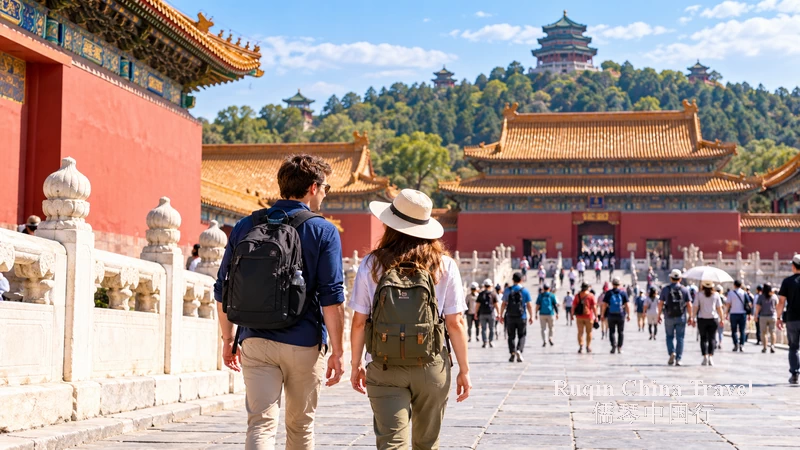
This is one of Beijing’s most underestimated walking days. The Forbidden City follows a south-to-north visitor flow. You enter through the Meridian Gate and normally leave through the Gate of Divine Prowess, so you cannot simply return to your starting point inside the palace.
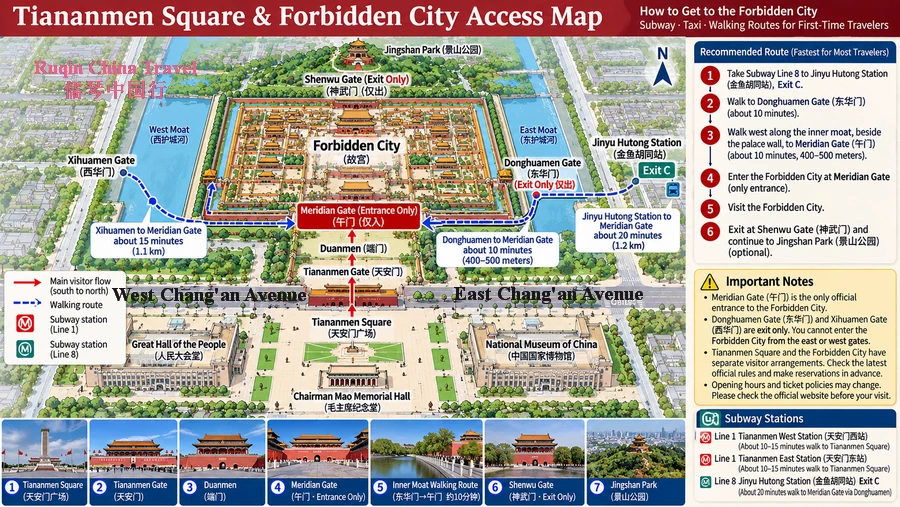
Tiananmen Square – Forbidden City Walking Map
The shortest central-axis visit is manageable for many travelers, but side palaces, the Treasure Gallery, Clock Gallery, cafés, and toilets add distance. Stone paving can also feel harder on the feet than the same distance on a smooth pavement.
Adding Jingshan Park is geographically logical because its south gate stands opposite the Forbidden City’s north exit. Physically, however, the climb to Wanchun Pavilion comes at the end of several hours on your feet. If your knees or energy are limited, enjoy the lower park or save the summit for another day.
I would not automatically add the Temple of Heaven simply because it appears nearby on an itinerary. The transfer, new security check, and another large park can turn a good day into an exhausting one.
Temple of Heaven
The Temple of Heaven is a park as well as a collection of historic buildings. The Hall of Prayer for Good Harvests, Imperial Vault of Heaven, Echo Wall, and Circular Mound Altar do not sit beside one another.
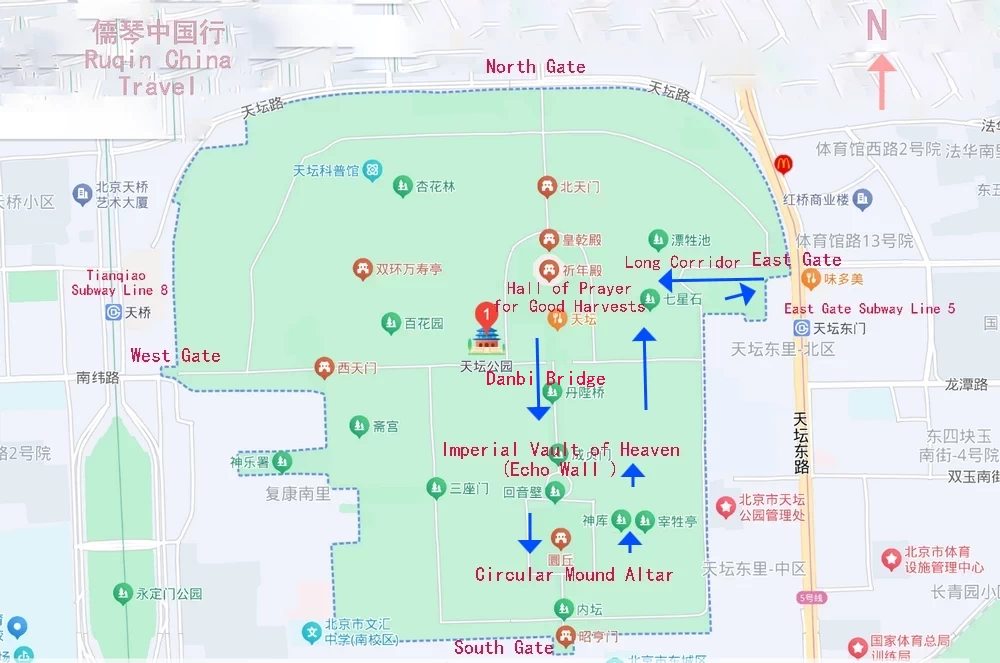
The Walking Route Map of the Temple of Heaven Park
Gate choice matters. Entering from one gate and leaving from another reduces backtracking. A north-to-south or south-to-north route normally works better than returning to the same entrance.
The main paths are broad and mostly manageable, but the site still involves steps around terraces and considerable open-air walking. In summer, start early. In winter, remember that cold wind across the open grounds can make a moderate distance feel longer.
Summer Palace
The Summer Palace occupies more than three square kilometres, although much of that area is Kunming Lake. A visitor who tries to see every garden, hall, hilltop structure, and lakeside landmark will cover a substantial distance.
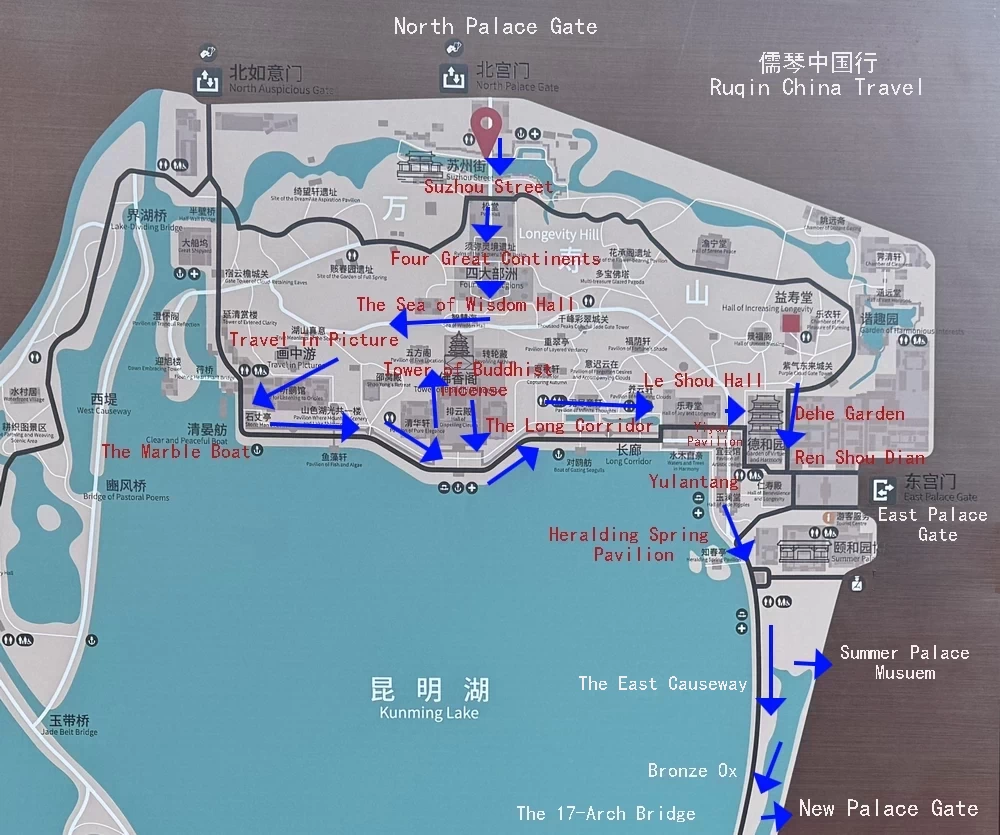
Summer Palace Walking Route Map
For a gentler visit, choose one main zone. The East Palace Gate, Long Corridor, Marble Boat, and nearby lakeside paths form a practical route. Climbing Longevity Hill adds stairs and effort; it should be optional, not something every member of a group must complete.
Boats can reduce walking when they are operating, but service depends on season, weather, water conditions, and daily arrangements. Do not build a mobility plan that fails if the boats are suspended.
Mutianyu Great Wall
Taking a cable car does not make Mutianyu a step-free visit. Travelers may still need to cross the visitor area, use the internal shuttle, walk uphill from the upper parking area, and manage steep or uneven steps near the Wall.

Best Mutianyu Great Wall Photo Spot and Walking Map
For a lower-effort plan, use the enclosed cable car serving the Watchtower 14 area, walk only as far as feels comfortable, then return by the same cable car. Do not buy a cable-car-up and toboggan-down combination unless everyone understands that it requires walking along the Wall between different tower areas.
The Wall is physically different from a city pavement. Uneven step heights, gradients, wind, heat, and limited seating matter more than the raw kilometre count.
Subway Travel Adds Hidden Steps
Beijing’s subway saves time and money, but it does not eliminate walking. Large stations may have long corridors, several flights of stairs, security screening, and exits spread across a major intersection.
A route with two transfers may add one or two kilometres before sightseeing begins. Older lines and some exits are less convenient for elevators than visitors expect. An accessible entrance may also be on the opposite side of the road from the shortest walking route.
Use the subway for long, direct journeys. For a short but awkward transfer between major sights, a licensed taxi or DiDi can protect your energy. This is especially useful after the Forbidden City, at the end of a Summer Palace visit, or when traveling with older parents.
How to Build a More Comfortable Itinerary
Alternate Heavy and Light Days
Place the Forbidden City, Summer Palace, and Great Wall on separate days. Between them, schedule a museum, one compact neighborhood, a performance, or a relaxed meal.
A balanced four-day plan might look like this:
- Heavy: Tian’anmen Square, Forbidden City, optional lower Jingshan Park
- Moderate: Lama Temple, one short hutong route, early dinner
- Heavy: Mutianyu Great Wall with cable car
- Moderate: Summer Palace lakeside route, without a full circuit
This plan still includes plenty of walking, but it avoids stacking the hardest sites back to back.
Choose One Main Sight Per Half-Day
Beijing rewards depth more than speed. A major palace or park already fills a morning. Security, toilets, meals, and transport take real time even when everything runs smoothly.
If you finish early and still feel comfortable, add something nearby. Do not make the optional stop essential to the success of the day.
Use the Correct Gate
At large sites, the right entrance can save both time and steps. Confirm the gate, subway exit, ticket requirement, and final exit before leaving your hotel.
The place name shown in English may not identify the gate you need. Save the Chinese name and a screenshot of the entrance on your map app.
Advice for Seniors, Families, and Travelers with Limited Stamina
Plan around the slowest person in the group. A traveler may walk comfortably on level ground but struggle with prolonged standing, stone paving, slopes, or repeated stairs.
Use elevators and cable cars where available, but confirm what walking remains at both ends. Carry a small bag, water, essential medicine, tissues, sun protection, and a light layer. Good shoes matter more than stylish shoes on Beijing’s stone surfaces.
Schedule a seated lunch rather than eating while walking. A 40-minute break in a restaurant can improve the whole afternoon.
Wheelchair users and travelers who require step-free access should consult attraction-specific accessibility information. Beijing has improved many facilities, but historic thresholds, bridges, hills, and older subway exits still create gaps.
Weather Changes the Effort
The same route feels very different in July heat, autumn sunshine, winter wind, or after snow. In hot weather, start early and shorten exposed midday walking. During rain or snow, stone steps and Great Wall paving may become slippery.
In winter, avoid assuming that cold weather makes walking easier. Heavy clothing, wind, short daylight, and icy surfaces can slow the day. In spring, wind and dust may also make long outdoor routes uncomfortable.
Ruqin’s Practical Advice
For a first Beijing visit, expect more walking than the itinerary appears to contain. A realistic target for many healthy travelers is one major attraction and one small nearby activity in a day—not three large sights joined by subway transfers.
If you enjoy long walks, Beijing can easily give you 15,000 to 20,000 steps. If your stamina, knees, mobility, age, or weather conditions call for a slower pace, shorten the route without feeling that you have missed the city. Choose the central part of each attraction, use a car when it genuinely saves effort, and keep one flexible afternoon for rest.
Further Reading
4-Day Beijing Itinerary for First-Time Visitors
How to Get Around Beijing: Subway, Bus, Bike & Walking Tips
Beijing City Walks: Routes, Maps & Essential Travel Tips
Your First Day in Beijing: A Low-Stress Arrival-Day Plan
Beijing Wheelchair Accessible Travel Guide
Mutianyu Great Wall for Senior Travelers: A Recommended Route