
Words by Ruqin · September 17, 2026
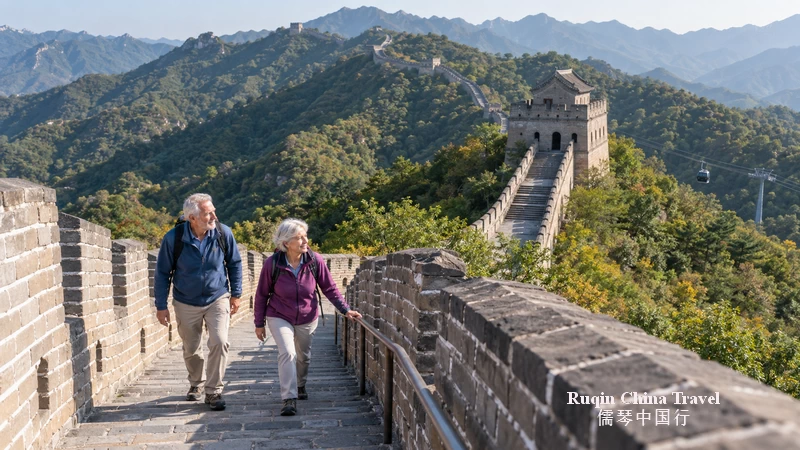
Mutianyu is often recommended to families traveling with older parents. It has an enclosed cable car, restored paths, good visitor facilities, and fewer bottlenecks than some sections of the Great Wall.
However, “cable car access” does not mean a step-free visit. Seniors must still manage some walking, slopes, uneven paving, and steps. The best plan is to take the cable car to Watchtower 14, walk only as far as everyone feels comfortable, and return by the same cable car.
For an older traveler who walks independently and can manage a short flight of steps, this can be a rewarding and realistic day. For someone who uses a wheelchair or cannot safely climb steps, Mutianyu may not be the right section. Badaling is generally better for wheelchair access and visitors with significant mobility limitations.
Is Mutianyu Suitable for Seniors?
Age alone is not the main issue. Mobility, balance, heart and lung health, knee strength, and confidence on uneven surfaces matter more.
Mutianyu can suit seniors who:
- Can walk for 20 to 30 minutes with breaks
- Can manage short flights of uneven steps
- Feel comfortable entering and leaving a moving cable-car cabin
- Can stand during short queues
- Do not need a completely step-free route
The visit becomes more difficult for travelers with severe knee pain, poor balance, limited walking endurance, or a recent injury. Wind, summer heat, rain, and icy paving can increase the effort considerably.
A cable car removes the long uphill climb from the valley. It does not remove every physical barrier between the parking area, entrance, cable-car station, and Wall.
The Recommended Mutianyu Route for Older Visitors
Mutianyu has more than one uphill transport system. For a straightforward senior visit, use the enclosed cable car serving the area around Watchtower 14.
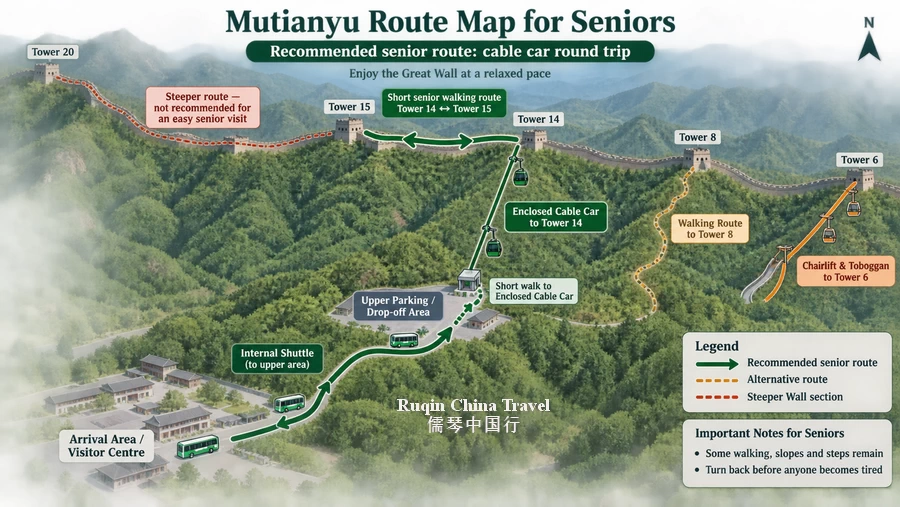
Mutianyu Great Wall Route Map for Seniors
The official Mutianyu website recommends a short route from the North Ticket Gate to the cable car, Watchtower 14, and Watchtower 15. It describes this as a leisurely route requiring light physical activity.
A Simple Step-by-Step Plan
- Arrive at the scenic area early.
- Take the internal shuttle if it is not included in your transport.
- Follow signs for the cable car to Watchtower 14.
- Buy a round-trip ticket for the same cable car.
- Ride up and take a break before entering the Wall.
- Walk toward Watchtower 15 only if everyone feels steady.
- Turn around before anyone becomes tired.
- Descend using the same cable car.
This route provides mountain views and time on the Great Wall without committing the group to a long hike.
Do not make Watchtower 20 the target simply because it is the highest developed point. The western route becomes steeper, and energy used on the outward walk is still needed for the return.
| Stage | Likely effort | Practical point |
|---|---|---|
| Beijing to Mutianyu | Mostly seated | Allow about 1.5–2 hours each way, depending on traffic |
| Arrival area to cable car | If you travel from Beijing to Mutianyu by public bus, you will normally need to take the internal shuttle from the ticket office to the upper parking area. From there, it is still about a 600-metre walk along a gently uphill paved path to the cable-car station. A private car or direct tourist bus may take you straight to the upper parking area. This allows you to skip the internal shuttle, although the final walk to the cable car remains. | A shuttle reduces distance but does not eliminate walking |
| Cable car to Tower 14 | From the upper cable-car station, you still need to climb more than 20 metres of steep steps to reach the viewing platform below Watchtower 14. This short section can be challenging for older visitors. | Use the enclosed cable car for both directions |
| Tower 14 to Tower 15 | Uneven paving and steps | Walk slowly and turn back whenever necessary |
| Return to vehicle | Downhill walking and queues | Save energy for this final section |
Do Not Confuse the Cable Car and Chairlift
Mutianyu has separate uphill systems serving different parts of the Wall.
The enclosed cable car reaches the area around Watchtower 14. This is generally the more practical choice for senior travelers because the cabin offers greater protection and the same system can be used for the return.

The cable cars at Mutianyu Great Wall
The chairlift and toboggan serve the lower-numbered tower area near Watchtower 6. They are operated separately from the Tower 14 cable car. Their lower stations and ticket arrangements are not interchangeable.
The toboggan is popular, but it should not be the foundation of a senior itinerary. The operator applies age, health, and safety conditions, and enforcement can change. Travelers also need enough mobility to board, control, and leave the sled safely.
For a calm visit, buy a round-trip Tower 14 cable-car ticket. This avoids crossing a long section of the Wall merely to reach a different downhill system.
How Much Walking Remains?
The exact distance depends on where your bus or driver stops, whether you use the internal shuttle, and which entrance is operating.
Expect walking through the visitor area, ticket checks, paths leading to the cable car, and the transition from the upper station to the Wall. Some surfaces are paved, but they may slope or become slippery.
If you travel from Beijing to Mutianyu by public bus, you will normally need to take the internal shuttle from the ticket office to the upper parking area. From there, it is still about a 600-metre walk along a gently uphill paved path to the cable-car station.

From the upper parking lot, you still need to have a 600-metre walk along a gently uphill paved path to the cable-car station.
A private car or direct tourist bus may take you straight to the upper parking area. This allows you to skip the internal shuttle, although the final walk to the cable car remains.
From the upper cable-car station, you still need to climb more than 20 metres of steep steps to reach the viewing platform below Watchtower 14. This short section can be challenging for older visitors.

Climb more than 20 metres of steep steps to reach the viewing platform below Watchtower 14.
Once on the Wall, the stones are not uniform. Steps vary in height and depth. Some sections have handrails, but visitors should not depend on continuous support.

The open platform below the Tower 16 at Mutianyu
A senior who can walk comfortably through a shopping center may still find the Great Wall harder. The difference is the combination of gradients, uneven steps, exposure to the weather, and limited places to sit.
Keep the first section short. A ten-minute walk followed by a pause is more sensible than pushing toward another tower and discovering that the return is too tiring.
Choose Comfortable Transport from Beijing
For seniors, transport should reduce unnecessary standing and transfers.
A private car with a driver is the easiest option. It provides hotel pickup, a flexible departure time, and somewhere to leave spare clothing. Confirm the return arrangement before leaving Beijing; do not assume that finding a suitable car at Mutianyu will be effortless.
A reputable direct tourist shuttle can also work well. Check its departure point, walking distance from the nearest subway exit, return time, and where it stops inside the Mutianyu area. Some services reduce the need to use the scenic-area shuttle, while others leave passengers farther away.
The public-bus route through Huairou is cheaper but involves transfers and more uncertainty. I would not choose it for an older traveler with limited stamina unless the group understands the route and is comfortable waiting for local buses.
Regardless of transport, a vehicle cannot take you directly onto the Great Wall. Some walking remains unavoidable.
Arrive Early and Avoid Extreme Weather
The official Mutianyu website currently lists peak-season hours from March 16 to November 15. It opens at 7:30 a.m., closing at 6:00 p.m. on weekdays and 6:30 p.m. on weekends. Off-season hours are listed as 8:00 a.m. to 5:30 p.m.
Opening hours can change for maintenance, weather, holidays, and special programs. Check again shortly before visiting.
An early start provides three advantages: cooler temperatures, shorter cable-car queues, and more time to walk without worrying about the final admission or descent.
Summer heat can be tiring because much of the Wall has little shade. In winter, wind and ice may make a short route unsafe. After heavy rain, wet stone steps require particular care.
If the forecast shows thunderstorms, strong wind, snow, or freezing conditions, reconsider the visit. Cable-car operations can be interrupted, and a senior should not be left with an unexpectedly difficult descent.
Tickets, Passports, and Senior Concessions
Buy the entrance ticket and cable-car ticket from official or clearly authorized channels. The scenic-area shuttle, admission, and cable car may be priced separately.
Senior discounts or free entrance can depend on age, nationality, identification, and current scenic-area policy. Carry each visitor’s original passport and ask which concession applies before paying. Currently, foreign visitors aged 60 and over are eligible for half-price admission. However, they must pay the full fare for the cable car and chairlift.
Even if a senior receives free or discounted general admission, the cable car and shuttle may still require separate tickets. Do not choose a difficult walking route merely to avoid these charges. The cable car is the part of the visit that makes Mutianyu practical for many older travelers.
Keep tickets and booking confirmations accessible. Avoid storing everything on one family member’s phone in case the group becomes separated at a checkpoint.
What Senior Travelers Should Carry
Bring water, essential medication, tissues, sun protection, and a light snack. Wear shoes with firm soles and good grip.
A light jacket is useful even when central Beijing feels warm. Mutianyu is in the mountains, where the temperature and wind can feel different from the city.
Keep the bag small. Carrying a heavy daypack affects balance and adds strain on steps. Another family member can carry shared water and extra clothing.
Use toilets before taking the cable car. Facilities on or close to the Wall may be less convenient, and reaching them can require additional walking.
Plan the Visit Around the Slowest Person
A family group does not need to remain together for every metre, but it does need a clear meeting plan.
After reaching Watchtower 14, the older traveler can complete a short walk and return with one companion. Fitter family members can continue farther only if there is enough time and everyone knows exactly where to meet.
Do not leave a senior waiting alone at an unfamiliar cable-car station without a working phone, ticket, or return instructions. Mobile reception is not a substitute for a simple plan.
Set a turnaround time before starting. The return journey often feels longer because the group is tired and afternoon queues may have formed.
When Badaling May Be a Better Choice
Mutianyu works well for seniors who remain independently mobile. It is not fully accessible for wheelchairs, and some transitions include steps or uneven paths.
Badaling may be the more suitable choice for a wheelchair user or someone unable to climb any steps. It has a more developed accessible route, although the exact section and operating arrangements should be confirmed before visiting.
Badaling also has easier rail connections from Beijing, but it can be much more crowded. The best section therefore depends on the traveler’s mobility, not simply which Great Wall destination is most popular.
If you are uncertain, describe the traveler’s abilities precisely when asking for advice. “Can walk 500 metres but cannot climb stairs” is more useful than “elderly.”
Ruqin’s Practical Advice
For most mobile seniors, I recommend the Tower 14 cable car and a short walk toward Watchtower 15. Use the same cable car to return. This provides a proper Great Wall experience without turning the visit into an endurance test.
Arrange a private car or simple direct shuttle, arrive early, and leave the afternoon flexible. Do not combine Mutianyu with several other distant attractions.
Most importantly, let the older traveler decide when to turn back. Reaching one watchtower comfortably is better than reaching three and struggling through the return journey.
More Great Wall Travel Guides
How to Get to Mutianyu Great Wall from Beijing
Mutianyu Great Wall Wheelchair Accessible Guide: Paths & Tips
Badaling Great Wall Wheelchair Accessible Guide: Ramps & Toilets
Mutianyu Great Wall Day Tour: A Practical One-Day Itinerary
Mutianyu vs Badaling: Best Great Wall Section for First-Timers
Senior Discounts for Foreign Visitors Aged 60+ in Beijing