
Written and updated by Ruqin
October 26, 2026
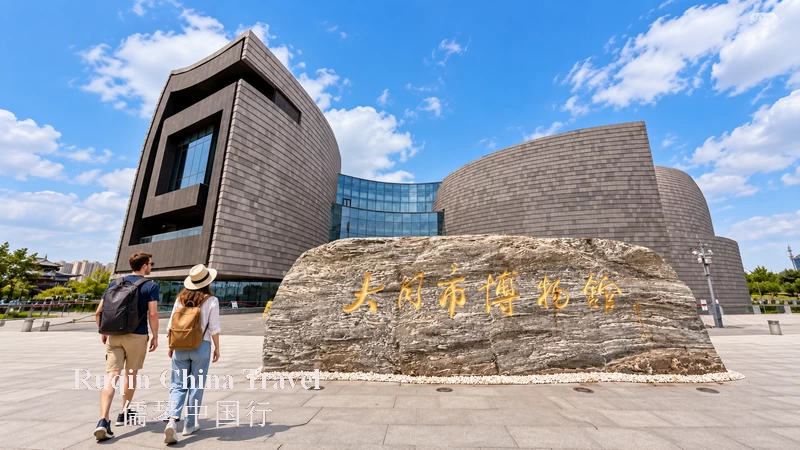
Datong Museum (大同市博物馆) is one of the best places to understand the history of Datong before exploring its ancient temples and Buddhist grottoes. Admission is free, but visitors must reserve a time slot in advance. Most travelers should allow approximately two to three hours.
Located in the eastern part of Datong, the museum houses an impressive collection of Northern Wei, Liao, and Jin dynasty artifacts. Its exhibitions explain how Datong developed from an important frontier settlement into one of northern China’s great historical capitals.
For first-time international visitors, I recommend including the museum if you have two or more days in Datong.
1. Why Visit Datong Museum?
Most international travelers come to Datong for the Yungang Grottoes (云冈石窟) and the Hanging Temple (悬空寺).
Both deserve their reputation. However, they represent only part of Datong’s long history.
During the Northern Wei dynasty, Datong was known as Pingcheng (平城). In 398, it became the dynasty’s capital and developed into a major political and cultural center.
The city later served as an important secondary capital during the Liao and Jin dynasties. Its location between the northern grasslands and China’s agricultural heartland encouraged centuries of cultural exchange.
Datong Museum helps explain these historical connections.
The museum’s collection includes more than 170,000 cultural objects, with over 3,000 classified as precious cultural relics. The present museum building opened in December 2014 and is recognized as a national first-class museum.
Rather than simply displaying ancient objects, the museum follows Datong’s development through different historical periods.
You can see pottery figures, Buddhist sculptures, architectural decorations, ceramics, and other objects that help explain the city’s past.
Ruqin’s suggestion: If you enjoy Chinese history, visit the museum before exploring Datong’s major historical sites. You will understand much more of what you see afterward.
2. Datong Museum Tickets and Opening Hours
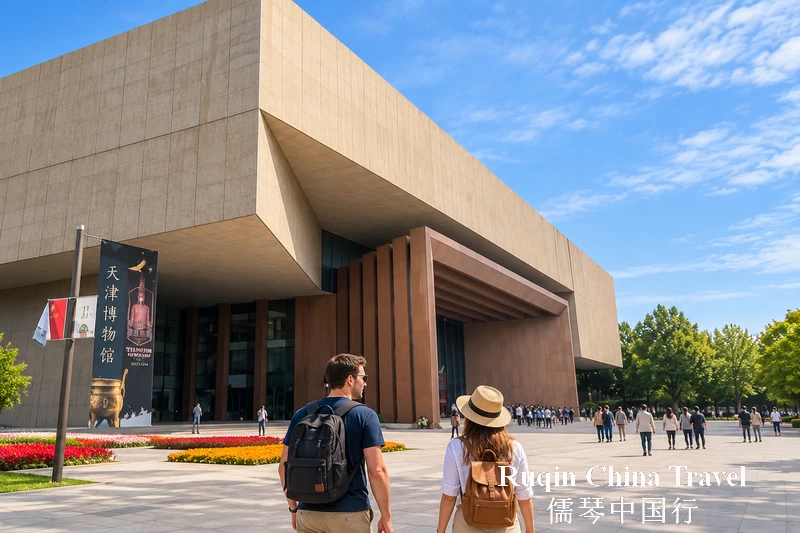
Datong Museum is located at No. 506 Taihe Road (太和路506号), Pingcheng District, Datong.
It stands in the Yudong area, east of the ancient city.
This is important when planning your visit. The museum is not within the old city walls, so you should allow additional time for transportation.
Opening Hours
According to the Datong Municipal Cultural Relics Bureau’s official announcement dated August 6, 2026:
- Tuesday–Sunday: 9:00 a.m.–5:00 p.m.
- Last admission: 4:30 p.m.
- Monday: Closed, except during statutory public holidays.
- Admission: Free, with advance reservation required.
- Telephone: 0352-2303518.
Opening arrangements may change during major holidays or special events. Check the museum’s official WeChat account before visiting.
An important reminder: Monday, October 26, 2026, is a regular closing day. Visitors planning to go today should choose another date.
3. How to Reserve Free Datong Museum Tickets
Admission to Datong Museum (大同市博物馆) is free, but visitors to the main museum must make a real-name reservation.
International travelers can use their passports to book tickets through the museum’s official WeChat account or reservation website. If you have trouble booking online, museum staff can also help you register in person at the entrance.
There are three ways to arrange your free admission.
Option 1: Book Through WeChat (Recommended)
For most visitors, the official WeChat account is the easiest booking method.
- Open WeChat and search for 大同市博物馆 (Datong Museum).
- Follow the museum’s official account and select 门票预定 (Ticket Reservation) from the bottom menu.
- Choose 护照 (Passport) as your identification document. Other supported documents include certain Hong Kong, Macao, and Taiwan travel permits and the Foreign Permanent Resident ID Card.
- Select your visiting date and available entry time.
- Enter your name and passport number exactly as they appear on your passport.
- Submit your reservation and save a screenshot of the confirmation QR code.
When you arrive, show your reservation QR code and original passport to the entrance staff for verification.
Option 2: Book Through the Official Website
If you prefer not to use WeChat, you can also try the museum’s official website.
Look for 预约服务 (Reservation Service), select your identification type, and enter your passport information.
Check Datong Museum Official Booking Platform ( Chinese only )
The reservation process is similar to the WeChat system.
Remember to save your booking confirmation and bring your original passport on the day of your visit.
Option 3: Get Help Booking at the Museum Entrance
This is particularly useful for international travelers who have difficulty using Chinese booking platforms.
If you cannot complete the online reservation, you can bring your original passport directly to the museum’s visitor service center.
Staff can assist with manual registration and help arrange free admission.
Once your registration is completed, you can enter using the registration confirmation.
However, I recommend arriving early, especially during weekends and Chinese public holidays. On-site assistance should not be treated as a guarantee of admission when visitor capacity has been reached.
Important Reservation Tips for International Travelers
- Booking window: Reservations can be made up to seven days in advance, including the visiting day.
- Daily ticket allocation: The reported system provides 9,000 advance tickets and another 3,000 tickets released at varying times on the visiting day.
- Passport verification: Bring your original passport. A photograph or photocopy is not a substitute for the original document.
- Free admission: Official reservations are free. There is no need to pay a third-party agent for an ordinary admission ticket.
- Cancellation: If your plans change, cancel your reservation through the booking system. Under the reported policy, three missed reservations may result in a 30-day booking restriction.
Ruqin’s Practical Tip: I recommend reserving through WeChat before your visit. However, if you cannot complete the Chinese-language booking process, don’t immediately give up. Bring your passport to the museum’s visitor service center and ask for assistance.
The museum is normally open Tuesday to Sunday, from 9:00 a.m. to 5:00 p.m., with last admission at 4:30 p.m. It is generally closed on Mondays except during statutory public holidays.
4. How to Get to Datong Museum
Datong Museum (大同市博物馆) is located at No. 506 Taihe Road (太和路506号), in the Yudong area east of Datong Ancient City.
The museum is about 6–7 km by road from Datong Ancient City and approximately 6 km from Datong South Railway Station (大同南站).
You can reach it by taxi, DiDi, or public bus. For most international travelers, a taxi or DiDi is the easiest option. However, public buses are inexpensive and convenient if you have a little more time.
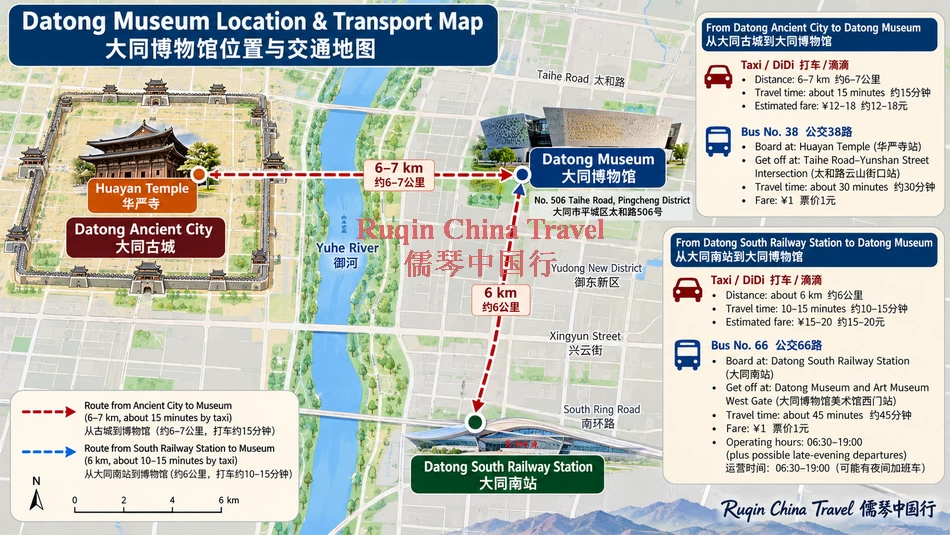
Datong Museum Location and Transport Map
From Datong Ancient City to Datong Museum
If you are staying near Huayan Temple (华严寺) or elsewhere in Datong Ancient City, you have two practical options.
Option 1: By Taxi or DiDi (Recommended)
- Distance: Approximately 6–7 km
- Travel time: Around 15 minutes in light traffic
- Estimated fare: ¥12–18
Enter 大同市博物馆 into DiDi or show the driver the museum’s Chinese address:
大同市平城区太和路506号
One thing to remember: some streets in the historic center restrict motor vehicles. If you are staying near Huayan Temple, you may need to walk to a designated pickup point outside the restricted area.
I recommend taking a taxi or DiDi if you are traveling with seniors, children, or anyone who prefers to avoid changing buses.
Option 2: By Public Bus No. 38
Bus No. 38 provides an inexpensive connection between the ancient city area and the museum.
- Board at: Huayan Temple Bus Stop (华严寺站)
- Get off at: Taihe Road–Yunshan Street Intersection (太和路云山街口站)
- Travel time: Approximately 30 minutes
- Fare: Around ¥1 per person
The bus stop is close to the museum, so you should only need a short walk after getting off.
Before leaving, check the current route and stop locations using Gaode Maps (高德地图) or Baidu Maps (百度地图).
From Datong South Railway Station to Datong Museum
Datong South Railway Station (大同南站) is Datong’s main high-speed railway station.
The museum lies approximately 6 km north of the station, making it a convenient stop if you arrive in Datong by train.
Option 1: By Taxi or DiDi (Recommended)
- Distance: Approximately 6 km
- Travel time: Around 10–15 minutes
- Estimated fare: ¥15–20
After leaving the station, follow the signs to the official taxi rank or the designated ride-hailing pickup area.
For a taxi driver, show the destination:
大同市博物馆 — Datong Museum
This is the most convenient option if you have limited time or are unfamiliar with Datong’s bus network.
Option 2: By Public Bus No. 66
Bus No. 66 connects Datong South Railway Station with the museum area.
- Board at: Datong South Railway Station (大同南站), at the station’s bus interchange
- Direction: Toward Datong Railway Station (大同站)
- Get off at: Datong Museum and Art Museum West Gate (大同博物馆美术馆西门站)
- Travel time: Approximately 45 minutes
- Fare: Around ¥1 per person
From the bus stop, allow about two minutes to walk to the museum entrance.
The regular operating hours are approximately 6:30 a.m. to 7:00 p.m., with buses generally running every 4–10 minutes. Additional late-evening departures may operate to accommodate arriving trains.
However, do not rely on these extra departures without checking the current timetable.
How to Pay for Public Buses in Datong
You can generally pay using Alipay (支付宝).
Open Alipay, select Transport (出行), choose Datong, and activate the available local bus QR code.
Scan the code when boarding, following the driver’s instructions.
This is convenient for international travelers who already use Alipay in China. If you cannot activate the local bus code, ask whether cash payment is accepted and carry small change.
Practical Tips for Visiting Datong Museum
If you are staying in Datong Ancient City, I recommend taking a taxi or DiDi to the museum. The journey is short, and the fare is relatively inexpensive.
If you arrive at Datong South Railway Station without heavy luggage, Bus No. 66 is a budget-friendly option. However, a taxi saves time.
Remember that the museum normally closes at 5:00 p.m., with last admission at 4:30 p.m. Arriving on a late-evening train will not leave time for a museum visit that day.
Ruqin’s Practical Tip: For a relaxed visit, take a taxi or DiDi from Datong Ancient City to the museum in the morning. Spend two to three hours exploring the exhibitions, then return to the ancient city for lunch and an afternoon walk around Huayan Temple and the surrounding streets.
5. Free Luggage Storage at Datong Museum
Good news for travelers arriving with suitcases! Datong Museum (大同市博物馆) offers free luggage storage, including space for larger suitcases and backpacks.
This is particularly convenient if you arrive at Datong South Railway Station (大同南站) and want to visit the museum before checking into your hotel.
Where to Store Your Luggage
The museum provides two luggage storage options:
- Small bags: Self-service lockers are available near the entrance hall. You can store and collect your belongings yourself.
- Large suitcases and backpacks: Ask the staff near the security checkpoint or visitor service center for assistance with luggage storage.
If the self-service lockers are full, speak to the entrance staff. They may be able to help you find another storage option.
Luggage Storage Hours
The luggage storage service follows the museum’s regular opening hours:
- Tuesday–Sunday: 9:00 a.m.–5:00 p.m.
- Monday: Closed, except during statutory public holidays.
Although the museum stops admitting visitors at 4:30 p.m., you can still collect your luggage afterward. However, make sure to retrieve everything before the museum closes at 5:00 p.m.
Important Things to Know
Luggage storage at Datong Museum is free. You do not need to pay a third-party storage service.
Keep your passport, wallet, phone, cash, and other valuables with you. Dangerous or flammable items cannot be stored.
If you are traveling with an oversized suitcase, it is sensible to confirm storage availability with the museum staff before starting your visit.
Ruqin’s Practical Tip: If you arrive at Datong South Railway Station in the morning, you can take a taxi or DiDi directly to Datong Museum, store your suitcase, and spend two to three hours exploring the exhibitions. Afterward, collect your luggage and continue to your hotel in Datong Ancient City. This can save you an unnecessary trip back and forth.
6. What to See at Datong Museum: Floor-by-Floor Highlights & Visiting Route
Datong Museum has three main exhibition floors, covering the city’s history from prehistoric times to the Ming and Qing dynasties.
For first-time visitors, I recommend following the exhibitions floor by floor. Allow around two to three hours for a comfortable visit.
The second floor is the highlight of Datong Museum. It houses some of the museum’s most important Northern Wei artifacts, including painted pottery figures, blue glass vessels, and objects associated with the tomb of Sima Jinlong.
Here is what to see on each floor and which historical treasures you should not miss.
First Floor (一层): Early Datong History & Dinosaurs
Main Exhibition Halls:
- Early History of Datong (沧桑代地)
- Datong Dinosaurs (大同恐龙)
Start your visit on the first floor, where the exhibitions introduce Datong’s history before it became an important imperial capital.
The Early History of Datong exhibition covers the region from prehistoric times through the Qin and Han dynasties. You will see archaeological discoveries, ancient pottery, bronze objects, and evidence of early human settlement.
The dinosaur exhibition is particularly interesting for families with children. It features fossils discovered in the Datong region, including impressive dinosaur skeletons.
First-Floor Must-See Artifacts (一层必看文物)
1. Bronze Ox-Shaped Ritual Vessel (青铜牛牺尊)
This bronze vessel, dating from the Shang dynasty, is shaped like an ox.
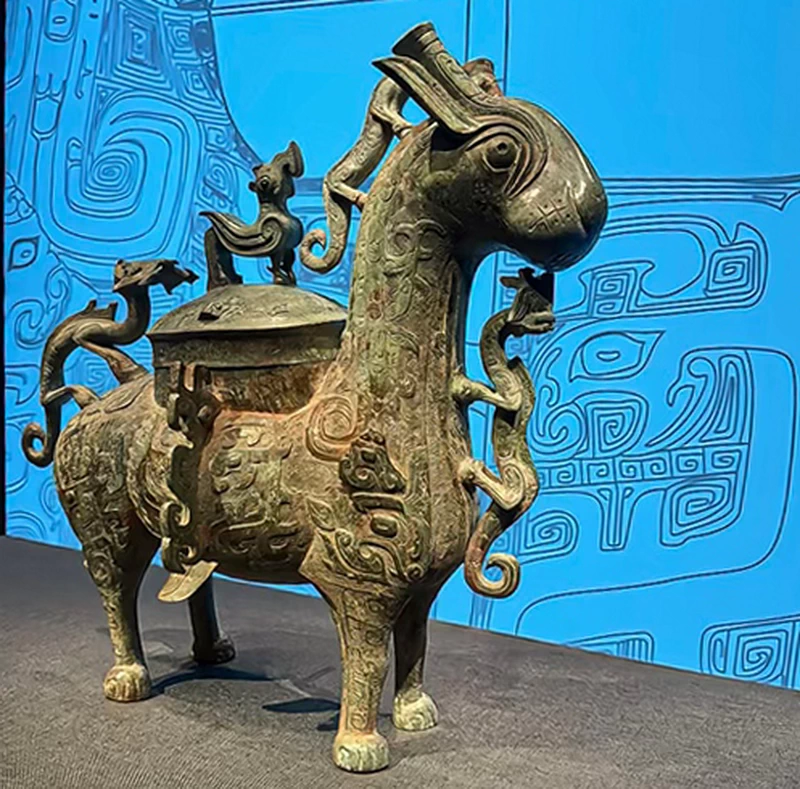
Bronze Ox-Shaped Ritual Vessel (青铜牛牺尊)
Its rounded body and carefully crafted animal features make it an attractive example of ancient Chinese bronze craftsmanship.
Look closely at the animal’s shape and decorative details. Bronze ritual vessels were important objects in ancient Chinese ceremonial life.
2. Tianzhen Ankylosaurus Fossils (天镇甲龙化石)
One of the most eye-catching displays is the collection of Tianzhen ankylosaurus fossils.
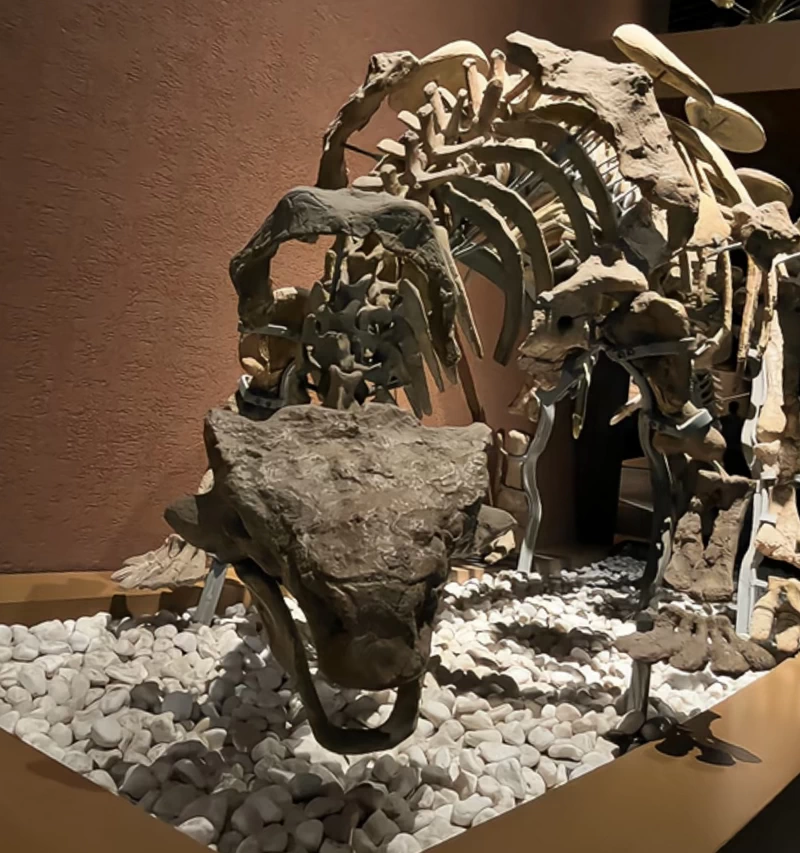
Tianzhen Ankylosaurus Fossils (天镇甲龙化石)
The exhibition features five reconstructed dinosaur skeletons associated with discoveries in the Tianzhen area of Datong.
These armored dinosaurs lived millions of years before the city’s recorded history.
If you are visiting with children, allow extra time here. The large skeletons are often easier for younger visitors to appreciate than displays of smaller archaeological objects.
Second Floor (二层): Northern Wei Capital — The Museum’s Main Highlight
Main Exhibition Hall: Northern Wei Capital (魏都平城)
If you have limited time, this is the floor I recommend prioritizing.
During the Northern Wei dynasty (386–534), Datong was known as Pingcheng (平城). It served as the dynasty’s capital from 398 to 494.
The city became an important political and cultural center, bringing together the traditions of the Xianbei people and other communities across northern China.
The second-floor exhibitions contain remarkable objects from this period, including pottery figures, Buddhist sculptures, glass vessels, and artifacts recovered from aristocratic tombs.
Second-Floor Must-See Artifacts (二层必看文物)
1. Painted Lacquer Screen from Sima Jinlong’s Tomb (司马金龙墓漆画屏风)
This is one of the most celebrated artworks associated with Northern Wei Datong.
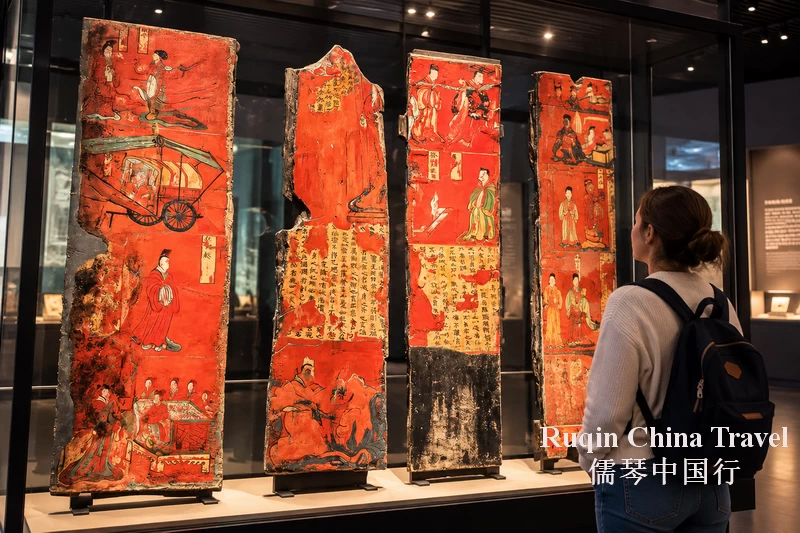
Painted Lacquer Screen from Sima Jinlong’s Tomb (司马金龙墓漆画屏风)
The original painted lacquer screen was discovered in the tomb of Sima Jinlong (司马金龙), an important Northern Wei official.
Its painted panels depict historical figures and moral stories, including examples of filial devotion and virtuous behavior.
The paintings offer a rare glimpse into the artistic traditions and social values of fifth-century China.
Important: The screen displayed at Datong Museum is a reproduction. The original is preserved at the Shanxi Museum (山西博物院) in Taiyuan.
Even as a reproduction, it is worth seeing because it helps explain the artistic achievements of the Northern Wei period.
2. Northern Wei Blue Glass Vessels (北魏蓝玻璃器)
These striking blue glass vessels are among the most unusual objects associated with Northern Wei Datong.
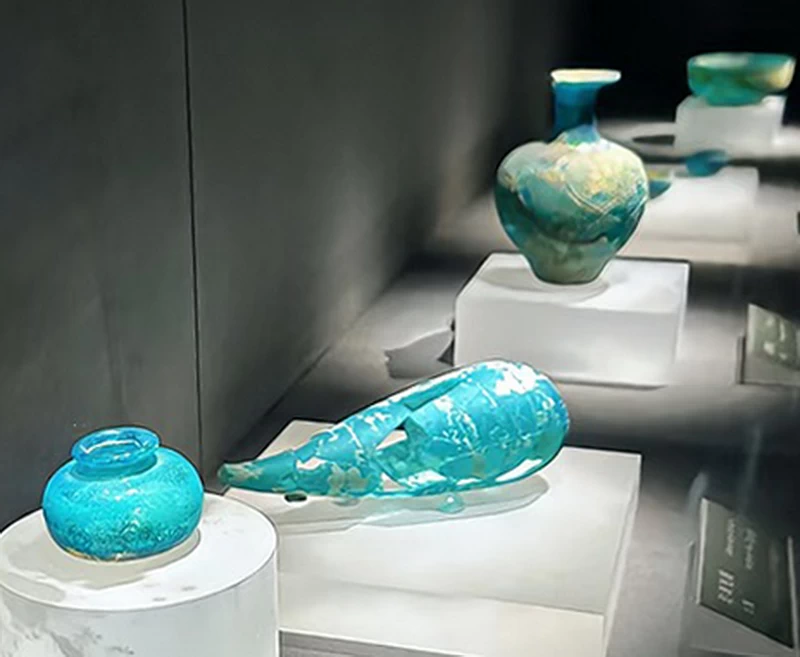
Northern Wei Blue Glass Vessels (北魏蓝玻璃器)
Their deep blue color and delicate craftsmanship reflect glassmaking traditions connected with the Sasanian Persian world.
They also provide evidence of the long-distance cultural and commercial exchanges that linked northern China with Central and Western Asia.
Take a moment to examine their shape and color.
For travelers interested in the ancient Silk Road, these objects are particularly fascinating.
3. Pottery Figurine Procession from Sima Jinlong’s Tomb (司马金龙墓陶俑阵)
This impressive display features a large ceremonial procession of pottery figures discovered in Sima Jinlong’s tomb.
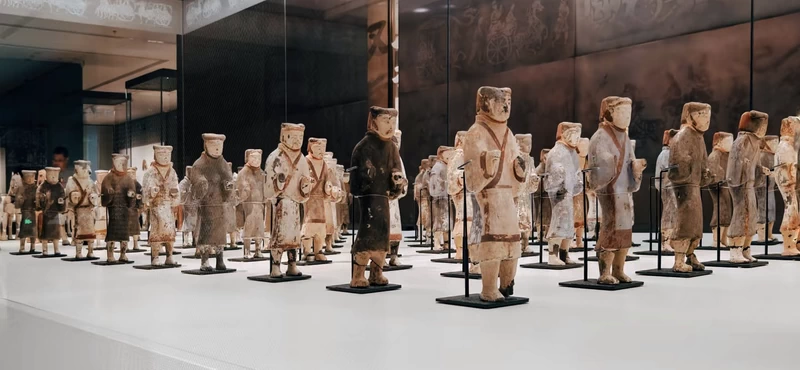
Pottery Figurine Procession from Sima Jinlong’s Tomb (司马金龙墓陶俑阵)
The burial assemblage is reported to include 238 figures, representing soldiers, attendants, horses, and other members of an aristocratic procession.
Sometimes described as the “Northern Wei Terracotta Army,” the figures offer a vivid picture of military organization, clothing, hairstyles, and social hierarchy during the Northern Wei dynasty.
Look carefully at the different figures.
You can see how clothing and ceremonial arrangements reflected the cultural traditions of northern China at that time.
For me, this is one of the most memorable displays in the museum.
Ruqin’s Tip: Spend at least 45–60 minutes on the second floor. If you plan to visit the Yungang Grottoes (云冈石窟), the Northern Wei exhibitions will give you valuable historical background before you see the Buddhist sculptures carved into the cliffs.
Third Floor (三层): Liao, Jin, Ming, Qing & Buddhist Art
Main Exhibition Halls:
- Liao and Jin Western Capital (辽金西京)
- Ming and Qing Frontier City (明清重镇)
- Buddhist Art (梵语清音)
The third floor explores Datong’s later history, particularly its role as an important city during the Liao, Jin, Ming, and Qing dynasties.
During the Liao and Jin periods, Datong was known as Xijing (西京), or the Western Capital.
The exhibitions include ceramics, architectural decorations, religious objects, and artifacts from daily life.
These displays are especially useful if you plan to visit Huayan Temple (华严寺) or Shanhua Temple (善化寺), both known for their historical architecture.
The Ming and Qing exhibition explains Datong’s later development as a frontier military and commercial center.
The Buddhist Art exhibition introduces the region’s religious traditions through sculptures and other Buddhist objects.
Third-Floor Must-See Artifact (三层必看文物)
Liao Dynasty Glazed Ceramic Chiwen Roof Ornament (辽代琉璃鸱吻)
This enormous glazed architectural ornament is one of the most impressive objects associated with Datong’s Liao dynasty heritage.
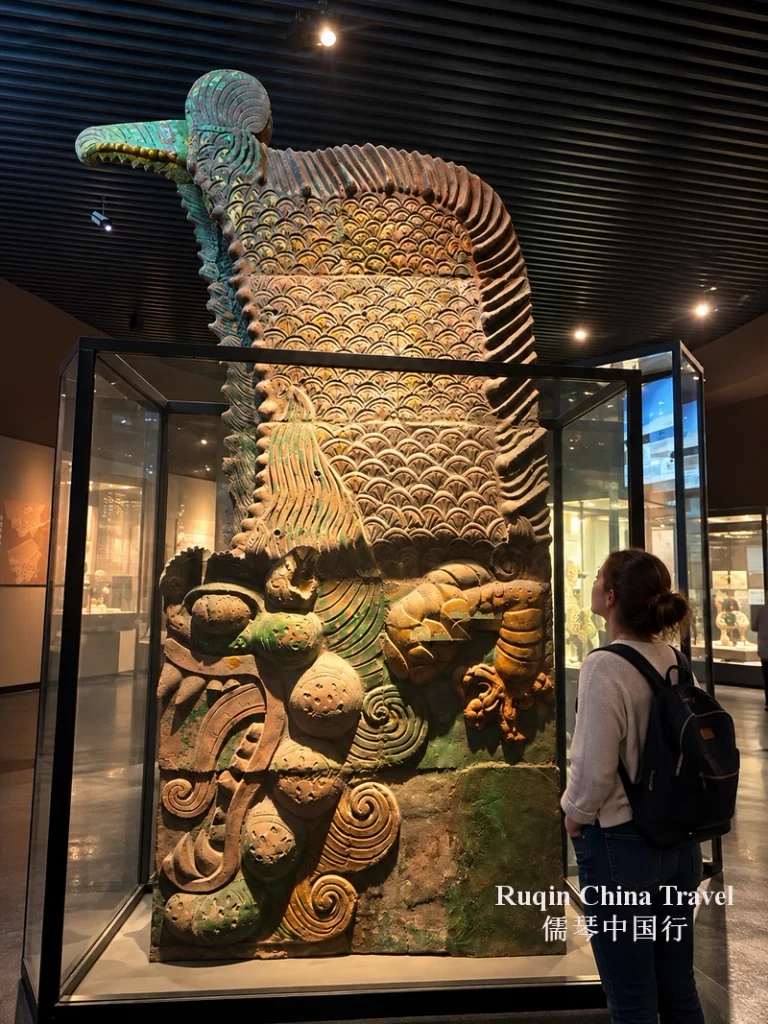
Liao Dynasty Glazed Ceramic Chiwen Roof Ornament (辽代琉璃鸱吻)
Originally from the main ridge of a hall at Huayan Temple, the ornament stands nearly three meters tall.
Its design combines features of a dragon’s head and a fish-like body.
In traditional Chinese architecture, chiwen (鸱吻) ornaments were placed at the ends of roof ridges. They served both decorative and symbolic purposes.
Look closely at the detailed craftsmanship and the glazed surface.
The ornament gives you a sense of the scale and sophistication of Liao dynasty temple architecture.
If you visit Huayan Temple afterward, you will better appreciate the architectural details of its historic buildings.
My Recommended Two-to-Three-Hour Visiting Route
For a first visit, I suggest the following route:
First 30–40 minutes — First Floor (一层)
Start with the Early History of Datong (沧桑代地) and Datong Dinosaurs (大同恐龙) exhibitions.
Focus on the Bronze Ox-Shaped Ritual Vessel (青铜牛牺尊) and Tianzhen Ankylosaurus Fossils (天镇甲龙化石).
Next 60 minutes — Second Floor (二层)
Spend most of your time in Northern Wei Capital (魏都平城).
Prioritize the Painted Lacquer Screen (司马金龙墓漆画屏风), Northern Wei Blue Glass Vessels (北魏蓝玻璃器), and Pottery Figurine Procession (司马金龙墓陶俑阵).
This is the most important part of your museum visit.
Next 40–50 minutes — Third Floor (三层)
Explore Liao and Jin Western Capital (辽金西京), Ming and Qing Frontier City (明清重镇), and Buddhist Art (梵语清音).
Do not miss the Liao Dynasty Glazed Ceramic Chiwen Roof Ornament (辽代琉璃鸱吻).
Final 10–15 minutes — Return to Your Favorite Exhibition
If you have time remaining, return to the exhibition that interested you most or explore any temporary displays.
Exhibition locations and individual objects may change during renovations or special exhibitions. Check the floor directory when you arrive.
Ruqin’s Practical Tip: If you only have 90 minutes, skip a detailed tour of the first floor and head directly to the Northern Wei exhibition on the second floor. Then spend your remaining time exploring the Liao and Jin collections on the third floor.
These two floors provide the best historical introduction to Datong’s most famous attractions, particularly the Yungang Grottoes and Huayan Temple.
7. Datong Museum or Yungang Grottoes: Which Should You Visit First?
These two attractions offer different experiences.
Yungang Grottoes is an extraordinary collection of Buddhist sculptures carved directly into cliffs.
Datong Museum is an indoor historical museum that explains the political, cultural, and artistic background of the region.
If you have only one day in Datong, I would prioritize Yungang Grottoes.
The grottoes are the city’s most internationally recognized attraction and deserve several hours.
However, if you have two days, the museum becomes a worthwhile addition.
My preferred arrangement would be to visit the museum first, then explore the grottoes on the following day.
This allows you to learn about the Northern Wei dynasty before seeing one of its greatest artistic achievements.
If your schedule works better in the opposite order, that is perfectly reasonable too.
The important thing is not to squeeze both attractions into an already crowded itinerary.
8. Practical Tips for Families, Seniors and First-Time Visitors
Datong Museum is a useful alternative to spending an entire day walking through outdoor attractions.
This is particularly relevant during winter, when Datong can be very cold.
For Senior Travelers
Allow more time than the standard two-hour visit if you prefer a relaxed pace.
Concentrate on the exhibitions that interest you most rather than trying to see everything.
The museum is a modern building, but visitors with specific mobility requirements should confirm accessible entrances, lifts, and wheelchair arrangements directly with the museum.
For Families With Children
Start with the dinosaur exhibition if your children enjoy prehistoric animals.
Then introduce the Northern Wei pottery figures.
The miniature soldiers, horses, and attendants can help children imagine life in ancient China.
Keep the visit reasonably short for younger children.
A focused 60–90-minute visit may be more enjoyable than a lengthy tour of every gallery.
Photography
Check the photography signs in each exhibition hall.
Museums may allow ordinary photography while restricting flash, tripods, or photography of particular objects.
Never touch displayed artifacts or cross protective barriers.
Language
Some exhibitions provide English information, but the amount of translation may vary.
A phone translation app can help you understand Chinese-only explanations.
If you are particularly interested in history, consider asking whether the museum currently offers English-language interpretation or audio guides.
9. Common Mistakes to Avoid
The first mistake is arriving on a Monday without checking the opening schedule.
Datong Museum normally closes on Mondays, except during statutory holidays.
The second is assuming that free admission means no reservation is needed.
The main museum still uses a real-name booking system.
Another mistake is underestimating the distance from Datong Ancient City.
Although both attractions are in Pingcheng District, they are not part of the same compact walking area.
Finally, avoid planning your museum visit too late in the afternoon.
Even though last admission is officially 4:30 p.m., entering at that time leaves little opportunity to explore the collections.
For a comfortable visit, I recommend arriving before 2:00 p.m.
10. How to Include Datong Museum in Your Itinerary
If you have two days in Datong, I recommend reserving part of your first day for the museum.
You could visit the museum in the morning, have lunch, and then explore Datong Ancient City in the afternoon.
This creates a balanced day combining indoor historical exhibitions with outdoor sightseeing.
On your second day, visit the Yungang Grottoes.
Travelers who also want to see the Hanging Temple should consider allowing additional time or arranging transportation carefully.
I would not recommend adding Datong Museum to an already demanding itinerary involving Yungang Grottoes, Hanging Temple, and Yingxian Wooden Pagoda on the same day.
Datong deserves a little more time than many visitors initially expect.
Ruqin’s Practical Tip
Datong Museum is more than a place to spend a few hours indoors.
It provides the historical background that connects many of the city’s famous attractions.
If you have enough time, visit the Northern Wei exhibition before going to Yungang Grottoes. Then, when you stand before the enormous Buddhist sculptures, you will have a better understanding of the people and history behind them.
Before leaving your hotel, remember to check three things: your reservation, the museum’s opening schedule, and the transportation route.
With these details arranged, visiting Datong Museum is straightforward.
You May Also Like
Datong Travel Guide: Map, Walking Routes, Highlights and Tips
Beijing to Datong Day Trip by High-Speed Train DIY Guide
How to Book Datong Attraction Tickets: All You Need to Know
How to Get from Beijing to Datong: Map, Train, Flight and Bus
Datong to Xi’an High‑Speed Train: Tickets, Tips & What to Expect