Ruqin’s Notes | February 15, 2026
Tomorrow is Lunar New Year’s Eve. Today feels almost too calm.
It is February 2026. The temperature swings between 7°C and 21°C—a mild winter day in Hangzhou. In the afternoon, I walk around my community, as I often do. I grew up here. I left. Then I came back home. Now, I observe.
This year, it is a Quiet Chinese New Year.
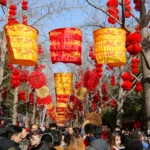
A few lanterns hang at the gates of my community, placed there more out of obligation than celebration. They look inexpensive. Mass-produced. Not to celebrate with heart. I pause and look at them. They feel symbolic. Decoration without emotion.

A few lanterns hang at the gates of my community
Meanwhile, the local street office—the most basic level of administration in China—has already hung a large banner in a prominent spot: “No fireworks or firecrackers. Safety must not be relaxed.” The message is clear. Order first. Celebration second. The banner sets the tone for this Quiet Chinese New Year.

“No fireworks or firecrackers. Safety must not be relaxed.”
So I walk up Turtle Hill inside my community. From the top, I look out over the roads. Traffic is thinning. Students have gone home. Migrant workers have gone home. Office workers have gone home. In China, Spring Festival still means migration. The city exhales.

Traffic is thinning
Fifty years ago, Hangzhou had a population of about one million. Now, the permanent resident population exceeds 12 million. It is one of China’s fastest-growing cities. This is the birthplace of Alibaba. This is where DeepSeek was born. Opportunity draws people here. Technology reshapes life here.
And yet today, it feels quiet.
As a boomer, I carry a different memory of the New Year. In my childhood, Chinese New Year was loud. Firecrackers exploded day and night. Smoke filled the air. Neighbors visited each other without appointment. Everyone was equally poor. That equality created a strange unity. We all waited for the same thing: new clothes on the first day of the year, meat dishes we could not afford during ordinary months, and red envelopes with a few precious bills inside.
Now life is better. Materially, much better. But this Quiet Chinese New Year feels emotionally thinner.
Tomorrow, I will drive about 100 kilometers to Huzhou to visit my parents-in-law. Then I will return to Hangzhou to see my father. He is 93 years old. My mother passed away in 2017. I still think of her during holidays.
In my generation—those of us born in the 1960s and 70s—we still believe caring for our parents is our responsibility. It is not something we debate. It is simply what we do. However, I sometimes wonder if we are the last generation to feel this way. Some of the best traditions in Chinese culture are slowly fading.
My son lives abroad. I do not expect him to take care of me in old age. His world is different. The younger generations—those born in the 1990s and 2000s—face global mobility, high pressure, and individual choices we never had. I do not blame them. Times change.
Before the holiday officially begins, I take care of practical matters. Late this afternoon, I do two things: I fill up the gas tank and wash the car. My car has been a reliable partner in my life. It carries me between cities. It carries gifts. It carries responsibility.

I fill up the gas tank
I drive to the nearest PetroChina gas station. Several cars are lined up. Interestingly, only one car is actually filling gas. The others are waiting for the free car wash offered by the station. Free service is a competitive tool here. China is highly competitive. Businesses fight for customers in visible ways.

Inside the Gas Station Shop
After filling up, I go inside to pay. I use the PetroChina WeChat app. I still have more than 600 yuan in my account. The gas costs 320 yuan. The payment takes seconds. Digital life in China is efficient. Frictionless. Sometimes almost invisible.
The staff member tells me I can receive two free cups of hot coffee. I politely decline. I do not like free things attached to transactions. They always come with calculation behind them.
I also skip the free car wash.

The small and shabby car wash shop
Instead, I drive to the small car wash shop I have used for years. It is old-fashioned. The owner is a local villager. He often washes cars himself. He hires one or two helpers most of the year. However, this season is different. His regular helpers have already returned to Henan for the New Year. So today, two of his relatives are helping him.
Business looks slightly better than usual. On the wall, I notice the price list. The new price—50 yuan per car—is pasted directly over the old 35 yuan price. It is a simple adjustment. Transparent. Seasonal. I accept it without complaint. It is almost New Year. They are still working. That matters.
Across from the car wash is a flower and plant shop. I see customers coming in and out. Finally, a small sign of festivity. The owner is not local. His family stays in Hangzhou during the holiday to continue operating the business. I have bought plants from him before. He works long hours. Many people like him still believe that consistent effort, year after year, will eventually create a better life.

The flower and plant shop
I respect that belief. I grew up with it.
After returning home, I open the Sam’s Club app. I order New Year gift packages. Within twenty minutes, the delivery man calls. Shortly after, the gifts arrive. Efficiency again. Two sets. One for my parents-in-law. One for my father.
The gifts are practical: protein powder imported from New Zealand, American ginseng ginseng tea, and Changbai Mountain ginseng. At this stage of life, health is the most meaningful gift.

Part of My New Year gift packages
When I was young, I could not wait for Chinese New Year. The excitement was physical. Now, it feels different. People gather, but conversations sometimes feel shallow. Social classes have widened. Income gaps have widened. Opinions have widened. In the AI era, everyone lives inside their own information bubble. It is harder to truly talk.
That is perhaps why this Quiet Chinese New Year feels so noticeable to me.
Hangzhou is greener than many cities, even in winter. My community remains surrounded by trees. Life continues. Development continues. Convenience improves. But emotionally, something has shifted.
Still, I do not feel pessimistic.
Every era changes the meaning of tradition. What remains constant is responsibility. Tomorrow I will drive. I will visit family. I will sit with my 93-year-old father. I will bring gifts. I will ask about his health. These actions matter more than fireworks.
This Quiet Chinese New Year may not be loud. It may not be dramatic. But it reflects who we are becoming as a society—modern, efficient, mobile, and slightly distant.
And perhaps maturity means accepting that.
Hangzhou
Ruqin
February 15, 2026
Further Reading
The Street Cleaners in Beijing
Walking Turtle Hill: My Growing Community in Hangzhou
Trade and Internet Promote the Similarity Between China and the West
Grandma’s Hanging Basket: A Memoir of Resilience and Love
Hangzhou Travel Guide: Map, Highlights, Food, Transport & Tips