
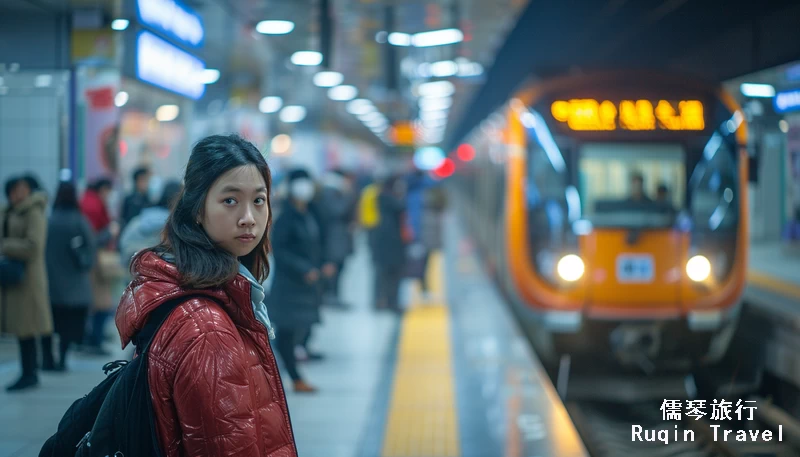

Tour Summary
Most visitors move around Beijing by private car. That’s comfortable — and often practical.
But if you really want to understand how the city functions day to day, take the subway. Stand on the platform during morning rush. Watch commuters scroll through phones, elderly residents with market bags, students in uniforms. The rhythm feels different.
This one-day route follows major landmarks — Tiananmen Square, the Forbidden City, hutongs, Olympic Park — but connects them the way locals do: by subway and bus. It’s not about efficiency alone. It’s about perspective.
Route: Local Subway → Tiananmen Square → Forbidden City → Bus to Nanluoguxiang → Olympic Park → Subway Return
Duration: 8–9 hours
Best For: Independent-minded travelers, return visitors, culturally curious guests
Travel Style: Urban immersion + iconic highlights
Pace: Steady (moderate walking + public transport transfers)
Tour Itinerary
Beijing’s subway system is modern, extensive, and surprisingly easy once you understand it.
This route moves from the political center to imperial history, then into residential hutongs, and finally to Olympic-era modern architecture. The transitions feel natural because you experience them the same way residents do — station by station.
You’ll see not just monuments, but movement.
- Use your credit card or use mobile payment for metro access.
- Avoid peak rush hours if possible (early morning and late afternoon).
- Subway is fastest for long distances; buses are useful for shorter cultural neighborhoods.
- Security checks are standard at metro entrances.
Morning
Subway to Tiananmen Square
Start around 8:30 AM by walking to your nearest subway station.
The Beijing metro is clean, clearly marked, and efficient. Announcements are bilingual. You’ll pass through a quick security check before entering.
Arrive at
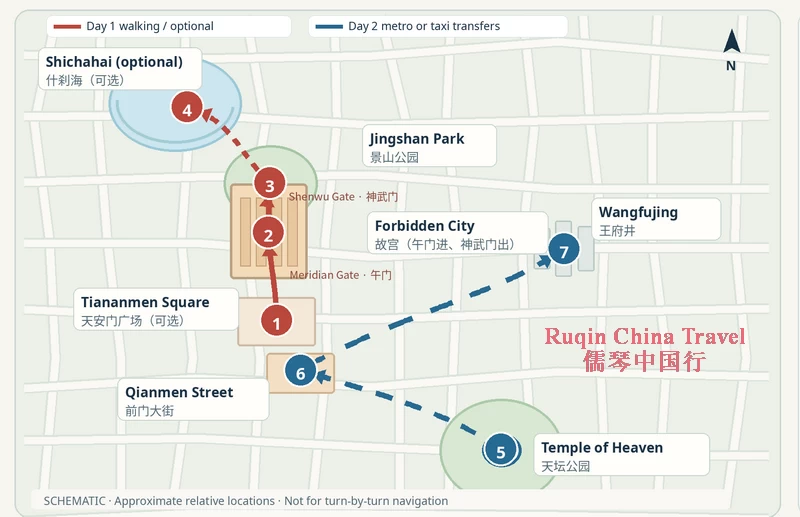
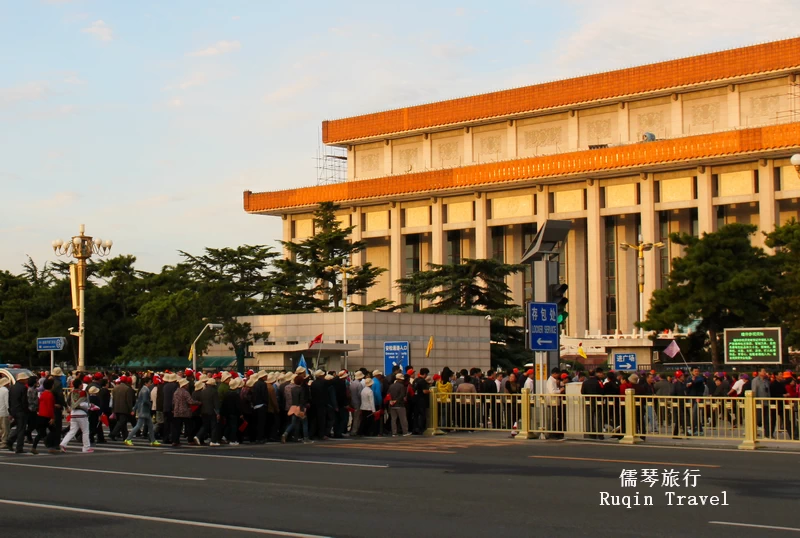
Tiananmen Square, one of the largest public squares in the world.
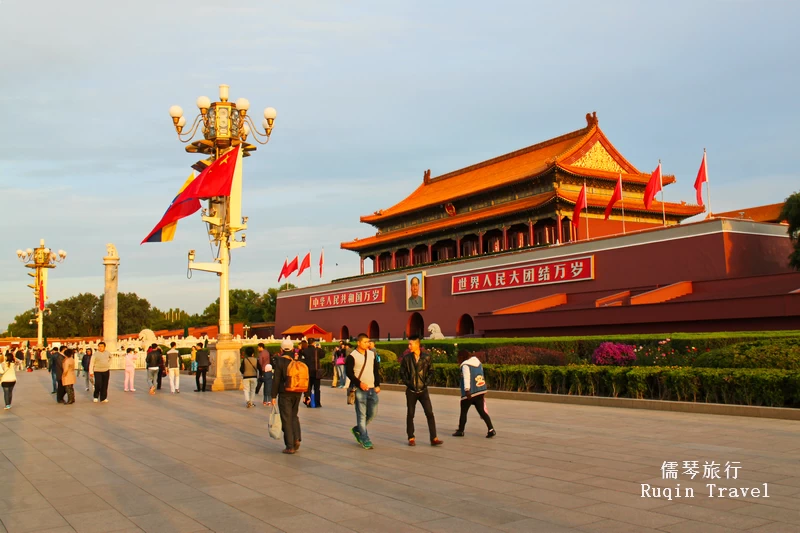
Tiananmen Square
Here you’ll see:
- Monument to the People’s Heroes
- Chairman Mao Memorial Hall (exterior)
- The Great Hall of the People
The scale feels even larger when you emerge from underground and step into open space.
Allow about 45 minutes.
Forbidden City
From the square, walk north into the
Forbidden City.
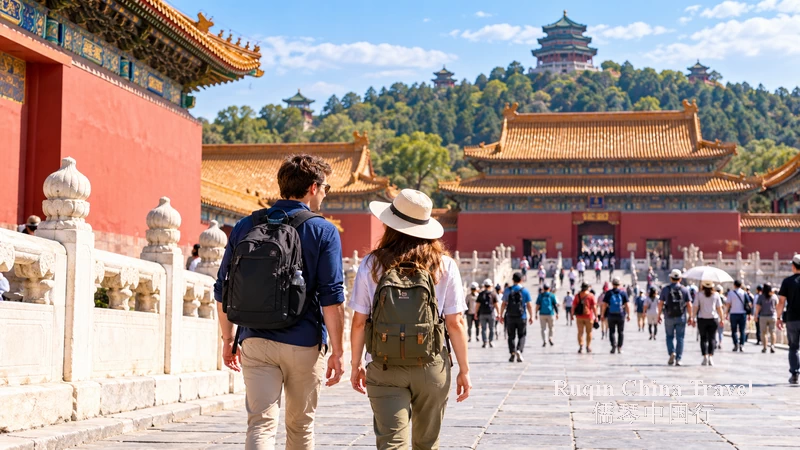
This is the imperial heart of China for nearly 500 years. After experiencing the subway crowd, entering these vast courtyards feels almost theatrical.
You’ll walk the central axis:
- Meridian Gate
- Hall of Supreme Harmony
- Inner Court residences
I usually suggest focusing on the main halls rather than trying to see everything. Public transport days require pacing.
Allow 2–3 hours.
Midday
Local Lunch
Around 12:30 PM, stop for lunch near the palace exit.
Simple northern dishes work well:
- Zhajiangmian (noodles with soybean paste)
- Dumplings
- Stir-fried vegetables
It doesn’t need to be formal. You’re traveling like a local today.
Afternoon
Bus to Nanluoguxiang
Around 1:30 PM, take a public bus toward
Nanluoguxiang.
Buses move slower than the subway but give you street-level views — flyovers, neighborhoods, daily life passing by the window.
Nanluoguxiang blends preserved hutong architecture with small shops and cafés. Wander into side alleys to escape the busiest stretch.

Nanluoguxiang
This is a good place to:
- Pause for tea
- Observe courtyard gates
- Notice how old lanes adapt to modern life
Allow about 1–1.5 hours.
Subway to Olympic Park
From Nanluoguxiang, take the subway north to Olympic Park.
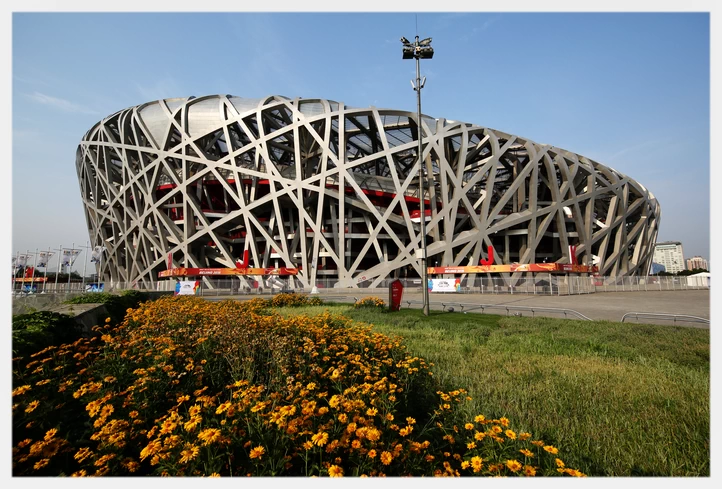
Beijing National Stadium (Bird’s Nest)
Here you’ll see:
- Beijing National Stadium (Bird’s Nest)
- Beijing National Aquatics Center (Water Cube)
The open plaza contrasts sharply with hutong lanes earlier in the day.
Walk the exterior paths and take photos. No need to rush.
Allow about 45–60 minutes.
Return by Subway
Around 4:30 PM, return to your hotel by metro.
By now, the system will feel familiar — stations, lines, platform signs.
You’ll likely feel more confident navigating the city independently.
Practical Notes from Me
- Wear comfortable shoes — transfers involve walking.
- Keep small change or use a transport card for convenience.
- Avoid rush hours if possible (roughly 7:30–9:00 AM and 5:00–7:00 PM).
- Be mindful of belongings in crowded stations.
- Forbidden City tickets must be booked in advance.
Taking public transport won’t show you a “hidden” Beijing.
It shows you the real one — structured, efficient, busy, and surprisingly orderly.
And once you’ve done it once, the city feels far less intimidating.
Further Reading
How to Visit Tiananmen Square: Maps, Tickets & Security Checks
How to Visit Forbidden City: Maps, Walking Routes and Travel Tips
Nanluoguxiang: Maps, Shopping, Bars, Cafes, Food, Hutong & Tips
Beijing Bird’s Nest Stadium & Water Cube: All You Need to Know
Questions About Planning Your Trip to China
If you still have questions after reading the guides, you’re very welcome to write to me.
I’ve helped many travelers think through routes, train connections, timing between cities, and the small details that make a trip smoother. If something feels unclear — or you’d simply like a second opinion — I’m happy to help.
Just use the short form below and tell me a little about your plan.
There’s no fee for a simple question. No pressure — just a practical reply based on real experience here in China.
If I’m traveling, replies may take a little time. Thank you for your patience.
We respect your privacy. Your details will never be shared or used for marketing.







Hello Marie,
Thank you for your inquiry about a two-day trip to Beijing!
Unfortunately, most of our English-speaking tour guides are fully booked due to the holiday. However, we’re happy to provide you with some travel tips for your trip to Beijing.
Getting Around:
We recommend using the Beijing subway to navigate the city. It’s convenient to purchase a Beijing Pass, which allows you to use the subway, taxis, and even the train to Badaling Great Wall. You can buy a Beijing Pass at the airports and railway stations.
For more details on the Beijing subway, check out this link: How to Use Beijing Subway
Markets:
Consider visiting the Silk Market or Panjiayuan Market during your stay.
For more information, please see this link: Top 10 Beijing Markets
Museums and Art:
We suggest visiting the 798 Art District and the National Art Museum, and catching a Peking Opera performance in the evening.
You can find more details here: Beijing Arts and Culture Tour and Top 10 Best Museums in Beijing.
We hope this information helps you plan your two-day trip to Beijing!
Have a nice time in Beijing!
Best regards,
Ruqin China Travel
———————————————————————
I have already seen Tiannemen Square and the Forbidden City but I would like to see other places of interest – contemporary art galleries, markets etc and learn how to use the metro. Please give me suggestions.