
Written and updated by Ruqin
Last updated: June 7, 2026
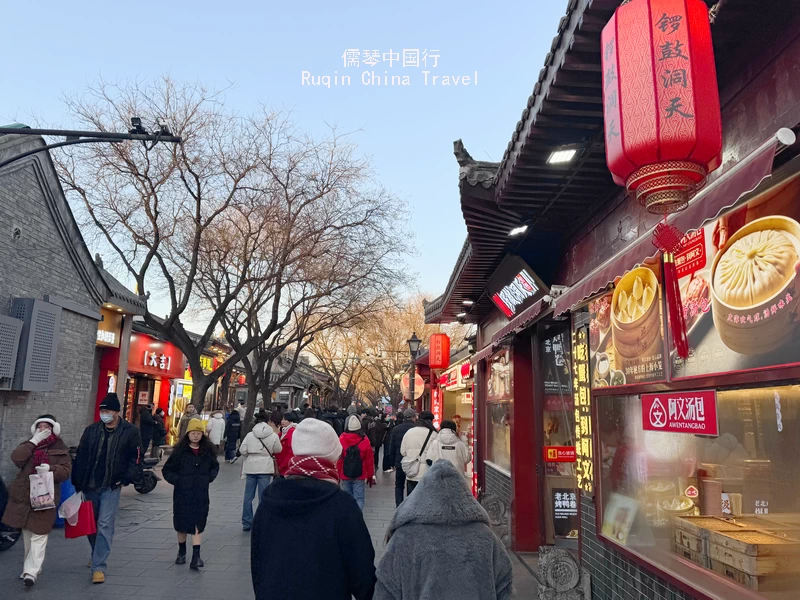
The first time I walked into Nanluoguxiang, I expected a quiet old hutong. Instead, I stepped into one of Beijing’s liveliest historic lanes—filled with street snacks, small shops, cafés, and the constant hum of visitors. In this Nanluoguxiang Hutong Travel Guide, I’ll help you understand what makes this famous alley special and how to experience it without feeling overwhelmed.
Nanluoguxiang (南锣鼓巷), also called South Luogu Lane or Nanluogu Lane, sits in Beijing’s Dongcheng District. The narrow hutong runs from Gulou East Avenue in the north to Ping’an Avenue in the south. Just 787 meters long, it’s one of the city’s best-preserved hutong streets—where centuries-old courtyards meet modern cafés, bars, and local food stalls.
1. The History of Nanluoguxiang
The first time I studied a map of Nanluoguxiang, I realized its story begins long before the cafés and snack shops arrived. This hutong dates back to the Yuan Dynasty (1271–1368), when Beijing was planned as an imperial capital. The lane follows a slightly uneven north–south ridge, once said to resemble the curved back of an old man. Because of that shape, locals originally called it Luoguo Alley (罗锅巷)—literally “Humpback Alley.”
Over time, the name softened. In 1750, during Emperor Qianlong’s reign, it was officially renamed Nanluoguxiang, a more elegant homophone that avoided the awkward meaning of the old name while keeping its familiar sound.
More importantly, the hutong itself grew into one of Beijing’s most refined residential lanes. During the Ming and Qing dynasties, aristocratic families, scholars, and officials lived in the courtyard homes branching off the alley. Even today, when you wander into the side hutongs, you can still sense that older Beijing—quiet courtyards, grey brick walls, and centuries of everyday life layered beneath the busy street.
2. How to get to Nanluoguxiang?
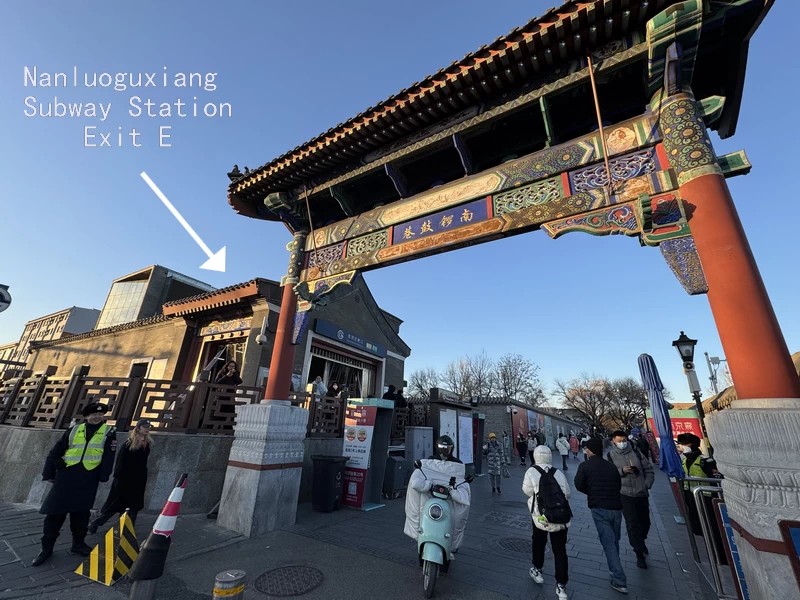
The easiest way to reach Nanluoguxiang is by subway. The hutong sits in Beijing’s Dongcheng District, right between the Drum Tower area and the old imperial neighborhoods, so public transport is simple and reliable.
Start with the subway. Take Line 6 or Line 8 to Nanluoguxiang Station, then follow Exit E. When you come up to street level, you’ll be standing right at the southern entrance of Nanluoguxiang Hutong, which makes it the most convenient starting point for first-time visitors.
The hutong actually has two main entrances.
- South entrance: Di’anmen East Avenue — closest to the subway and usually where most travelers begin.
- North entrance: Gulou East Avenue — near the Drum Tower area and often slightly quieter in the morning.
If you prefer the bus, several routes stop nearby. Buses 3, 4, 13, 42, 60, 118, 612, and Sightseeing Bus 3 stop at Nanluoguxiang Station, while 82, 107, 124, and 135 stop at Baochao Hutong, a short walk away.
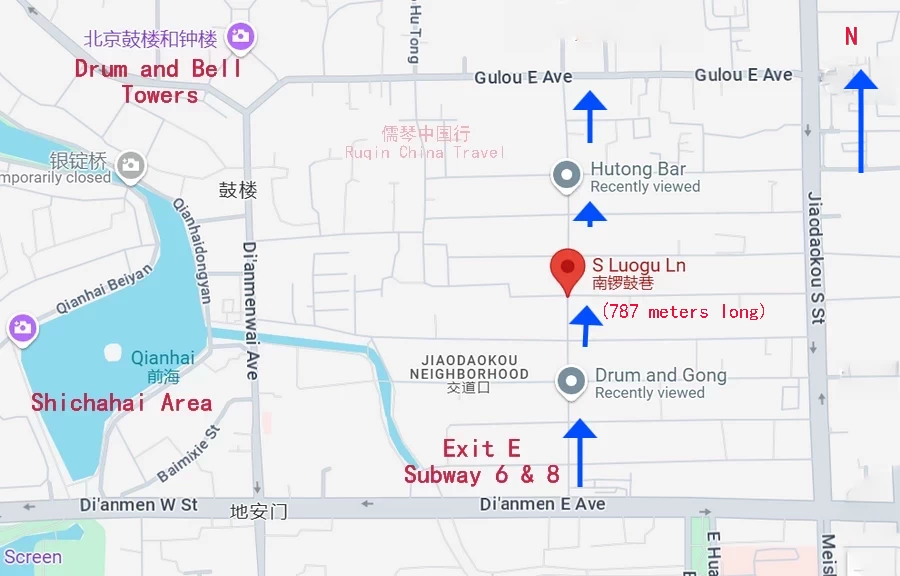
The location map: Nanluoguxiang ( S Luogu Ln) and Nanluoguxiang Subway Station
Taxis or ride-hailing apps like Didi also work well, especially if you’re coming from farther districts. Simply show the driver “Nanluoguxiang (南锣鼓巷)” on your phone. Just note that traffic around the hutong can be busy, particularly on weekends, so the subway is often faster.
3. The layout of Nanluoguxiang
When you first step into Nanluoguxiang, the layout feels surprisingly simple. A single straight alley runs about 787 meters from south to north, and almost everything happens along this central pedestrian street.
Today it’s lined with snack stalls, small boutiques, cafés, and bars, but the bones of the old hutong are still there—grey brick walls, traditional courtyard gates, and narrow lanes quietly branching away from the crowds.
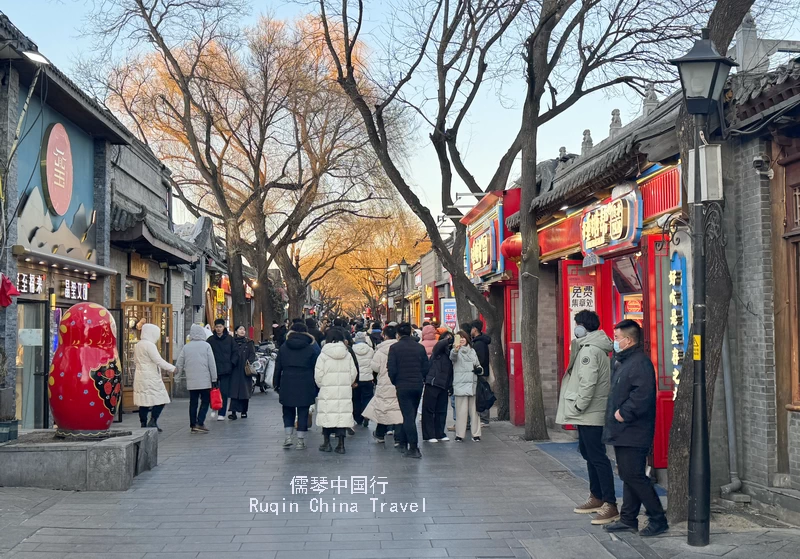
The Nanluoguxiang (South Gong and Drum Lane)
The main alley is lively, especially in the afternoon and evening. But the real character of Nanluoguxiang Hutong reveals itself once you step into the side alleys.
Sixteen hutongs branch out from the main lane—eight on the east side and eight on the west—forming a neat fishbone layout. From above, the pattern even resembles a centipede, which is why locals sometimes call it “Centipede Street” (蜈蚣街).
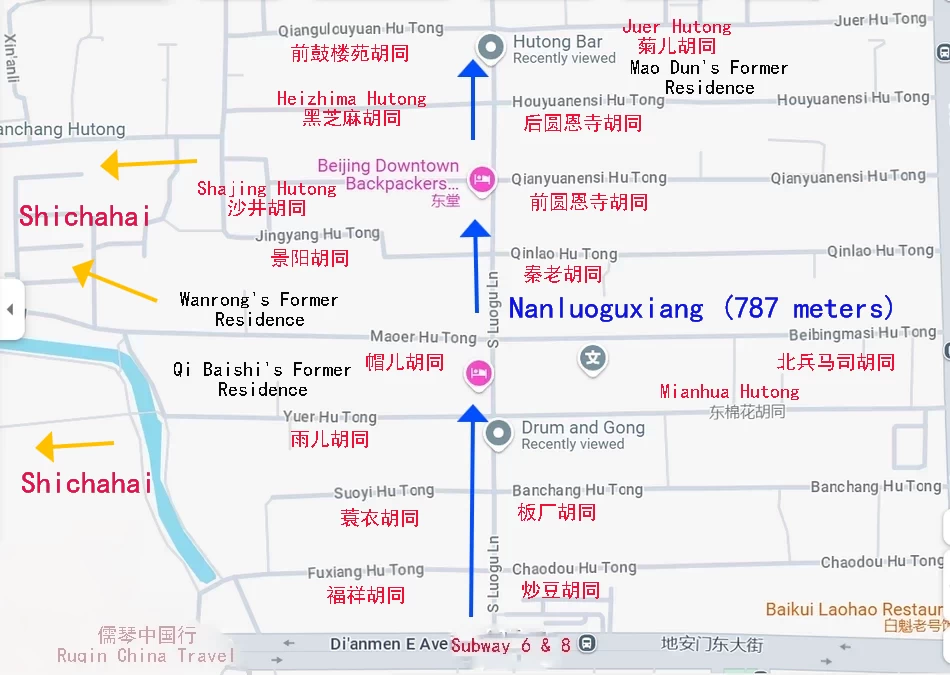
The Layout Map of South Luogu Lane ( Centipede Street 蜈蚣街) Google Maps soruce
Some of these side lanes are well known. On the west side you’ll find Fuxiang Hutong (福祥胡同), Suoyi Hutong (蓑衣胡同), and Yuer Hutong (雨儿胡同), while the east side includes hutongs like Chaodou Hutong (炒豆胡同) and Banchang Hutong (板厂胡同), each with its own unique character and hidden stories.
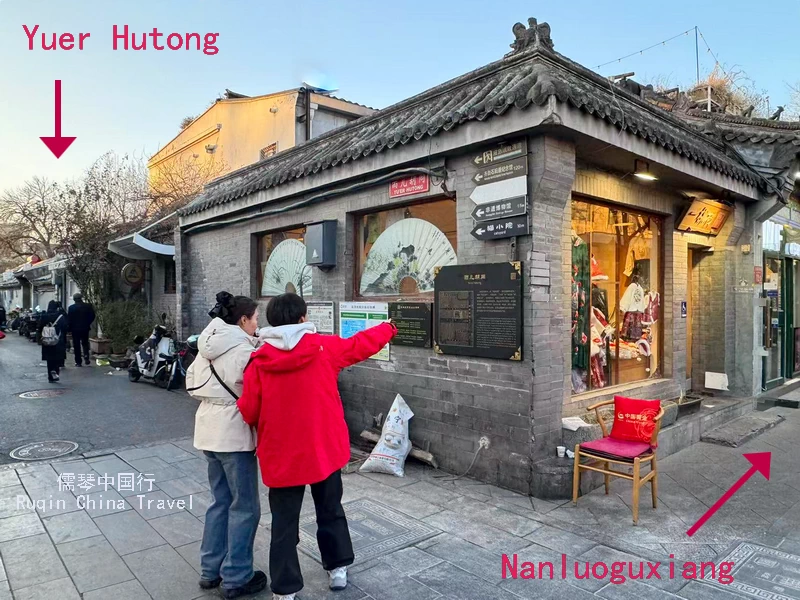
Walk just a few steps into them and the atmosphere changes quickly. The souvenir shops disappear, the crowds thin out, and you begin to see everyday Beijing life—residents chatting by doorways, bicycles leaning against old courtyard walls, and quiet corners that feel far removed from the busy main street.
That contrast is part of what makes wandering Nanluoguxiang so rewarding.
4. Architectural Features of Nanluoguxiang
When you walk through Nanluoguxiang, the architecture quietly tells the story of old Beijing. Look beyond the shop signs and café windows, and you’ll notice the classic hutong details still everywhere—grey brick walls, sloping tiled roofs, and deep red wooden gates often framed by carved stone drums. The color palette—mainly grey, red, and black—feels familiar because it echoes the architectural style seen throughout Beijing’s imperial era.
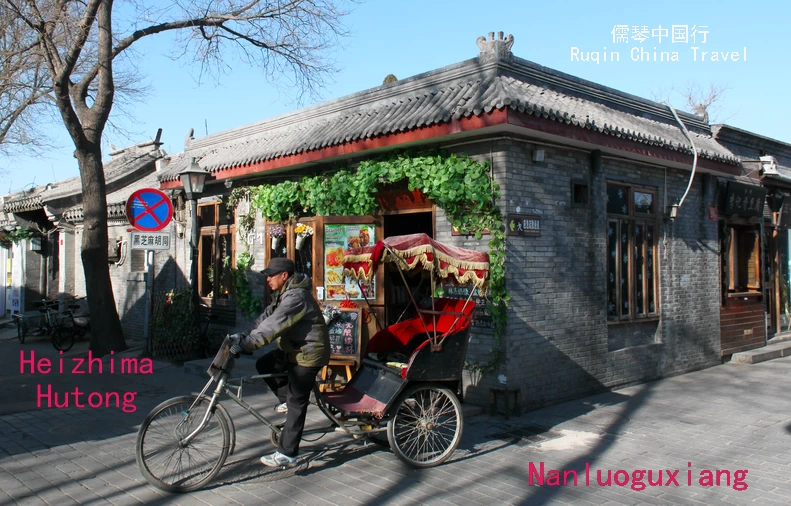
Even the rooftops once reflected social status. Historically, elite residences used green-glazed roof tiles, while ordinary homes were covered with dark grey or black tiles. These small details may seem subtle today, but they hint at the social hierarchy that once shaped the neighborhood.
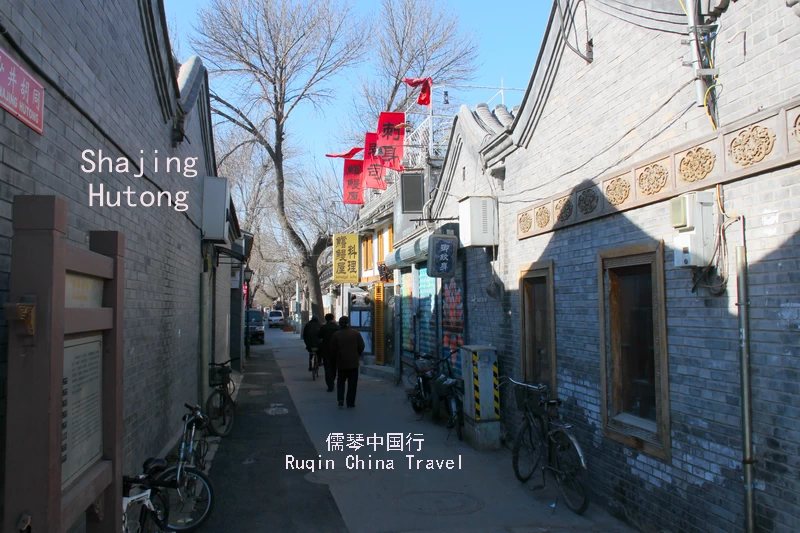
Shajing Hutong branching off the Nanluoguxiang Hutong
Along the side hutongs branching off the main street—such as Heizhima Hutong or Shajing Hutong—you’ll still find many traditional siheyuan courtyards. These classic Beijing homes are built around a central courtyard, with rooms arranged on four sides. The layout created a quiet, enclosed family space, protected from the busy street outside.
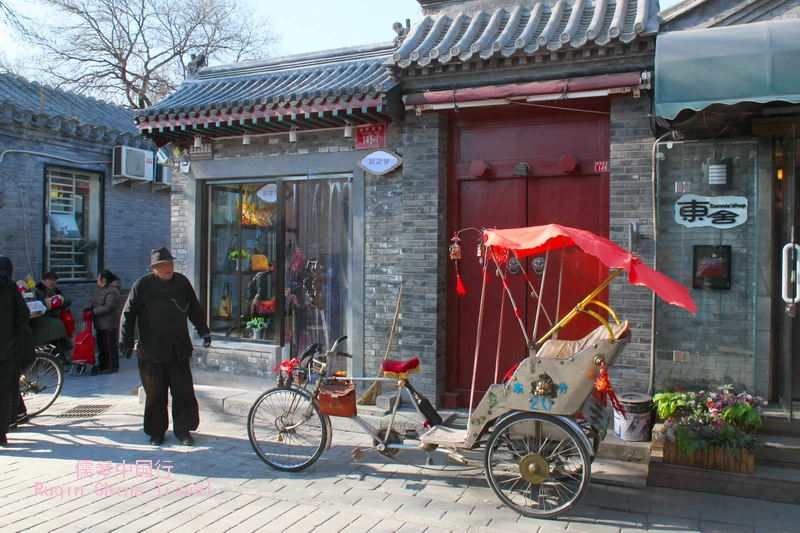
The traditional houses along Nanluoguxiang
During the Ming and Qing dynasties, many aristocratic families and scholars lived in these courtyard homes. Some historic residences remain today, including the former home of Qi Baishi in Yuer Hutong. Walking past these old gates, it’s easy to imagine the generations who once lived behind them.
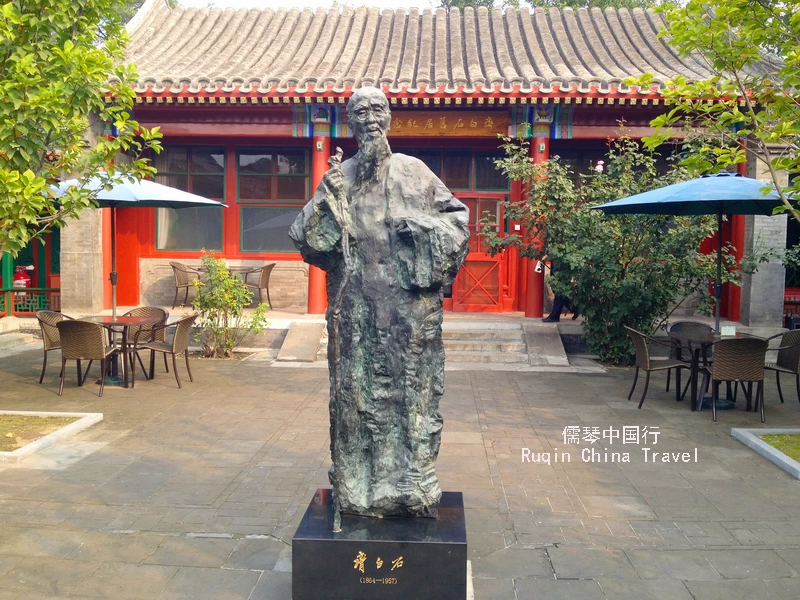
Qi Baishi’s Former Residence ( A Typical siheyuan courtyard) 13 Yuer Hutong.
In many ways, Nanluoguxiang still feels like a living architectural museum hidden inside a busy modern street.
5. Nanluoguxiang: Boutique Shops, Trendy Bars, Cozy Cafes and Eateries
The first thing most visitors notice about Nanluoguxiang is the energy. What was once a quiet residential hutong has gradually transformed into one of Beijing’s most popular pedestrian streets. As you walk down the alley today, you’ll pass a lively mix of boutique shops, snack stalls, cafés, and small bars, all packed into traditional courtyard buildings.
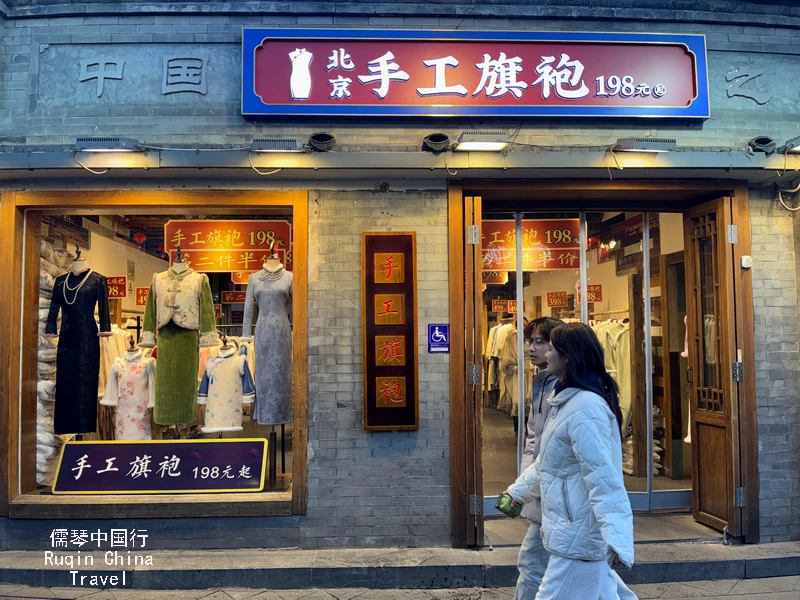
The Hand-made Qipao Shop
Food is often what pulls people in first. Along the main alley you’ll see vendors selling classic Beijing street snacks like jianbing (Chinese savory crepes), grilled skewers, and candied hawthorn sticks. At the same time, many small restaurants experiment with creative twists—serving dumplings, noodles, burgers, desserts, and fusion dishes designed for curious travelers.
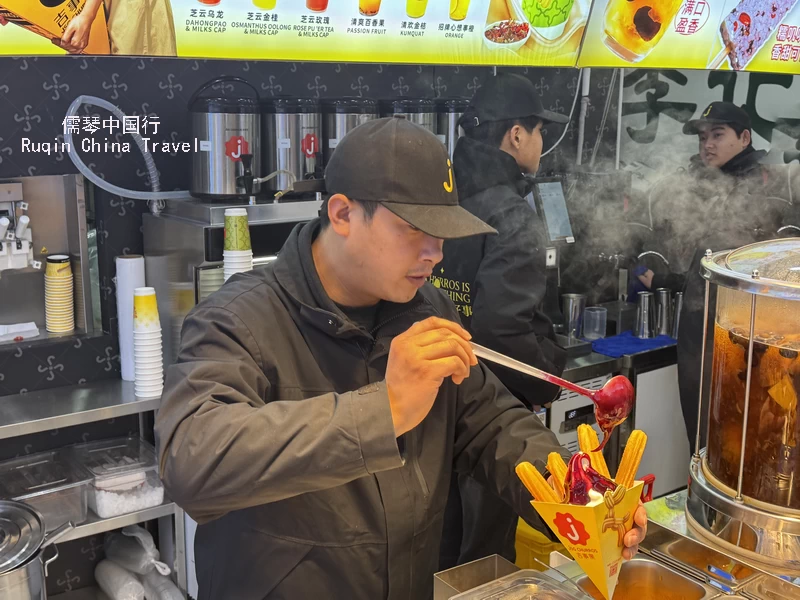
Churros (吉事果)originated from Spain ( No. 50, Nanluoguxiang)
Then there are the cafés. Some are modern and stylish, while others hide inside renovated siheyuan courtyards, where a quiet table and a cup of coffee offer a welcome break from the crowds outside. These courtyard cafés are some of my favorite places to pause and watch hutong life move at a slower pace.
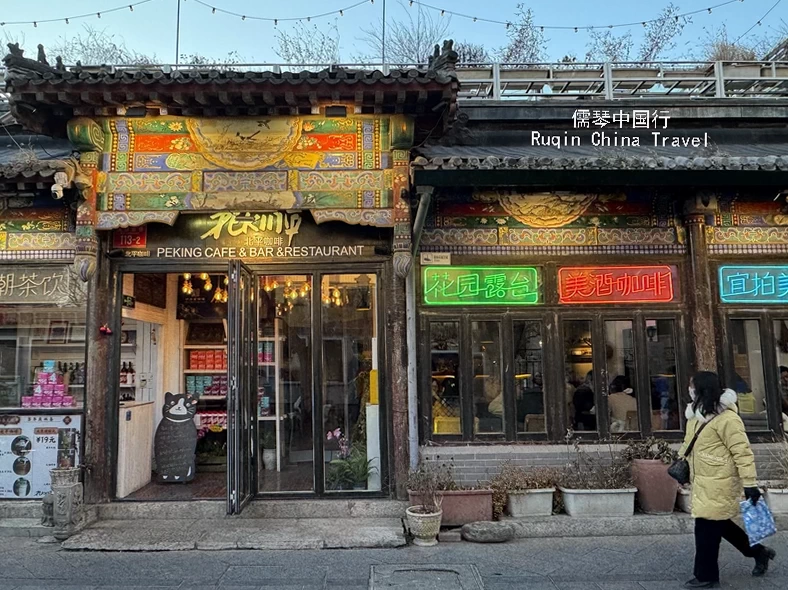
Peking Cafe and Bar Restaurant on Nanluoguxiang
As evening arrives, Nanluoguxiang’s bars begin to fill up. You’ll find everything from casual craft beer spots to small cocktail bars tucked into side lanes. The atmosphere is relaxed rather than flashy, which makes it a pleasant place to unwind after a day of exploring Beijing.
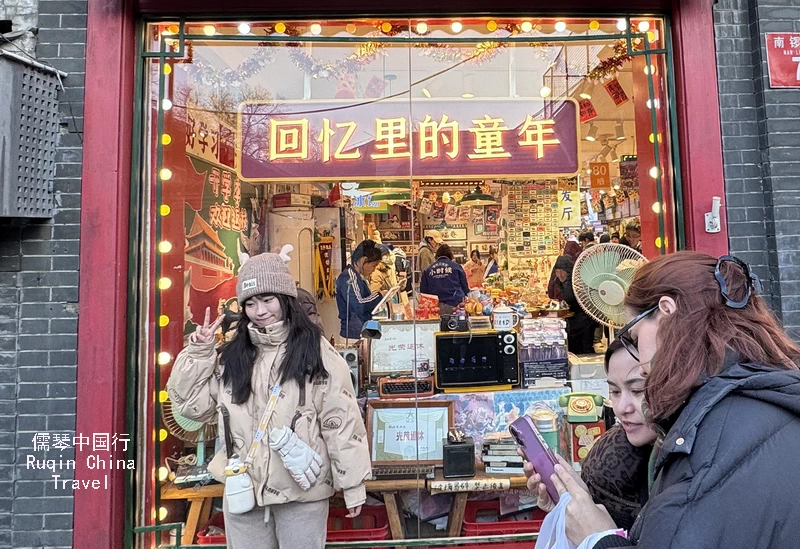
A shop filled with childhood memories.
That said, the main street can feel crowded, especially on weekends. If you wander a little deeper into the side hutongs, you’ll often discover quieter cafés, small design shops, and creative studios that still capture the spirit of old Beijing.
6. Best Time to Visit Nanluogu Lane
Timing makes a big difference when visiting Nanluoguxiang. If you arrive in the middle of the afternoon, you’ll usually find the alley at its most lively. From about 3 PM to 9 PM, the street fills with energy—snack stalls start cooking, cafés are busy, and the lanterns and shop lights gradually brighten as evening approaches.
As the sun lowers, the grey-brick hutong walls take on a soft golden color, and the atmosphere becomes especially pleasant for strolling. By early evening, the area begins to feel a bit like a casual night market. Food aromas drift through the alley, street performers sometimes appear, and the small bars start to open their doors.
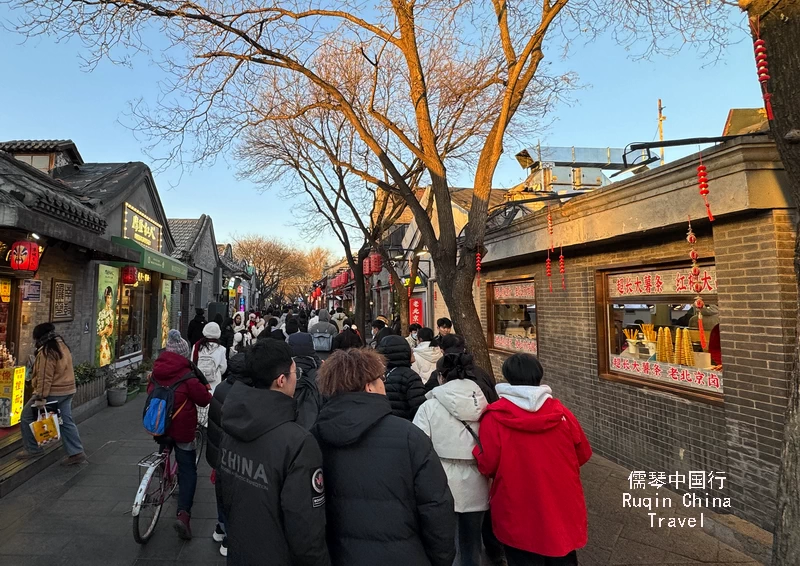
Nanluogu Lane under the sunset glow
That said, Nanluoguxiang can get very crowded, particularly on weekends, holidays, and summer evenings. If you prefer a quieter experience, try visiting earlier in the morning or on a weekday afternoon. The shops may open more slowly, but the lane itself feels calmer, and you can explore the side hutongs without navigating dense crowds.
Personally, I find the late afternoon window the most enjoyable—lively enough to feel exciting, but still comfortable for wandering and discovering the quieter corners of the hutong.
7. Hotels in and around South Luogu Lane
If you want to experience a more intimate side of Beijing, staying near Nanluoguxiang or the nearby Shichahai lake area is a wonderful choice. These historic hutong neighborhoods feel very different from the city’s modern business districts. Narrow lanes, traditional courtyard homes, and small local cafés create an atmosphere that feels distinctly old Beijing.
One of the best ways to experience this area is by staying in a boutique hutong hotel. Places like The Orchid Hotel and Shichahai Shadow Art Performance Hotel are well-known for transforming traditional siheyuan courtyards into comfortable, stylish accommodations. The experience is quieter and more personal than large chain hotels—you might start your morning with tea in a small courtyard before stepping out into the hutong streets.
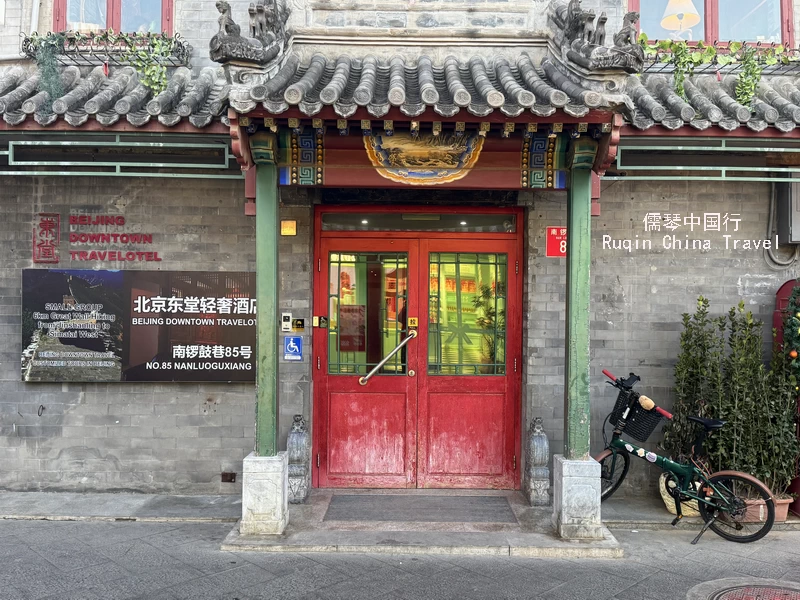
Beijing Downtown Travelotel (No.85 Nanluoguxiang)
You’ll also find smaller guesthouses tucked directly inside the lane itself, such as Beijing Downtown Travelotel (No. 85 Nanluoguxiang). Staying here places you right in the middle of the hutong atmosphere.
Location is another advantage. From these neighborhoods, you can easily walk to Nanluoguxiang’s shops and cafés, explore the lakes and bars around Shichahai, and reach landmarks like the Drum Tower and Bell Tower within minutes.
Just keep in mind that hutong hotels are usually small and boutique-style, so it’s wise to book ahead, especially during busy travel seasons.
8. Nanluoguxiang Nearby Attractions and City Walk
One of the reasons I often recommend Nanluoguxiang to first-time visitors is its location. From here, you can easily turn a simple hutong stroll into a full Beijing city walk, linking several historic neighborhoods and landmarks within a short distance.
Start by walking north from the alley toward the Drum Tower and Bell Tower, two of Beijing’s most recognizable historic structures. Climbing the Drum Tower gives you a wonderful view over the surrounding hutong rooftops—one of the few places where you can still see the old city layout from above.
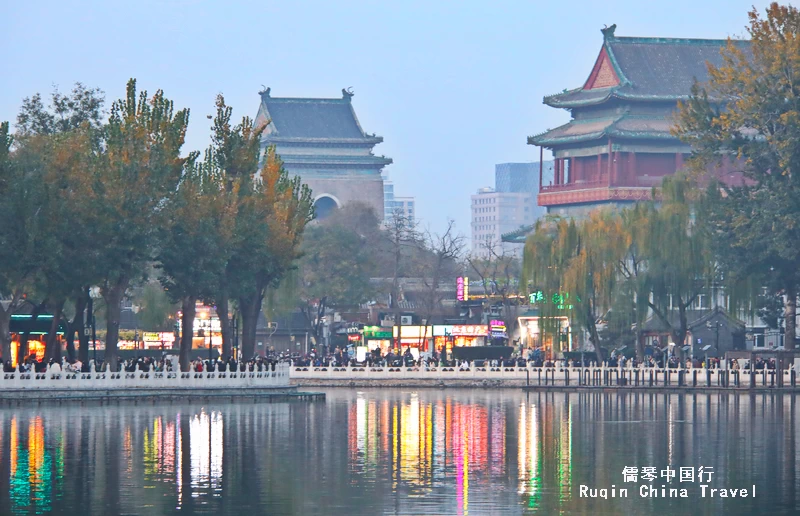
The Shichahai Area
From there, continue west toward the Shichahai lake area. Around Houhai, you’ll find lakeside paths, small cafés, and lively bars that become especially popular in the evening. Just nearby is Yandai Xiejie, one of Beijing’s oldest commercial streets, filled with traditional-style shops and small snack stalls.
If you’re interested in temples, the famous Lama Temple (Yonghegong) is also within reasonable walking or cycling distance from Nanluoguxiang.
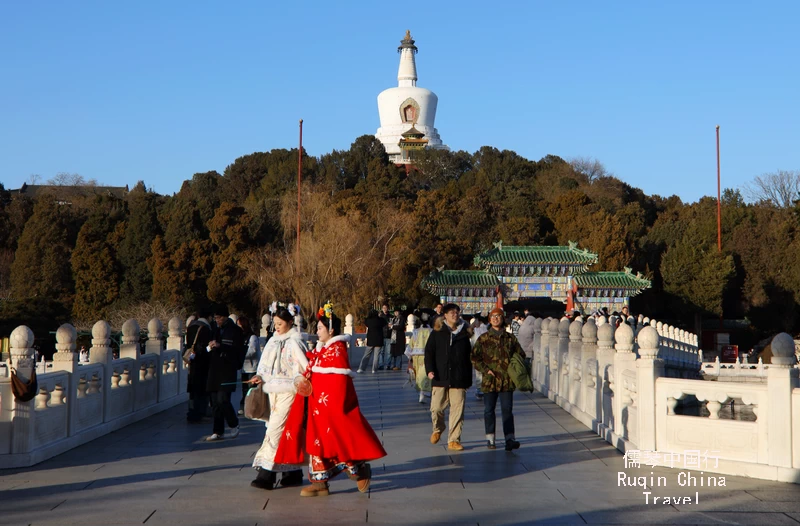
Beihai Park
For a quieter contrast, consider pairing your hutong walk with a visit to Beihai Park. The park’s peaceful lake, stone bridges, and historic pavilions offer a calm break from the busy hutong streets—and it’s a lovely place to slow down before continuing your Beijing exploration.
Frequently Asked Questions about Nanluoguxiang
1. How do I get to Nanluoguxiang?
The easiest way is by subway. Take Line 6 or Line 8 to Nanluoguxiang Station and exit at Exit E, which brings you directly to the south entrance of the hutong. You can also enter from the north end near Gulou (Drum Tower) if you’re exploring that area.
2. When is the best time to visit?
Weekday mornings or early afternoons are the calmest. Evenings and weekends are lively but can be very crowded.
3. What can I shop for here?
Most shops sell creative souvenirs and small designer items—things like Chinese-style accessories, paper cut art, enamel cups, handmade crafts, and quirky Beijing-themed gifts.
4. What food should I try?
Popular street snacks include jianbing (savory crepe), tanghulu (candied fruit skewers), and roujiamo (Chinese-style sandwich). You’ll also find plenty of cafés, dessert shops, and small noodle restaurants.
5. Are the bars and cafés open late?
Yes. Many cafés stay open into the evening, and the small bars usually stay open until midnight or later, especially on weekends.
6. Should I explore the side hutongs?
Definitely. Step into lanes like Yuer Hutong or Fuxiang Hutong to see quieter courtyards, local homes, and places like Qi Baishi’s former residence.
7. How much time should I plan?
Most travelers spend 1–2 hours, but if you explore nearby hutongs, cafés, and shops, it can easily fill half a day.
Nanluoguxiang is one of those places where Beijing’s past and present quietly meet. One moment you’re standing beside a centuries-old courtyard gate, and the next you’re sipping coffee in a small hutong café or sampling a freshly made street snack. The contrast is part of the charm.
So don’t rush your visit. Wander slowly down the main alley, then step into the side hutongs where the pace softens and everyday Beijing life still unfolds. With a little curiosity—and a bit of time—Nanluoguxiang becomes more than just a busy tourist lane. It becomes a small window into the rhythm of old Beijing.
About the Author
Ruqin is the founder of Ruqintravel.com and has spent more than four decades working in China’s travel industry. Drawing on hands-on experience in cities like Beijing and Hangzhou, he personally researches and updates each guide to help international travelers navigate China with confidence.
Further Reading
Best Street Food in Beijing: What to Eat and Where to Find It
Guijie Street (Ghost Street) in Beijing: Map & Food Guide
Dashilan Street: Map, Food, Shopping & Hotels
Huguosi Street, Beijing (Huguosi Snack Street): A Visitor’s Guide
Yandai Xiejie Street (Yandaixie): Shops, Food, Sights and Tips
Xianyukou Street, Beijing: What to Eat, Shop & See Before You Go
Qianmen Street Beijing: Map, Food, Shopping & Hotels
Shichahai Travel Guide: Hutongs, Bars, Food & Things to Do
Wudaoying Hutong: Shops, Cafes, Food and Travel Tips