
China Destination Guides — by Ruqin
China is a large country, and travel here is rarely the same from one place to another. What matters is not only where you go, but how you move through it—how cities feel, how transport works in real time, and how your plans change once you are actually there.
These destination guides come from time spent traveling across China, helping visitors adjust routes, timing, and expectations based on real conditions, not theory.
Below are different parts of China destination guides, each focused on a specific kind of experience and decision.
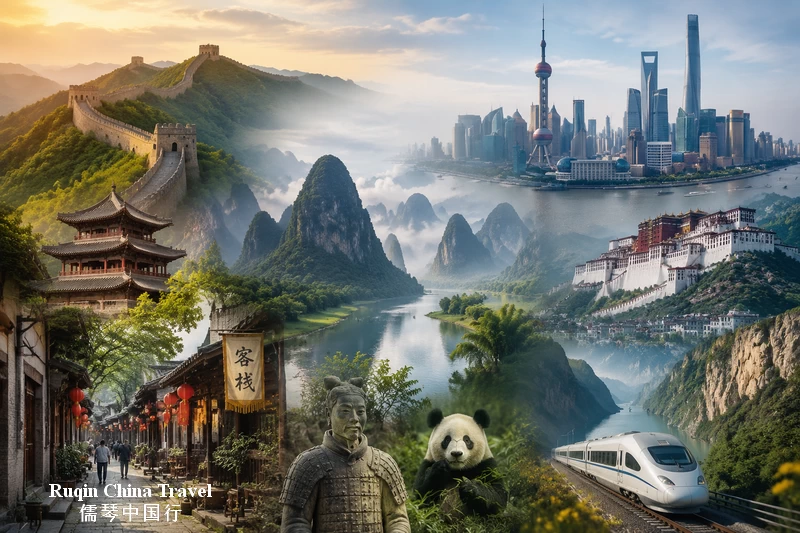
China City Travel Guides
Major cities like Beijing, Shanghai, Xi’an, Chengdu, Guilin, Xinjiang, and Tibet each move in their own way.
These notes focus on how cities actually feel on the ground—walking distances, transport rhythm, neighborhoods, and how to plan your time in a realistic way.
Not just what to see, but how it works when you are there.
• Northern China — Imperial History & Grasslands
This is where China feels wide, open, and deeply historical. You move between imperial cities, grasslands, and ancient capitals.
| Beijing Travel Guide | Tianjin Travel Guide | Chengde Travel Guide |
| Datong Travel Guide | Pingyao Travel Guide | Baotou Travel Guide |
| Hohhot Travel Guide | Yinchuan Travel Guide |
This cluster works beautifully as a Beijing → Datong → Pingyao loop if you like ancient architecture and slower travel pacing.
• Northeast China — Winter Cities & Industrial Heritage
Cold, dramatic winters and a very different cultural rhythm. These cities feel spacious and bold.
Harbin especially becomes a completely different world in winter — ice, light, and Russian-influenced architecture.
• Eastern China — Classical Gardens & Modern Skylines
This is the most balanced travel zone: gardens, canals, skyscrapers, and lakes.
| Shanghai Travel Guide | Suzhou Travel Guide | Hangzhou Travel Guide |
| Qingdao Travel Guide | Huangshan Travel Guide | Wuyuan Travel Guide |
A very natural route here is Shanghai → Suzhou → Hangzhou, with Huangshan as a mountain extension.
• Southern China — Canton Culture, Islands & Coastal Life
This is warmer, slower, and more food-focused. Travel feels easier and more relaxed.
| Guangzhou Travel Guide | Shenzhen Travel Guide | Hong Kong Travel Guide |
| Guilin Travel Guide | Sanya Travel Guide |
This region works well for first-time China travelers, especially if combining Hong Kong → Guangzhou → Guilin.
• Southwest China — Mountains, Minority Culture & Slow Travel
This is where China starts to feel more dramatic and emotionally expansive.
| Chengdu Travel Guide | Chongqing Travel Guide | Kunming Travel Guide |
| Lhasa Travel Guide | Shigatse Travel Guide | Zhangjiajie Travel Guide |
A common flow I often suggest is Chengdu → Chongqing → Yunnan, depending on time and pace.
• Northwest China — Silk Road & High-Desert Landscapes
This is the most cinematic part of China. Long distances, ancient trade routes, big skies.
| Xi’an Travel Guide | Lanzhou Travel Guide | Xining Travel Guide |
| Urumqi Travel Guide | Kashgar Travel Guide | Alashan (Alxa) League Guide |
This is where Silk Road travel begins to make sense as a route instead of isolated destinations.
Central China — Historic Heartland
These cities don’t always get grouped together, but they feel connected through history and accessibility.
Luoyang pairs naturally with Xi’an for ancient capital travel.
If you’re still unsure where to go, this is where I usually tell people: don’t start with the city — start with the feeling.
Then pick the region that matches it.
👉Explore All China Destination Guides
Great Wall Travel Guides
The Great Wall is not one place, but many sections spread across different landscapes.
Some are restored and easy to access, others are quiet and less visited.
These Great Wall Travel Guides focus on how to choose the right section, how long it really takes, and what the experience feels like when you walk it, rather than just arrive at it.
• Mutianyu Great Wall
Mutianyu is one of the most balanced sections of the Great Wall, with restored paths and wide views that are easy to enjoy. I often recommend it to visitors who want a smooth first experience without too much difficulty in access or walking.
| How to Get to Mutianyu Great Wall | Best Way to Reach Mutianyu: Cable Car, Chairlift |
| Mutiannyu Great Wall Wheelchair Travel | Mutianyu Great Wall Photo Spots |
• Badaling Great Wall
Badaling is the most visited section of the Great Wall and the easiest to reach from Beijing. It can feel busy, but it is very well maintained and still worth seeing if you want a straightforward and clear view of the Wall’s scale.
| How to Get to Badaling Great Wall | Best Hiking Trails at Badaling Great Wall |
| Badaling Great Wall Autumn Photography | Badaling Great Wall Spring Flowers |
• Juyongguan Pass (Great Wall at Juyongguan)
Juyongguan is a historic mountain pass rather than a long hiking section of the Wall. I like it for its strong sense of history and its position in a narrow valley that once controlled access to Beijing.
• Simatai Great Wall
Simatai is one of the most dramatic and rugged sections, especially if you see it at night or during quieter hours. The terrain is steep, and it feels closer to how the Wall might have originally been experienced.
Gubeikou Great Wall
Gubeikou is quiet, unrestored, and feels far away from the usual tourist routes. I often come here when I want a more natural, open walk with very few people around.
| Gubeikou Great Wall: Maps, Hiking Routes, Transport & Tips |
| Hiking from Gubeikou Great Wall to Jinshanling Great Wall |
• Jinshanling Great Wall
Jinshanling sits between restored and wild sections, which makes it ideal for walking longer stretches of the Wall. The light here is often very good in the early morning, and it’s one of the places I personally enjoy photographing the most.
China Road Trip
Road travel in China opens access to landscapes and regions that are not always connected by fast rail.
These China Road Trips are based on real routes and travel flow—distances, road conditions, pacing, and how journeys feel when you move outside major cities.
Still Have Questions About Traveling in China?
Every journey in China feels a little different once you are actually here.
You may still be thinking about where to go, how long to stay in each place, or how to connect different regions in a way that feels realistic rather than rushed.
These are not just planning questions—they are travel decisions that shape your whole experience.
If you are unsure how to start, or want a second opinion on your itinerary, you can send me a message.
I’ll reply when I can, and share practical thoughts based on real travel experience in China—what usually works, what often feels too tight, and what I would personally adjust.
China Travel Consultation (Free)
Your privacy matters. Any information you provide will be kept confidential and will never be shared with third parties or used for unsolicited marketing.
Warm wishes,
Ruqin
China Travel Notes & Curated Tours