
Itinerary designed by Ruqin
Last updated: August 15, 2026
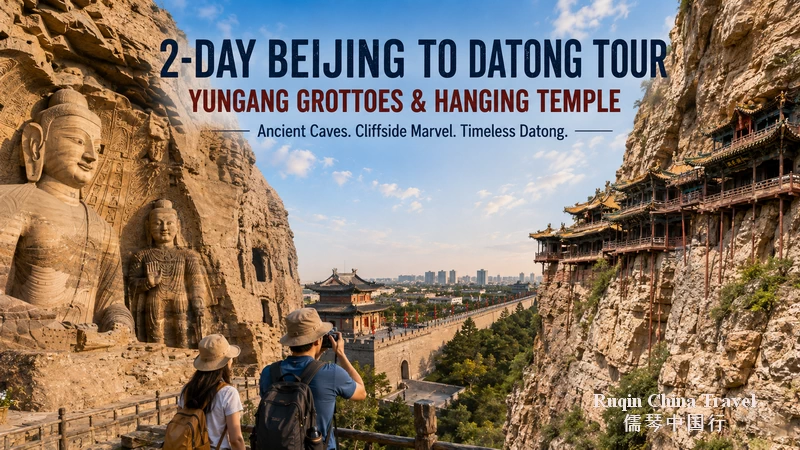
2-Day Beijing to Datong Tour Overview
Datong makes one of the most rewarding two-day side trips from Beijing. High-speed trains have made the journey much easier, with many services taking around two hours.
The main reason to come is the Yungang Grottoes. These remarkable Buddhist caves contain thousands of sculptures carved into sandstone cliffs more than 1,500 years ago.
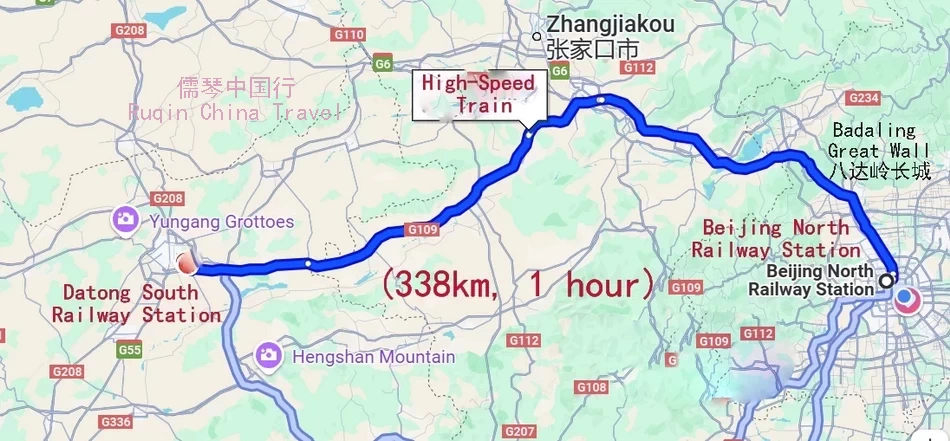
Beijing North Railway Station to Datong South Railway Station High-Speed Train Map
Then, on Day 2, travel into the mountains to see the Hanging Temple beneath Mount Heng. Built against a sheer cliff, it offers a completely different experience from Yungang.
I would also leave time for Datong Ancient City. Its walls, temples, old streets, and evening atmosphere help connect these famous monuments with the city around them.
Who Is This Side Trip For?
I recommend this itinerary for first-time visitors interested in Chinese history, Buddhist art, architecture, and UNESCO heritage.
It also works well for travelers who want to experience northern China beyond Beijing. Datong feels smaller and less overwhelming than the capital.
However, the Hanging Temple lies well outside central Datong. Therefore, Day 2 requires careful transport planning.
Beijing to Datong 2-Day Tour at a Glance
Day 1 — Beijing → Datong → Yungang Grottoes
Beijing → High-Speed Train → Datong → Lunch → Yungang Grottoes → Datong Ancient City → Dinner
Suggested departure: Around 7:00–8:00 am
Train journey: Around 2 hours, depending on service
Main sight: Yungang Grottoes
Evening: Datong Ancient City
Overnight: Central Datong
Day 2 — Hanging Temple → Beijing
Datong → Hanging Temple → Lunch → Return to Datong → High-Speed Train → Beijing
Main sight: Hanging Temple
Road travel: Allow roughly 1½–2 hours each way
Suggested return train: Late afternoon or early evening
Arrival in Beijing: Evening
Day 1: Beijing to Datong & Yungang Grottoes
6:30–7:00 am — Leave Your Beijing Hotel
Start early.
Most travelers will use a morning high-speed train from Beijing to Datong. Check your ticket carefully because Beijing has several major railway stations. There are high-speed trains departing from both Beijing North Station (北京北站) and Qinghe Railway Station (清河站).
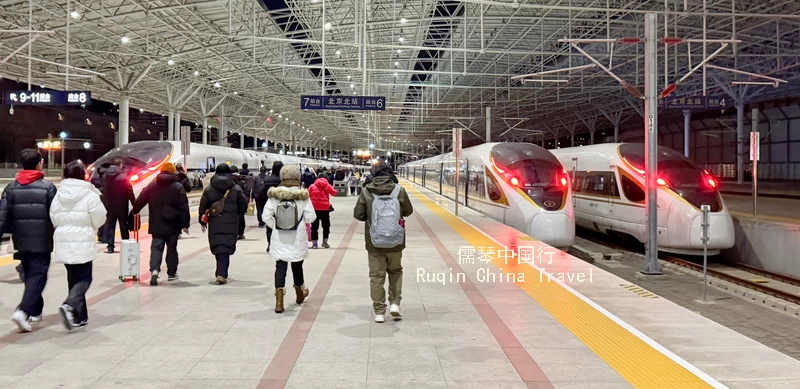
The Platform at Beijing North Railway Station (Beijingbei Railway Station)
Allow enough time for the journey to the station, security checks, and finding your departure gate.
I recommend arriving around 45–60 minutes before departure, especially if you are unfamiliar with Chinese railway stations.
Keep your passport easily accessible.
Around 7:30–8:00 am — High-Speed Train to Datong
Board your high-speed train to Datong South Railway Station.
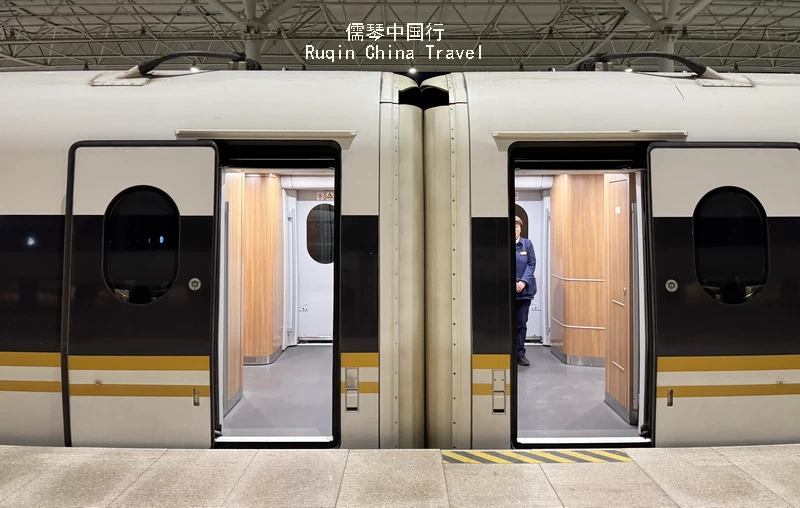
Board your high-speed train to Datong South Railway Station.
Many services complete the journey in roughly two hours. That makes Datong much more practical as a short Beijing side trip than it once was.
The train also gives you time to relax before sightseeing.
Have breakfast before boarding or bring something with you. Then enjoy the changing landscape as Beijing gives way to the mountains and plains of northern China.
Around 9:30–10:00 am — Arrive at Datong South Railway Station
Datong South is outside the historic city center.
If you are traveling light, you can head toward your hotel and leave your overnight bag. Alternatively, arrange luggage storage before continuing.
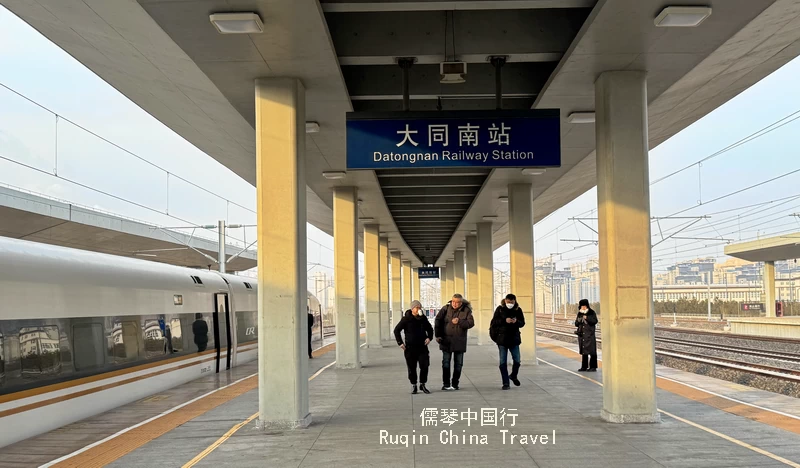
Arrive at Datong South Railway Station (Datongnan Railway Station)
For a two-day trip, pack lightly.
A small backpack or overnight bag is enough.
10:30–11:30 am — Early Lunch
Have an early lunch before visiting Yungang.
Datong and the wider Shanxi region are famous for wheat-based foods. This is a good opportunity to try hand-cut noodles, knife-cut noodles, dumplings, or other local dishes.
Keep lunch reasonably quick.
You will want several hours at Yungang.
12:00–3:30 pm — Explore the Yungang Grottoes
The Yungang Grottoes are the highlight of Day 1 and one of China’s great Buddhist art sites.
Carvers began creating the caves mainly during the Northern Wei period in the fifth and sixth centuries. Today, the site contains hundreds of niches and tens of thousands of Buddhist figures.
Give Yungang at least three hours.
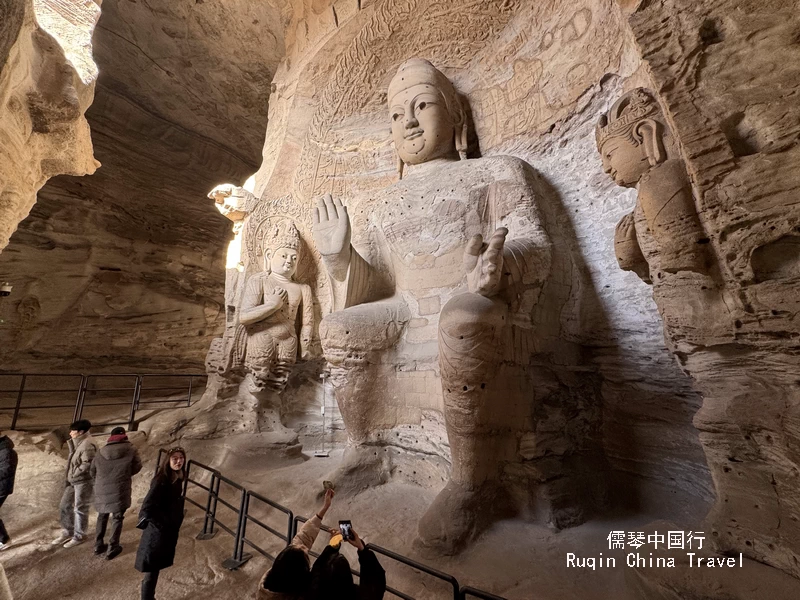
Cave 3, the largest cave in Yungang Grottoes
Some caves contain monumental Buddhas, while others reward you with smaller carvings covering walls and ceilings.
Do not simply walk from one large Buddha to the next.
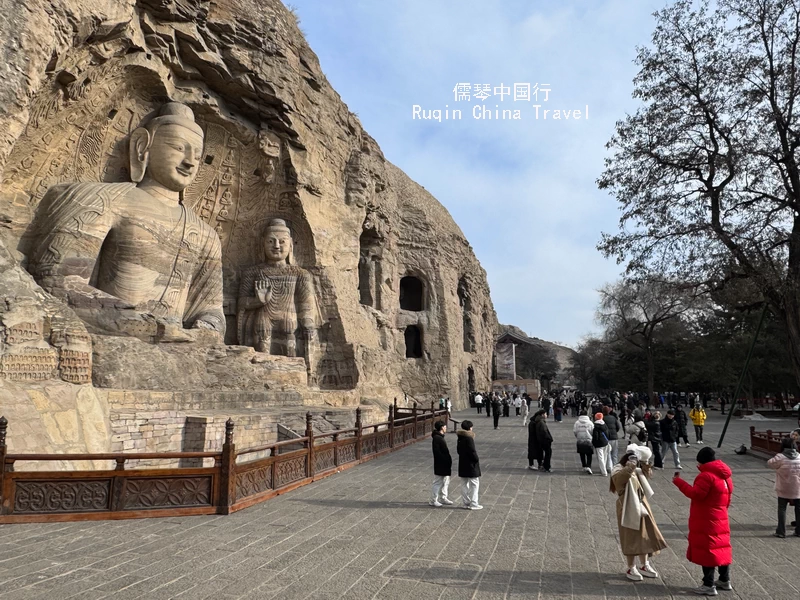
The iconic Cave 20, 13.7 meters high
Look at the faces, clothing, decorative patterns, musicians, celestial figures, and architectural details. They reveal how Buddhist art changed as ideas moved along ancient cultural routes into northern China.
The site also shows how foreign artistic influences gradually blended with Chinese traditions.
That makes Yungang much more than a collection of caves.
3:30–4:15 pm — Return Toward Central Datong
After Yungang, head back toward central Datong.
Check into your hotel if you have not already done so. Then take a short rest.
I recommend staying near Datong Ancient City for this itinerary.
You can walk to restaurants and historic areas in the evening without spending more time in a car.
5:00–7:00 pm — Explore Datong Ancient City
Spend the early evening walking through the historic center.
Datong has undergone substantial restoration and reconstruction. Therefore, do not expect every building you see to be untouched ancient fabric.
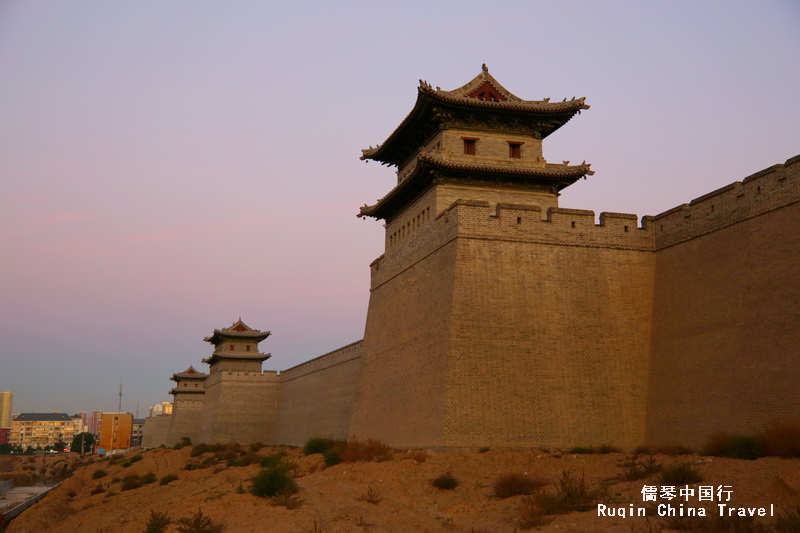
Datong Ancient City Wall ( Rebuilt)
However, several important historic monuments survive within the old city.
If opening hours allow, consider visiting Huayan Temple, one of Datong’s most important Buddhist sites. Otherwise, enjoy the old streets, city walls, gates, and surrounding neighborhoods.
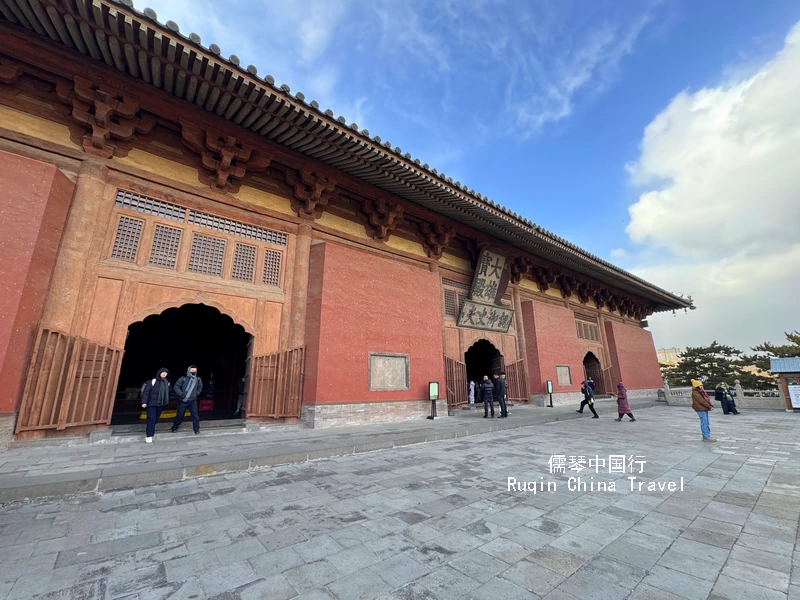
The Daxiong Baodian Hall at Huayan Temple
The city becomes particularly attractive as evening lights appear.
After spending the afternoon among ancient Buddhist caves, this slower walk gives you another view of Datong.
7:00–8:30 pm — Shanxi Dinner
Finish your first day with a local dinner.
Shanxi cuisine makes excellent use of wheat, noodles, vinegar, lamb, and hearty northern flavors.

Try Datong knife-cut noodles (刀削面)
Try Datong knife-cut noodles (刀削面) if you have not already done so.
Then return to your hotel and rest.
Tomorrow involves a longer road journey into the mountains.
Day 2: Hanging Temple & Return to Beijing
7:00–7:30 am — Breakfast
Have breakfast at your hotel and leave early.
The Hanging Temple lies near Hunyuan County, southeast of Datong. Allow roughly 1½–2 hours for the drive, depending on traffic and road conditions.
For this part of the itinerary, I recommend arranging a private car or reliable local transport in advance.
Public transport is possible, but transfers can consume valuable time on a two-day trip.
7:30–9:15 am — Drive to the Hanging Temple
The drive takes you away from urban Datong into a much more mountainous landscape.
Use the journey to rest.
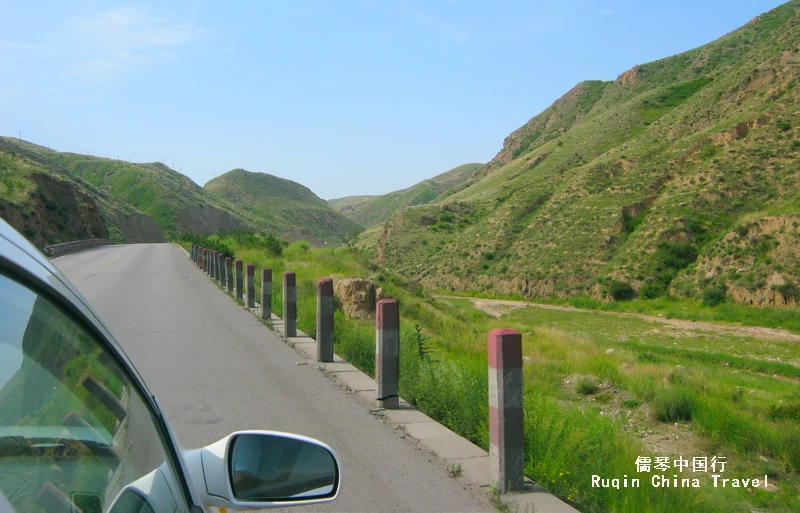
Drive to the Hanging Temple
As you approach the Mount Heng area, the terrain becomes increasingly dramatic.
The Hanging Temple appears against the cliff almost suddenly.
9:15–11:30 am — Visit the Hanging Temple
The Hanging Temple, or Xuankong Temple, is one of northern China’s most unusual historic structures.
The complex appears to cling to a vertical cliff above the valley. Wooden halls, narrow passageways, and supporting structures create the impression that the temple floats against the rock.
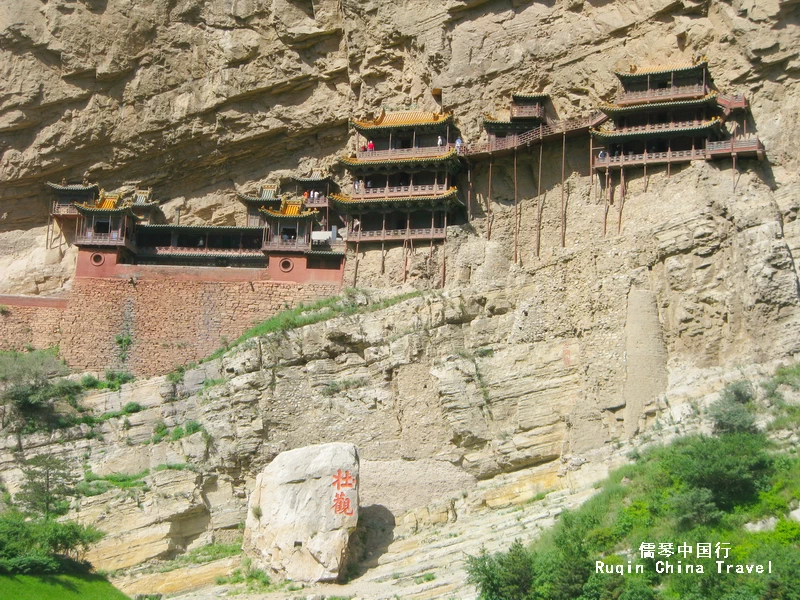
Hanging Temple (悬空寺)
From below, spend some time looking at the entire structure before going closer.
This wider view helps you understand how extraordinary the location really is.
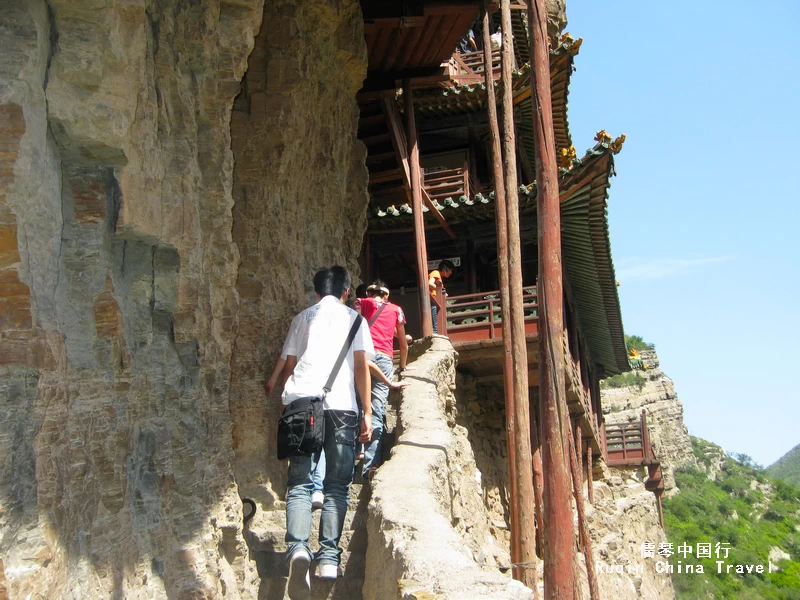
Climb up the Hanging Temple
The temple is traditionally associated with Buddhism, Taoism, and Confucianism. That combination makes it culturally unusual as well as architecturally dramatic.
If access to the upper temple structures is open, expect narrow stairs, small platforms, and confined passageways.
Move slowly and follow staff instructions.
A Note for Travelers Afraid of Heights
The Hanging Temple is not a comfortable experience for everyone.
Some walkways are narrow and elevated. Therefore, travelers with a strong fear of heights may prefer viewing the temple from below.
You can still appreciate the architecture without climbing through every section.
Also, visitor access may be restricted during bad weather, maintenance, or periods of heavy crowding.
Check current conditions before your trip.
11:30 am–12:30 pm — Lunch Near Hunyuan
After the temple, have lunch in the Hunyuan area.
Choose a simple local restaurant rather than rushing straight back to Datong.
This also gives you time to rest after the temple stairs and walkways.
Then begin your return journey.
12:30–2:30 pm — Return to Datong
Drive back toward Datong.
The exact journey time depends on traffic and your final destination.
If you left luggage at your hotel, collect it before heading to the railway station.
Keep your train departure time in mind throughout the afternoon.
Around 3:30–5:00 pm — High-Speed Train Back to Beijing
Take a late-afternoon or early-evening high-speed train from Datong South Railway Station.
I would not book the earliest possible return after visiting the Hanging Temple.
Road delays happen.
Giving yourself extra time makes the day much less stressful.
Once aboard, sit back and rest.
After two days of caves, temples, stairs, and mountain roads, the train ride back to Beijing may feel very welcome.
Around 6:00–8:00 pm — Arrive in Beijing
Return to your Beijing hotel after arriving at the station.
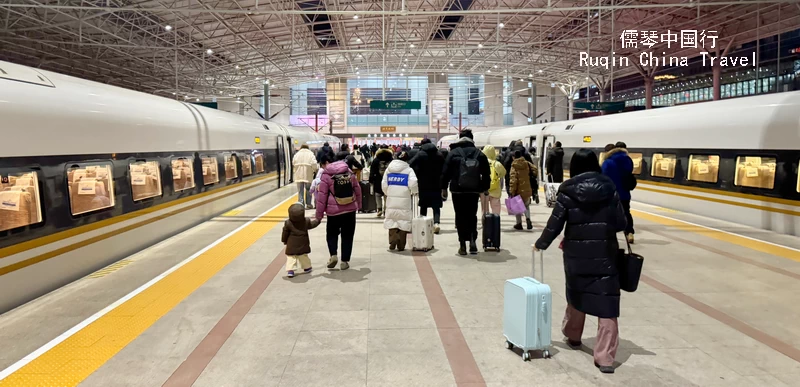
Arrive at Beijing North Railway Station in Beijing
Keep the evening free.
Datong may look close to Beijing on the high-speed rail map, but you have still covered a lot in two days.
Tickets, Transport & What to Bring
Beijing–Datong High-Speed Train Tickets
Book your high-speed train tickets in advance, especially during weekends and Chinese public holidays.
For this itinerary, choose an early train to Datong on Day 1. Then choose a late-afternoon or early-evening return on Day 2.
Second class is comfortable for the relatively short journey.
Your passport serves as your main identification for rail travel. Keep it easily accessible at the station.
Check Your Beijing Railway Station
Beijing has several large railway stations. For going to Datong from Beijing, there are high-speed trains departing from both Beijing North Station (北京北站) and Qinghe Railway Station (清河站).
Always check the exact departure station shown on your ticket rather than assuming which one your train uses.
Allow additional travel time during the morning rush hour.
Going to the wrong Beijing station can easily ruin a two-day side trip.
Getting Around Datong
Taxis and ride-hailing services work well for journeys between Datong South Railway Station, central Datong, and Yungang.
For the Hanging Temple, I prefer arranging a car and driver.
It costs more than public transport. However, it saves time and gives you much better control over the Day 2 schedule.
If several travelers share the car, the convenience becomes even more worthwhile.
Yungang Grottoes Tickets
Book Yungang Grottoes tickets ahead during busy travel periods.
Carry your passport for identification and ticket verification.
Photography rules may vary between caves and exhibition areas. Follow posted signs rather than assuming photography is allowed everywhere.
Most importantly, do not use flash around sensitive historic art.
Hanging Temple Tickets
The Hanging Temple may have different arrangements for scenic-area admission and access to the elevated temple structures.
Visitor numbers on the temple itself can also be controlled for safety.
Therefore, check current ticketing and access arrangements before leaving Datong.
During Chinese holidays, advance planning becomes particularly important.
Where to Stay in Datong
For one night, I recommend staying near Datong Ancient City rather than near Datong South Railway Station.
You will have easier access to historic sights, restaurants, and evening walks.
This also makes the overnight stay feel like part of the trip rather than simply a pause between train journeys.
What to Bring
Travel light with a small overnight bag.
Bring comfortable walking shoes, your passport, phone, charger, and portable power bank.
Datong sits at a higher elevation than Beijing and can feel cooler, especially in the morning and evening. Bring an extra layer outside the hottest summer months.
Meanwhile, summer visitors should carry sunscreen, a hat, and water.
The Hanging Temple area can also be windy.
Finally, bring some patience with the stairs and crowds. Both major attractions deserve to be experienced slowly.
Ruqin’s Trip Design Note
For a two-day Datong trip, I would resist adding too many attractions.
Datong has much more to see, including Huayan Temple, Shanhua Temple, the Nine Dragon Screen, city walls, Yingxian Wooden Pagoda (佛宫寺释迦塔) and Mount Heng. However, trying to cover everything would turn these two days into a race.
I would build the trip around Yungang on Day 1 and the Hanging Temple on Day 2.
They complement each other beautifully.
At Yungang, you stand in front of enormous Buddhist figures carved directly into the cliffs. The experience is about sculpture, faith, history, and cultural exchange.
Then, the next morning, you see people using a cliff in a completely different way.
Instead of carving inward, the builders of the Hanging Temple constructed outward.
That contrast is what makes this two-day route work.
I added Datong Ancient City because visitors should also see the city between these two monuments. An evening walk gives you that experience without making the schedule too heavy.
Two days will not show you all of Datong. However, they will show you why this northern city deserves a place on a first journey through China.
Plan More of Your Beijing & Datong Trip
Use Ruqin China Travel’s practical guides to prepare for China high-speed trains, Datong transport, attraction tickets, mobile payments, internet access, local food, and independent travel in northern China.
If you have a third day, slow the trip down rather than adding another distant destination like Yingxian Wooden Pagoda (佛宫寺释迦塔). Spend more time inside Datong Ancient City and visit Huayan Temple, Shanhua Temple, or the Nine Dragon Screen before returning to Beijing.
Datong Travel Guide: Map, Walking Routes, Highlights and Tips
Beijing to Datong High-Speed Train Day Trip: A DIY Guide
How to Get from Beijing to Datong – Your Complete Guide
How to Book Datong Attraction Tickets: All You Need to Know
The Best Datong Tour Itinerary – Ruqin China Travel
Questions About Planning Your Beijing to Datong Trip?
Still have questions about this route? You’re welcome to write to me.
If you need advice on timing, transport, tickets, or adjusting the itinerary, I’m happy to offer a practical suggestion based on my experience in Beijing and Datong.
There’s no fee for a simple question. Just use the form below and tell me about your plans.
We respect your privacy. Your details will never be shared or used for marketing.