
Written by Ruqin
June 26, 2026
Start: Jianguomen Station (Exit C), Subway Line 1 & 2
End: Silk Street Market
Distance: Approx. 3.8 km
Walking Time: About 2.5 hours with photo stops
Best Time: Late afternoon to evening
Surface: Flat sidewalks and paved urban paths
Crowd Level: Moderate on weekdays, quieter in side streets
I started this CBD walk in the late afternoon of June 26, 2026. I came out of Jianguomen Station through Exit C and immediately felt the heat of the street. Even though it was already around 5 pm, the air was still dry and heavy, with little relief from the sun.
The temperature that day stayed between 31°C and 21°C, but the shift was slow. There was no sudden coolness—just a gradual change as the light softened and the long shadows of the buildings began to stretch across Jianguomen Avenue.
I stepped into the flow of the sidewalk and started walking eastward.
Why I Walked This Route
The CBD in Beijing is mainly centered around the Guomao Bridge area. It is often compared to Lujiazui in Shanghai or Manhattan in New York, a place where Beijing’s most visible modern skyline takes shape.
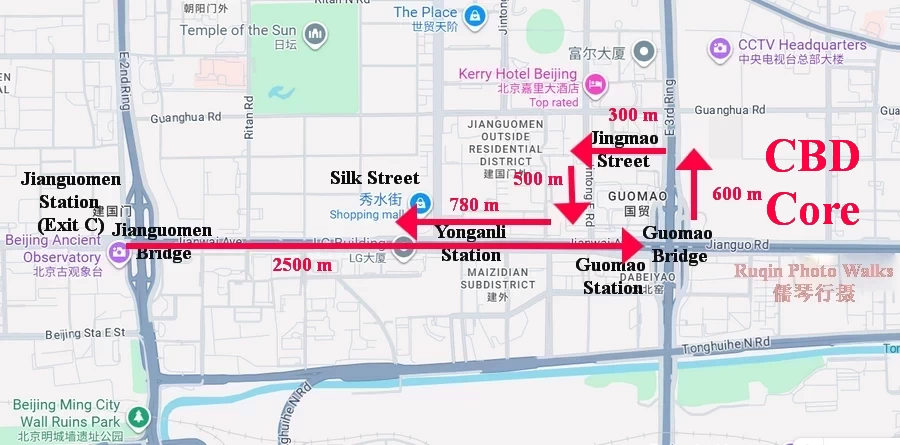
Beijing CBD Photo Walk Map (Google Maps)
From street level, the impression is immediate. Tall buildings stand close together, rising in layers without much open space between them. Among them, China Zun reaches 528 meters, standing as one of the tallest buildings in the world. Not far away, the CCTV Headquarters appears in its distinctive “looped” form, easily recognizable even from a distance.
Around these landmarks, more than ten towers rise above 200 meters, forming a dense cluster of high-rises. The skyline shifts constantly depending on where you stand—sometimes compressed between buildings, sometimes opening suddenly across intersections.
I had been to the CBD several times before. This time, I returned without a fixed purpose, simply to walk through it again and observe how it feels in the late afternoon light.
Step-by-Step Beijing CBD Photo Walk Routes
Step 1: Jianguomen Bridge → Guomao Bridge
Distance: Approx. 2.5 km
Walking Time: About 1.5 hours
My Beijing CBD Photo Walk started with Jianguomen Station Exit C. I left Jianguomen Station Exit C at around 5:00 pm. The sun was still high, and although it was already late afternoon, the heat outside had not eased yet. It felt more like the middle of the day than the end of it.
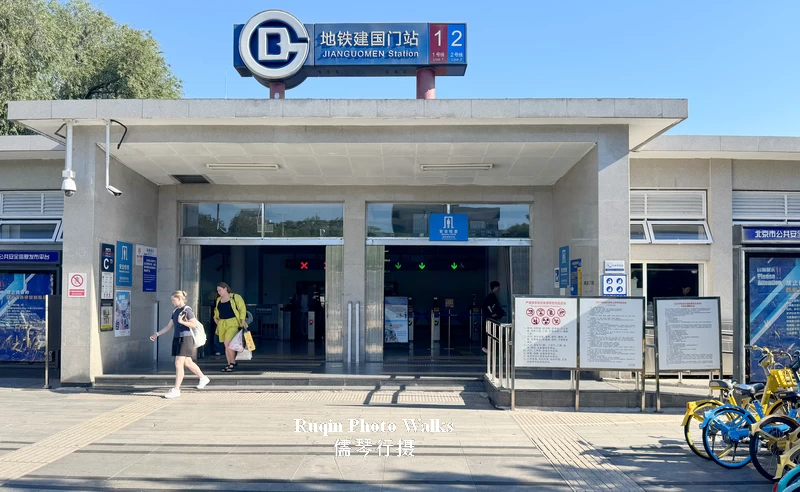
My Beijing CBD Photo Walk started with Jianguomen Station Exit C
I walked east and soon passed under Jianguomen Bridge. Here the traffic structure becomes layered — the Second Ring Road runs below, while Jianguomen East and West Avenue stretches above. The movement of cars felt continuous, building slowly toward the evening rush hour.
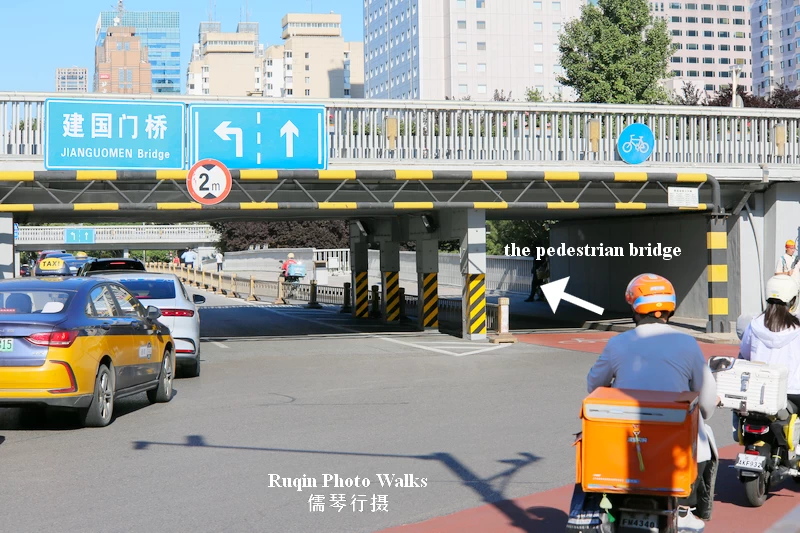
I walked east and soon passed under Jianguomen Bridge
I stepped onto the pedestrian bridge and paused for a moment. Looking down, I could see vehicles flowing steadily through the ring road below, headlights and reflections beginning to appear in the distance as the city started to shift toward peak traffic.
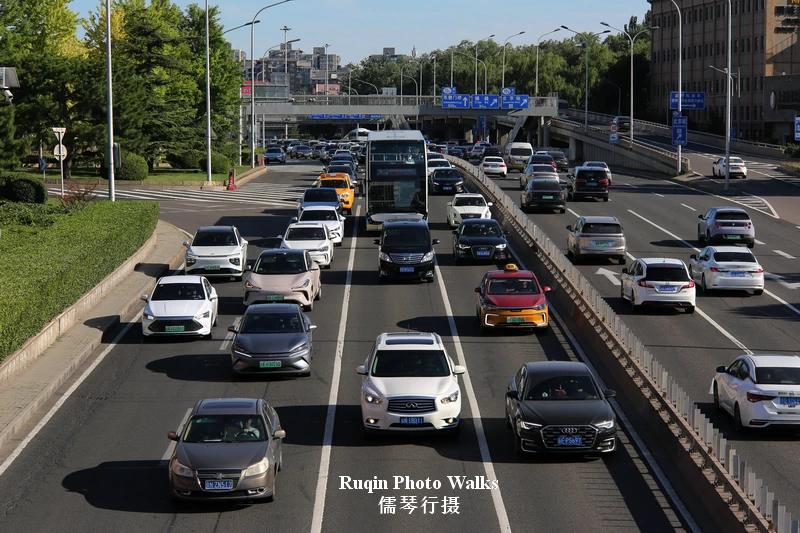
Vehicles flowing steadily through the ring road Jianguomen Bridge
When I turned around, I noticed the Beijing Ancient Observatory standing nearby. Its fortress-like brick structure felt quietly different from everything around it — stable, restrained, and slightly distant from the speed of the modern roads.
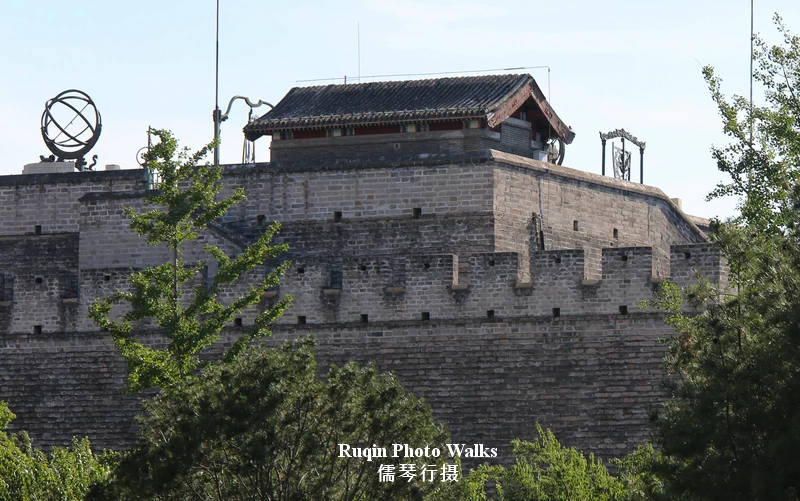
Beijing Ancient Observatory
In a city that keeps expanding upward and outward, it still holds its own presence without needing to change.
• Jianguomen Outer Avenue → Toward Guomao CBD Core
I continued walking along the southern sidewalk of Jianguomen Outer Avenue toward Guomao Bridge, which sits at the center of Beijing’s CBD. This stretch of road between Jianguomen Bridge and Guomao Bridge is very wide.
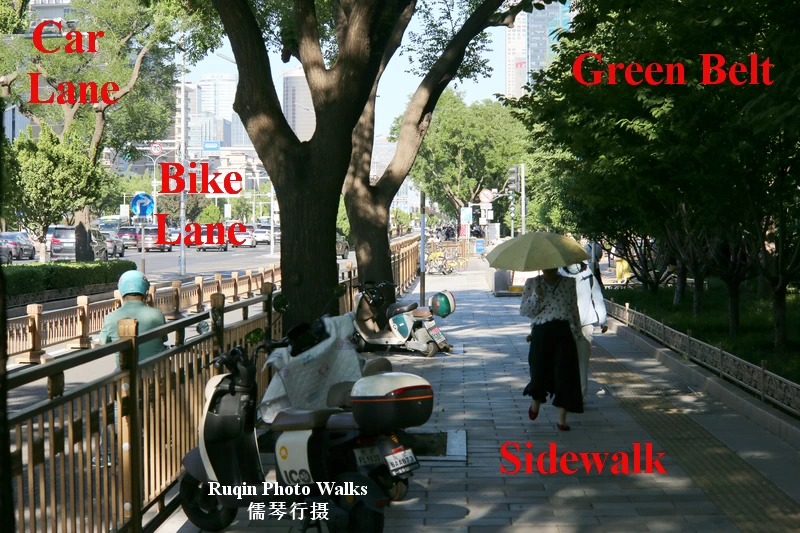
Jianguomen Outer Avenue is very wide
The layout is clearly structured: in the middle are multiple lanes of traffic and bus stops, then a separated non-motorized lane (bike), and further out, the pedestrian walkwa, green belt and office buildings.
Between the sidewalk and the buildings, there is a continuous green buffer zone. Trees, low shrubs, and small resting spaces are built into it, so pedestrians can step inside and sit for a while.
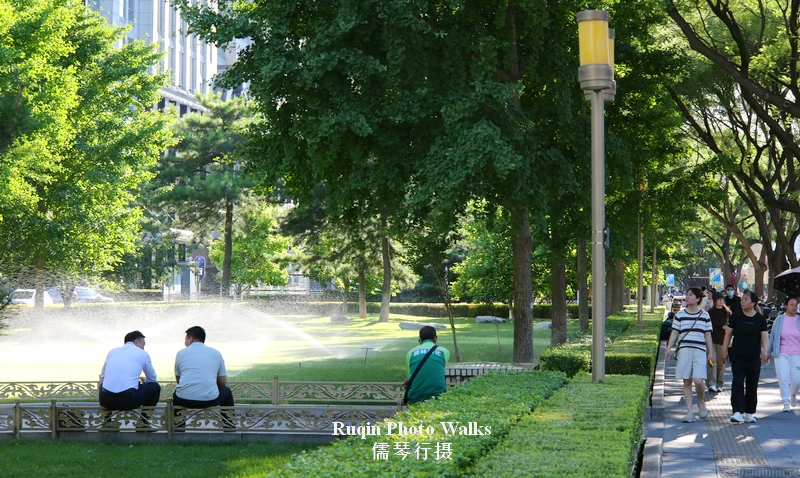
The continuous green buffer zone on both sides of Jianguomen Outer Avenue
I stopped there more than once, taking breaks and drinking water under the shade. The design makes the long walk feel less rigid, especially in the heat of the afternoon.
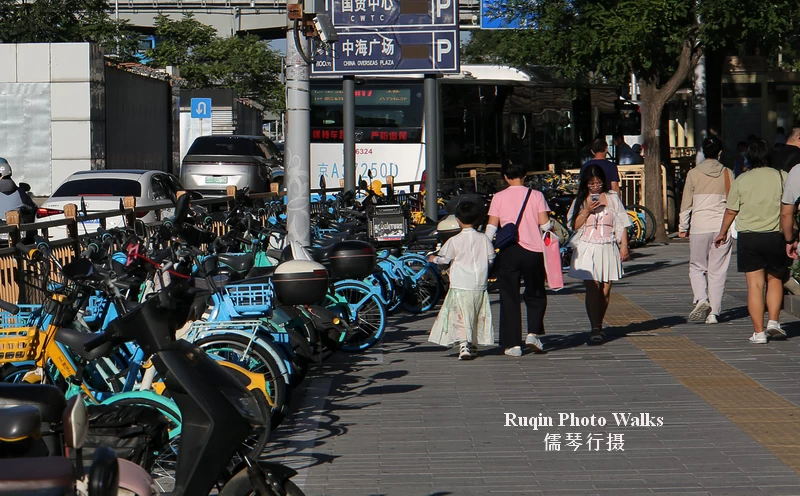
Rows of shared bicycles neatly lined up at intervals.
On the sidewalk itself, I noticed rows of shared bicycles neatly lined up at intervals. They were constantly being used by office workers and pedestrians for the last short connection between subway stations, offices, and nearby streets.
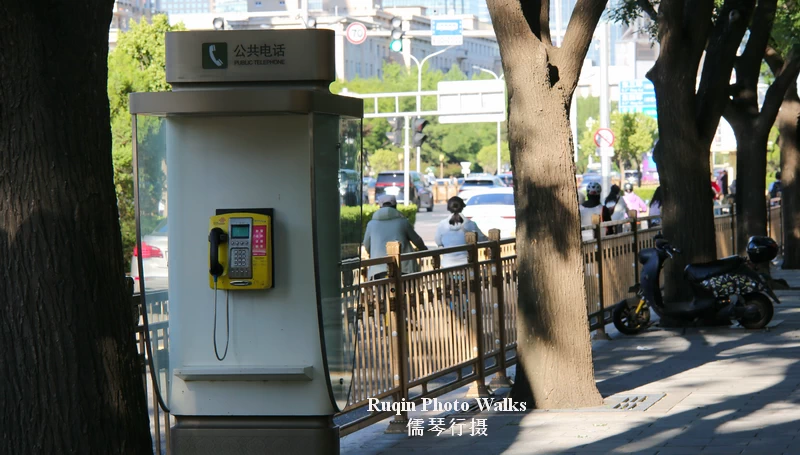
an old public telephone booth standing by the roadside
A little further along, I saw something I did not expect — an old public telephone booth standing by the roadside. In a city where almost everyone uses mobile phones, seeing it felt slightly out of place, but also familiar in a quiet way. It remained there, unchanged, as if holding a small piece of another time.
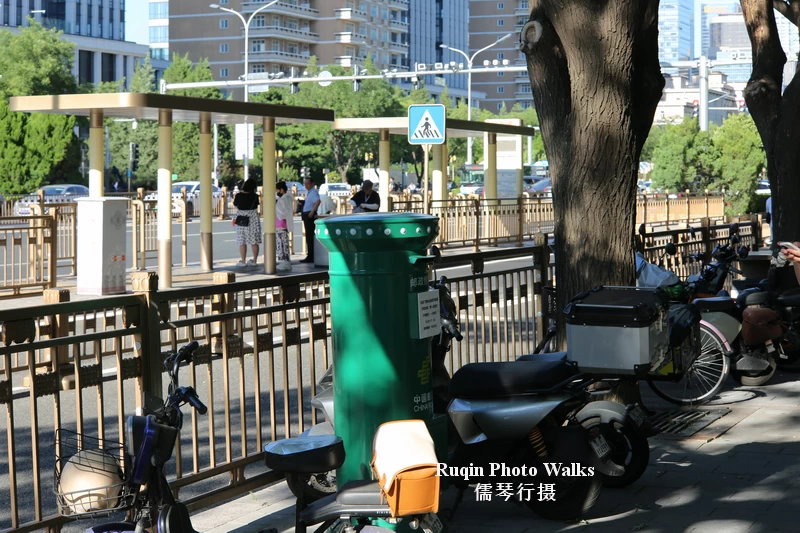
A green postal box.
Not far from it was a green postal box. The color was bright and noticeable among the concrete and glass around it. Few people seemed to use it, yet it still stood there. I paused for a moment looking at it. In a world of instant messages, emails, WeChat, and WhatsApp, it felt like a slower form of communication that had not completely disappeared.
Standing on this long avenue, with traffic moving steadily in the middle and glass towers rising ahead toward Guomao, these small objects — the phone booth, the mailbox, the resting green spaces — felt like quiet interruptions in an otherwise fast-moving city.
• People on Jianguomen Outer Avenue — A Street at 5 PM
It was just after 5:00 pm, and the sidewalk had already begun to fill with different flows of people. This was the time when school finishes, and the rhythm of the street quietly changes.
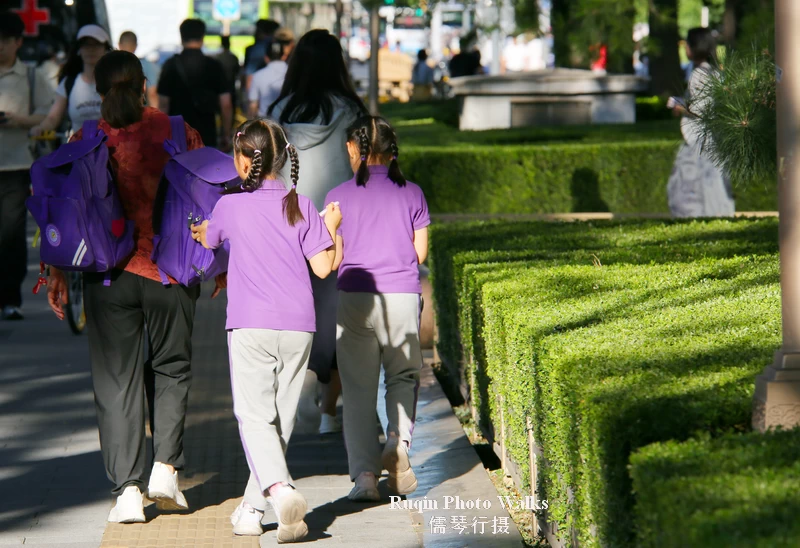
The grandmother carried two school bags for her two granddaughters
One scene stayed with me for a while — an elderly grandmother walking with two young twin granddaughters toward Guomao. Each girl carried a school bag that looked a little heavy for their size. After a short while, the grandmother stopped, took both bags, and carried them herself while continuing to walk forward at a steady, slightly slower pace.
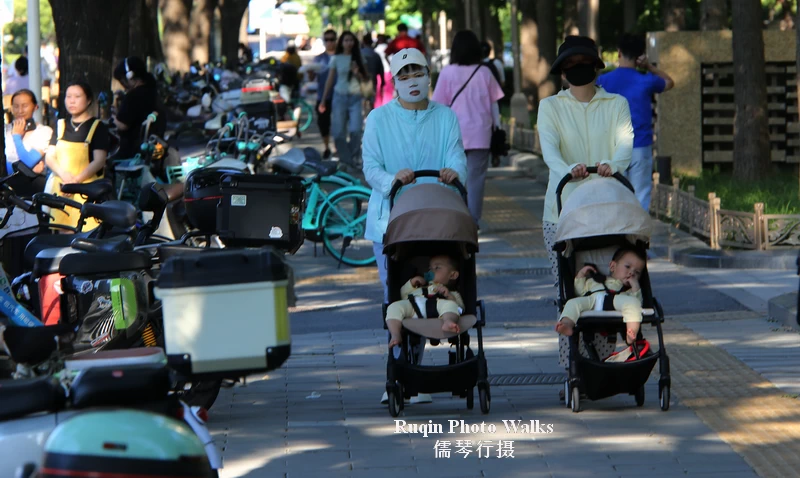
two young mothers walked side by side, each pushing a stroller.
Further along the sidewalk, I noticed two young mothers walked side by side, each pushing a stroller. Because of the strong afternoon sun, they had covered most of their faces with hats and sun protection, leaving only small gaps visible as they walked in step with each other.
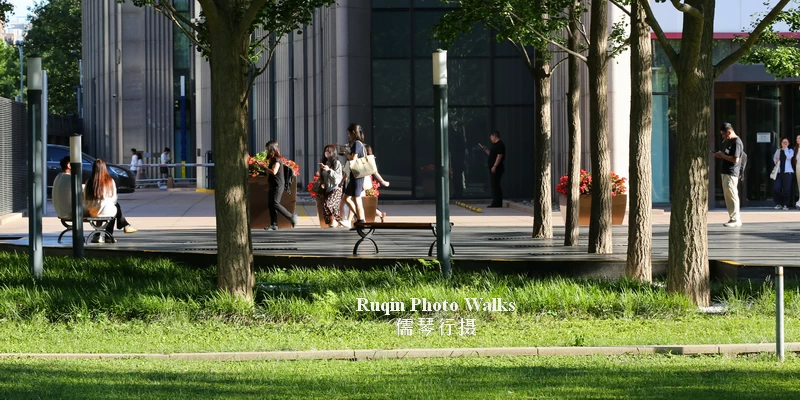
office workers began to appear from the glass towers lining both sides of the street
As the hour moved closer to evening, office workers began to appear from the glass towers lining both sides of the street. They came out in small groups, then gradually separated — some heading toward the subway entrances, others unlocking shared bicycles, and a few walking together while talking quietly about dinner plans.
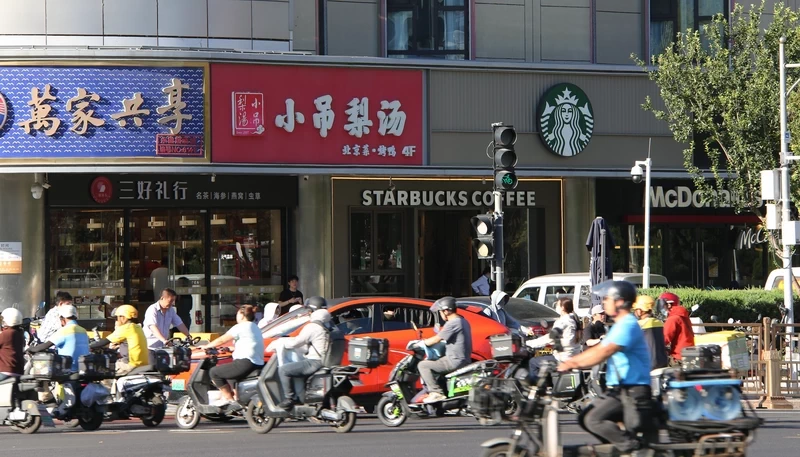
Delivery riders moved constantly through the scene
Delivery riders moved constantly through the scene, weaving between pedestrians and stopping briefly at intersections or building entrances. They seemed to be everywhere along the avenue, always in motion, always adjusting to traffic, lights, and orders coming in on their phones.
Among all of this movement, I stood out slightly as someone simply walking without urgency. There were not many people like me on the sidewalk at that time. The heat was still strong, and most visitors had not yet arrived. I imagined that once the sun lowered further and the lights of the CBD came on, the character of the street would change again — tourists would appear, cameras would come out, and the same avenue would be seen in a completely different way under the evening lights.
• Beijing CBD Skyline — Between Jianguomen and Guomao
As I continued walking along Jianguomen Outer Avenue, the skyline gradually became more concentrated. On both sides of the road, especially toward Guomao Bridge, clusters of high-rise buildings began to dominate the view. The city here feels more vertical, with glass towers rising behind rows of trees and traffic.
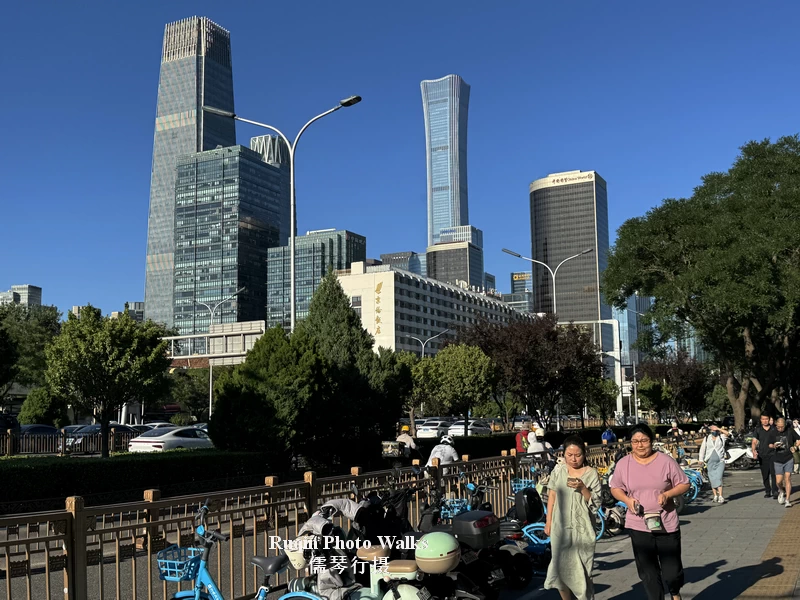
Clusters of high-rise buildings began to dominate the view
Among them, China Zun stands out immediately. At 528 meters, it rises far above the surrounding buildings and anchors the entire CBD skyline.
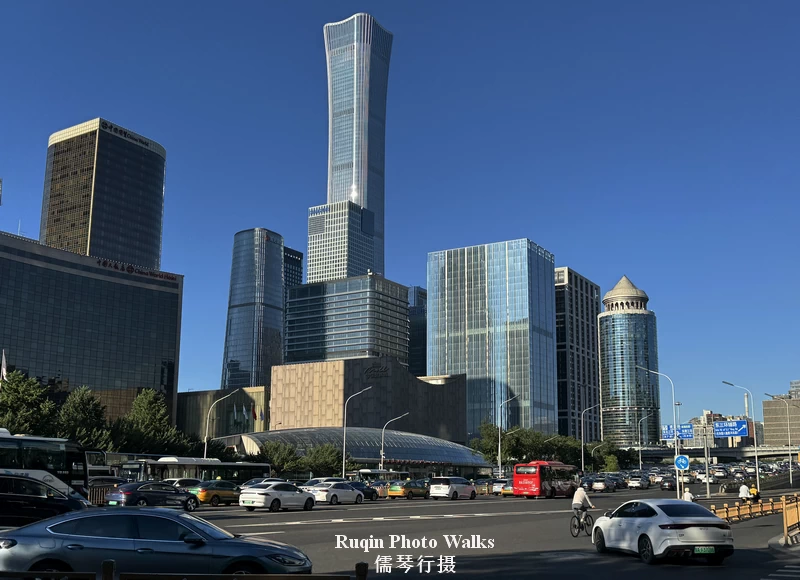
China Zun stands out at 528 meters
Not far away, the CCTV Headquarters — often called the “big pants” building — appears with its looping structure, breaking the usual vertical rhythm of the surrounding towers.
Around these two landmarks, more than ten skyscrapers over 200 meters form a dense cluster, each slightly different in height and shape.
From Jianguomen Bridge toward Guomao, the buildings appear layered rather than isolated — some closer to the road, others set deeper into the district, creating a shifting skyline as you move forward.
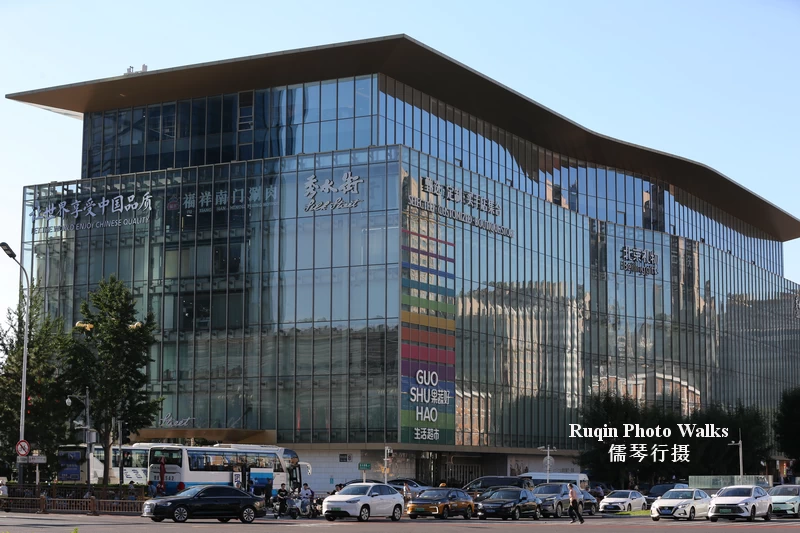
Between Jianguomen and Guomao, the walking distance is about 2.5 kilometers. In between lies Yong’anli Station, which is also known for the nearby Silk Street area. This part of the walk often serves as a natural stopping point for some people, before entering the deeper CBD core near Guomao.
The density of tall buildings increases as you approach Guomao, but the height is still relatively controlled compared with other global financial districts. The skyline feels compact rather than extreme — closely arranged, but structured within clear limits.
As I walked closer toward Guomao, I became aware that this stretch of road is not just a transition between two bridges, but a gradual entry into the core of Beijing’s modern financial and media district.
Step 2: Guomao Bridge → Silk Street Market
Distance: Approx. 1.3 km
Walking Time: About 1 hour (with photo stops)
• Guomao Bridge
I continued walking along Jianguomen Outer Avenue and soon arrived beneath Guomao Bridge. The structure here is fully three-dimensional. The East Third Ring Road passes above and below in a layered interchange, while Jianguomen Outer Avenue continues eastward as Jianguo Road toward Tongzhou.
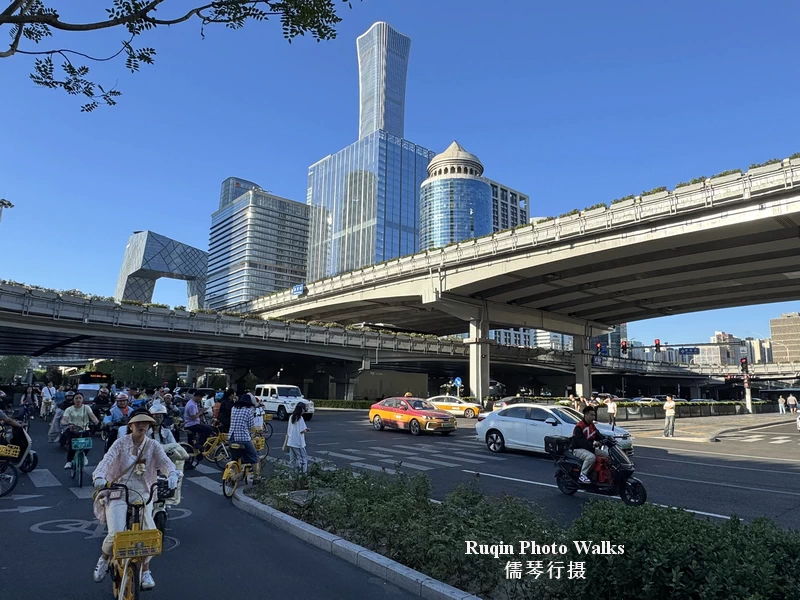
The photo was taken under Guomao Bridge
It was already the evening rush hour. Under the bridge, traffic was dense and constantly moving. Buses pulled in and out of stops, private cars and taxis flowed through the intersections, and ride-hailing vehicles slowed briefly before merging again.
Among them, shared bicycles moved quietly through the gaps, weaving through the larger flow of traffic. The whole scene felt active and tightly packed, like the city was fully awake at once.
• High-rise buildings in Beijing CBD
At the four corners of the Guomao intersection, the landmark buildings of the CBD stood in different directions — China World Hotel, China Merchants Tower, CITIC Tower cluster buildings, China World Trade Center Phase III, and China World Mall. They framed the intersection rather than sitting apart from it.
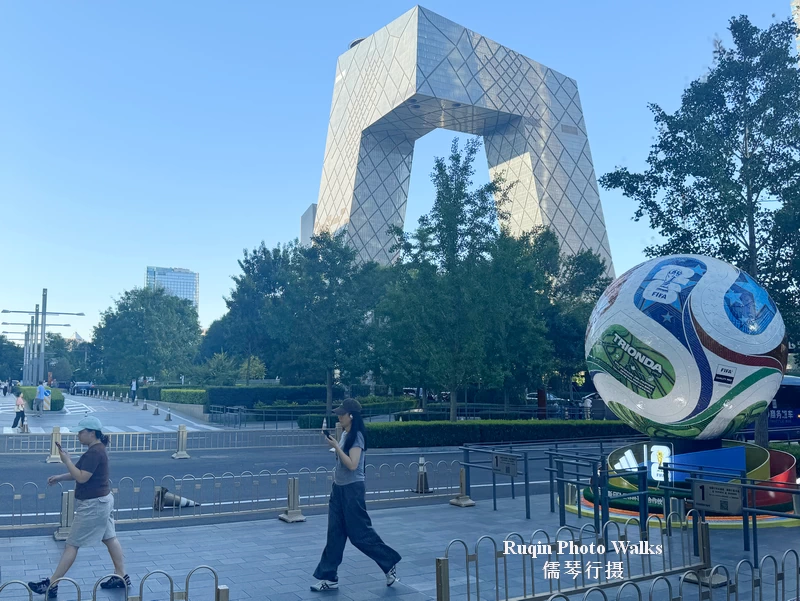
The CCTV Headquarters and the 2026 World Cup
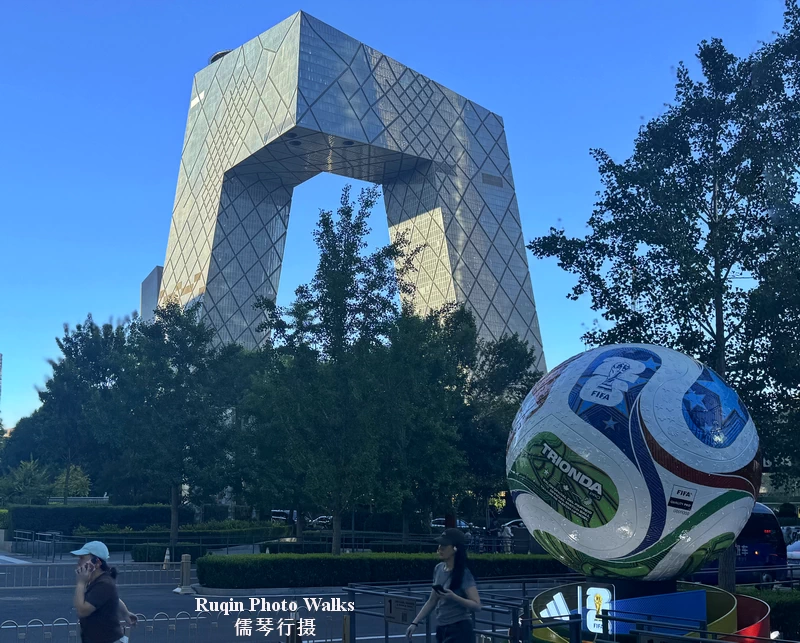
I walked north along the eastern side of the Third Ring Road for a while. The CCTV Headquarters gradually came closer, its looped structure becoming more dominant as I approached. I have passed beneath this building many times in the evening and at night, and each time its shape feels slightly different depending on the light.
This time, however, there was something new not far from it — a large football installation marking the 2026 World Cup. It created an unusual contrast between a fixed architectural landmark and a temporary global event marker. The city felt layered with different moments in time.
• Jingmao Street
I paused there for a while before turning into Jingmao Street and heading west. This short street cuts between the north and central sections of the China World Mall complex. Around me were high-end commercial spaces — restaurants, offices, and hotels — including China World Trade Center Phase III, one of the tallest buildings in Beijing.
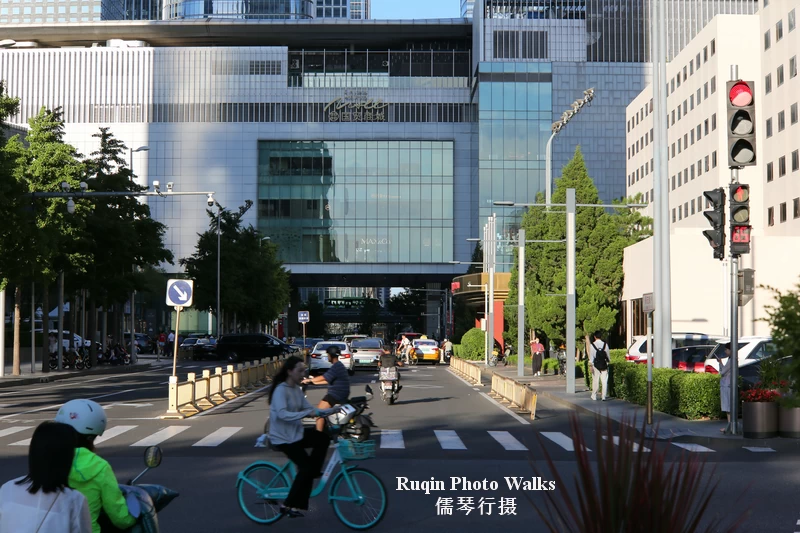
Jingmao Street and China World Mall
I have been to the China World Mall before, including the Blue Frog on the 6th floor of the north section. It is a casual Western-style bar and restaurant serving mainly American-style food, with a relaxed atmosphere inside the mall.
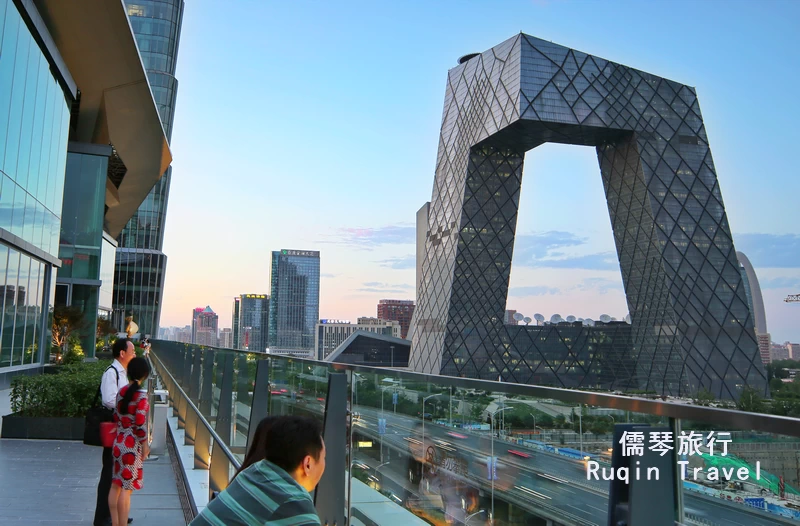
The CCTV Tower viewed from Blue Frog
From the window seats, you can look out toward the CCTV Headquarters and China Zun in the distance, two of the most recognizable landmarks in the Beijing skyline.
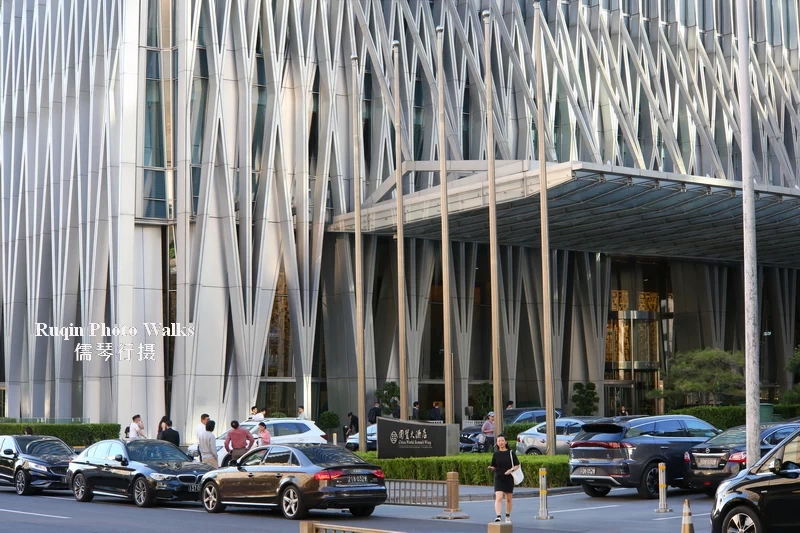
China World Summit Wing ( Luxury Hotel ) along Jjingmao Street
As I walked further, the character of the street shifted again. The flow of office workers increased as the workday ended. Jingmao Street eventually led me to a T-junction connecting with Jintong East Road. I turned south and soon rejoined Jianguomen Outer Avenue.
• Jintong East Road
This section felt noticeably quieter on the western side of Jintong East Road. One side belongs to the commercial core of the CBD, while the other opens into older residential-style buildings, lower in height and more subdued in atmosphere.
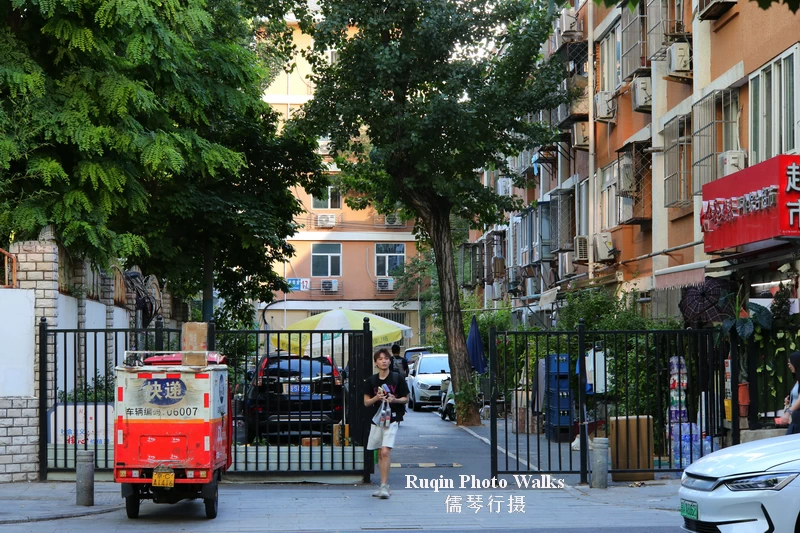
The older residential-style buildings on west side of Jintong East Road
Delivery riders moved in and out of the area, and people entered and exited buildings at a slower pace compared with the main CBD corridor.
• Again Back to Jianguomen Outer Avenue
I then continued walking west along the northern sidewalk of Jianguomen Outer Avenue. This time, I was on the opposite side of where I had started earlier in the day. From the intersection of Jintong East Road and Jianguomen Outer Avenue, it was about 780 meters to Silk Street Market.
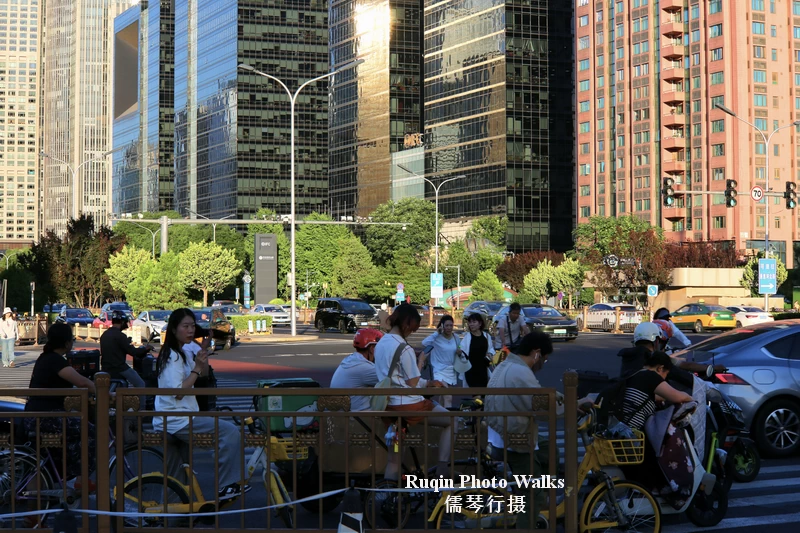
On the way westward to Silk Market along Jianguomen Outer Avenue
The afternoon light had softened by this point. Along the street were hotels and restaurants, including the historic Jianguo Hotel — one of the earliest joint-venture hotels in Beijing — as well as Jinglun Hotel, McDonald’s, Starbucks, and other familiar chains.
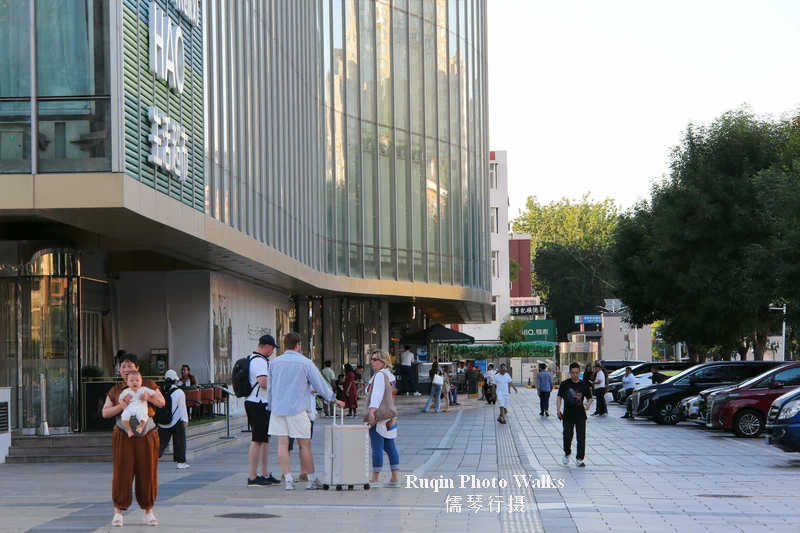
My Beijing CBD Photo Walk ended at Silk Street Building
My Beijing CBD Photo Walk ended at Silk Street Building, near Yong’anli Station. The building rises six floors above ground with one basement level. What was once a simple street market has now become an international commercial space, where shopping, dining, and cafés sit side by side. It felt like the final transition point of the walk — from the dense core of the CBD back toward a more open, everyday city rhythm.
Practical Notes for This Beijing CBD Walk
In summer, Beijing can feel hot and dry in the late afternoon. It helps to prepare for the heat. Light clothing, sun protection, and a hat make the walk easier. Comfortable shoes are also important, especially if you stay out until evening.
I suggest start about one hour before sunset. The light becomes softer at that time. The city also begins to change. For photography, the period just before and after sunset works best. This is the blue hour. Glass buildings shift from warm reflections to night lights.
There are several good places around the CBD to rest during or after the walk. Some cafés and restaurants look out toward the skyline. They let you stay close to the atmosphere while taking a break. Blue Frog in China World Mall is a relaxed option.
At the Hyatt Regency Beijing Guomao, the 15th-floor China Grill restaurant offers an elevated view of the CBD skyline. The view is especially good in the evening when the lights come on.
Sitting in these spaces and watching the city shift from day to night is also part of the walk.
Ruqin is the founder of Ruqintravel.com and has decades of experience in China’s travel industry. Drawing on hands-on work across major destinations throughout the country, he personally researches and updates each guide to help international travelers explore China with confidence.
Further Reading
Beijing City Walks: Routes, Maps & Essential Travel Tips
Beijing Hutong Walks: Routes, Maps & Local Tips
Riverside Walk from Liangma River to Solana
Beijing Second Ring Road Moat Greenway Walk