
Written by Ruqin
March 2, 2026
Quick Walk Overview
- Start: Shichahai Station (Exit A2)
- End: Nanluoguxiang (optional extension)
- Distance: ~2.5 km / 1.5 miles (approx.)
- Walking Time: 1–1.5 hours slow walk with photo stops (approx.)
- Best Time: Early morning (7:00–9:00 am)
- Surface: Flat pavement, hutong stone lanes
- Crowd Level: Very quiet early morning
Early March in Beijing still feels like winter. When I did this walk, it was just 1°C, overcast, and completely still. The lake looked like a black-and-white ink painting. No tour groups, no music from the bars — just locals moving quietly through their morning routines. If you want to see the real Shichahai before it turns lively and loud, this is the time.
Why I Walked This Route
I like Shichahai in the early morning because it shows its true face. During the day and especially in the evening, it’s full of tourists, bar music, snack vendors, and boutique shopping. That version is fun — but it’s not the one I come for when I want atmosphere.
In early March, the trees are still bare. The lake feels open and exposed. The light is soft and flat under an overcast sky, which actually makes the tones more subtle — grey roofs, dark water, pale sky. It simplifies everything.
I also like that the walking flow makes sense. You exit the subway, grab something warm, reach the lake in one minute, then naturally move into the hutongs and continue north toward the Drum and Bell Towers. No backtracking. Just a steady, quiet line through old Beijing.
Step-by-Step Walking Route
Step 1: Exit Shichahai Station (Exit A2)
Take Subway Line 8 to Shichahai Station.
Use Exit A2.

Line 8 to Shichahai Station and Use Exit A2.
As soon as you come up, you’ll see a Starbucks on your right. It opens at 7:30 am.
Add photo(s): Subway exit, morning street light, Starbucks storefront in soft light.
Step 2: Warm Up Before the Lake (1–2 minutes)
On this walk, I grabbed a hot beef roll and a cup of coffee. With 1°C air, you’ll want something warm in your hands.
From the station exit, walk to the west along the short lane on the north edge of the Starbucks toward the lake. It’s about a 1-minute walk.

Houhai Lake feels bare and muted in the early March light
You’ll arrive at Houhai, part of the larger Shichahai area.
Step 3: Walk Along Houhai (Back Lake) — Slow Loop (20–30 minutes)
In the early morning, it’s almost silent.
I saw:
- A few locals walking briskly
- Some elderly residents doing light exercise
- Rickshaw drivers standing beside their tricycles, scanning for early customers
No tour groups yet. No loudspeakers. No bar music.

Houhai Lake reflections, rickshaw waiting quietly, bare willow branches, wide empty boardwalk.
The lake under an overcast sky looked like a Chinese ink painting — mostly black, white, and grey. The bare branches reflected in the water. Very minimal. Very calm.
If you want to photograph reflections, this is the moment. By late morning, the surface usually gets disturbed.
Add photo(s): Lake reflections, rickshaw waiting quietly, bare willow branches, wide empty boardwalk.
Step 4: Observe Local Morning Life
If you wander slightly into the nearby hutongs, you’ll notice small, temporary roadside vegetable setups. Locals buying fresh greens. Produce laid directly on cloth on the ground. No fancy displays.
This is the real hutong rhythm — practical, unpolished, lived-in.

Open-air vegetable stalls, locals shopping at Shichahai
If you want to understand the atmosphere of old Beijing neighborhoods, come early. Later in the day, the storefront businesses take over the visual space.
Add photo(s): Open-air vegetable stalls, locals shopping, narrow hutong entrance.
Step 5: Enter Yandai Xiejie (232 meters) — Quiet Passage Through History
From the north side of Houhai, walk toward Yandai Xiejie.
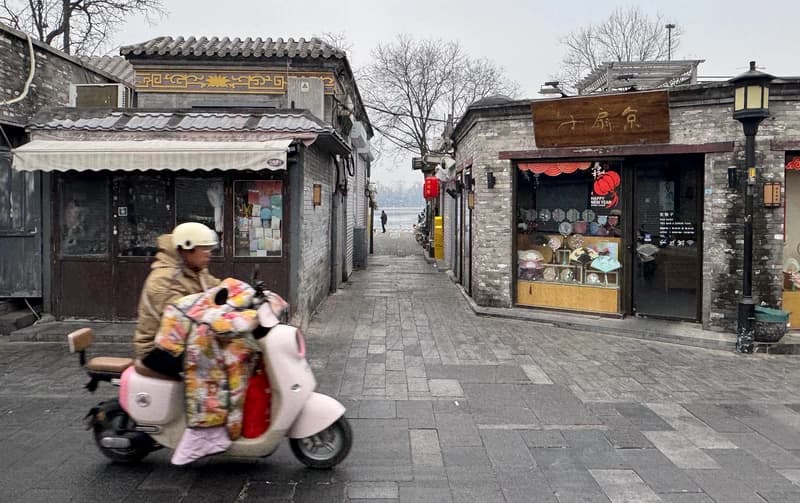
This diagonal lane is about 232 meters long and 4 meters wide (approx.). In the early morning, all the boutique doors are closed. Metal shutters down. Totally quiet.

Early morning Yandai Xiejie Street: an empty lane, grey tiled roofs, closed wooden doors, old signage
When it’s empty like this, the grey bungalows and traditional courtyard façades stand out more clearly. Without crowds, you can actually see the proportions of the architecture.

At that hour, it’s just you and the bricks.
Historically, this street became famous in the late Qing dynasty because it either resembled a tobacco pipe in shape or had many tobacco shops. Even today, some stores still sell traditional pipes and tobacco-related crafts. Others sell qipao, paper cuts, Beijing snacks, and souvenirs — but not at 8 am. At that hour, it’s just you and the bricks.
Add photo(s): Long empty perspective of the lane, grey tiled roofs, closed wooden doors, old signage.
Step 6: Visit the Qing Post Office Site
Along Yandai Xiejie, you’ll see the historic Da Qing Post Office cabinet, now part of a working China Post branch. It reflects the development of modern Chinese postal services from the late Qing into the Republican period.

Exterior of the old-style post office – the Qing Dynasty Post Office Site
It’s still operational today — you can actually mail a postcard from here, which I always find charming.
Add photo(s): Exterior of the old-style post office, antique interior displays if open.
Step 7: Stop by Guangfu Taoist Temple
Further along at No. 37 is Guangfu Temple.
It was first built in 1459 during the Ming Dynasty. It has gone through name changes and renovations, including being called Fuyou Palace during the Qing Dynasty.

Guangfu Taoist Temple
In the early morning, it’s quiet and understated. No crowds. Just the red gates against grey walls.
Add photo(s): Temple entrance, architectural details, courtyard if accessible.
Step 8: Continue North to Drum and Bell Towers (10–15 minutes)
At the east end of Yandai Xiejie, you’ll reach Di’anmen Outer Avenue.

The east end of Yandai Xiejie
Walk north.
Soon you’ll see the impressive Drum Tower.
Just behind it stands the Bell Tower.

Soon you’ll see the impressive Drum Tower
In the morning, the square is still relatively open. The scale of the buildings feels stronger without heavy foot traffic.
Add photo(s): Drum Tower front view, Bell Tower alignment shot, open plaza space.
Optional Extension: Walk to Nanluoguxiang (10 minutes)
From the Bell Tower, walk east along Gulou East Avenue.
In about 8–10 minutes (approx.), you’ll arrive at Nanluoguxiang.
By late morning, this area becomes busy. If you arrive early enough, you’ll still catch it waking up.
Add photo(s): Entrance arch of Nanluoguxiang, side hutongs branching off.
What the Area Feels Like Right Now
In early March, it’s still winter-cold. The trees are bare. The light is flat. The colors are muted — mostly greys and browns.
But that’s what makes it powerful.
The silence feels real. You hear bicycle wheels, footsteps, maybe distant traffic — but not amplified music or tour guides.
Rickshaw drivers stand quietly, hands in pockets. Local residents carry vegetables home in small bags. It feels lived-in, not staged.
By late morning, this calm disappears.
Practical Tips
- Dress warmly — early March mornings can hover around 0–3°C.
- Bring gloves if you plan to photograph. Your fingers will freeze quickly.
- Come before 9:00 am for the quiet atmosphere.
- If you want lively bars and food, return in the evening instead.
- The walking surface is flat and easy.
- You can easily combine this with Nanluoguxiang or Jingshan Park afterward.
Who This Walk Is Best For
- Photographers who like minimal tones and reflections
- Travelers who want to see hutong life beyond tourist hours
- Early risers adjusting to jet lag
- Anyone curious about the contrast between quiet morning and busy nightlife
Shichahai at night is energetic and colorful. But early in the morning, it feels honest. I like seeing it before the performance begins. If you can handle the cold, it’s worth it.
About the Author
Ruqin is the founder of Ruqintravel.com and has spent more than four decades working in China’s travel industry. Drawing on hands-on experience in cities like Beijing and Hangzhou, he personally researches and updates each guide to help international travelers navigate China with confidence.
Further Reading
Beijing City Walks: Routes, Maps & Essential Travel Tips
Beijing Hutong Walks: Routes, Maps & Local Tips
Beijing Ming City Wall Relics Park Morning Walk | Beijing Photo Walks by Ruqin
Shichahai Travel Guide: Hutongs, Bars, Food & Things to Do
Yandai Xiejie Street (Yandaixie): Shops, Food, Sights and Tips
Beijing Drum Tower: What to See, Do & Know Before You Go
Beijing Bell Tower: What to See, Do & Know Before You Go
Nanluoguxiang: Maps, Shopping, Bars, Cafes, Food, Hutong & Tips