Itinerary designed by Ruqin
Last updated: August 14, 2026
Gubeikou to Jinshanling Great Wall Hike Overview
For experienced walkers, the hike from Gubeikou to Jinshanling is one of the most rewarding Great Wall journeys near Beijing.
The route connects two very different sections. Gubeikou remains largely wild and weathered, while Jinshanling gradually introduces more complete watchtowers and restored sections.
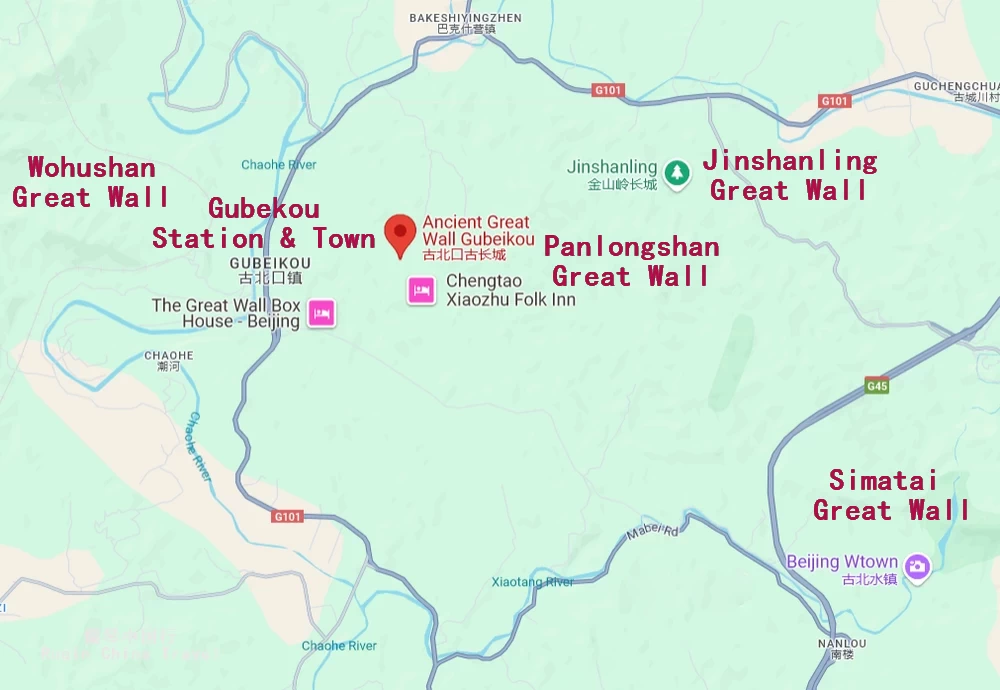
Gubeikou Great Wall (aka Panlongshan & Wohushan), Jinshanling and Simatai
I have walked this route myself. What stayed with me was not simply the distance, but how often the landscape changed beneath our feet.
We walked on old earthen walls, climbed broken Ming brickwork, crossed valleys, passed farmland, and eventually reached Jinshanling late in the afternoon.
However, this is not an ordinary sightseeing walk. The full route can reach roughly 10 – 12 kilometers, depending on detours, and requires around 6–8 hours of hiking.
One section also passes beside a restricted military area. You cannot continue along the Great Wall through that zone and must leave the wall and follow a detour through the surrounding countryside.
That detour is difficult to find. Therefore, I strongly recommend doing this hike with a local guide who knows the current route.
Why Make It a 2-Day Tour?
Technically, you can hike from Gubeikou to Jinshanling and return to Beijing on the same day. I do not think that gives you the best experience.
After six to eight hours of walking, rushing to catch transport back to Beijing adds unnecessary pressure.
Instead, stay overnight at the Jinshanling Great Wall Hotel near the scenic area. You can shower, eat, rest, and enjoy the mountain atmosphere after most day visitors leave.
Then, on Day 2, return to Jinshanling for a slower morning walk before heading back to Beijing.
Who Is This Hike For?
This itinerary suits fit travelers with previous hiking experience and good endurance.
You do not need technical climbing skills. However, you should feel comfortable walking for six to eight hours across rough, uneven, and sometimes overgrown terrain.
The hike is not suitable for young children, travelers with limited mobility, or anyone uncomfortable with long mountain walks.
A local guide is strongly recommended. The military-zone detour alone makes local route knowledge particularly valuable.
Gubeikou to Jinshanling 2-Day Hike at a Glance
Day 1 — The Wild Great Wall Traverse
Beijing → Gubeikou → Panlongshan → Northern Qi Earth Wall → Ming Great Wall → General Tower → 24-Eye Tower → Military-Zone Detour → Jinshanling → Sunset if timing allows → Jinshanling Great Wall Hotel
Driving: Around 2–2½ hours from central Beijing
Hiking: Roughly 10–12 km depending on route
Hiking time: Around 6–8 hours
Difficulty: Moderate to challenging
Overnight: Jinshanling Great Wall Hotel
Day 2 — Sunrise & Jinshanling Great Wall
Sunrise at Jinshanling → Breakfast → Relaxed Jinshanling Walk → Lunch → Return to Beijing
Walking: Flexible, around 2–3 hours
Difficulty: Easy to moderate
Return to Beijing: Afternoon
Day 1: Gubeikou to Jinshanling Great Wall
6:30–7:00 am — Leave Central Beijing
Start early.
Gubeikou lies around 130 kilometers northeast of central Beijing. Allow roughly two to 2½ hours by road, depending on traffic.
For this two-day itinerary, I recommend a private car and driver. It simplifies the journey and allows you to carry a small overnight bag separately from your hiking pack.
Your driver can drop you at Gubeikou and arrange for your luggage to reach the hotel. This means you only carry what you need on the trail.
Check the weather before leaving Beijing. If thunderstorms, heavy rain, strong winds, snow, ice, or dense fog are expected, postpone the hike.
9:00 am — Arrive at Gubeikou
Gubeikou has guarded this strategic mountain passage for centuries.
Today, the Great Wall around the town includes the Panlongshan and Wohushan areas. For this hike toward Jinshanling, you will use the Panlongshan section.
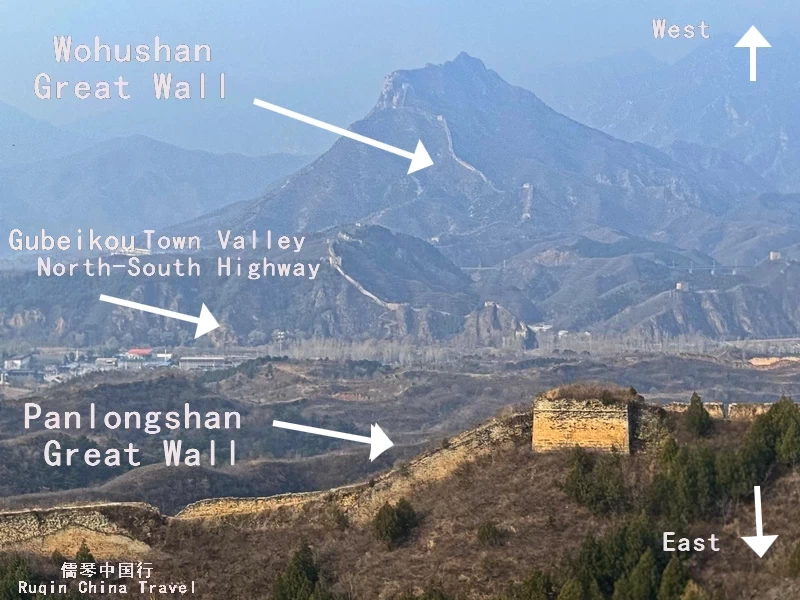
Location Map: Gubeikou Town, Wohushan and Panlongshan ( aka Gubeikou Great Wall)
Wohushan is much rougher and may be subject to access restrictions. It is not part of this itinerary.
Use the toilet before starting and make a final equipment check.
Once you leave the developed area, facilities become extremely limited.
9:15 am — Begin the Panlongshan Hike
One of the fascinating features around Gubeikou is the presence of walls from different periods.
You can see remnants associated with the Northern Qi (526–559 AD) period alongside later Ming defenses (1368-1644AD). The older sections look very different from the Great Wall most foreign visitors imagine.
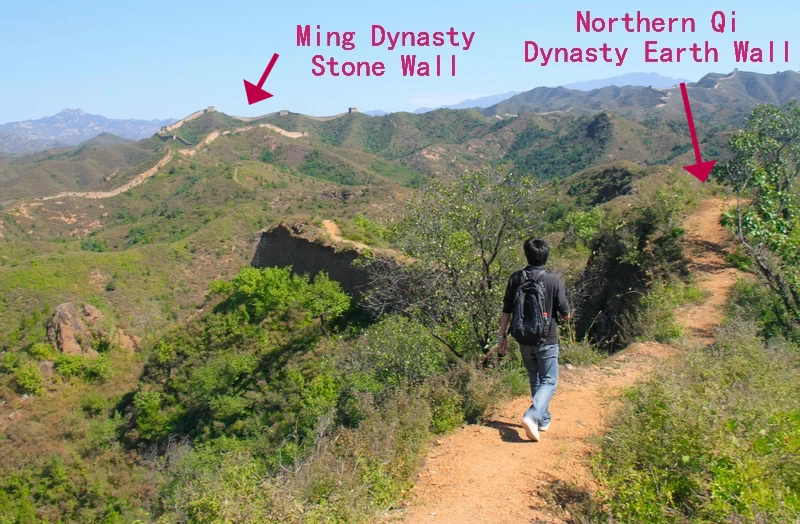
Start wtith earthen wall built in Northern Qi Period
Some sections resemble an earthen ridge rather than a stone fortress.
Depending on current access and your guide’s route, you may begin around the older earthen defenses before connecting with the Ming wall.
Do not rely on old painted arrows or online route descriptions. Trails and access conditions change.
Follow your guide.
10:00–10:30 am — From Earth Wall to Ming Wall
As you move through Panlongshan, the character of the landscape changes.
The weathered earthworks eventually give way to more substantial Ming stone defenses. Between them, expect narrow paths, vegetation, valleys, and uneven climbs.
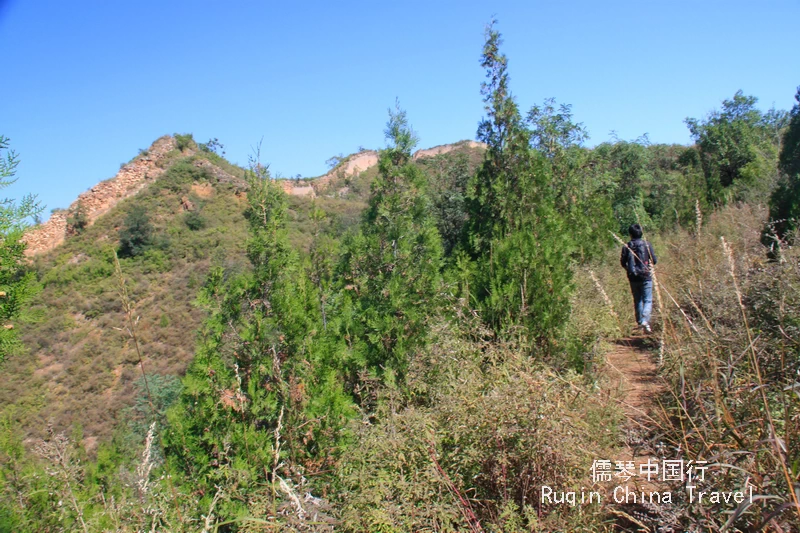
Walk down the valley and then up to the Ming brick wall.
When I walked here, this transition was one of the most interesting parts of the day.
You are not simply hiking along one wall. You are moving through different layers of Great Wall history.
10:30 am–12:00 pm — Hike the Wild Panlongshan Great Wall
Now the route becomes more recognizably Great Wall.
However, this is nothing like restored Badaling or Mutianyu. Grass grows through old brickwork, shrubs cover sections of the path, and some towers have partly collapsed.
Walk carefully.
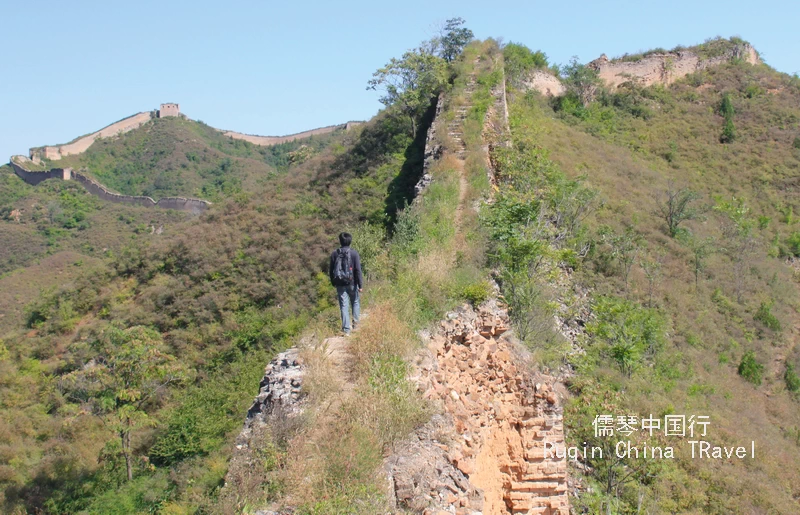
Loose stones and worn surfaces can make both climbs and descents difficult.
Loose stones and worn surfaces can make both climbs and descents difficult. Meanwhile, there are no handrails to protect you.
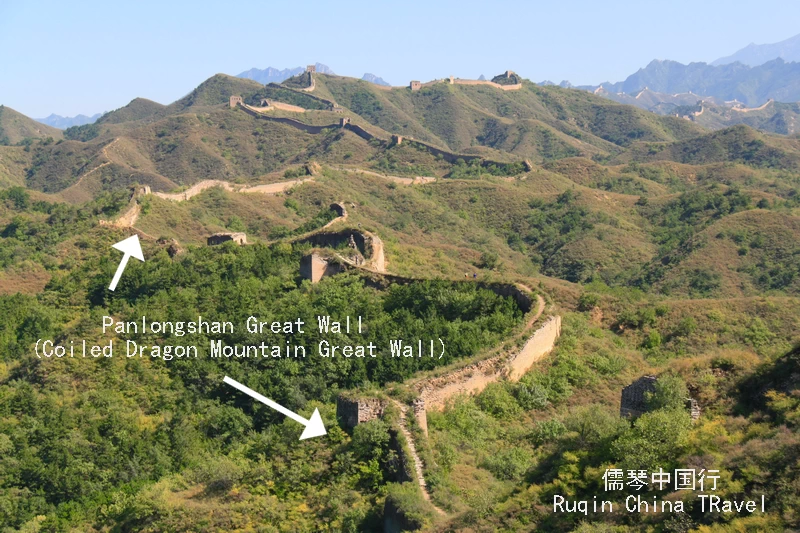
Panlongshan Great Wall ( aka Coiled Dragon Mountain Great Wall)
The scenery gradually opens as you gain height. Behind you, Gubeikou Town sits in the valley, while Wohushan stretches across the mountains to the west.
Around 12:00 pm — General Tower
The General Tower area makes a natural place for a short rest.
From the higher ground, you can see why Gubeikou once held such strategic importance. Mountain ridges and defensive walls surround the narrow passage below.
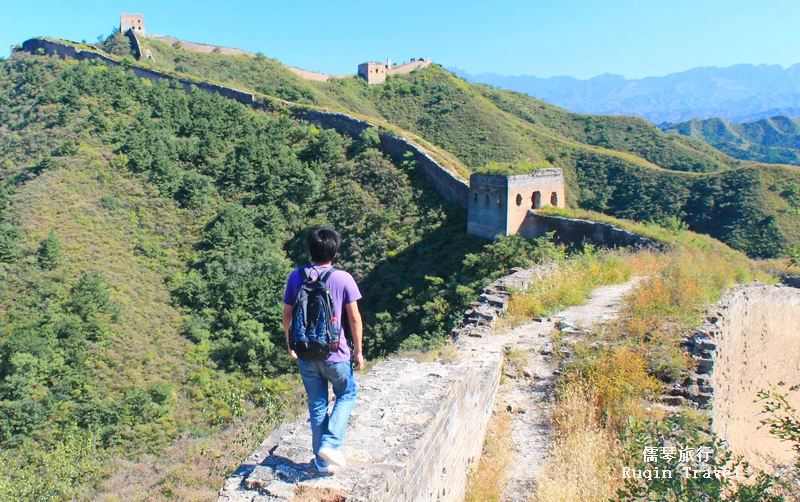
Hiking to the General Tower
Take photographs, drink some water, and eat a small snack.
However, do not make this your main lunch stop. You still have a long afternoon ahead.
12:30–1:30 pm — Continue Toward the 24-Eye Tower
Continue east along Panlongshan.
The wall remains unrestored, and vegetation may narrow the walking route. Keep your pace steady rather than fast.

Continue Toward the 24-Eye Tower at the eatern tip of Gubeikou Great Wall
Eventually, you approach the area traditionally known for the 24-Eye Tower.
This marks an important transition in the hike.
Beyond this area lies restricted military land. You cannot simply stay on the Great Wall and continue directly toward Jinshanling.
Around 1:30 pm — Leave the Wall for the Military-Zone Detour
This is the most important navigation point of the entire route.
Do not enter the restricted military area.
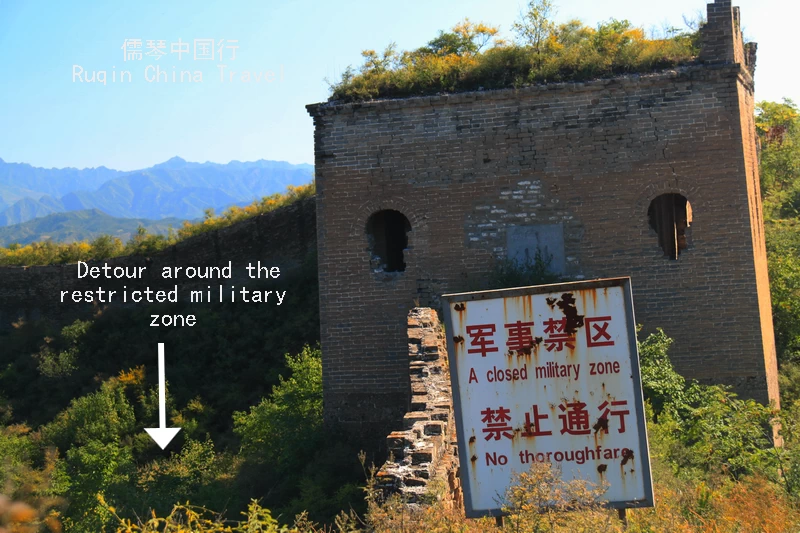
Do not enter the restricted military area
Instead, leave the Great Wall and follow the permitted detour through the valleys and countryside below.
This detour is one reason I strongly recommend a local guide. The route can become confusing, and old online descriptions may no longer match current conditions.
When I walked it, this section proved much harder to navigate than the Great Wall itself.
1:30–4:00 pm — Hike Around the Restricted Area
Expect this section to take several hours.
You will descend away from the Great Wall and move through valleys, vegetation, rural paths, and farmland. At times, the wall may disappear completely from view.
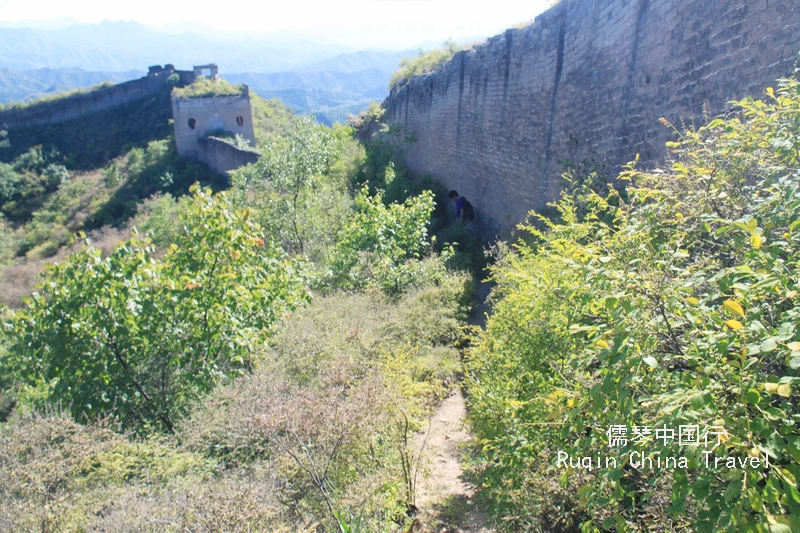
First walk along the Wall
The path can also become muddy or overgrown depending on the season.
Do not cross private fields unnecessarily. Follow your guide and respect local farms and village property.
This part of the hike may lack the dramatic battlements you came to photograph. However, it gives the journey another character.
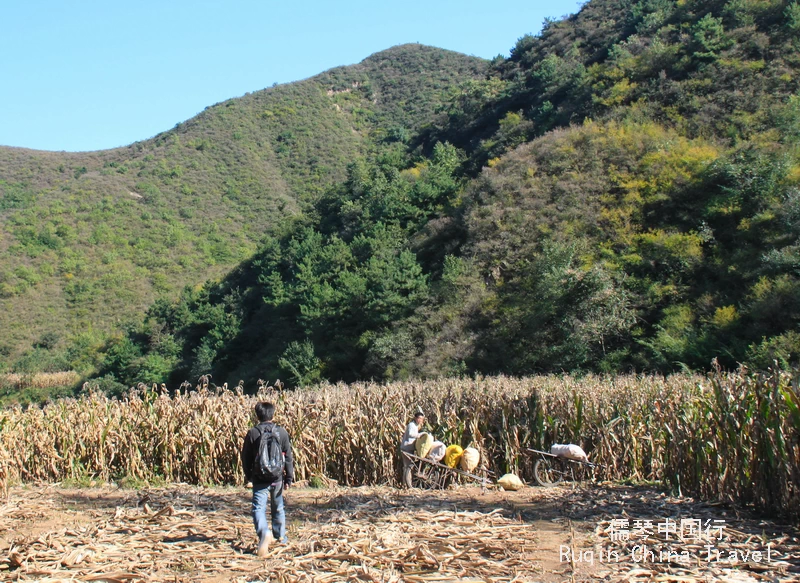
Pass through the working farmland
When I walked here, we passed working farmland beneath the ancient wall. That quiet contrast between history and present-day rural life remains one of my strongest memories of the route.
4:00–5:00 pm — Approach Jinshanling
Eventually, the mountains open and Jinshanling begins to appear ahead.
After hours on wild paths and broken walls, the sight feels particularly welcome.
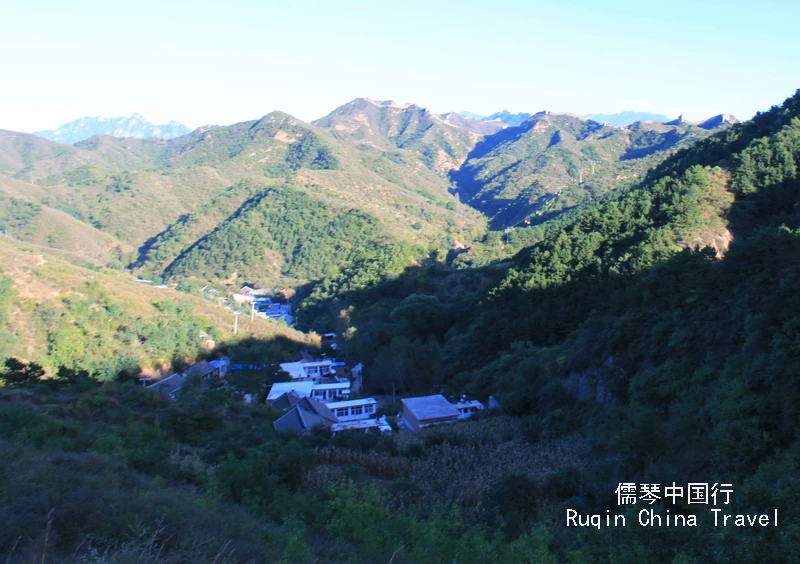
Eventually, the mountains open and Jinshanling and the village begins to appear ahead.
Your legs will probably be tired by now. Therefore, keep a steady pace and resist the temptation to rush the final approach.
Depending on your exact route, hiking speed, and current access arrangements, you should reach the Jinshanling area in the late afternoon.
Around 5:00 pm — Arrive at Jinshanling
Reaching Jinshanling marks the end of the day’s main traverse.
You have now walked from wild Gubeikou through mountains and valleys to one of Beijing’s most beautiful Great Wall sections.
Take a proper break.
If you arrive late, do not immediately force yourself into another long climb simply because sunset is approaching.
Optional — Jinshanling Sunset
If conditions, opening arrangements, daylight, and your energy all allow, sunset at Jinshanling can be magnificent.
I still remember arriving exhausted after our Gubeikou hike. Then we realized the evening light was disappearing quickly.
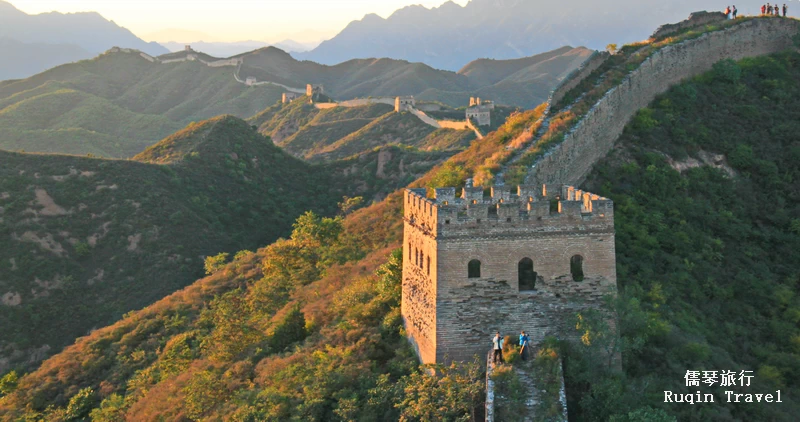
The sunset glow at Jinshanling Great Wall
Somehow, we found enough energy for one final climb.
The wall glowed across the mountains as the sun dropped behind the ridges. After the long hike, that quiet evening light felt like the day’s reward.
However, I would treat sunset as a bonus, not an obligation.
If your legs are finished, go to the hotel. Tomorrow morning gives you another chance to enjoy Jinshanling.
Evening — Check In at Jinshanling Great Wall Hotel
Check in, shower, and give your legs a rest.
Have dinner nearby or at the hotel, depending on current arrangements.
Drink plenty of water as well. After a full day on the trail, hydration and rest matter more than evening entertainment.
Then sleep early.
Tomorrow begins with a much gentler Great Wall experience.
Day 2: Sunrise & Jinshanling Great Wall
Early Morning — Optional Sunrise
If you enjoy photography and conditions allow, get up early for sunrise.
Jinshanling is particularly beautiful in soft morning light. Watchtowers rise and fall across the mountain ridges, often with fewer visitors than later in the day.
However, check current opening and access arrangements before planning an early entry.
Do not enter closed areas simply to reach a sunrise viewpoint.
If sunrise access is unavailable, sleep longer. You earned it yesterday.
7:30–8:30 am — Breakfast
Return to the hotel for breakfast or eat before starting your main morning walk.
Take your time.
Day 2 should not feel like another endurance challenge. The purpose is to enjoy Jinshanling with fresh eyes.
9:00 am–12:00 pm — Explore Jinshanling Great Wall
Return to Jinshanling for a relaxed two-to-three-hour walk.
Jinshanling offers a wonderful contrast with yesterday’s Gubeikou section. Parts have been restored, while others retain a weathered character.
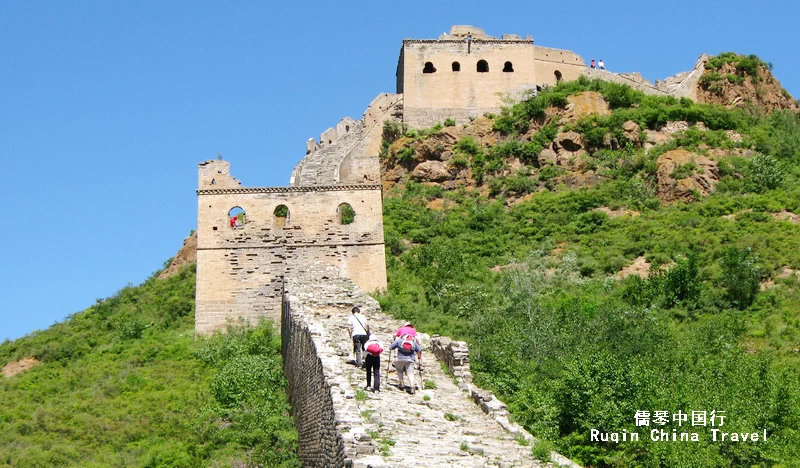
Explore Jinshanling Great Wall
The watchtowers also vary considerably in design.
Walk only as far as your legs comfortably allow. Stop inside the towers, look back along the wall, and enjoy the mountain views.
After yesterday’s long traverse, you may notice details you would normally miss.
This is the advantage of staying overnight.
You are no longer racing against the return journey to Beijing.
Around 12:00 pm — Descend for Lunch
Leave the wall around midday and have lunch near the scenic area.
By now, you have experienced the Great Wall in several different ways: wild, ruined, rural, restored, sunset or sunrise, and finally at an easy walking pace.
That is enough.
There is no need to add another Great Wall section.
1:30–2:00 pm — Leave Jinshanling for Beijing
After lunch, start the return journey.
By private car, allow roughly two to 2½ hours depending on traffic.
Sit back and give your legs a rest.
Around 4:00–5:00 pm — Return to Central Beijing
You should reach Beijing by late afternoon under normal conditions.
Keep your evening free.
After two days in the mountains, a shower, a comfortable dinner, and an early night may sound better than another sightseeing attraction.
Tickets, Transport & What to Bring
Gubeikou Great Wall Tickets
Panlongshan at Gubeikou operates as an accessible Great Wall area, but ticket arrangements and permitted routes can change.
Check current admission rules before your hike. Your guide should also confirm which entrances and trails are presently open.
Do not assume that an old trail report guarantees current access.
Most importantly, respect all closures around military and restricted areas.
Jinshanling Great Wall Tickets
Jinshanling is a developed scenic area with its own admission system.
Check current ticket prices, opening hours, shuttle arrangements, and sunrise or sunset access before traveling.
If you stay overnight, ask the hotel about the latest Great Wall entrance arrangements.
Carry your passport for both days.
Getting from Beijing to Gubeikou
Private Car and Driver
For this two-day point-to-point itinerary, I recommend a private car.
It gives you an early start and removes uncertainty around public transport. More importantly, your overnight luggage can travel separately while you hike.
Arrange pickup at Jinshanling for Day 2 before leaving Beijing.
Train
Rail services can sometimes provide an affordable way to reach the Gubeikou area.
However, schedules change. Do not build a long hiking day around an old published departure time.
Check the current timetable shortly before your trip. You will also need local transport between the station and trailhead.
Bus
Public buses via Miyun can also reach the Gubeikou area.
They cost less but involve more transfers and waiting.
For a normal Gubeikou visit, that may be acceptable. For a 10–12 km point-to-point hike, I prefer removing unnecessary transport complications.
Why I Recommend a Local Guide
Gubeikou itself is much easier to approach than Jiankou. However, the Gubeikou-to-Jinshanling traverse is not a simple signed hiking trail.
The restricted military area forces hikers off the Great Wall.
Once you enter the detour, paths can become difficult to distinguish. Vegetation, farmland, erosion, and seasonal conditions can also alter the route.
When I walked this section, navigation became our biggest problem. That experience convinced me that a local guide is worth having.
A knowledgeable local guide can help you follow the permitted route and avoid restricted land.
Still, never follow anyone into a closed military area. A guide does not override official restrictions.
What to Bring
Water and Food
Carry around 3 liters of water per person for Day 1 in warm conditions. Adjust the amount according to weather, your body, and professional advice.
There are no reliable water stations along much of the hiking route.
Also carry a packed lunch or substantial snacks. Nuts, fruit, sandwiches, energy bars, and other easy-to-carry foods work well.
Do not depend on finding food halfway.
Hiking Shoes and Clothing
Wear sturdy hiking boots or trail shoes with excellent grip.
High-ankle boots can provide extra support on loose and uneven terrain. Whatever you choose, break them in before the trip.
Dress in layers and carry a windproof outer layer.
Long trousers also help protect your legs from bushes and rough vegetation.
Navigation and Communication
Carry a fully charged mobile phone and power bank.
Download offline maps before leaving Beijing. However, treat them as backup rather than your primary navigation method.
Mobile reception can weaken in remote valleys.
Your guide’s local knowledge remains more important than a blue dot on a screen.
Other Essentials
Bring sunscreen, sunglasses, a hat, tissues, toilet paper, a compact first-aid kit, and any personal medication.
A headlamp is also worth carrying even though you plan to finish before dark. Delays happen.
Carry your passport and some emergency cash as well.
Finally, bring a small rubbish bag.
Everything you carry onto the Great Wall should leave with you.
Weather and Safety
Spring and autumn generally provide the best conditions for this hike.
April and May can offer pleasant temperatures and greener mountains. September and October often bring clearer skies and excellent autumn scenery.
Summer can become extremely hot, with long exposed sections and little shade.
Winter creates another problem. Ice, snow, cold winds, and short daylight hours can turn a moderate hike into something much more serious.
Never attempt the route during thunderstorms, heavy rain, strong winds, dense fog, snow, or icy conditions.
If the weather looks wrong, change your plans.
Travel Insurance
Arrange travel insurance appropriate for a long outdoor hike.
Check whether your policy covers hiking, accidental injury, evacuation, and activities on unrestored Great Wall sections.
Read the exclusions carefully.
Insurance should support sensible decisions, not encourage unnecessary risks.
Toilets
Use the toilet before starting the Gubeikou hike.
Facilities are extremely limited once you enter the mountain route. Carry toilet paper and follow responsible outdoor practices.
Facilities become available again once you reach the developed Jinshanling area.
Leave No Trace
Much of the Great Wall around Gubeikou remains unrestored.
Do not remove bricks, carve names, damage towers, or leave rubbish behind.
Also respect the villages and farmland along the detour.
The route passes through landscapes where people still live and work. Treat them as communities, not simply scenery for hikers.
Ruqin’s Trip Design Note
When I walked from Gubeikou to Jinshanling, I expected the Great Wall itself to be the hardest part.
It wasn’t.
The military-zone detour was the real challenge. Once we left the wall, the route disappeared into valleys, bushes, paths, and farmland.
At one point, we became genuinely unsure of the way. That experience is why I now recommend a local guide for this traverse.
The other lesson came at Jinshanling.
We arrived exhausted late in the afternoon. Yet the evening light tempted us back onto the wall, and we somehow found enough strength for another climb.
The sunset was unforgettable. However, if I were designing the trip for foreign travelers today, I would remove that pressure.
Stay overnight.
If you catch sunset, enjoy it. If not, shower, eat, and sleep. Jinshanling will still be waiting the next morning.
That is why I prefer this as a two-day Great Wall journey rather than a rushed day hike. Day 1 gives you the challenge and wildness of Gubeikou. Day 2 gives you time to appreciate Jinshanling.
Together, they show you something a short Great Wall visit cannot: how the wall changes across terrain, centuries, restoration, villages, and everyday landscapes.
Plan More of Your Beijing Trip
For an easier first Great Wall visit, start with my Mutianyu Great Wall Day Tour from Beijing. It offers excellent scenery with cable cars and developed visitor facilities.
For convenient public transport and better accessibility, consider the Badaling Great Wall Day Tour from Beijing. Experienced hikers can also explore the Jiankou to Mutianyu Great Wall Day Hike, with careful planning and appropriate local guidance.
How to Hike the Great Wall from Gubeikou to Jinshanling
Gubeikou Great Wall: Maps, Hiking Routes, Transport & Tips
How to Get to Jinshanling Great Wall from Beijing: Bus, Train & Car
Gubeikou Railway Station Beijing: Maps, Tickets, Times & Tips
Questions About This Beijing Itinerary?
Still have questions about this route? You’re welcome to write to me.
If you need advice on timing, transport, tickets, or adjusting the itinerary, I’m happy to offer a practical suggestion based on my experience in Beijing.
There’s no fee for a simple question. Just use the form below and tell me about your plans.
We respect your privacy. Your details will never be shared or used for marketing.