
Itinerary designed by Ruqin
Last updated: August 14, 2026
Important: Jiankou is an unrestored “wild” section of the Great Wall and is not officially open as a standard tourist attraction. Access rules can change. Check current local restrictions before your trip, never cross closures or barriers, and do not attempt this route without an experienced local guide. Avoid the hike completely in rain, thunderstorms, strong winds, snow, ice, or heavy fog.
Jiankou to Mutianyu Great Wall Hike Overview
For experienced walkers, the hike from Jiankou to Mutianyu reveals two very different faces of the Great Wall.
You begin among the unrestored walls, broken watchtowers, bushes, and mountain paths of Jiankou. Then, several hours later, you cross naturally onto the restored stonework of Mutianyu.
I have walked this route myself as part of a small familiarization group. We started from Nanjili Village, climbed to Zhengbeilou, and then walked east toward Mutianyu.
The route described here is important. I do not recommend approaching from the much more dangerous western Jiankou sections around Upward Flying Eagle Tower, Sky Ladder, and Beijing Knot.
Instead, this itinerary starts below Zhengbeilou, east of those extreme sections. From there, you continue east toward Mutianyu.
Even this route involves risk. You will encounter steep mountain paths, loose stones, broken brickwork, dense vegetation, and unrestored sections without safety barriers.
Who Is This Hike For?
This hike suits physically fit travelers with previous hiking experience. You should feel comfortable on steep, rough, and sometimes exposed mountain terrain.
It is not suitable for young children, travelers with limited mobility, inexperienced hikers, or anyone uncomfortable with scrambling over broken surfaces.
You should also have suitable travel insurance covering hiking and accidental injury. Most importantly, go with an experienced local guide who knows the current route and access situation.
If you simply want beautiful Great Wall scenery, choose Mutianyu instead. You do not need to hike Jiankou to have a memorable Great Wall experience.
Jiankou to Mutianyu Hike at a Glance
Suggested route:
Beijing → Xizhazi Village → Nanjili Village → Mountain Trail → Zhengbeilou → Jiankou Great Wall → Bypass Ox Horn Edge → Mutianyu Tower 23 → Mutianyu Great Wall → Descend → Beijing
Recommended time: About 7:00 am–6:30 pm
Driving from Beijing: Around 2–2½ hours each way, depending on traffic and conditions
Mountain ascent to Zhengbeilou: Allow roughly 1½–2 hours
Zhengbeilou to Mutianyu Tower 23: Around 2 hours in suitable conditions
Mutianyu section and descent: Around 1½–2 hours
Difficulty: Challenging
Best for: Fit, experienced hikers
Guide: Strongly recommended
Recommended transport: Private car with driver
The Route I Recommend
The most important decision comes before you start walking.
From Xizhazi, head toward Nanjili Village, traditionally known as Team 2. From there, climb toward Zhengbeilou, also called the Sharp North Tower.
Do not start from Jiushuikeng with the intention of tackling Upward Flying Eagle Tower and Sky Ladder. Those sections involve extremely steep, exposed, and dangerous terrain.
Once at Zhengbeilou, head east toward Mutianyu.
This gives you the dramatic wild-wall experience without deliberately including Jiankou’s most extreme western sections.
Detailed Jiankou to Mutianyu Day Hike
7:00 am — Leave Central Beijing
Leave Beijing early.
Xizhazi lies deep in the mountains north of Huairou. The drive takes roughly 2 to 2½ hours under normal conditions, but mountain roads and traffic can add time.
For this itinerary, I recommend a private vehicle and driver. Public transport is too complicated for a long hiking day with a different finishing point.
Your driver can take you to the starting area and later meet you at Mutianyu.
Before leaving Beijing, check the weather once more. If conditions look unsafe, cancel the hike.
9:00–9:30 am — Arrive Around Xizhazi and Nanjili
Xizhazi sits in a mountain valley north of Jiankou Great Wall.
The village consists of several small settlements. For this route, your destination is Nanjili, traditionally known as Team 2 of Xizhazi.
This is the practical starting point for climbing toward Zhengbeilou.
Before setting off, use the toilet and check your equipment. There are no proper toilet facilities along the wild hiking section.
9:30–11:00 am — Climb from Nanjili Toward Zhengbeilou Tower
From behind the village, follow the mountain trail uphill.
This first stage is not a leisurely Great Wall walk. You are climbing through mountain terrain before you even reach the wall.

Parts of the path can become narrow, steep, and overgrown. Depending on vegetation and conditions, you may need to push through bushes or use your hands for balance.
This is where a local guide becomes particularly valuable. Trail conditions can change, and unofficial paths are not always obvious.
Take short breaks, but keep moving steadily. You still have several hours of hiking ahead.
Around 11:00 am — Reach Zhengbeilou
Reaching Zhengbeilou is one of the most memorable moments of the hike.

Reaching Zhengbeilou Tower is one of the most memorable moments of the hike
From the tower, look west. In clear weather, you can see some of Jiankou’s famous dramatic terrain toward Upward Flying Eagle Tower, Sky Ladder, and Beijing Knot.

From the tower, look west, you can see some of Jiankou’s famous dramatic terrain toward Upward Flying Eagle Tower, Sky Ladder, and Beijing Knot.
Admire them from a distance.
Do not turn west and attempt to include those sections in this itinerary. They belong to a completely different level of risk.
Now look east and northeast. You will see the wall twisting through the mountains toward the distinctive Ox Horn Edge section.
That is your direction toward Mutianyu.
11:15 am–1:15 pm — Hike East Toward Mutianyu
Leave Zhengbeilou and follow the unrestored wall eastward.
This is the heart of the hike.
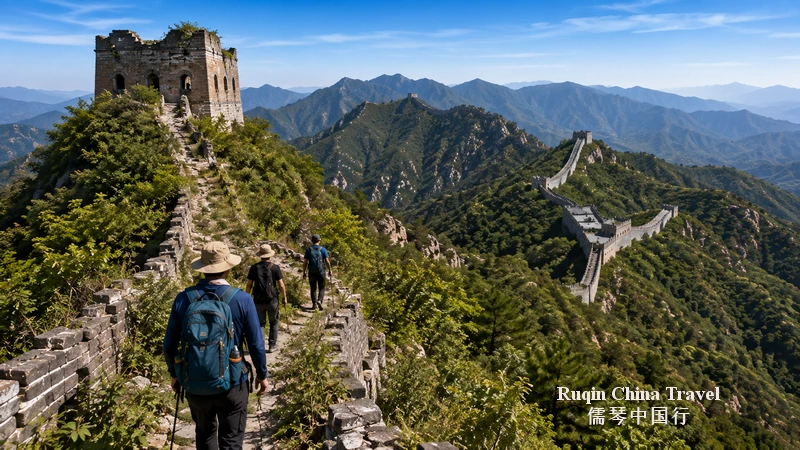
Expect broken brickwork, loose stones, vegetation, soil-covered sections, and ruined watchtowers. In places, bushes narrow the walking line considerably.

Expect broken brickwork, loose stones, vegetation, soil-covered sections at Jiankou
The masonry itself tells a story. You can see old slabs, mortar, drainage channels, and the remains of a defensive structure that has not received Mutianyu-style restoration.

Hiking through an overgrown section of the Jiankou Great Wall
However, keep your eyes on your feet. Loose bricks and unstable edges require concentration.
Allow roughly two hours between Zhengbeilou and the western end of restored Mutianyu in good conditions. Slower groups may need longer.
Bypass the Ox Horn Edge
One section deserves special attention.
The Ox Horn Edge forms a pronounced U-shaped rise along the wall. The old brickwork can be steep, broken, overgrown, and unstable.

Bypass the Ox Horn Edge
When I walked this route, we chose not to hike directly over it.
Instead, we left the wall and used a short dirt path below to bypass the dangerous section. We then rejoined the route on the other side.

We left the wall and used a short dirt path below to bypass the dangerous section.
I recommend the same approach when your local guide confirms that the bypass remains safe and permitted.

Continued to hike along the broken section of Jiankou Great Wall
There is no prize for choosing the most dangerous line. On wild Great Wall hikes, good judgment matters more than bravado.
Around 1:15 pm — Reach Mutianyu Tower 23
Eventually, something changes beneath your feet.
Broken wild wall gives way to restored brickwork. You have reached the western end of the restored Mutianyu section, around Watchtower 23.

Reach Mutianyu Tower 23 ( not open to the public )
The contrast is striking.
Behind you lies the rugged Jiankou section you have just crossed. Ahead, the restored Mutianyu Great Wall follows the ridge through a long chain of watchtowers.

Ahead, the restored Mutianyu Great Wall follows the ridge
Stop here for water, snacks, and a proper rest.
You have completed the hardest part of the traverse.
1:30–3:00 pm — Walk Down Through Mutianyu
Now continue east along Mutianyu.
Although the wall is restored, your day is not over. You still have a substantial descent, and tired legs make steep steps more demanding.
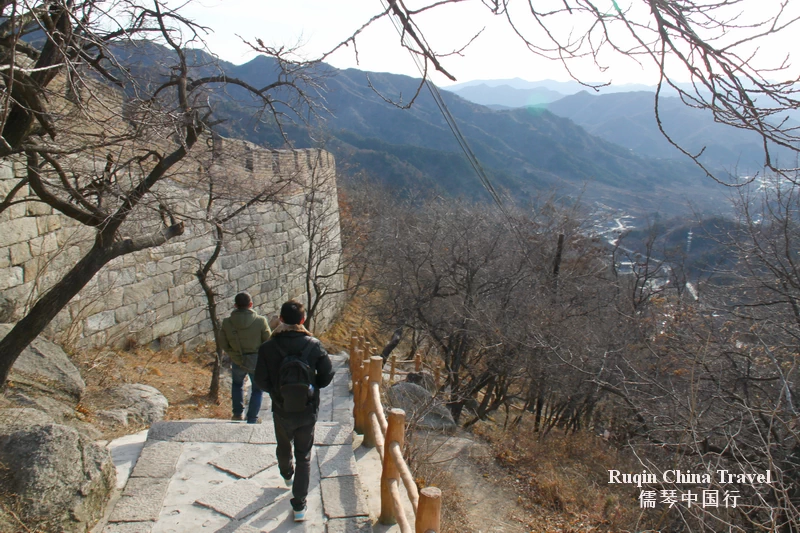
We walked down Mutinayu Great Wall
If you feel exhausted, head toward a convenient cable-car descent rather than extending the walk unnecessarily.
Stronger hikers can continue farther through Mutianyu before walking down. Depending on current operations and your route, other descent options may also be available.
Listen to your legs.
After several hours on Jiankou, there is little value in turning the final hour into an endurance test.
3:00–3:30 pm — Descend to the Mutianyu Visitor Area
Once you leave the wall, make your way toward the visitor area.
Meet your driver here rather than attempting to return to your original starting point at Xizhazi.
This is one reason private transport works so well for this traverse. You start on one side of the mountains and finish at another established scenic area.
Use the restroom, refill your water, and take a proper break.
3:30–4:30 pm — Late Lunch or Early Meal
After a long hike, I would eat at Mutianyu before returning to Beijing.
A proper meal feels very different after several hours in the mountains.
However, keep your timing flexible. If your hike took longer than expected, leave for Beijing first and eat later.
Safety and daylight matter more than the restaurant schedule.
4:30 pm — Leave Mutianyu for Beijing
Start the drive back to central Beijing.
Traffic conditions will determine your arrival time. Allow roughly 1½–2 hours or longer during busy periods.
Most importantly, do not make a tight evening reservation.
Around 6:00–6:30 pm — Return to Beijing
Once back at your hotel, your Great Wall day is finished.
This is not the evening to schedule another attraction. Eat, rest, and give your legs a break.
Tickets, Transport & What to Bring
Access and Current Restrictions
Jiankou is not a normal ticketed scenic area like Mutianyu or Badaling. It is an unrestored wild section, and access rules or local restrictions can change.
Do not interpret access through a village or surrounding scenic area as official permission to hike Jiankou. A local entrance or village fee, if currently collected, does not necessarily represent Great Wall admission.
Therefore, check the latest situation before traveling. Follow all posted restrictions, closures, conservation rules, and instructions from local authorities.
If access is closed, do not enter.
Transport from Beijing
A private car and driver is the practical choice for this itinerary.
You need transport to the Xizhazi/Nanjili starting area. Then you need pickup at Mutianyu several hours later.
This point-to-point arrangement removes the need to return across the mountains to your starting point.
Leave Beijing around 7:00 am or earlier. During shorter daylight months, consider an even earlier departure.
Why You Should Use a Local Guide
I strongly recommend an experienced local guide for this hike.
Jiankou does not have the signs, paved paths, railings, and visitor infrastructure you find at Mutianyu. Trails can become overgrown, and conditions change after rain, erosion, or local access changes.
A guide can also help you locate the safer bypass around dangerous terrain.
However, a guide cannot make Jiankou risk-free. You remain responsible for judging whether the conditions and your fitness are suitable.
Travel Insurance
Arrange travel insurance that covers hiking and accidental injury before attempting the route.
Read the exclusions carefully. Some policies treat hiking on unofficial, closed, or technically restricted routes differently.
Do not assume ordinary travel insurance automatically covers every outdoor activity.
What to Wear
Wear proper hiking shoes with strong grip. Ordinary city sneakers are not ideal for loose stones, dirt paths, and broken brickwork.
I also recommend long trousers and long sleeves, even during warmer months. Vegetation can become dense along the unrestored sections.
Bring a hat, sunglasses, sunscreen, and weather-appropriate layers.
In colder months, pay particular attention to wind and ice. A dry-looking Beijing morning does not guarantee safe conditions on the ridge.
What to Carry
Carry enough water for several hours because there are no reliable supplies along the wild section.
Bring snacks or a simple packed lunch, trekking poles if you normally use them, tissues or toilet paper, lip balm, and a compact first-aid kit.
Also carry a fully charged mobile phone and a power bank. Download offline maps before leaving Beijing, but do not rely on your phone as a substitute for local route knowledge.
Keep your pack light. Every unnecessary kilogram becomes noticeable on the climb to Zhengbeilou.
Toilets
Use the toilet before starting from the village area.
There are no proper toilets along the Jiankou hiking route. Carry toilet paper and pack out anything that should not remain in the mountains.
Once you reach the developed Mutianyu area, facilities become much easier to find.
Weather
Do not hike Jiankou during rain, thunderstorms, lightning, heavy fog, snow, ice, or strong winds.
Wet bricks and loose stones can become extremely slippery. Meanwhile, fog reduces visibility on terrain where route finding already requires care.
If the forecast looks doubtful, choose Mutianyu instead.
The Great Wall will still be there on a better day.
Leave No Trace
Jiankou’s unrestored condition is exactly what makes it special. It also makes the landscape vulnerable.
Take all rubbish out with you. Do not remove bricks, carve names, damage vegetation, or disturb the historic structure.
Take photographs and memories. Leave the wall as you found it.
Ruqin’s Trip Design Note
I have walked this route, and the most important decision we made was what not to hike.
We did not tackle Upward Flying Eagle Tower or Sky Ladder. We started from Nanjili, climbed to Zhengbeilou, and then headed east toward Mutianyu.
Later, we also bypassed the crumbling Ox Horn Edge rather than climbing directly over it. That decision saved time and reduced unnecessary risk.
This is how I approach wild Great Wall hiking. The goal is not to prove how brave you are.
The real reward comes from watching the wall change beneath your feet. You begin among ruined towers, bushes, loose bricks, and old masonry. Then, hours later, the restored Mutianyu wall appears ahead.
That transition is what makes the Zhengbeilou-to-Mutianyu route memorable.
However, Jiankou remains wild, fragile, and potentially dangerous. If current restrictions, weather, or your guide tell you not to go, change your plans.
Choosing Mutianyu instead is not a lesser Great Wall experience. Sometimes the best travel decision is knowing when to turn around.
Plan More of Your Beijing Trip
For an easier Great Wall experience, use my Mutianyu Great Wall Day Tour from Beijing. You can also consider the Badaling Great Wall Day Tour from Beijing for convenient high-speed train access. For experienced hikers wanting a longer Great Wall journey, continue with the 2-Day Gubeikou to Jinshanling Great Wall Hike.
How to Visit the Great Wall of China: Best Sections, Tickets & Tips
Less Touristy Sections of the Great Wall near Beijing
Questions About This Beijing Itinerary?
Still have questions about this route? You’re welcome to write to me.
If you need advice on timing, transport, tickets, or adjusting the itinerary, I’m happy to offer a practical suggestion based on my experience in Beijing.
There’s no fee for a simple question. Just use the form below and tell me about your plans.
We respect your privacy. Your details will never be shared or used for marketing.