Written by Ruqin
August 08, 2026
Meeting Laozi on the Road: A Traveler’s Introduction
When I travel with foreign visitors in China, there is one moment I never get tired of seeing.
It usually happens when they enter an old Taoist mountain, walk through a gate covered by ancient trees, or sit quietly beside a mountain stream. After a while, their expression changes. The busy feeling of travel slowly disappears, and they begin to notice something calmer.
Then, they often turn to me and ask:
“What exactly is the Dao that Laozi talked about?”
This question is not easy to answer in one sentence. However, I can take them for a walk.
Because Laozi’s philosophy is not only found in books. It is also found in mountains, rivers, old gardens, quiet temples, and the way Chinese people have learned to live with nature for thousands of years.
For foreign travelers, understanding Laozi is not about memorizing philosophical terms. It is about learning a different way of looking at the world.
Who Was Laozi? The Mysterious Sage Behind the Dao De Jing
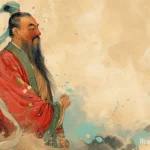
Laozi, or 老子 (Laozi), lived about 2,600 years ago during the late Spring and Autumn period in ancient China.
According to traditional accounts, his family name was Li and his personal name was Er (李耳). He worked as a keeper of records and books in the Zhou royal court. This position gave him access to many ancient texts and allowed him to observe politics, society, and human behavior.
Later, as the Zhou Dynasty weakened, Laozi decided to leave the political world behind. According to legend, he rode west on a green ox and reached Hangu Pass (函谷关).
The guard at the pass was named Yin Xi (尹喜). When he learned that Laozi was leaving, he asked him to leave behind some wisdom before continuing his journey.
Laozi then stayed for several days and wrote a short text of about 5,000 Chinese characters.
That text became the 《道德经》 (Dao De Jing, also known as the Tao Te Ching).
After writing it, Laozi passed through the gate and disappeared. No one knows exactly what happened to him afterward.
Perhaps that mystery is part of his lasting appeal.
A wandering old man on a green ox left behind only a small book, yet those words traveled across centuries and languages. Today, the Dao De Jing remains one of the most translated books in the world, attracting readers from many cultures.
Laozi’s influence has reached far beyond China. Western philosophers, including Hegel and Heidegger, studied and discussed his ideas.
A person who quietly disappeared into history left behind a voice that still speaks today.
Dao: Something You Cannot Explain, but Can Experience
If you want to understand Laozi, begin with one word:
Dao (道).
But Dao is also the hardest word to explain.
Laozi begins the Dao De Jing with a famous sentence:
“The Dao that can be spoken is not the eternal Dao.”
In simple terms, he means that the deepest truth cannot be completely captured by words.
Dao is not a human-like god who controls the universe. It is closer to a natural order, a rhythm behind everything that exists. You cannot see it directly, but you can notice its presence everywhere.
So how can a traveler experience Dao?
Go into the mountains.
Watch how a stream moves around a stone instead of fighting against it. Look at how a tree grows toward sunlight. Observe how clouds gather, change, and disappear.
These ordinary scenes show something about Dao.
They follow their own nature.
Laozi wrote:
“Human beings follow the Earth. The Earth follows Heaven. Heaven follows Dao. Dao follows what is natural.”
Here, “natural” does not simply mean forests and rivers. It means things developing according to their own original nature, without unnecessary force.
This idea has influenced Chinese gardens, landscape painting, architecture, and ways of living.
When you visit China, you may discover that some places feel peaceful before you even understand why.
That feeling is often connected with this ancient idea.
Wu Wei: Doing Without Forcing
Among Laozi’s ideas, Wu Wei (无为) is probably the most misunderstood.
Many foreign visitors first think it means doing nothing.
It does not.
Wu Wei means not forcing things against their natural direction. It means acting wisely, choosing the right moment, and avoiding unnecessary struggle.
Laozi wrote:
“By practicing non-forcing, everything can be accomplished.”
This idea may sound unusual today because modern life often celebrates speed, competition, and constant effort.
I often explain Wu Wei with an example from surfing.
A good surfer does not fight the wave. Instead, the surfer observes the movement of the water, chooses the right moment, adjusts balance, and moves together with the wave.
The surfer is not doing nothing.
The surfer is doing exactly what is needed.
That is Wu Wei.
During travel, this idea can also be useful.
Many visitors plan every minute of their China trip. They rush from one attraction to another because they worry about missing something.
However, sometimes the best travel moments happen when you slow down.
A quiet walk through an old neighborhood, a conversation with a local person, or an unexpected stop at a small temple may become the memory you remember most.
The Wisdom of Water: Understanding “The Highest Good Is Like Water”
One of Laozi’s most beautiful images is water.
He wrote:
“The highest goodness is like water. Water benefits all things and does not compete.”
Water gives life to everything, yet it does not demand attention. It flows downward, stays in low places, and quietly supports the world around it.
Water looks weak.
However, over time, water can shape stone.
Water is gentle.
Yet without water, life cannot exist.
For Laozi, this was not only a lesson about nature. It was also a lesson about human character.
In a world that often encourages competition and strength, Laozi offered another possibility.
Being gentle does not mean being weak.
Being humble does not mean being defeated.
Sometimes the greatest strength does not need to make noise.
This idea helps explain why water appears so often in Chinese culture. You can find it in gardens, paintings, poetry, and traditional architecture.
When you stand beside a quiet pond in a Chinese garden, you are not only looking at scenery.
You are also seeing an old cultural idea.
How Laozi Changes the Way You Travel in China
Understanding Laozi can change the way foreign visitors experience China.
It is not only philosophy.
It is a practical travel perspective.
First, Laozi Changes Your Travel Pace
Many travelers prepare detailed schedules before coming to China. They plan every attraction, every meal, and every hour.
Good preparation is useful.
However, Laozi reminds us that too much control can prevent us from seeing what is in front of us.
He wrote:
“Less is more.”
When you stop chasing every famous attraction, you may discover something quieter.
Spend an afternoon sitting on the steps of a Taoist temple. Watch the shadows of trees move across an old wall. Listen to the sound of wind passing through a mountain forest.
That is not wasted time.
That is a different way of traveling.
Second, Laozi Changes How You See Landscapes
Chinese landscapes, gardens, and traditional villages often carry Taoist ideas.
When you visit Humble Administrator’s Garden (拙政园) in Suzhou, you may notice how water, rocks, plants, and buildings create a balanced relationship.
The designer did not try to control every part of nature.
Instead, the garden creates a conversation between human design and the natural world.
Empty space has meaning.
Silence has meaning.
A small bridge over water, a window framing distant scenery, or a hidden path turning behind bamboo all invite you to slow down.
This is close to the idea of Dao.
Third, Laozi Changes How You Handle Unexpected Moments
Travel rarely goes exactly as planned.
The weather may change. A train may be delayed. A temple you hoped to visit may be under renovation.
Laozi reminds us:
“Good fortune may contain the seeds of bad fortune; bad fortune may contain the seeds of good fortune.”
A rainy afternoon may lead you into a small tea house.
A missed bus may introduce you to a local person.
An unexpected change may become the most memorable part of your journey.
Travel teaches the same lesson as Laozi:
Do not fight every change.
Learn how to move with it.
Where to Experience Laozi and Taoist Culture in China
If you want to experience Laozi’s world during your China trip, several places are worth visiting.
Wudang Mountain (武当山), Hubei
Wudang Mountain is one of China’s most famous Taoist mountains.
The mountain is known for its ancient temples, peaceful forests, and connection with Taoist martial arts.
Early in the morning, you may see practitioners practicing Tai Chi (太极拳) in the mountain mist.
Many visitors find that Wudang Mountain offers something beyond sightseeing.
The slow rhythm of mountain life itself becomes part of the experience.
Zhongnan Mountain (终南山), Shaanxi
Zhongnan Mountain has long been associated with Taoist cultivation and traditional Chinese hermit culture.
The mountains contain old temples, forests, and quiet paths.
For centuries, some people have chosen to leave busy urban life and seek a simpler existence here.
Walking through the mountains, you can understand why this landscape inspired generations of thinkers and practitioners.
Baiyun Temple (白云观), Beijing
Located in central Beijing, Baiyun Temple is one of the most important Taoist temples in northern China.
It is one of the three major ancestral temples of the Quanzhen School (全真派).
Unlike remote mountain temples, Baiyun Temple shows how Taoism continues inside a modern city.
Local residents visit to pray, explore traditional culture, and experience a quiet space away from busy streets.
Qingcheng Mountain (青城山), Sichuan
Qingcheng Mountain is known as one of the birthplaces of Taoism.
The mountain is famous for its deep green forests and peaceful atmosphere.
The saying “Qingcheng Mountain is the most secluded under heaven” describes the feeling many visitors have when they walk among its ancient trees and temples.
Each Taoist mountain has its own character.
You do not need to search for a special feeling.
Often, you simply arrive, walk slowly, and notice it yourself.
Final Thoughts: Travel With Laozi in Mind
Laozi never wrote a travel guide.
Instead, he left behind a way of seeing the world.
When you stand on a mountain and watch clouds move below you, when you sit beside a stream and hear water flowing around stones, or when you walk through an old village where life has continued for centuries, you are already close to Laozi’s world.
He wrote:
“The greatest sound is silent. The greatest image has no form.”
Some things cannot be fully explained.
They can only be experienced.
The meaning of traveling in China is not only about how many places you visit. It is also about the way you look at those places.
Laozi offers a quiet way of seeing:
Follow nature.
Avoid unnecessary struggle.
Stay humble.
Remain open.
Carry that attitude with you on your journey.
Then you may discover that Chinese mountains, rivers, gardens, and ancient towns are not only places to visit.
They are places to listen.
They are places to feel.
They are places where you can meet Laozi.
Ruqin is the founder of Ruqintravel.com and has spent more than four decades working in China’s travel industry. Drawing on hands-on experience in cities like Beijing and Hangzhou, he personally researches and updates each guide to help international travelers navigate China with confidence.
Further Reading
Confucius Philosophy – A Foreigner’s Guide to Confucianism
How to Understand Mencius: A Foreigner’s Guide to His Philosophy
Feng Shui – A Foreigner’s Guide – Ruqin China Travel
Chinese Zodiac Signs: Understanding the Meaning Behind the 12 Animals
Traditional Chinese Festivals: Understanding China Through Its Celebrations
Traditional Chinese Clothing: Understanding the Beauty Behind the Fabrics
Chinese Red Envelope Tradition: A Cultural Guide for Foreigners