
Written by Ruqin
August 12, 2026
A Chinese Meal Is About More Than Food
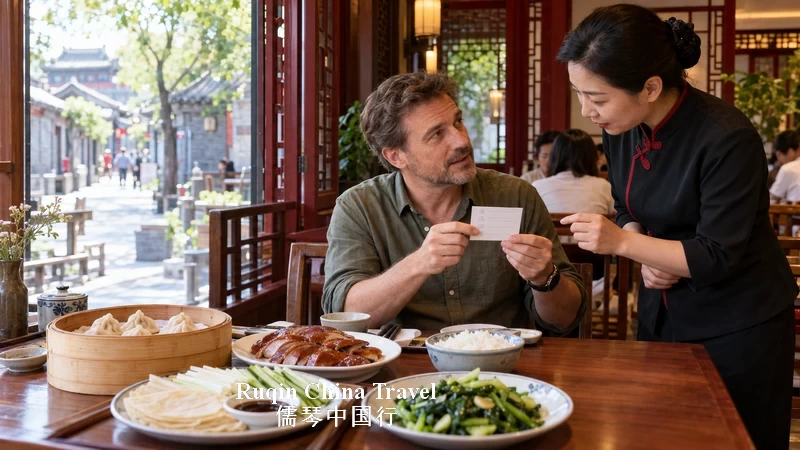
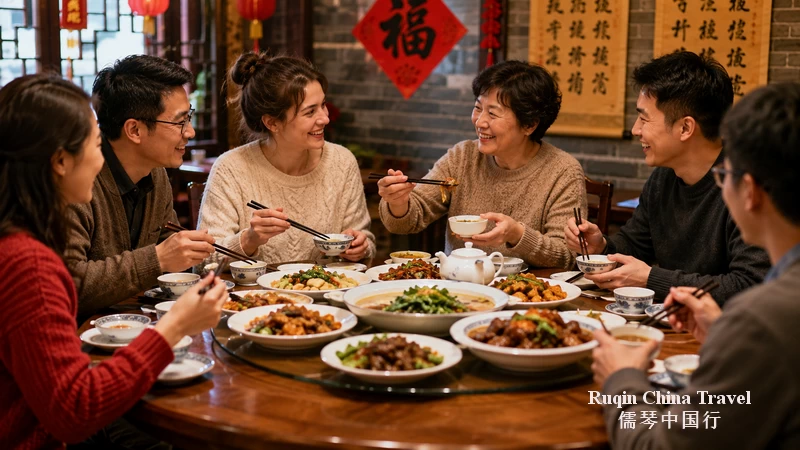
If a Chinese friend invites you to dinner, you may notice something before the food even arrives. Nobody asks, “What are you having?” Instead, one person orders several dishes, and everything goes into the middle of the table.
Then the meal begins. Someone pours tea for you, another person places food on your plate, and glasses rise for the first toast. Later, you may quietly reach for the bill, only to discover that somebody has already paid it.
For a first-time foreign visitor, Chinese dining culture can feel warm, generous, and slightly confusing. However, once you understand a few habits, the whole experience becomes much easier. More importantly, the dining table gives you a surprisingly good view of Chinese relationships.
1. Why Does Everyone Share the Food?
One of the biggest differences between Chinese and many Western meals is simple: Chinese people usually share dishes.
In many Western restaurants, each person orders a main course. Your steak is yours, my fish is mine, and perhaps we share an appetizer. At a traditional Chinese meal, however, several dishes arrive together and everyone eats from the same selection.
This is why Chinese restaurant tables are often round. At larger meals, you may also find a rotating glass platform in the center, usually called a Lazy Susan in English. You turn it gently until the dish you want comes within reach.
For Chinese people, sharing food feels natural. A meal is not simply several individuals eating beside each other. Everyone is eating together, and the shared dishes help create that feeling.
I have taken many foreign visitors to Chinese restaurants over the years. At first, some wait patiently for “their dish” to arrive. Then I explain that everything on the table belongs to everyone, and the meal suddenly becomes much more relaxed.
2. How Chinese People Order for the Table
If you eat with Chinese friends, one person may take charge of ordering. Usually, this is the host or someone who knows the restaurant well. The host may ask what everyone likes, but that does not mean each person chooses one dish.
Instead, Chinese people usually think about the table as a whole. They may order meat, fish, vegetables, tofu, soup, and a staple such as rice or noodles. They also try to balance cooking methods, colors, textures, and stronger or lighter flavors.
There is an old practical rule of ordering roughly one dish per person, perhaps with an extra dish or soup. However, this varies greatly with portion sizes and the type of restaurant. These days, avoiding food waste has also become more important.
If you are the foreign guest, you do not need to control the ordering. Tell your host about allergies, foods you cannot eat, or whether you dislike very spicy dishes. Then let your host introduce you to the local specialties.
If someone asks what you would like, choosing one dish is perfectly polite. I usually suggest picking something you genuinely want to try. Your host will then build the rest of the meal around the table.
3. The Round Table: Everyone Has a Place
Round tables are common at Chinese banquets because they make sharing food easy. However, the round shape does not always mean that every seat has the same social meaning. At formal dinners, seating can still reflect age, status, and the relationship between host and guests.
Traditionally, the most important guest sits in the seat of honor (主位 or 主宾位, depending on the occasion). Its exact location depends on the room and table arrangement. It is often positioned facing the entrance or in the place considered most prominent.
The main host usually sits in a position that makes serving and communicating with guests convenient. Other seats may then follow according to seniority or importance. At weddings, business banquets, and official dinners, people may pay close attention to this arrangement.
However, do not worry too much during an ordinary meal with friends. Modern Chinese dining is far less formal in most situations. If you are unsure where to sit, simply wait for your host to show you.
This is one situation where I would not rush to grab the most comfortable chair. Stand for a moment and see where your host directs you. That small pause avoids almost every seating problem.
4. Chopsticks: The Rules You Really Need to Know
Many foreign visitors worry about chopsticks before their first Chinese meal. In reality, nobody expects you to use them perfectly. If you make a small mistake, Chinese friends will usually help rather than judge you.
Still, a few habits are worth knowing. Most importantly, never stick your chopsticks upright into a bowl of rice. The image resembles incense placed upright during traditional rituals for the dead, so it looks uncomfortable at an ordinary meal.
Also, avoid pointing at people with chopsticks. Do not wave them around while talking, and do not use them to dig repeatedly through a shared dish searching for your favorite piece. Take what is easy to reach and continue eating.
At many restaurants, you may see separate serving chopsticks (公筷) or serving spoons. Use them for shared dishes when provided. This practice has become increasingly common and is both hygienic and easy to follow.
If chopsticks become too difficult, ask for a spoon or fork. There is no shame in that. Enjoying the meal matters much more than demonstrating perfect chopstick technique.
5. When Someone Keeps Putting Food on Your Plate
This surprises many foreign visitors.
You are eating happily when your Chinese host suddenly picks up a piece of fish or meat and places it on your plate. Then another piece arrives. Before long, you may wonder whether your host thinks you cannot feed yourself.
Do not worry. In traditional Chinese dining culture, serving food to a guest is often an expression of hospitality. Parents do it for children, younger people may do it for elders, and hosts often do it for important guests.
I have seen foreign friends politely finish everything placed before them, only to receive more immediately. Their mistake was assuming that an empty plate meant, “I am finished.” To an enthusiastic Chinese host, it can mean, “Our guest needs more food.”
Today, people are more conscious about hygiene, so serving chopsticks are increasingly used. Younger Chinese diners may also serve others less frequently than previous generations. Still, you will certainly encounter the custom, especially at family meals and banquets.
If you are full, smile and say “我吃饱了,谢谢” (Wǒ chī bǎo le, xièxie) — “I’m full, thank you.” You can also leave a little food on your plate rather than forcing yourself to eat beyond comfort.
6. Tea Usually Arrives Before the Food
At many Chinese restaurants, tea appears soon after you sit down. Sometimes it is included automatically, while other restaurants charge a small tea fee. In Cantonese restaurants, tea plays an especially important role.
If someone pours tea for you, saying “thank you” is enough. In southern China, however, you may notice people tapping two or three fingers lightly on the table. This is an informal way of thanking the person pouring tea.
There are different stories about how this custom began. The best-known connects it with the Qing emperor Qianlong, although the story is difficult to verify historically. For a traveler, the important thing is simply to recognize what the gesture means.
You do not need to copy it. A smile and a quiet “xièxie” (谢谢) work everywhere. However, once you recognize the finger tap, you may start noticing it at tables around you.
Also, watch what happens when the teapot becomes empty. In some restaurants, guests leave the lid slightly open or move it aside to signal that more hot water is needed. Customs vary, so follow what local diners do.
7. Toasting: What Does “Ganbei” Really Mean?
At a Chinese banquet, especially a business dinner or celebration, alcohol may appear quickly. Someone fills the glasses, the host stands or raises a glass, and you hear the famous word “ganbei” (干杯).
Literally, ganbei means “dry the glass.” Traditionally, it can suggest finishing the drink. However, modern practice depends greatly on the people, setting, and drink involved.
You do not have to drink alcohol to be polite. If you do not drink, say so clearly and early. Tea, juice, soft drinks, or water can usually be used for a toast instead.
If you do drink, do not feel pressured to match everyone glass for glass. A friendly smile and a small sip are often enough at casual dinners. At formal occasions, watch your host and the other guests before deciding what to do.
You may also notice people holding their glass slightly lower when toasting an older or more senior person. This traditionally shows respect. If both people keep trying to lower their glasses, the result can become quite amusing.
The important thing is not the exact height of your glass. Join the moment, make eye contact, and respond warmly. The toast is usually about connection rather than drinking itself.
8. Who Pays? The Chinese Battle for the Bill
This may be one of the most entertaining parts of a Chinese meal.
In many Western countries, friends simply split the bill. In China, especially when someone has invited you, the host traditionally expects to pay. The phrase “我请客” (Wǒ qǐngkè) means “It’s my treat.”
Then comes the famous Chinese struggle over the bill. One person reaches for it, another stops them, and somebody may already be walking toward the cashier. Voices rise, hands wave, and a foreign visitor may wonder whether an argument has started.
Usually, nobody is angry.
They are being polite.
Offering to pay shows generosity and respect. Refusing your guest’s money can also show hospitality. Among younger friends, however, splitting bills has become much more common, especially through mobile payment apps.
If a Chinese friend clearly invited you, let them pay after making one sincere offer. Then say thank you and perhaps offer to buy coffee, drinks, or the next meal. This feels natural and avoids turning dinner into a wrestling match.
If you invited everyone, expect to pay. In China, “inviting someone to dinner” traditionally carries a stronger expectation that the inviter will cover the bill.
9. Why Is There So Much Food?
Foreign guests often notice another feature of Chinese hospitality: there seems to be too much food.
At a traditional banquet, an almost empty table at the end could once suggest that the host had not ordered enough. Therefore, hosts often preferred to order generously. Plenty of food showed that guests were well looked after.
However, attitudes are changing. China has promoted reducing food waste, and many restaurants encourage customers to order more carefully. Younger diners are also increasingly comfortable ordering less and adding another dish later if needed.
As a visitor, you do not need to finish everything to prove that you enjoyed the meal. Eat comfortably and compliment dishes you genuinely like. If there are leftovers, many Chinese diners now take them home.
You may hear people ask the restaurant to “dǎbāo” (打包) the remaining food. It simply means packing the leftovers to take away. There is nothing embarrassing about it.
10. At a Chinese Banquet, Watch Before You Act
A casual noodle lunch and a formal Chinese banquet are very different experiences. At a wedding, business dinner, or official reception, there may be more attention to seating, serving order, speeches, and toasts. If you are the foreign guest, you may even receive more attention than you expected.
My simplest advice is: watch the host. Do not start eating the moment the first dish touches the table if nobody else has begun. Wait a little, especially at a formal dinner, and follow the rhythm around you.
Likewise, do not worry about knowing every rule. Chinese hosts generally understand that foreign visitors come from different cultural backgrounds. Showing interest and basic respect matters far more than performing every custom perfectly.
If you make a small mistake, smile and continue. Meals should bring people closer, not make you nervous. Chinese dining culture has many customs, but hospitality sits underneath most of them.
11. Useful Chinese Phrases at the Dinner Table
A few simple Chinese phrases can make a meal much easier. You do not need perfect pronunciation, and local friends usually appreciate the effort. These are the ones I would remember first.
“谢谢” (Xièxie) means “Thank you,” while “很好吃” (Hěn hǎochī) means “It’s delicious.” If you have eaten enough, say “我吃饱了,谢谢” (Wǒ chī bǎo le, xièxie) — “I’m full, thank you.”
If spicy food worries you, say “不要太辣” (Bú yào tài là) — “Not too spicy.” If you want the bill, “买单” (Mǎidān) is widely understood. Meanwhile, “干杯” (Gānbēi) is the toast you will probably hear most often.
You do not need to memorize a long phrasebook. These few expressions, together with a smile, will carry you through many meals. Food is one of the easiest places to start speaking Chinese.
12. What the Chinese Dinner Table Tells You About China
After many years of working with foreign travelers, I have come to see the Chinese dinner table as a small picture of Chinese society.
Sharing dishes emphasizes the group. Pouring tea and serving food express care. Seating can acknowledge age and status, while fighting for the bill expresses generosity and the importance of relationships.
Of course, China is changing. Young people split bills, serving chopsticks are more common, formal banquet customs are becoming less rigid, and families develop their own habits. There is no single set of dining rules followed by 1.4 billion people.
Still, the old patterns remain visible.
Once you understand them, a Chinese meal begins to look different. What first seemed like a collection of strange rules starts to make sense as a language of hospitality.
A Note from Ruqin: Relax, Eat, and Join the Table
If a Chinese family or friend invites you to eat, do not spend the whole meal worrying about etiquette. Wait for your host to show you where to sit, share the dishes, use serving chopsticks when provided, and join a toast in whatever way feels comfortable.
Most importantly, talk, taste, and enjoy the company. Ask about unfamiliar dishes and tell people which ones you like. Chinese hosts are often delighted when a foreign guest takes a genuine interest in local food.
Some of my best memories with foreign visitors have happened around a Chinese table. After the sightseeing ends, people relax, dishes keep arriving, stories come out, and cultural differences suddenly become easier to talk about.
That is why eating with locals can teach you something no museum label can explain. In China, the dining table is not only a place to eat. It is where people share food, friendship, respect, and a little of their lives.
Ruqin is the founder of Ruqintravel.com and has spent more than four decades working in China’s travel industry. Drawing on hands-on experience in cities like Beijing and Hangzhou, he personally researches and updates each guide to help international travelers navigate China with confidence.
Further Reading
Eight Great Cuisines of China: A Foreigner’s Food Guide
Popular Chinese Dish Names Explained in English: Meanings & Ingredients