
Written by Ruqin
August 12, 2026
Meta Title: What to Eat in China: A First-Time Visitor’s Food Guide
Meta Description: Wondering what to eat in China? Discover breakfast, noodles, dumplings, hot pot, street snacks and regional dishes with practical ordering tips.
Start with the Food Around You
One of the pleasures of traveling in China is that food changes almost as quickly as the scenery. Take a high-speed train for three hours, and breakfast may change. The noodles may change, too, along with the sauces, dumplings, vegetables, and local snacks.
For first-time visitors, however, Chinese food can also feel overwhelming. Restaurant menus may contain hundreds of dishes, and some English translations create more confusion than help. Meanwhile, the Chinese food you know from home may represent only a small corner of what people actually eat here.
I have eaten with foreign visitors across China for many years. My advice is simple: do not try to “eat everything.” Instead, learn a few basic food categories, then follow the local specialties as you travel.
This guide is not a list of fifty famous dishes. It is a practical introduction to eating your way through China, one meal at a time.
1. Start with a Chinese Breakfast
If you want to see everyday China, get up early and find breakfast near your hotel. Before offices open, small restaurants fill with commuters, retirees, delivery workers, students, and parents taking children to school. Breakfast is cheap, quick, and wonderfully local.
In Beijing, try jianbing (煎饼), a thin savory pancake cooked on a hot griddle. The vendor adds egg, sauce, herbs, and something crisp inside before folding it. Another Beijing favorite is douzhi (豆汁), a fermented mung-bean drink, but its sour taste can challenge first-time visitors.
In Shanghai and nearby Jiangnan cities, look for shengjian bao (生煎包). These pan-fried buns have soft tops, browned bottoms, and juicy fillings. Meanwhile, xiaolongbao (小笼包) offers a gentler introduction to the region’s famous soup-filled dumplings.
Travel south to Guangzhou, and breakfast can turn into yum cha (饮茶). You sit down with tea and order small plates of dim sum. Shrimp dumplings, steamed buns, rice noodle rolls, and other dishes slowly fill the table.
Then there are foods you will see almost everywhere. Baozi (包子), steamed buns with different fillings, make an easy breakfast. Soy milk, boiled eggs, congee, noodles, and youtiao (油条) are also common.
For a traveler, breakfast has another advantage. You rarely need a long explanation or complicated reservation. Find a busy local shop, point to what looks good, and start your day like the people around you.
2. When in Doubt, Eat Noodles
China is a wonderful country for noodle lovers. However, there is no single thing called “Chinese noodles.” Every region seems to have found its own way to turn flour, water, broth, meat, vegetables, and spices into something different.
In Beijing, try zhajiangmian (炸酱面). Thick wheat noodles come with a savory fermented soybean sauce, minced meat, and fresh vegetables. Mix everything together before eating.
In Xi’an, look for biangbiang noodles (Biángbiáng面). The broad, hand-pulled noodles are thick and pleasantly chewy. Chili, vinegar, garlic, and other seasonings give them a bold northern character.
Then, in Lanzhou, try Lanzhou beef noodles (兰州牛肉面). You can often watch the cook stretch one piece of dough into long strands behind the counter. A clear beef broth, sliced beef, radish, herbs, and chili oil complete the bowl.
Chongqing offers something entirely different. Chongqing xiaomian (重庆小面) is usually spicy, fragrant, and full of chili and Sichuan pepper. If you dislike strong heat, tell the server “少辣” (shǎo là), meaning “less spicy.”
Noodles also make a good rescue meal when you feel tired of complicated restaurant ordering. Walk into a noodle shop, choose one bowl, and eat. After several large shared meals, that simplicity can feel very welcome.
3. Dumplings Are More Varied Than You Think
Many first-time visitors arrive in China already familiar with dumplings. However, once you travel here, you quickly discover that “dumpling” covers several very different foods.
Northern China is famous for jiaozi (饺子). These boiled, steamed, or pan-fried dumplings may contain pork and cabbage, pork and chives, beef, lamb, shrimp, or vegetables. In Beijing and other northern cities, a dumpling restaurant makes an easy and inexpensive meal.
Then there is xiaolongbao (小笼包), especially associated with Shanghai and the Jiangnan region. These delicate steamed dumplings contain filling and hot broth inside a thin wrapper. Lift one carefully, bite a small opening, let it cool, and then enjoy it.
In Chengdu and other parts of Sichuan, you may encounter chaoshou (抄手). They resemble wontons and often arrive in a spicy red chili-oil sauce. Meanwhile, Cantonese dim sum includes har gow (虾饺), translucent shrimp dumplings with a completely different texture.
So do not say, “I already tried Chinese dumplings.” Try them again in another city. They may barely resemble the ones you ate yesterday.
4. Try Hot Pot at Least Once
Few meals introduce Chinese social dining better than hot pot (火锅). A pot of simmering broth sits in the middle of the table, while plates of raw ingredients surround it. Everyone cooks small portions, eats, talks, and keeps going.
Chongqing and Chengdu are the obvious places to experience spicy hot pot. The broth can contain large amounts of chili and Sichuan pepper, creating both heat and the famous numbing sensation called má (麻). If that sounds intimidating, order a divided pot with both spicy and mild broth.
However, hot pot is not always fiery. Beijing’s traditional copper-pot mutton hot pot (铜锅涮肉) uses a much lighter broth. Thin slices of lamb cook in seconds, then you dip them into sesame sauce.
Elsewhere, you will find mushroom hot pot, fish hot pot, coconut chicken hot pot, and many local variations. Therefore, think of hot pot as a cooking method rather than one particular dish.
I often recommend hot pot to groups of foreign travelers because everyone can choose what they want. One person can cook mushrooms, another beef, and another leafy vegetables. Meanwhile, the shared pot naturally turns dinner into a social occasion.
5. Rice Dishes Are Your Reliable Travel Companions
Rice dominates much of southern China, although you will find it everywhere. Sometimes it appears as a simple bowl beside several shared dishes. At other times, the rice itself becomes the meal.
Yangzhou fried rice (扬州炒饭) is one familiar example. However, do not judge Chinese rice dishes only by fried rice. Clay-pot rice, rice noodles, rice rolls, congee, and regional rice bowls reveal much more variety.
In Guangdong, try clay-pot rice (煲仔饭). Rice cooks in a clay pot with ingredients such as Chinese sausage, chicken, or preserved meat. The slightly crisp layer at the bottom is often the best part.
Hainan offers one of China’s most approachable meals for foreign visitors: Hainan chicken rice (海南鸡饭). Tender chicken comes with fragrant rice and dipping sauces. It is simple, mild, and especially useful when you want a break from stronger flavors.
For a quick lunch, look for restaurants serving gaifan (盖饭). A cooked dish comes directly over rice, so you do not need to order several shared plates. It is one of the easiest ways to eat alone in China.
6. Do Not Miss China’s Everyday Home-Style Dishes
Visitors often focus on famous specialties, but ordinary Chinese dishes can be just as satisfying. In fact, many are closer to what Chinese families eat regularly.
Tomato and scrambled eggs (西红柿炒鸡蛋) is a perfect example. It sounds almost too simple to order while traveling, yet it remains one of China’s most loved home-style dishes. The combination is soft, slightly sweet, savory, and comforting.
Another useful dish is stir-fried shredded potatoes (酸辣土豆丝). The potatoes stay surprisingly crisp and usually come with vinegar and a little chili. Meanwhile, mapo tofu (麻婆豆腐) gives you a much stronger introduction to Sichuan flavors.
You will also see seasonal green vegetables on almost every Chinese menu. Ask the restaurant what vegetable is fresh that day. A simple plate of quickly stir-fried greens with garlic can balance a table full of meat.
These dishes may never appear on a “Top 10 Foods in China” list. However, they help you understand how people actually eat.
7. Street Snacks: Follow the Crowd, Not Just the Checklist
China’s street-food scene has changed over the years. In many large cities, authorities have moved food stalls into designated streets, markets, or permanent shops. Still, local snacks remain an important part of traveling here.
In Xi’an, you might try roujiamo (肉夹馍), sometimes described as a Chinese-style meat sandwich. The crisp flatbread holds chopped braised meat, creating a filling meal you can eat while exploring. Nearby, you will find many other Shaanxi snacks around the Muslim Quarter and local neighborhoods.
In Chengdu, snack shops serve dan dan noodles (担担面), zhong dumplings (钟水饺), and many small plates. In Shanghai, meanwhile, scallion oil noodles (葱油拌面) and shengjian bao make excellent casual meals.
Beijing has its own snack traditions, including lüdagun (驴打滚), a soft glutinous rice snack coated with soybean flour. You may also see tanghulu (糖葫芦), fruit covered with a crisp sugar shell, especially in cooler months.
My rule with street snacks is practical. Choose places with steady local customers and food cooked fresh in front of you. If something has been sitting uncovered for a long time, I simply move on.
8. Let Each Region Tell You What to Eat
One of the biggest mistakes first-time visitors make is ordering the same familiar dishes everywhere. China is too large for that. Instead, let each destination add something different to your trip.
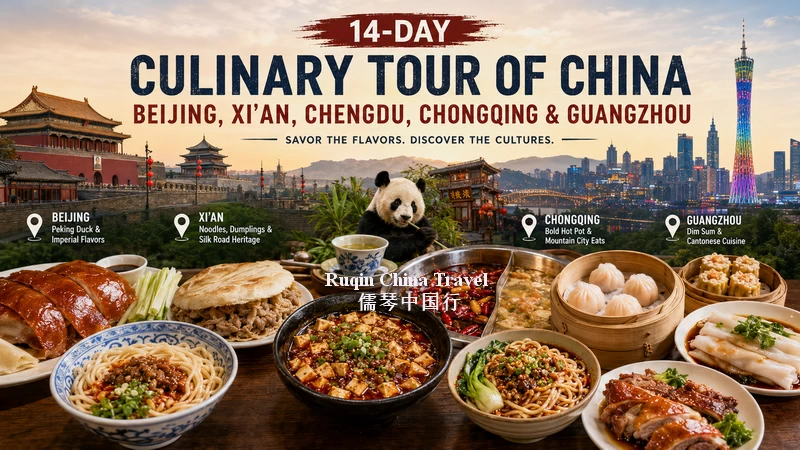
In Beijing, try Peking duck, zhajiangmian, dumplings, and copper-pot mutton. In Xi’an, explore roujiamo, biangbiang noodles, lamb dishes, and the city’s rich Muslim food traditions. Then, in Chengdu, move toward mapo tofu, dan dan noodles, Sichuan hot pot, and other dishes built around chili and Sichuan pepper.
In Shanghai, try xiaolongbao, shengjian bao, scallion oil noodles, and red-braised dishes. Nearby Hangzhou offers Dongpo pork, West Lake fish, and Longjing shrimp. These dishes often taste gentler and slightly sweeter than food from China’s southwest.
Farther south, Guangzhou rewards travelers who enjoy subtle flavors. Dim sum, roast meats, steamed fish, and fresh seafood are central to Cantonese dining. Meanwhile, Yunnan brings mushrooms, rice noodles, herbs, flowers, and foods influenced by the province’s many ethnic communities.
This is how I prefer to travel through Chinese food. I do not carry a national checklist. I arrive in a city and ask, “What should I eat here?”
That one question usually leads somewhere interesting.
9. Vegetarian Travelers Can Eat Well, but Explain Clearly
China has a long vegetarian tradition, especially around Buddhist temples. However, ordering vegetarian food in an ordinary restaurant can sometimes require more explanation than expected.
Simply saying “我不吃肉” (Wǒ bù chī ròu) — “I don’t eat meat” — may not cover everything. A vegetable dish could still contain meat stock, minced pork, oyster sauce, or animal fat. Therefore, strict vegetarians should explain their needs more clearly.
You can say “我是素食者,不吃肉,也不吃海鲜” (Wǒ shì sùshízhě, bù chī ròu, yě bù chī hǎixiān). This means, “I’m vegetarian. I don’t eat meat or seafood.” If you are vegan, you should also mention eggs and dairy.
Buddhist vegetarian restaurants can make things easier. They often create surprisingly elaborate dishes from tofu, mushrooms, gluten, vegetables, and soy products. However, remember that individual Buddhist restaurants may follow different rules about ingredients.
In large cities such as Beijing, Shanghai, Chengdu, and Hangzhou, vegetarian dining is increasingly easy. Still, keep a translated dietary note on your phone if your restrictions are important.
10. What If You Cannot Read the Menu?
This happens to almost every foreign traveler sooner or later. You sit down, open the menu, and discover several pages of Chinese characters with no English at all.
First, look for photographs. Many Chinese menus include pictures, especially at casual and mid-range restaurants. Pointing is perfectly acceptable.
Next, use your phone’s camera translation. It will not always produce elegant English, but it usually tells you enough about the main ingredient. Translation apps have made independent eating in China much easier than it was twenty years ago.
You can also look around the room. If another table has something appealing, point politely and tell the server “我要这个” (Wǒ yào zhège) — “I’d like this.” I have used this method myself in unfamiliar regional restaurants.
Finally, ask “有什么特色菜?” (Yǒu shénme tèsè cài?) — “What are your specialties?” Even if the conversation then involves pointing, photographs, and hand gestures, you will probably end up with something more interesting.
11. How Much Food Should You Order?
Chinese restaurants often serve dishes for sharing, which can confuse first-time visitors. Four people do not usually order four separate main courses. Instead, the group chooses several dishes for everyone.
For four people, you might begin with three or four dishes plus vegetables, soup, rice, or another staple. However, portion sizes vary enormously. Look at nearby tables or ask the server before ordering too much.
Try to create some balance. Choose one or two meat or fish dishes, one vegetable, perhaps tofu, and a staple. Then add another dish later if everyone is still hungry.
Also, remember that rice may not arrive automatically at the beginning of a formal meal. Chinese diners sometimes eat it later, especially when many dishes already fill the table. If you want rice immediately, just ask.
12. A Few Food-Safety Habits I Use When Traveling
China offers excellent food at every price level, from small noodle shops to formal restaurants. Still, travelers should use the same common sense they would anywhere else.
I prefer busy restaurants because ingredients turn over quickly. I also choose freshly cooked food over dishes that have sat outside for a long time. Meanwhile, I am more careful with raw foods when I do not know how they have been stored.
If you have allergies, prepare a Chinese-language note before the trip. Do not rely only on saying “no nuts” or “no seafood” in English. Ingredients such as peanut oil, sesame, shellfish sauces, and broths may not be obvious from a dish’s appearance.
Most importantly, listen to your own stomach. You do not need to prove your adventurous spirit at every meal. If yesterday’s dinner was heavy and spicy, a bowl of noodles or congee today may be exactly what you need.
13. Do Not Be Afraid to Say “Not Spicy”
Some visitors arrive expecting all Chinese food to be spicy. It is not. Cantonese, Jiangsu, Zhejiang, and many northern dishes can be quite mild.
However, in Sichuan, Chongqing, Hunan, Guizhou, and parts of Yunnan, chili can play a much larger role. If you want less heat, say “少辣” (shǎo là). For no chili, try “不要辣” (bú yào là).
There is one complication. A Sichuan cook’s idea of “a little spicy” may still feel very spicy to a visitor. Therefore, if you are sensitive to chili, say so clearly rather than bravely hoping for the best.
Also, remember that Sichuan food brings another sensation: má (麻), the numbing feeling from Sichuan pepper. It is not the same as chili heat. For many first-time visitors, that tingling sensation becomes one of the most memorable tastes of the trip.
14. Sometimes, Let the Local Person Order
Some of my most enjoyable meals with foreign visitors began without anyone studying the menu for long. We simply asked a local friend or restaurant owner to choose several specialties.
This works especially well in smaller cities. Tell them what you cannot eat, give them a rough budget, and ask for local dishes. Then let the meal surprise you.
Of course, you should still check ingredients if you have allergies or dietary restrictions. Otherwise, giving up a little control can be rewarding. You may discover a vegetable, noodle, mushroom, fish, or cooking style you would never have ordered yourself.
Travel works like that sometimes. The dish you remember years later may be the one whose name you never learned.
A Note from Ruqin: Eat the Journey, Not a Checklist
When friends ask me what they must eat on their first trip to China, I find it difficult to give them a fixed list. China is simply too large, and its food changes too much from place to place. A bowl of noodles in Lanzhou and dim sum in Guangzhou belong to the same country, yet they tell very different stories.
So start with breakfast. Then try the local noodles, share some dumplings, sit around a hot pot, and explore the snacks around you. When you reach another city, ask what people there are proud to eat.
You do not need to understand every ingredient or pronounce every Chinese name correctly. Point at a photograph, ask the server, watch what local people order, and stay curious. Some meals will surprise you, while others may not suit your taste, and that is part of travel.
After many years of introducing China to foreign visitors, I still think food offers one of the easiest ways into the country. You see geography, climate, history, family habits, and local character on the same table. Then, somewhere between your first breakfast and your last dinner, Chinese food stops being one cuisine and becomes part of the journey itself.
Further Reading
Eight Great Cuisines of China: A Foreigner’s Food Guide
Popular Chinese Dish Names Explained in English: Meanings & Ingredients
Chinese Dining Culture: A Foreigner’s Guide to Eating in China