
Written by Ruqin
June 16, 2026
Today is June 13, 2026 (Saturday). The temperature stays between 18–27°C, with light rain and overcast skies.
It was not an ideal day for photography, but I still decided to visit Red Brick Art Museum (北京红砖美术馆) — a place I had heard about for a long time. I thought that if I kept postponing it, I might not come at all. Some places are like that. You just go when the moment arrives.
The museum is not in the busy city center. It sits quietly in an art district in Cuigezhuang (崔各庄), Chaoyang District, Beijing. For someone like me who prefers quiet spaces and is drawn to architecture and light, this felt like a planned visit rather than a casual stop.
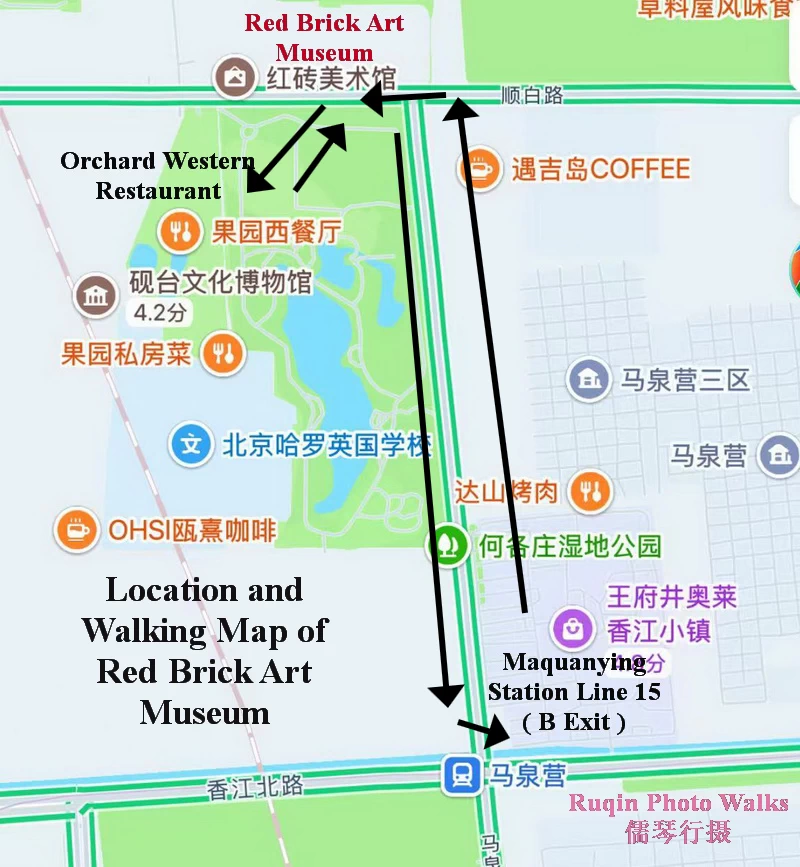
Location and Walking Map of Red Brick Art Museum
I took Subway Line 15 to Maquanying Station (马泉营站) and exited from Exit B. From there, I followed the map north along Maquanying West Road (马泉营西路) — about 1.1 kilometers, roughly a 16-minute walk. You can also take a shared bike which takes around ten minutes.
Then the red appears — a clear, geometric wall of brick, slightly unexpected in its color and rhythm. That’s when I knew I had arrived.
1. Entrance to the Museum
The entrance is easy to miss at first.
There is no large plaza, no grand architectural gesture announcing arrival. Instead, it feels restrained — almost as if the building is holding itself back before revealing anything.
A red-brick wall runs along the front, broken by three circular openings carved into it. If it weren’t for the small sign on the right that reads “Red Brick Art Museum,” you might not even realize this is a contemporary art museum with a landscape courtyard inside.
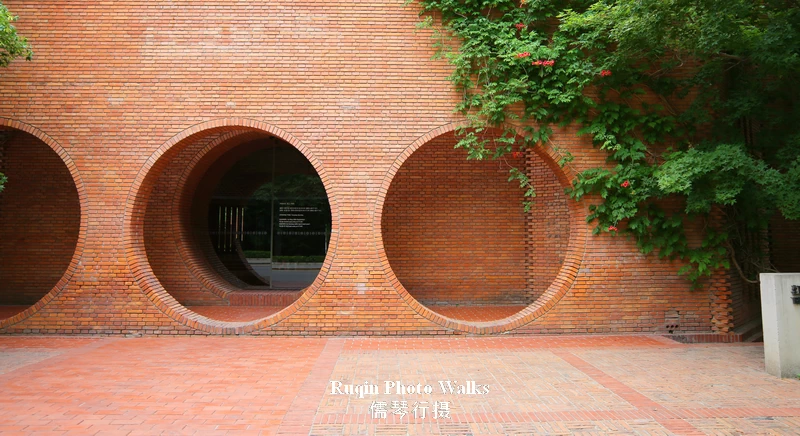
The three circular moon gates – Entrance to Red Brick Art Museum
The brick surface is alive in its own quiet way. Thick trumpet vine (Campsis radicans) climbs over parts of the wall, with small red flowers shaped like flutes, slightly loosened by the rain.
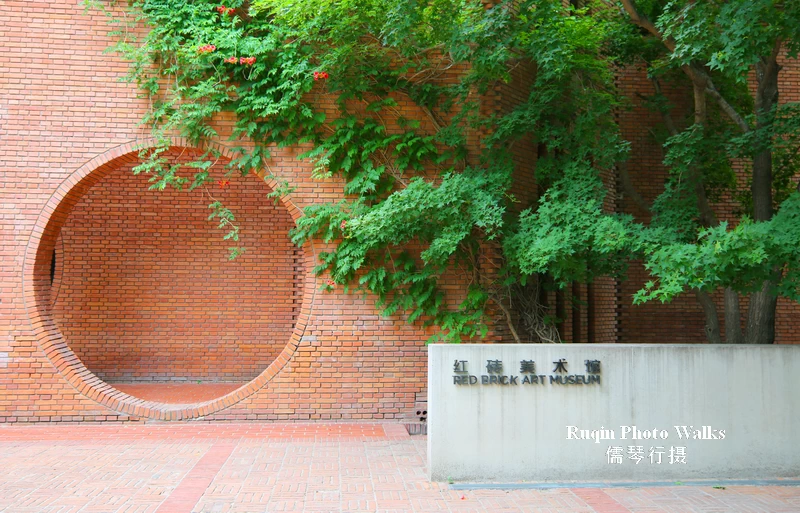
The small sign on the right that reads “Red Brick Art Museum
I stood there for a moment, just looking at the entrance rather than entering it immediately. It doesn’t push you in. You sort of slow down on your own.
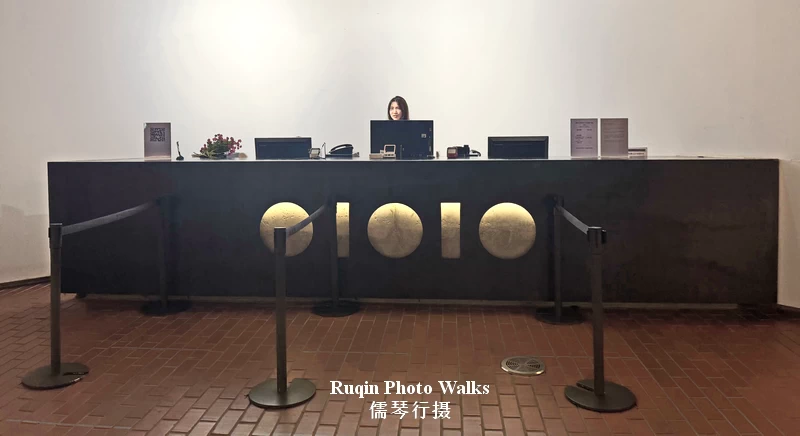
Once inside, the ticket counter is on the right
Once inside, the ticket counter is on the right. You can buy tickets on site — full price is around 120 RMB. The museum is closed on Mondays, something easy to forget if you don’t check ahead.
Nothing here feels like a typical museum arrival. It feels more like stepping through a quiet threshold that doesn’t insist on being noticed.
2. The Circular Forum Hall
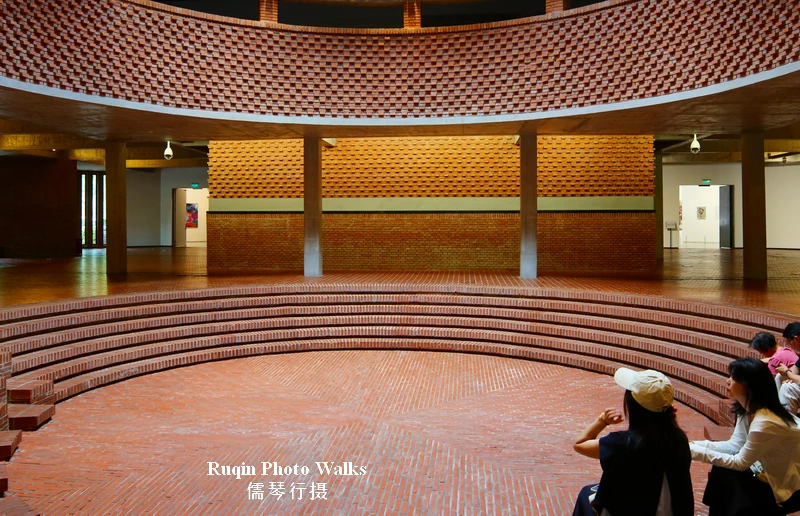
Once inside, the first space you walk into is not an exhibition room, but an open circular hall — the one I had seen in photos many times before.
It feels less like a museum interior and more like a small amphitheater wrapped in red brick. The space opens upward, and light drops in from a circular opening above, falling straight into the center like a natural spotlight.
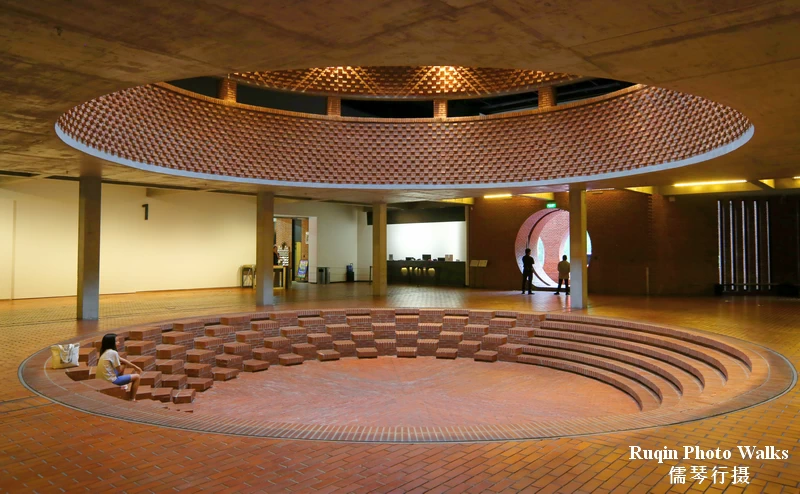
Like a small amphitheater wrapped in red brick.
Standing there, I didn’t immediately move on. I stayed in the middle for a moment. The space changes how you feel your own position — not just a visitor passing through, but something briefly placed inside the structure itself.
The steps around the hall spread outward in soft rings, like ripples frozen in brick. People move slowly along them, or pause without needing to sit.
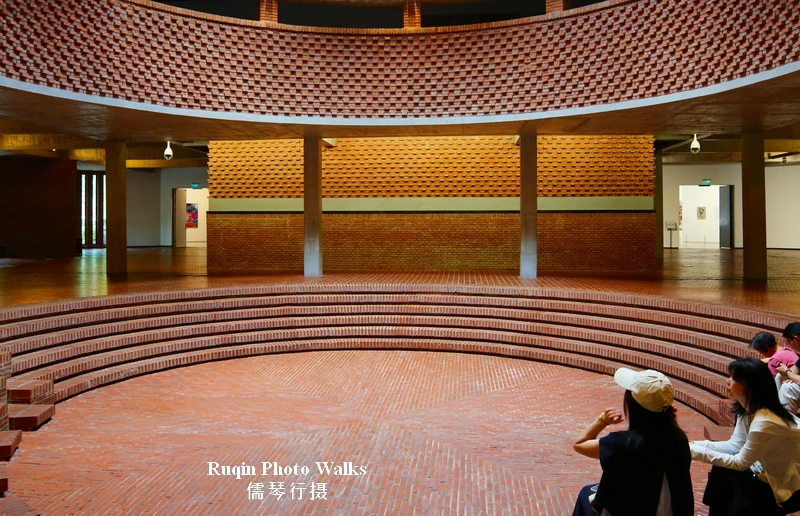
The steps around the hall spread outward in soft rings
The red brick tone shifts slightly under the daylight — warm, but not bright. With the soft diffusion of the overcast sky, everything feels calm and grounded, almost muted in its presence.
Nothing here feels designed to impress quickly. It feels more like a space that waits for you to adjust to it first.
3. Exhibition Spaces
Red Brick Art Museum is essentially divided into two parts: the exhibition halls and the contemporary landscape courtyard.
Walking through the interior, what I notice most is the sense of flow. The nine exhibition spaces are not arranged in a strict linear sequence like many traditional museums.
Instead, they are connected through corridors, skylights, and small stair transitions. You don’t feel like you are “moving room to room” — it feels more like drifting through connected pockets of space.
At the time of my visit, there were two exhibitions on view.
Ethiopian artist Tesfaye Urgessa, titled Primordial Paths
The first is the solo exhibition by Ethiopian artist Tesfaye Urgessa, titled Primordial Paths. It opened on March 21, 2026, and runs until June 21. More than 60 works are shown here — paintings, oil on canvas, drawings, and related documents.
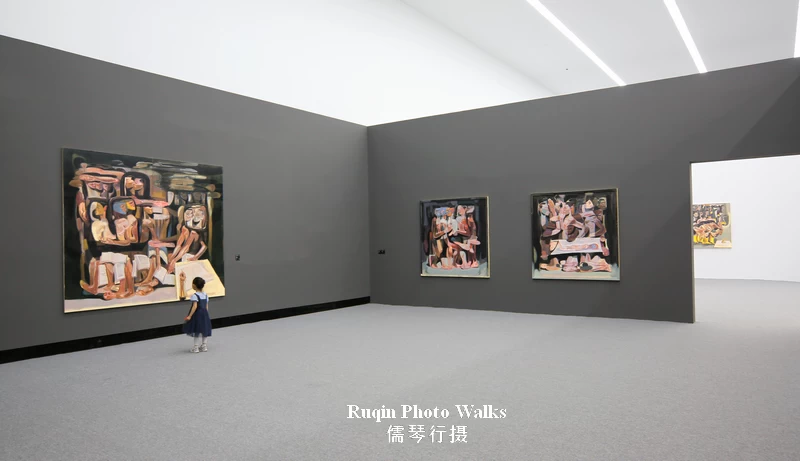
The solo exhibition by Ethiopian artist Tesfaye Urgessa, titled Primordial Paths
His work draws from Ethiopian church painting traditions while also absorbing elements of European art history. The palette often sits in earthy ochres, and the figures appear still at first glance, but never fully motionless.
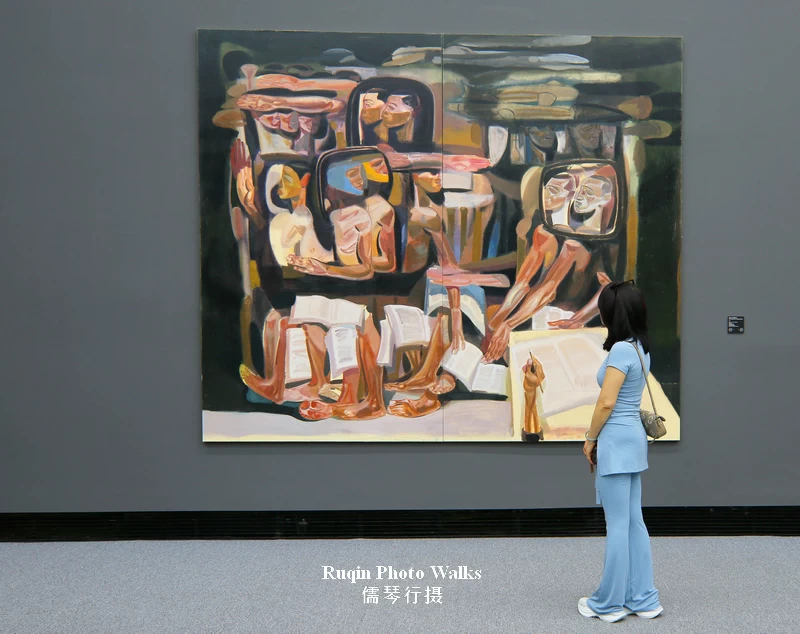
Figures appear still at first glance, but never fully motionless
There is always something slightly unsettled in the posture, as if movement is paused rather than absent. The idea of “primordial paths,” as I understand it here, is not about the beginning of history, but something that continues to unfold in the present — memory, identity, and displacement happening at the same time.
Aurora by Chinese artist Fu Rao
The second exhibition is Aurora by Chinese artist Fu Rao, marking his first major return exhibition in China after more than two decades in Germany. Around 50 works are presented, including oil paintings and works on paper.
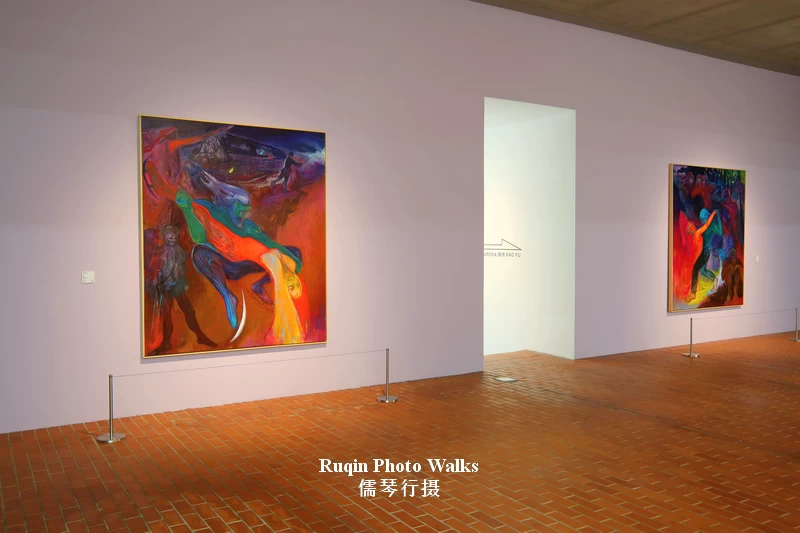
Aurora by Chinese artist Fu Rao
The idea of “aurora” appears less as a literal landscape and more as a condition — light emerging through pressure, contrast, and fracture. Rather than trying to heal or close gaps, the works seem to stay with them, allowing light to exist through the breaks.
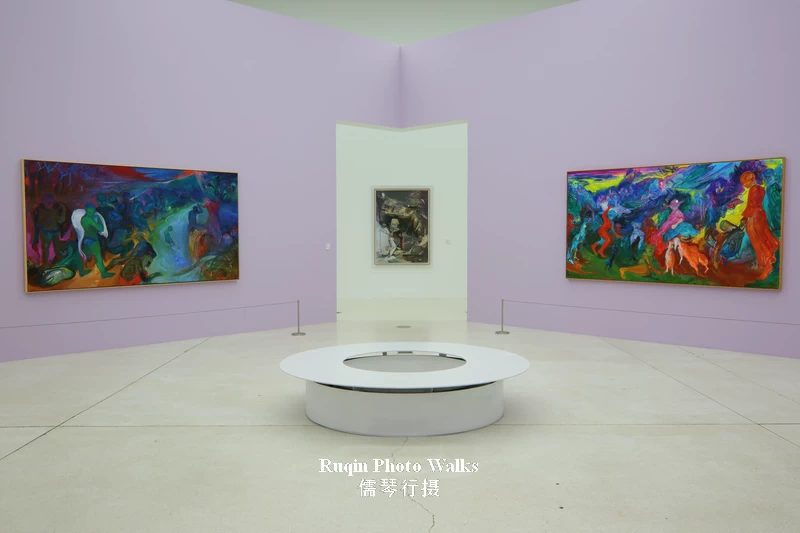
“aurora” — light emerging through pressure, contrast, and fracture
Moving between these two exhibitions, there is no sharp transition. The museum doesn’t interrupt your pace. You simply continue walking, and the shift happens quietly, almost without notice.
4. The Contemporary Courtyard — Outdoor Landscape
Stepping out from the indoor galleries, the atmosphere changes immediately.
It feels like whatever was inside — noise, thought, concentration — stays behind that doorway. What opens up in front of you is the most memorable part of Red Brick Art Museum: the contemporary courtyard hidden behind the brick structure.
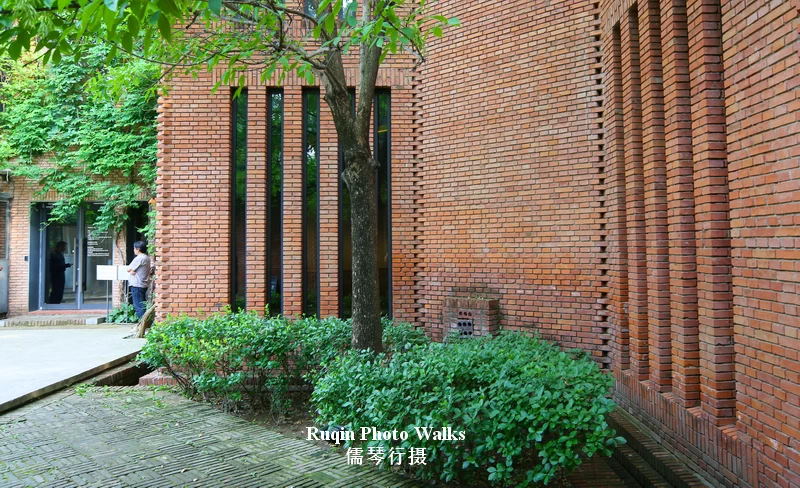
Stepping out from the indoor galleries, the atmosphere changes immediately
It borrows loosely from the language of traditional Suzhou gardens, but everything has been rebuilt in a more modern, architectural rhythm. Familiar, but not imitated.
The Central Pond
The first thing I notice is the still water at the center of the courtyard.
It is not large, but it holds everything around it. Brick walls, grey tiles, trees, rocks — all reflected on the surface as if the courtyard is folded into the water itself.
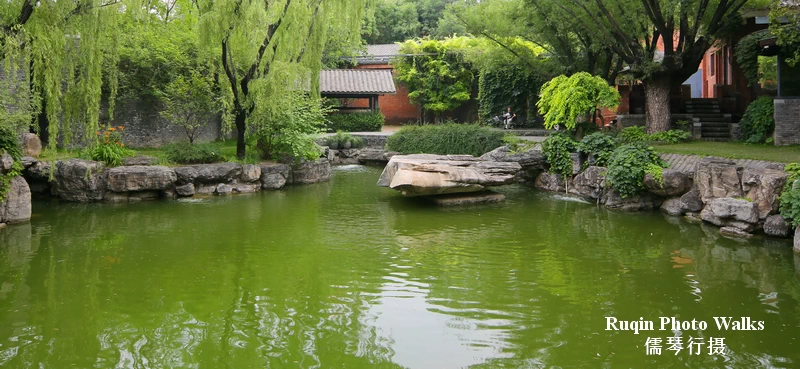
The first thing I notice is the still water at the center of the courtyard.
There are two black swans living here. They move slowly across the pond, almost without urgency. The red of their beaks stands out sharply against the dark feathers and muted water.
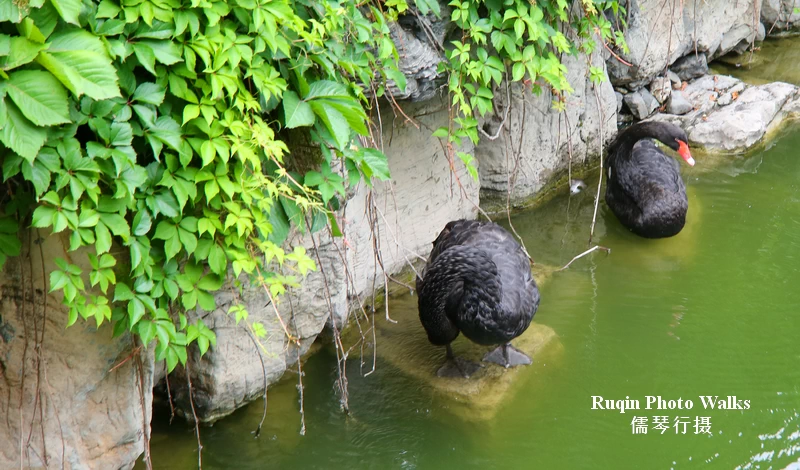
There are two black swans living here
They don’t feel like decoration. They feel like they belong here, as if the space quietly made room for them.
I walk along the edge of the water without stopping for long. From different angles, the courtyard keeps rearranging itself — trees becoming foreground, buildings slipping into reflection, sky breaking into fragments on the surface.
The Circular Arch Corridor
Further along, the space tightens into a corridor of repeated circular archways.
Layer after layer of moon gates line up in a quiet sequence, one framing the next. Walking through them feels slightly disorienting — not in a dramatic way, but in a soft, continuous shift of perspective.
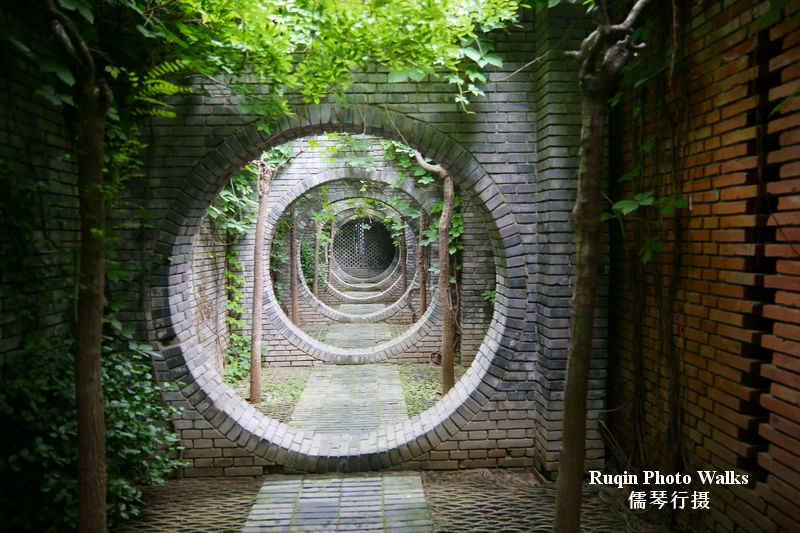
The Circular Arch Corridor
The brick here turns cooler in tone, closer to grey-blue. In summer, climbing vines drop down over the walls, forming uneven green curtains. The texture is dense but not heavy.
There is a contrast that doesn’t feel forced: red brick inside, grey brick outside, shadow and reflection moving across both.
The courtyard is not large, but it stretches perception. Distances feel slightly elastic here — a few steps can feel like a transition between completely different scenes.
Between Architecture and Landscape
What stays with me is not any single structure, but how loosely everything connects.
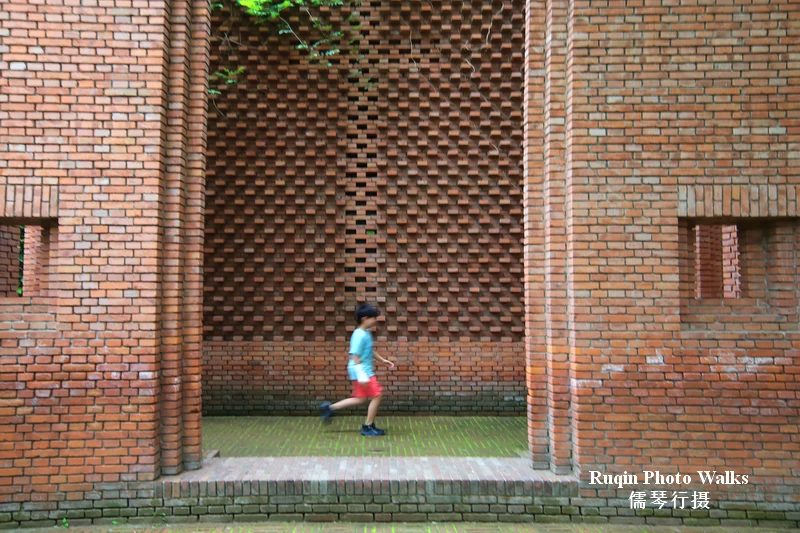
It behaves more like a sequence of partial framings
The courtyard doesn’t present itself as a “designed view.” It behaves more like a sequence of partial framings — water, wall, sky, passage, reflection — none of them complete on their own.
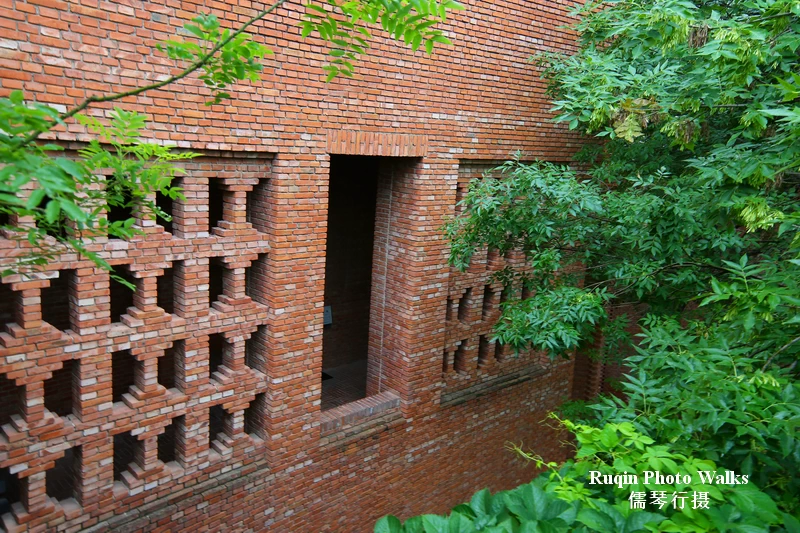
A short walk can feel like entering a new composition entirely
Even the scale feels slightly unstable. A short walk can feel like entering a new composition entirely, while a longer view collapses into stillness again.
This is not a garden meant to be understood quickly. It is a space that holds you in slow adjustment.
And because of that, it doesn’t feel like an “outdoor section” of a museum.
It feels like the museum continuing to breathe outside the building — quietly, without interruption.
5. The Design Shop
Before leaving Red Brick Art Museum, I stepped into the design shop next to the ticket entrance.
It’s not a large space, and it doesn’t feel like a typical museum gift shop either. The atmosphere is quieter than expected. People don’t move through it quickly. They tend to slow down here, almost as if the walk is not quite finished yet.
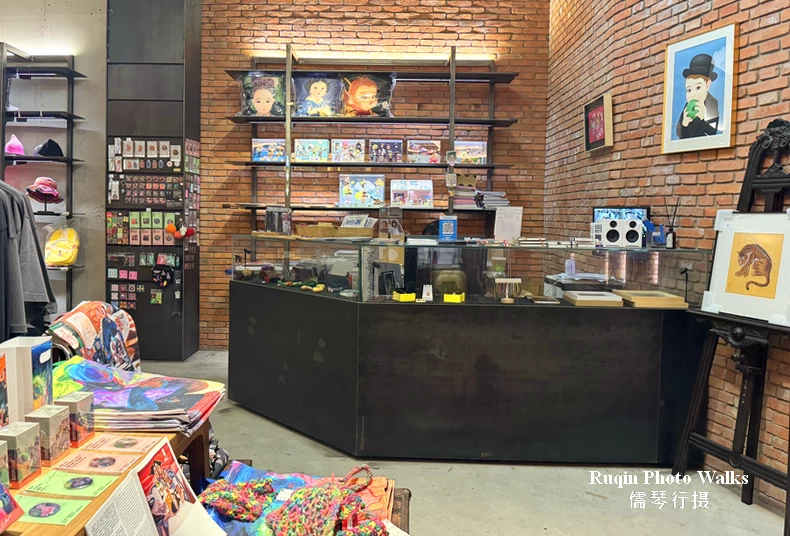
Inside the design shop in Red Brick Art Muaeum
After spending time inside the galleries and courtyard, this space feels like a softer landing point. A kind of in-between zone where the visit hasn’t fully ended.
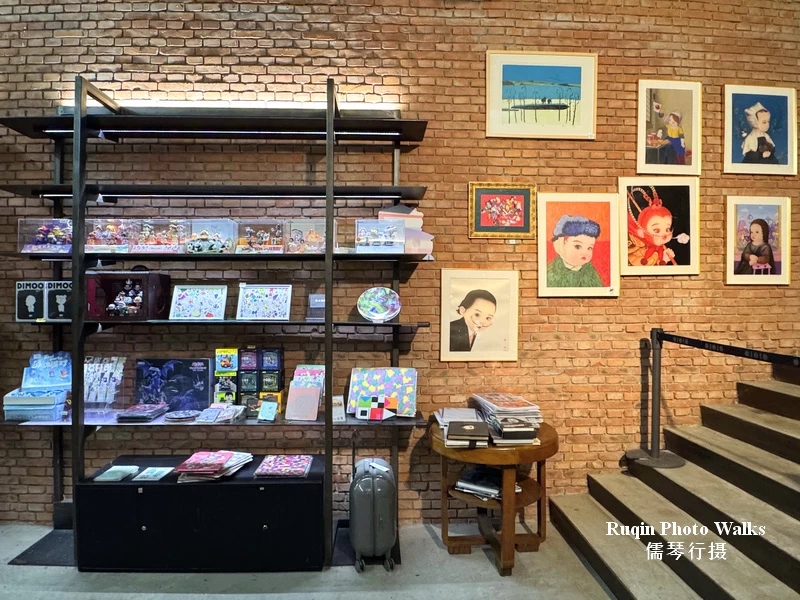
On the shelves, there are small printed objects
On the shelves, there are small printed objects — notebooks, postcards, bookmarks, exhibition catalogues. Simple things, but designed with a consistent visual language that matches the museum itself: restrained, clean, slightly architectural.
There are also books related to current and past exhibitions. Some visitors flip through them slowly, as if continuing the exhibition in a quieter format.
6. Dinner at Heggezhuang Orchard Western Restaurant
Leaving Red Brick Art Museum, I walked south for a few hundred meters — maybe 300 or so — and arrived at Heggezhuang Orchard Western Restaurant (何各庄果园西餐厅).
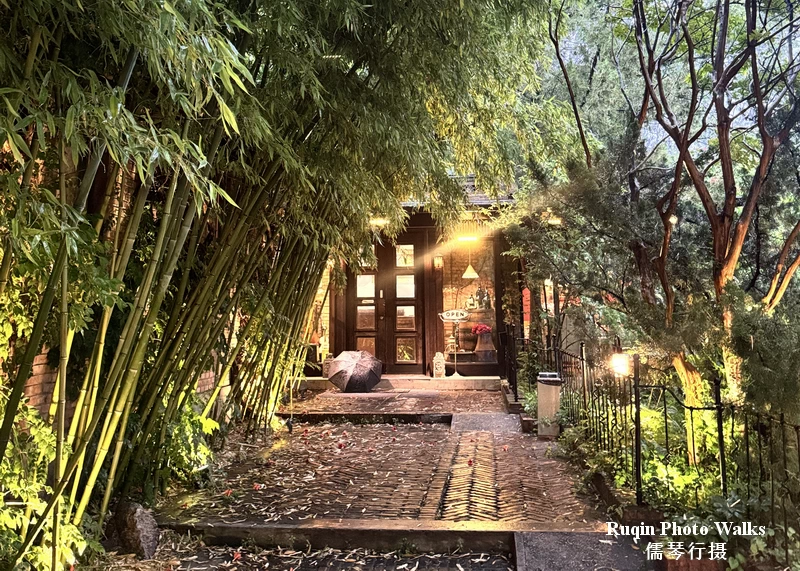
The stone road leading to the entrance to the Orchard Restaurant
The setting changes again, but very gently. It is still within the same quiet cluster of Cuigezhuang, still slightly removed from the main city rhythm, but the atmosphere becomes more social, more evening-oriented.
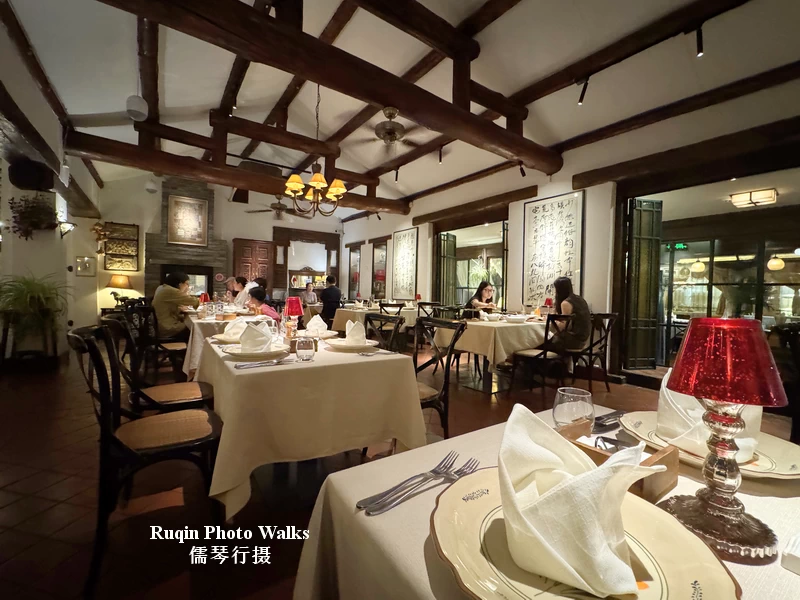
Inside the Orchard Restaurant
It is a courtyard-style restaurant, with greenery around the seating areas and a calm, slightly polished interior. On a weekend evening like this, the place is quite full. Most of the guests seem young, sitting in small groups, talking without much rush.
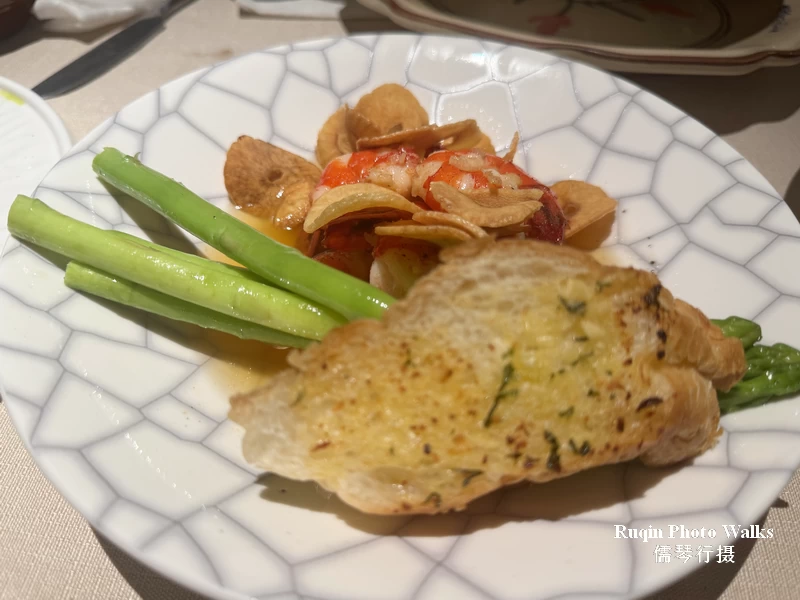
Shrimp with asparagus and bread
The menu is Western-style, and the prices are not low. For two people, a simple dinner easily goes over 500 RMB. Still, the tables are full, and there is a steady flow of people coming in and out. The contrast between “quiet art district” and “busy weekend dining” sits right next to each other here.
Nothing particularly stands out in terms of dishes or presentation. What stays with me more is the continuity of the day — from museum space, to courtyard, to this kind of dinner setting that still feels part of the same area, just with a different tempo.
After dinner, I walked back toward Maquanying Station on Line 15. The road was quiet again, with fewer people now, and the walk felt like the final stretch of the day slowly closing itself.
That’s where the Red Brick Art Museum walk ends — not with an exit, but with a gradual return to the city.
7. Practical Notes From the Visit
I don’t usually treat places like this as something to “prepare for,” but a few small things do make the visit smoother.
If possible, avoid Mondays — the museum is closed. In summer, arriving right at opening time around 10:00, or later in the afternoon after 3:00, feels better. The light at these times is softer, especially in the courtyard where shadows and reflections become more noticeable.
Opening hours are generally:
- Summer (May 1 – Sept 30): 10:00–18:00 (last entry 17:30)
- Winter (Oct 1 – Apr 30): 10:00–17:30 (last entry 17:00)
Closed on Mondays (except public holidays).
The ticket price is around 120 RMB for a standard entry.
For clothing, I noticed something simple while walking around the courtyard and galleries — neutral colors work best here. White, black, beige. The red brick is already strong visually, so simple tones tend to sit better against it without competing for attention.
In summer, especially in the courtyard, mosquito repellent is worth carrying. The garden areas are dense, and near the water, they become noticeable quite quickly.
Getting here is straightforward. Maquanying Station on Subway Line 15 is the closest. From there, it’s about a 1 km walk or short bike ride. If taking a taxi, just set the destination as “Red Brick Art Museum.”
For tickets, it’s better to book in advance through the museum’s official WeChat account, especially on weekends or during exhibitions. It avoids waiting and makes entry smoother.
None of these are strict rules. Just small details I noticed along the way that make the visit feel more natural.
About the Author
Ruqin is the founder of Ruqintravel.com and has decades of experience in China’s travel industry. Drawing on hands-on work across major destinations throughout the country, he personally researches and updates each guide to help international travelers explore China with confidence。
Further Reading
Beijing City Walks: Routes, Maps & Essential Travel Tips
Beijing Hutong Walks: Routes, Maps & Local Tips
Riverside Walk from Liangma River to Solana in Chaoyang — Beijing Photo Walks
Beijing Second Ring Road Moat Greenway Walk | Beijing Photo Walk by Ruqin
Beijing Ming City Wall Relics Park Morning Walk | Beijing Photo Walks by Ruqin
Beijing Photo Walks: Walk from Dongting Hutong to Dongbi Street
Early March Morning Around Shichahai — Beijing Photo Walks by Ruqin