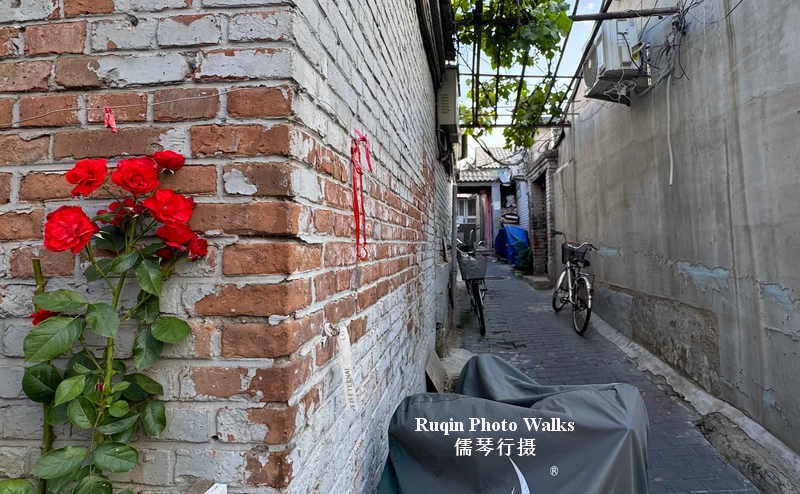

Written by Ruqin
June 11, 2026
Quick Walk Overview
Start: Ciqikou Station (Exit G), Subway Line 5 and &7
End: Eastern end of Dongbi Street (optional extension to Tejite Market)
Distance: Approx. 2.5 km
Walking Time: About 2 hours with photo stops
Best Time: Early morning (7:00–9:00 am)
Surface: Flat pavement and hutong lanes
Crowd Level: Very quiet early in the morning
This morning I took the first train on Subway Line 5 and got off at Ciqikou Station. The weather was ideal for walking, with temperatures between 20°C and 33°C and soft sunlight gradually reaching the rooftops of southern Beijing.
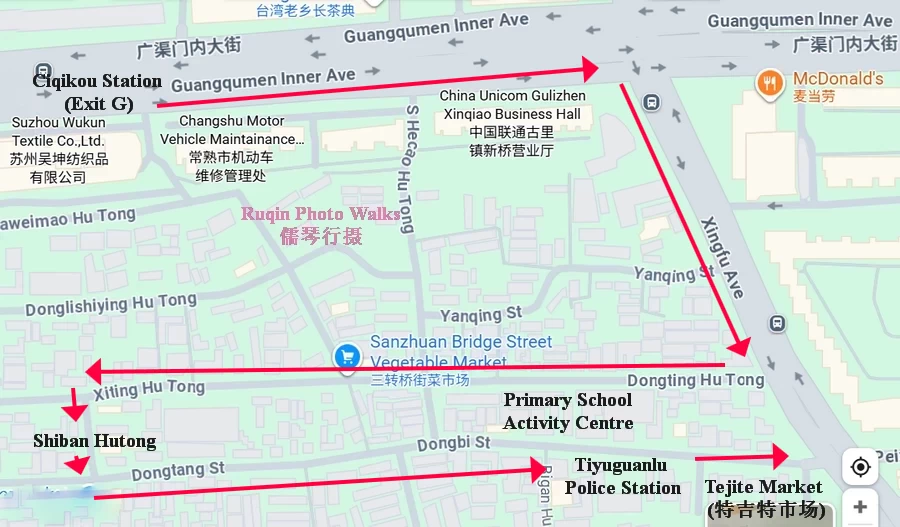
Sketch map of today’s walk through the hidden hutongs of southern Beijing
I was not heading toward a famous landmark. Instead, I wanted to spend a morning wandering through several old hutongs that have largely escaped both tourism and large-scale redevelopment. In a city that changes so quickly, places like Dongting Hutong (东厅胡同) and Dongbi Street (东壁街) feel increasingly rare.
Why I Walked This Route
Every year, I try to spend time in parts of Beijing that remain ordinary.
Not ordinary in a negative sense, but ordinary in the way real neighborhoods are. People live here, raise families here, park their bicycles here, and buy vegetables from nearby markets. There are no souvenir shops, no themed cafés, and no carefully designed “old Beijing experiences.”
When I walk through places like this, I feel closer to the city than I do at many of its famous attractions.
Step-by-Step Walking Route
Step 1: Ciqikou Station to Dongting Hutong
Distance: Approx. 800 meters
Walking Time: 20–30 minutes
After leaving Exit G of Ciqikou Station, I walked east along Guangqumen Inner Avenue (广渠门内大街).
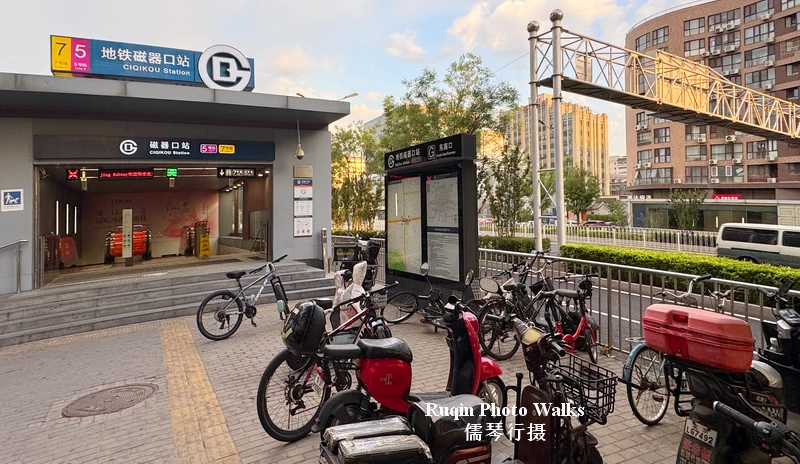
Exit G of Ciqikou Station Line 5 and 7
At that early hour, the storefronts were still closed or just beginning to open for the day. The wide avenue felt surprisingly calm, with only a handful of pedestrians on the sidewalk and occasional vehicles passing by.
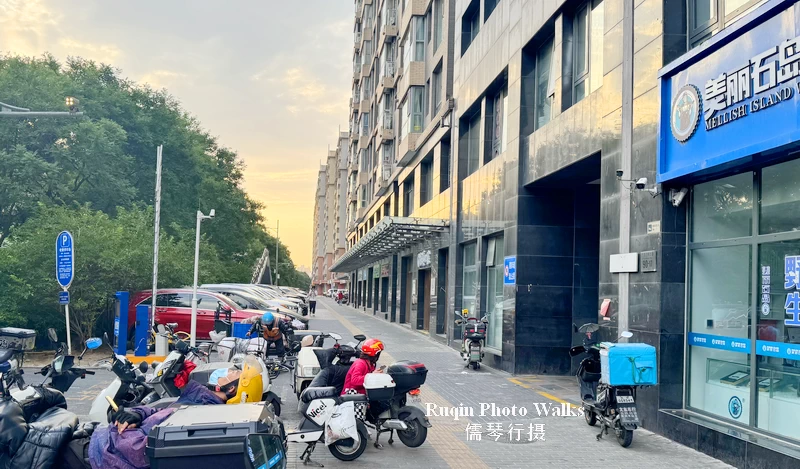
The sidewalk was quiet, with few pedestrians and most storefronts still closed.
Partway along the route, I climbed a pedestrian flyover and paused for a moment at the top. Looking east, I could see Guangqumen Inner Avenue stretching toward the morning light.
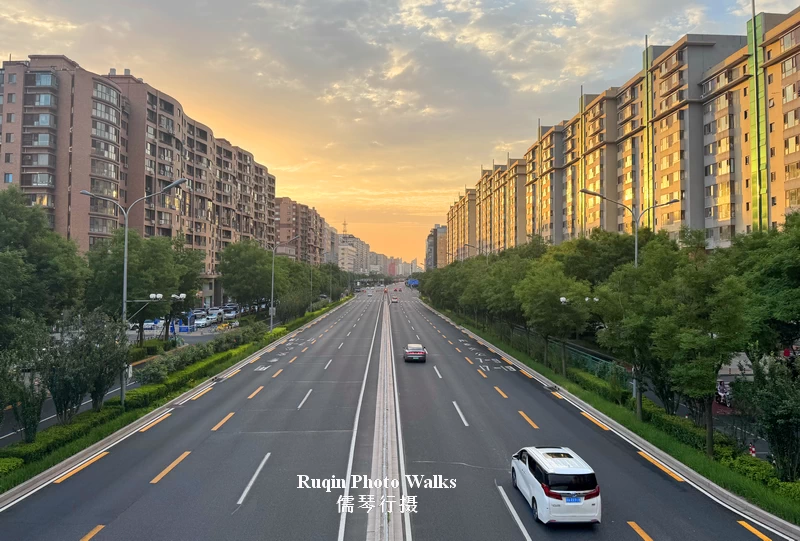
I could see Guangqumen Inner Avenue stretching toward the morning light.
Traffic was still thin, and the soft glow of sunrise reflected off the glass and concrete buildings lining both sides of the street. For a few minutes, the city seemed to be moving at a slower pace before the rush of the day began.
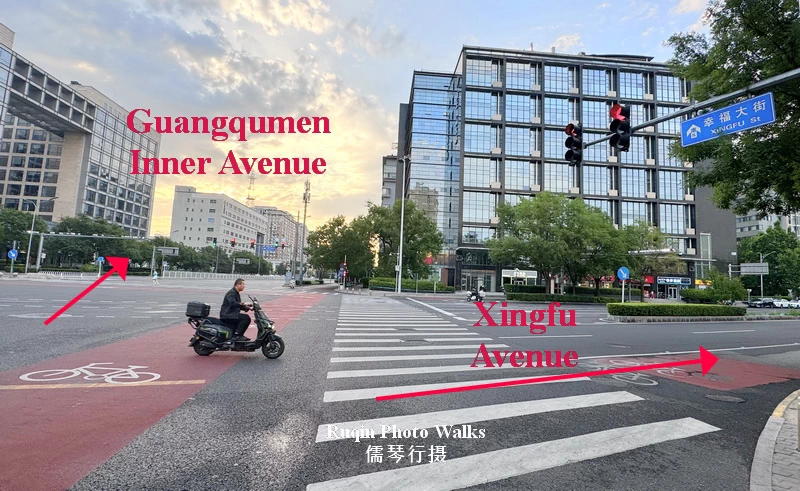
I reached the intersection of Guangqumen Inner Avenue and Xingfu Avenu
After about ten minutes of walking, I reached the intersection of Guangqumen Inner Avenue and Xingfu Avenue (幸福大街). The morning rush was beginning to gather momentum, but the city still felt only half awake. Traffic moved steadily through the intersection, though nothing like the congestion that would arrive later in the day.
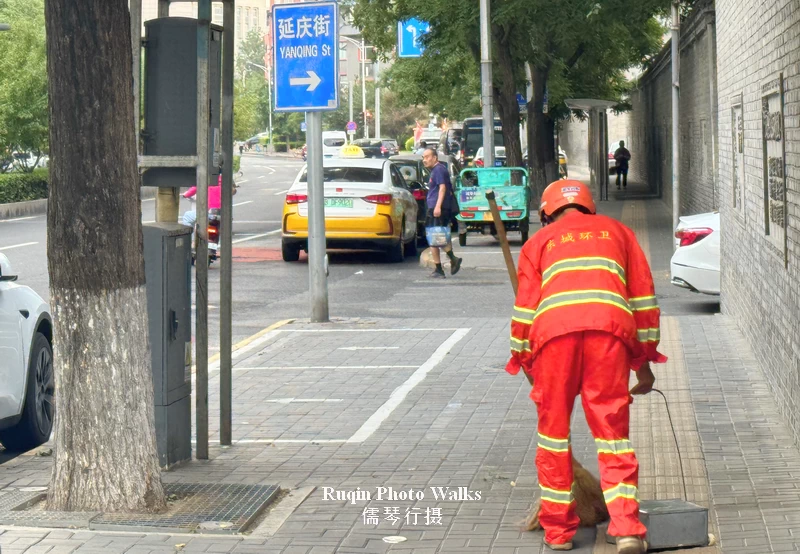
I noticed a municipal worker quietly sweeping the sidewalk
Turning south onto Xingfu Avenue, I noticed a municipal worker quietly sweeping the sidewalk. The rhythmic sound of the broom against the pavement was one of the few sounds on the street. Most storefronts remained closed, and only a handful of pedestrians passed by on their way to work.
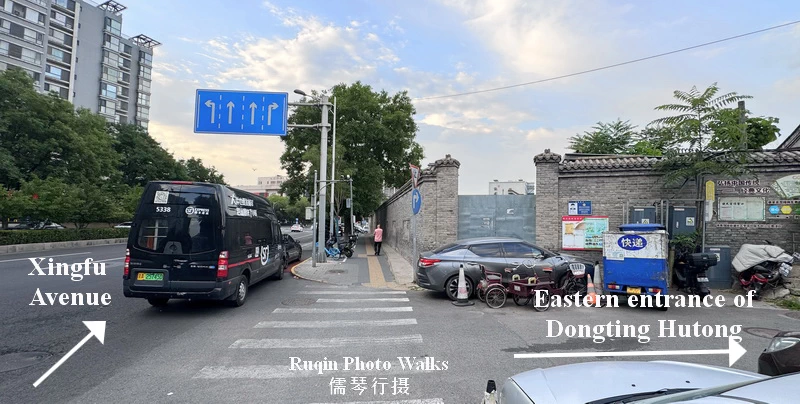
I arrived at the eastern entrance of Dongting Hutong
A few minutes later, I arrived at the eastern entrance of Dongting Hutong. The transition was immediate. Behind me was a broad modern avenue carrying buses, delivery vans, and morning commuters. Ahead of me stretched a narrow lane lined with low houses and overhead wires. It felt as though I had stepped across an invisible boundary into a different part of Beijing.
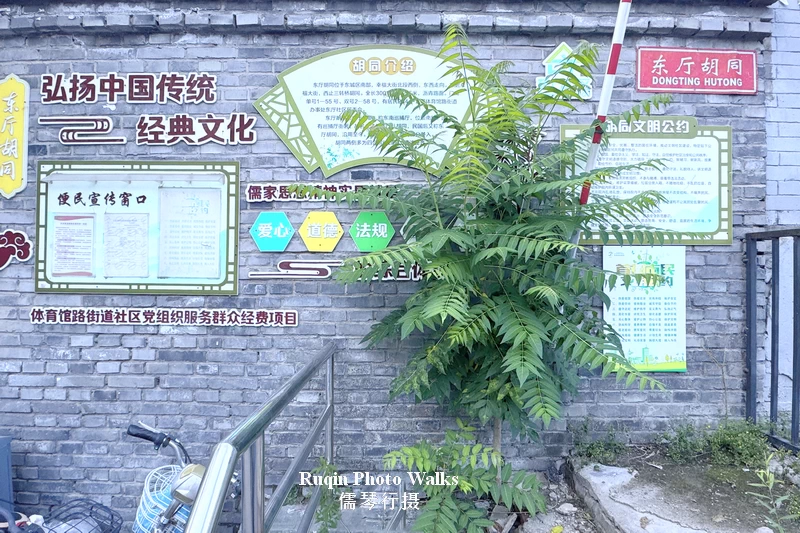
The Dongting Hutong Neighborhood Information Board
A neighborhood information board near the entrance explained that the hutong’s history stretches back to the Ming Dynasty. I glanced at it briefly, then continued into the lane.
Step 2: Walking Through Dongting Hutong and Xiting Hutong
Distance: Approx. 600 meters
Walking Time: 30–40 minutes
Dongting Hutong is narrow, no more than three or four meters wide in most places. The houses on either side are old, built from gray bricks and roof tiles darkened by decades of weather. The lane itself has been repaved, but the overall layout feels much older than the surrounding city.
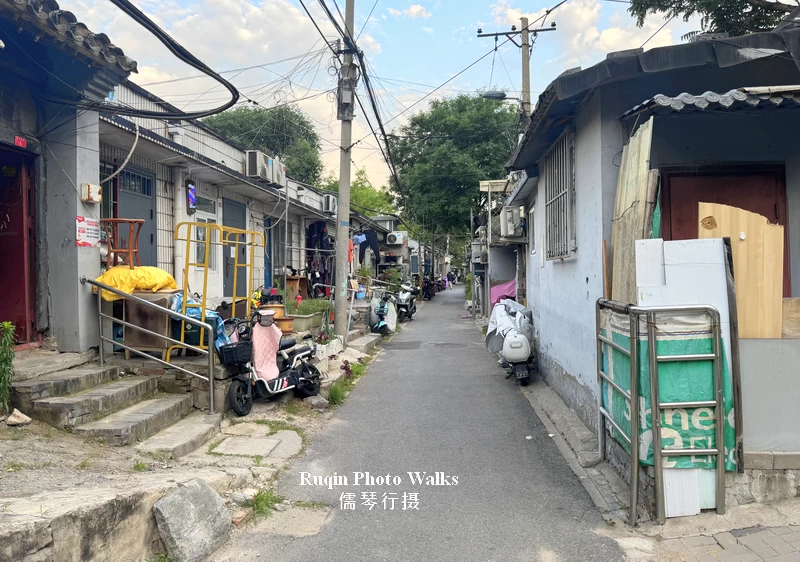
Dongting Hutong is narrow, no more than three or four meters wide.
At first glance, Dongting Hutong looks narrow and a little messy. Then I noticed the details. Along one side of the lane stood a row of neatly organized waste-sorting stations.
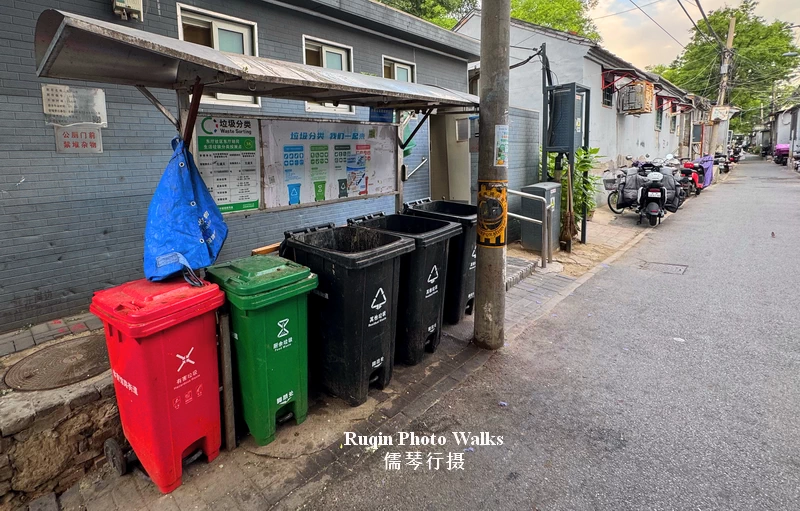
A row of neatly organized waste-sorting stations.
Further on, I saw several more serving different sections of the neighborhood. The houses may be old, but the hutong itself felt clean and surprisingly well maintained.
Further along, I noticed a Sam’s Club delivery scooter parked outside a courtyard gate. The rider was nowhere to be seen. Perhaps he lived here and was still at home before beginning a day of deliveries. Small details like this remind me that these hutongs are not frozen in time. They remain part of contemporary Beijing.
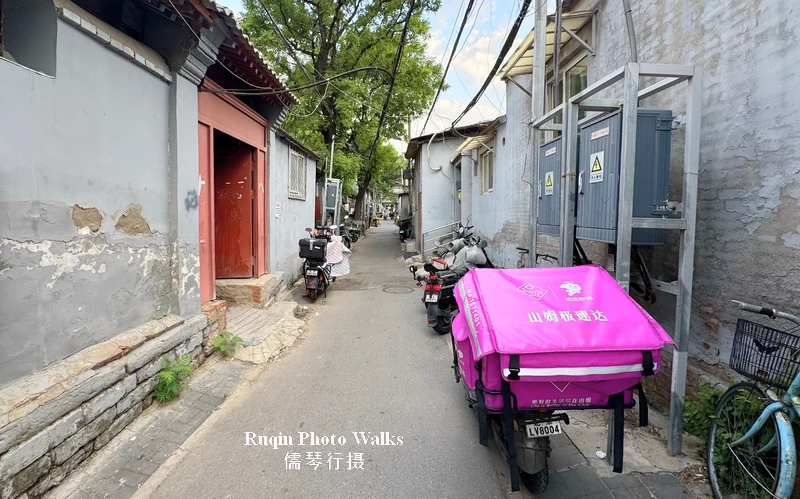
A Sam’s Club delivery scooter
As I walked through the hutong, I noticed several makeshift structures extending out from the courtyards and into the lane. They were one reason the passage felt so narrow in places. Many of these traditional courtyard compounds, or dazayuan, are now shared by several families, with each household occupying only a small living space, sometimes no more than 10 to 20 square meters.
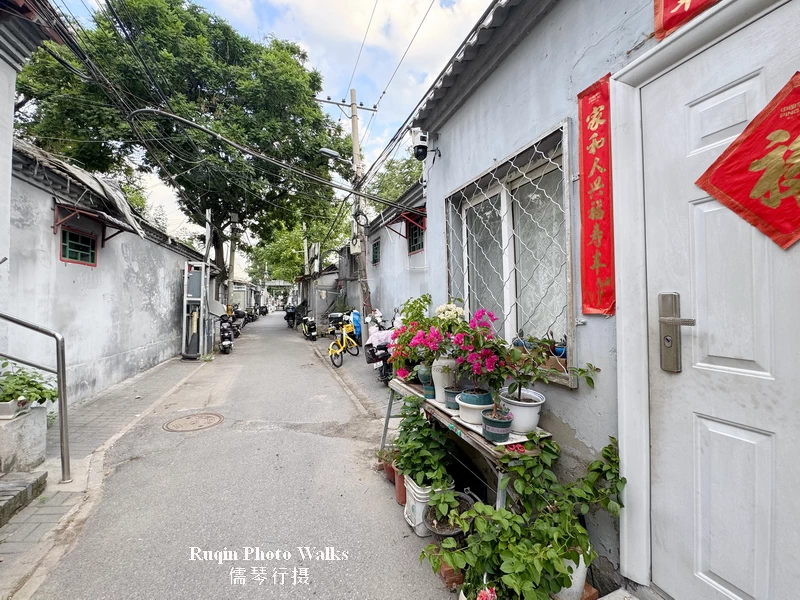
The makeshift structure and its Potted plants and bonsai
The house at No. 47, Dongting Hutong has the largest doorway in the lane. Two stone doorposts stand on either side, a subtle sign of status, and a carved lintel spans the top. Judging by these details, it was probably once the home of a wealthy family or a government official.
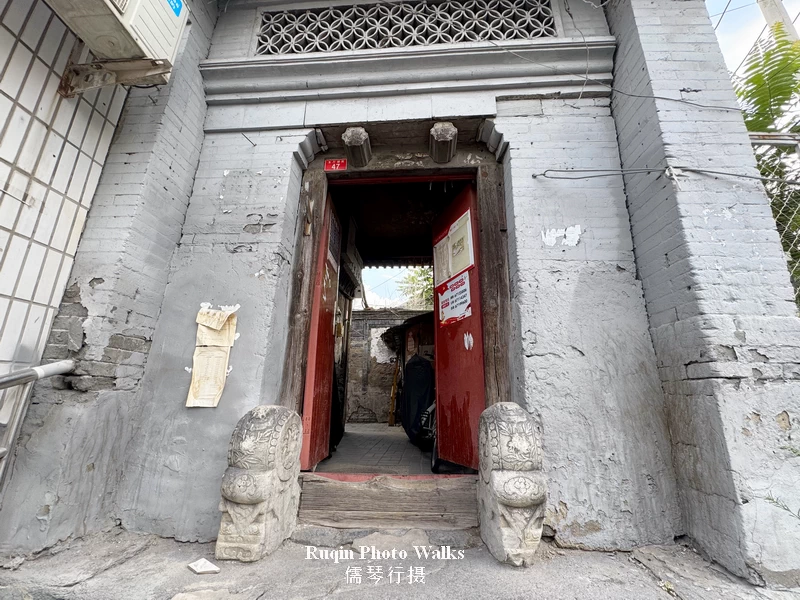
The house at No. 47, Dongting Hutong has the largest doorway in the lane.
In the narrow alley of Dongting Hutong, I came across a two-story building facing north-south, with traditional grey brick walls and a sturdy pitched roof. Built around 1910–1930, it reflects classic old Beijing residential architecture. The only building of its kind in the hutong, it rises above the surrounding single-story homes and is a rare survivor from an earlier era.
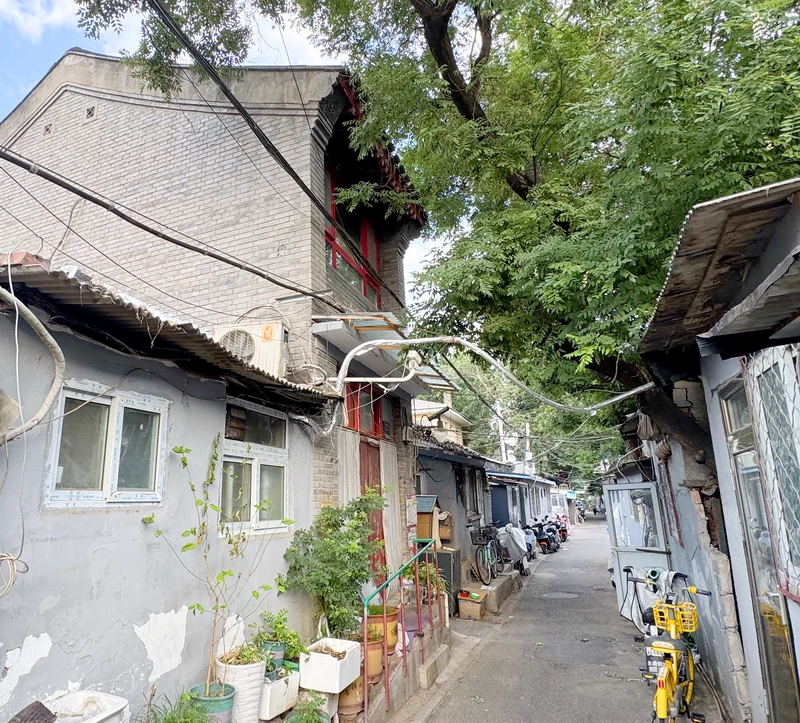
The two-story building facing north-south, with traditional grey brick walls
Soon Dongting Hutong became Xiting Hutong (西厅胡同). The name changed, but the atmosphere remained much the same.
The lane contained all the familiar elements of old residential neighborhoods: bicycles leaning against walls, laundry drying in the morning sun, flower pots outside doorways, and small storage sheds squeezed into any available space.
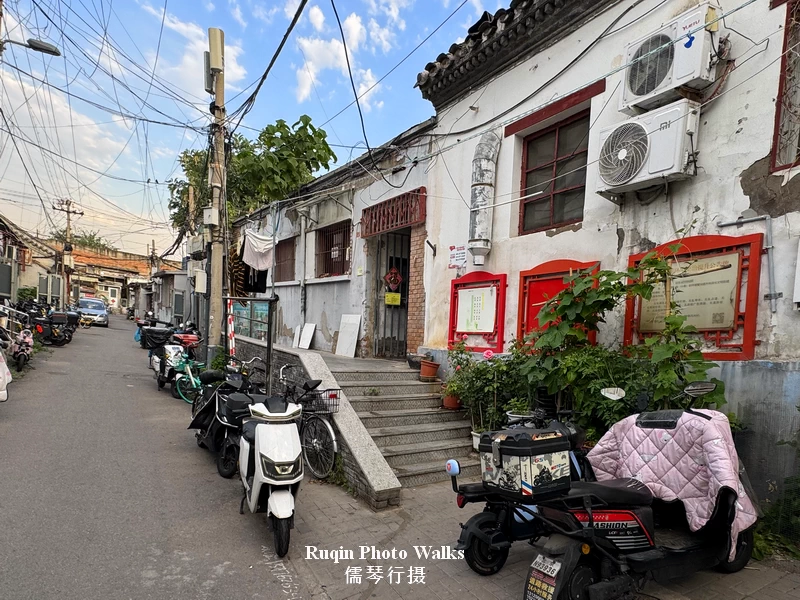
Xiting Hutong
At first glance everything appeared crowded, but the longer I looked, the more order I found.
Step 3: Walk from Shiban Hutong to the east end of Dongtang Street
Distance: Approx. 350 meters
Walking Time: 30–40 minutes
Before long, I reached Shiban Hutong ( 石板胡同 Stone Slab Hutong). The section between Xiting Hutong and Dongtang Street runs north to south and is only about 60 meters long. The hutong takes its name from the stone merchants who once stored stone slabs and millstones here, although little evidence of that history remains today.
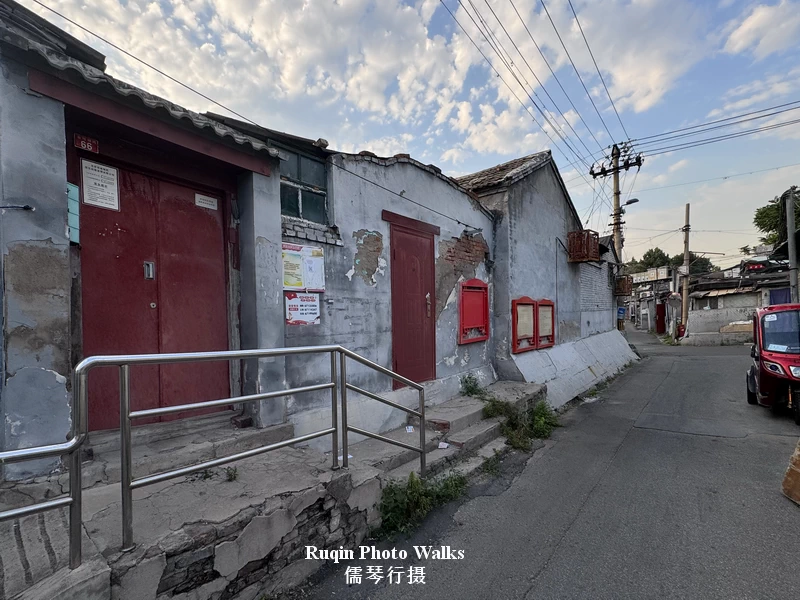
I followed the short lane south and soon emerged onto Dongtang Street.
I followed the short lane south and soon arrived at Dongtang Street (东唐街). Turning left, I continued east along this quiet residential street, which stretches for about 300 meters.
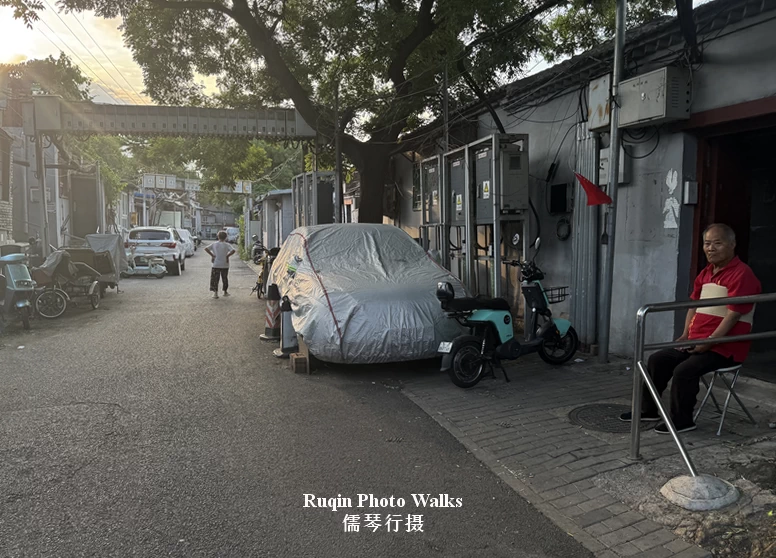
I soon arrived at Dongtang Street (东唐街)
This section of the walk felt especially quiet. Most of the houses were simple brick-and-wood structures dating from the middle decades of the twentieth century. There were no visitors, no guided tours, and no obvious points of interest. Yet I enjoyed this stretch more than many famous places in Beijing.
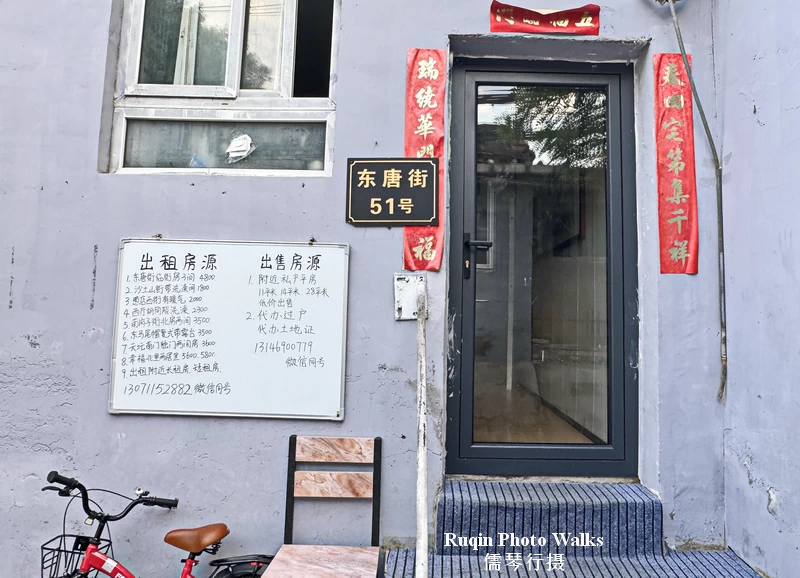
A small real estate office caught my eye
At No. 51 Dongtang Street, a small real estate office caught my eye. Its signboard listed rooms for rent and sale, a quiet reminder of how the neighborhood continues to function in modern Beijing.
Step 4: Walk from Dongtang Street to Dongbi Street
Distance: Approx. 300 meters
Walking Time: 20–30 minutes
As I walked east, I gradually entered Dongbi Street (东壁街). It shared much of the same quiet, lived-in character as Dongtang Street. The stretch from the far end of Dongtang to the far end of Dongbi is only about 300 meters, but it feels like a complete neighborhood on its own.
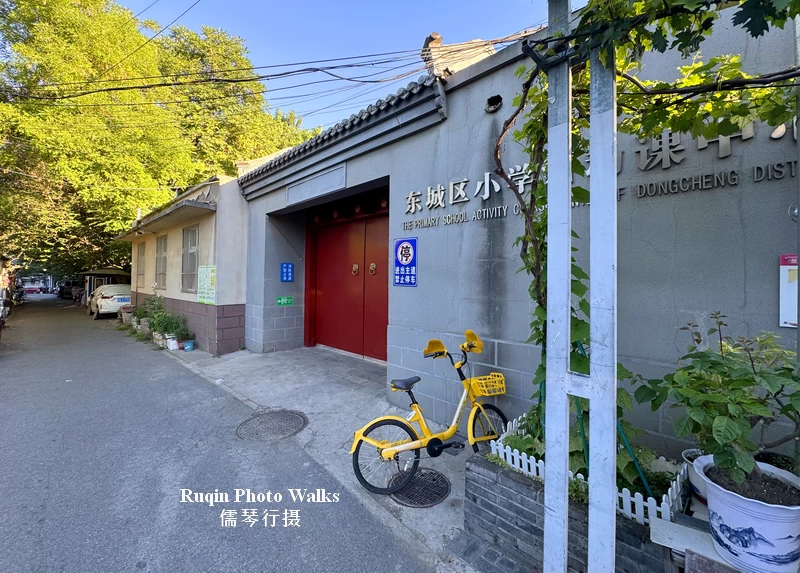
Primary School Activity Centre of Dongcheng District
Among the old courtyard houses of Dongbi Hutong, one building stands apart. This is the Primary School Activity Centre of Dongcheng District, its formal, slightly official style contrasting with the surrounding lanes.
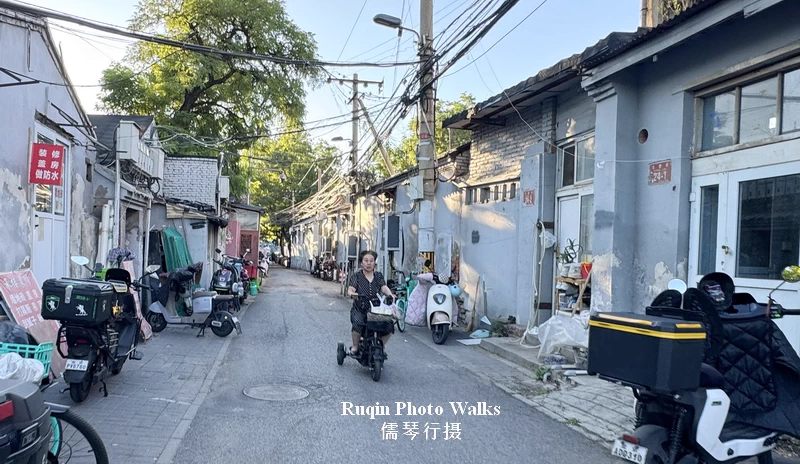
One of the things I noticed was the web of electrical wires overhead.
One of the things I noticed was the web of electrical wires overhead. They stretched from roof to roof and pole to pole, cutting across the morning sky. In newer parts of Beijing these cables have disappeared underground, but here they remain part of the everyday landscape. Some people might see only disorder. I found myself stopping to photograph them.
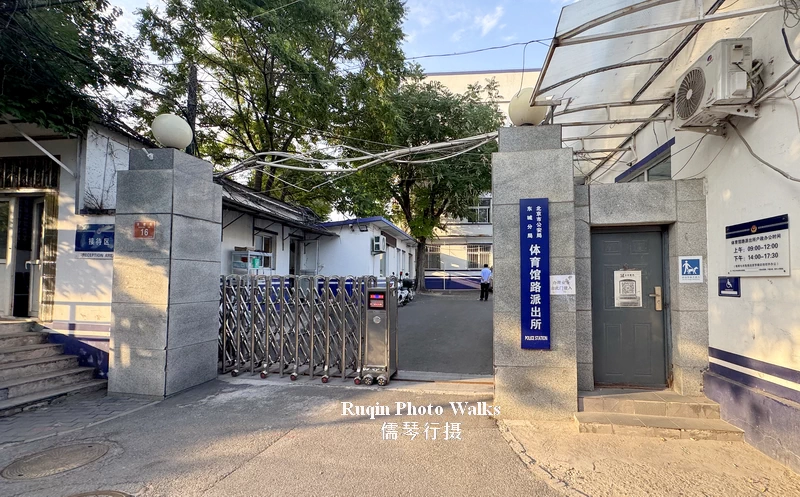
I came across the Tiyuguanlu Police Station.
Near the eastern end of Dongbi Street, I came across the Tiyuguanlu Police Station. The station serves the surrounding neighborhood, which falls under the administration of the Tiyuguanlu Subdistrict. Its presence was a reminder that, despite the age of the hutongs, this remains a fully functioning residential community.
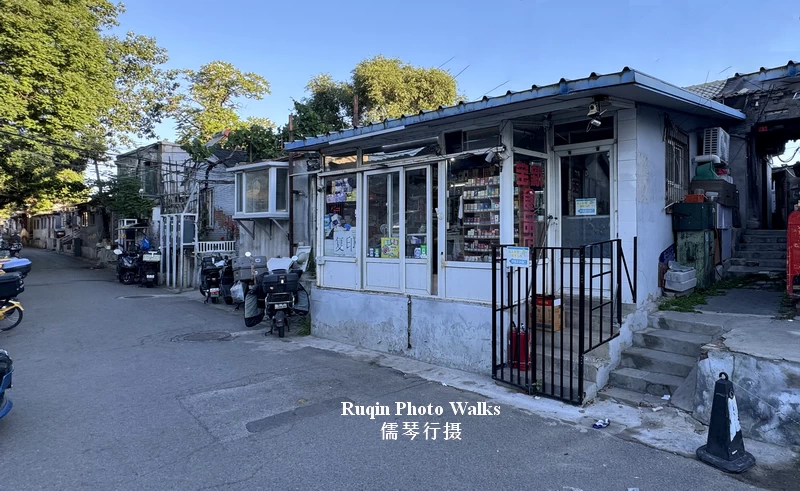
Asmall corner shop the eastern end of Dongbi Hutong
The street is short, but it contains many small traces of old Beijing. Some walls have lost their outer layer of plaster, exposing older bricks underneath. Stone door bases remain outside several courtyard entrances, their edges worn smooth by generations of use.
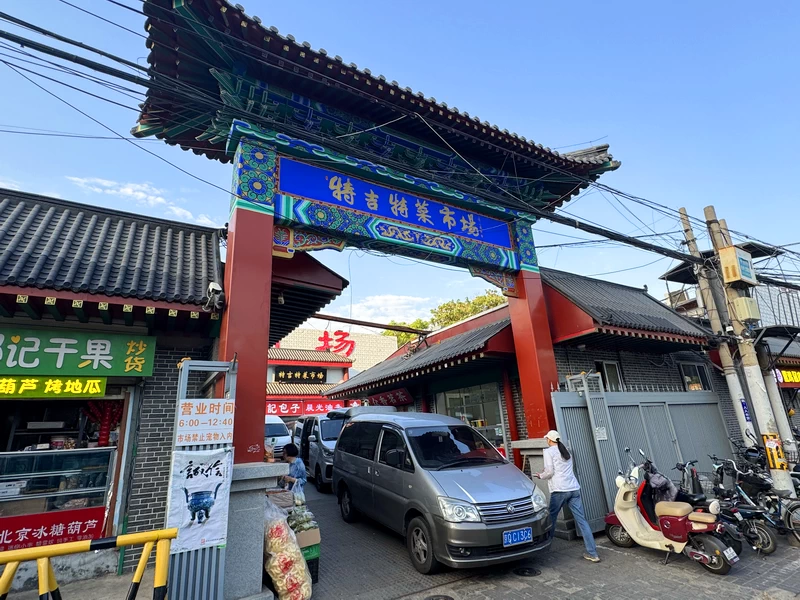
The exterior of Tejite Market (特吉特市场)
Passing the Tiyuguanlu Police Station, I was nearly at the eastern end of Dongbi Street. The quiet hutong atmosphere gradually gave way to a livelier scene. On the left, a small corner shop offered daily necessities, and across from it stood a large, bustling market—the Tejite Market (特吉特市场).
Inside the market, stalls were filled with fresh fruits, vegetables, and meat.
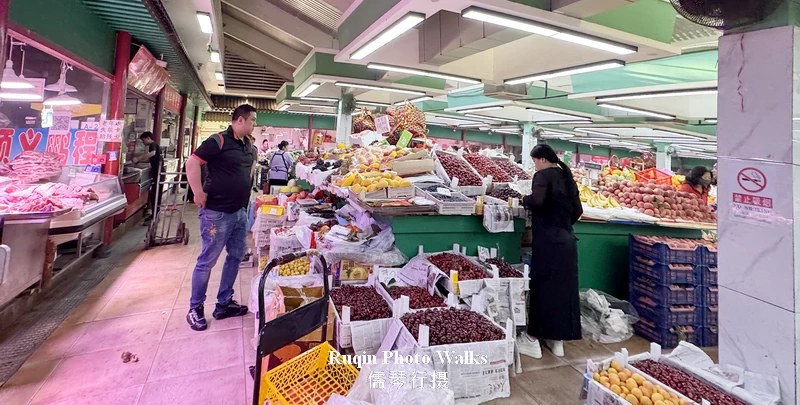
Inside the market, stalls were filled with fresh fruits, vegetables, and meat.
Outside, in the small courtyard, vendors sold breakfast: steamed buns, savory pancakes, fried dough sticks, and various kinds of porridge, from millet to bean-based varieties.
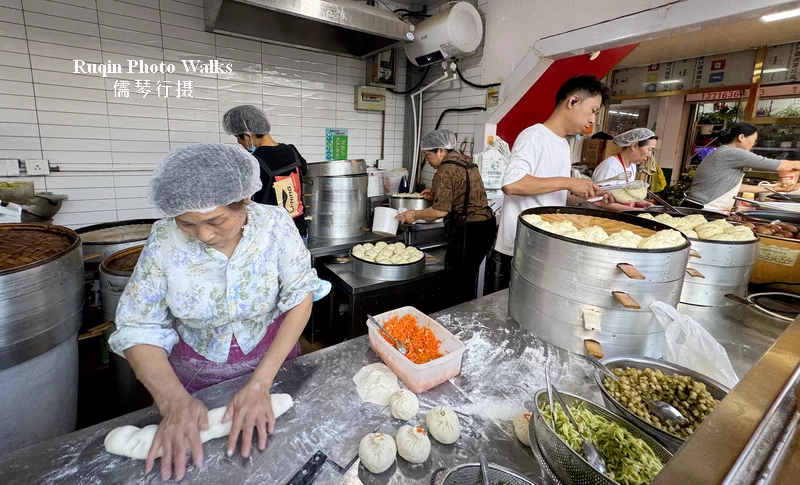
Vendors sold breakfast: steamed buns and more
The smells, colors, and sounds brought the street to life in a way that contrasted sharply with the quiet hutongs I had just walked through.
Standing there, I thought about the contrast between the market and the lanes I had just walked through. The hutongs provide the structure of the neighborhood, but places like this market provide its energy.
What the Area Feels Like Right Now
This part of southern Beijing feels increasingly uncommon.
Not because it is particularly old or picturesque, but because it remains largely untouched by tourism. The neighborhood still belongs primarily to the people who live there.
Walking through these streets, I never felt like I was visiting an attraction. I felt like I was passing through a living community that continues to follow its own rhythm.
Practical Tips
- Visit early in the morning for the quietest atmosphere.
- These are residential neighborhoods, so walk respectfully.
- Photography is fine, but avoid photographing residents without permission.
- Allow extra time for wandering side lanes.
- Tejite Market is worth visiting at the end of the walk.
Who This Walk Is Best For
This walk is ideal for:
- Street photographers
- Urban explorers
- Visitors interested in everyday Beijing life
- Travelers seeking non-touristy neighborhoods
- Anyone curious about the quieter side of the city
Why I Keep Coming Back
The places I remember most are not always the famous ones.
A delivery scooter outside an old courtyard. Overhead wires crossing a narrow lane. A watermelon vendor calling out to customers in a morning market. These small details may seem insignificant on their own, yet together they tell the story of a neighborhood far better than any monument could.
That is why I keep returning to walks like this. They remind me that the most interesting parts of a city are often hidden in its ordinary streets.
Last Walked On: June 11, 2026
Further Reading
Beijing City Walks: Routes, Maps & Essential Travel Tips
Beijing Hutong Walks: Routes, Maps & Local Tips
Beijing Second Ring Road Moat Greenway Walk | Beijing Photo Walk by Ruqin
Beijing Ming City Wall Relics Park Morning Walk | Beijing Photo Walks by Ruqin
Early March Morning Around Shichahai — Beijing Photo Walks by Ruqin
Where to Run in Beijing: Best Routes, Parks & Running Tips