Written and updated by Ruqin
Last updated: May 20, 2026
Daocheng Yading is one of those rare places you just have to see once in your life. Tucked away in Daocheng County, Sichuan, this 5A-rated wonder—along with Jiuzhaigou and Siguniang Mountain—ranks as one of western Sichuan’s top three scenic gems.
Known as a “pure land on the blue planet,” Yading Nature Reserve is home to three sacred snow-capped peaks and dozens of alpine lakes. During autumn (September to October), golden meadows glow under a deep blue sky—honestly, it feels like stepping into a dream.
Follow our wheels and footsteps into the wild beauty of Daocheng Yading.
1. Scenic Drive: Daocheng – Shangri-la Town – Yading
After enjoying a warm breakfast in downtown Daocheng on an early October morning, we finally began our long-awaited drive to Yading Nature Reserve.
We had slowly made our way out of town, following the GPS closely. With roadside cameras everywhere, we kept our speed in check.

Then we joined Highway S216—a scenic 74-kilometer stretch to Shangri-la Town (formerly Riwa 日瓦乡). The views had already started to amaze us. After that, just 34 more kilometers led us straight to stunning Yading Nature Reserve.
1) Golden Trees and Quiet Roadsides: Autumn Poplars Along the Way
That morning, clouds hung low, but no one minded. As long as it didn’t rain or snow, we were happy.
The S216 highway had surprised us—it was smooth, wide, and well-marked. Iron railings lined the edges, and the road curved gently through a peaceful valley.
Golden meadows, scattered Tibetan homes, and soft hills rolled past our windows. It felt like driving through a painting.

Then, about thirty minutes into the drive from Daocheng to Yading, we suddenly sat up in excitement. On both sides of the road, rows of Euphrates Poplars (胡杨林)—also known as Diversifolius Poplars—flashed golden in the autumn light.
These trees change with the seasons: green in spring, yellow in fall, and even red in winter. But autumn might be their most magical moment.
We couldn’t resist. We pulled over, grabbed our cameras, and wandered down to the riverbank.
The golden trees reflected in the water. Behind them, snow-capped peaks towered in silence.
For a few quiet minutes, we simply stood there—just us, the trees, and the open valley.
2) A Surprise Stop: Rewu Monastery
We got back in the car and continued our scenic drive from Daocheng to Yading along Highway S216. The landscapes rolled by so quickly that I felt I didn’t have enough eyes to take it all in.

About 16 kilometers south of downtown Daocheng, we spotted a cluster of white-walled, red-roofed Tibetan houses on a hillside. They looked peaceful, almost dreamlike.
Just as we wondered what the place was, a roadside sign gave us the answer—Rewu Monastery (热乌寺), plus a note: a viewing platform was 1,000 meters ahead.

We pulled over and parked at the platform. From there, the view was stunning. “Rewu,” I later learned, means “where the jar broke is where the temple should be built” in Tibetan.
The monastery had stood here for over 600 years, first built at the end of the Southern Song Dynasty.
Interestingly, Rewu is divided into two parts. The Upper Temple follows the Gelugpa school, while the Lower Temple belongs to the Sakya tradition. Both schools have peacefully coexisted here—something rarely seen in Tibetan Buddhism.
3) Legends in the Wind: Bowa Mountain and Lover’s Lake
We returned to our SUV and continued the drive south. The air felt thinner now—we were clearly gaining altitude.
About 23 kilometers from downtown Daocheng, we reached the highest point of our entire Daocheng to Yading drive: Bowa Mountain Pass, standing tall at 4,513 meters. It was the famous place known as Bowa Mountain and Lover’s Lake (波瓦山和情人湖).

By now, we had crossed several 4,000-meter passes in western Sichuan, so the elevation didn’t feel extreme. Butwe heard of the local guide, shared something that caught my attention.
“‘Bowa’ means ‘hero’ in Tibetan,” she said.
In the past, locals from nearby Sela Village used this mountain to defend their homeland. Rugged terrain and brave hearts had stopped invaders more than once.
She also told us a haunting local legend—about Lover’s Lake, just below the pass. It was said to be formed by the tears of a young man named Sangjizhima, who accidentally killed his bride with an arrow, thinking she had abandoned him. Overcome with grief, he ended his life too.
He became the mountain. She became the pasture. The lake? His tears.

We crossed the road and saw it—still, blue, and breathtaking. It truly looked like a shimmering eye staring back at the sky.
I walked down through snow-covered marsh. My feet sank into the soggy earth—were those his tears under my boots?
The reflection in the water was flawless. Mountain, sky, silence.
We stood quietly, moved by the beauty and the story. Then, reluctantly, we turned back toward the road to continue our drive to Daocheng Yading.
4) Zhongdui New Village: Harmony in the Highlands
Leaving Lover’s Lake behind, we began descending toward Yading. The road curved gently as the mountains opened up.
About 66 kilometers south of Daocheng, we spotted something unexpected—neatly lined Tibetan houses and golden barley fields, nestled in what felt like the middle of nowhere.
Curious, we pulled over. The air was still, almost sacred. We grabbed our cameras and wandered closer.

Later, we learned this was Zhongdui New Village (仲堆新村), a relocated community built to preserve the Tibetan way of life in harmony with nature.

As we explored, we saw a small group of villagers walking clockwise in quiet reverence around a sacred house below the road—a local kora, or pilgrimage ritual.
Tibetan culture holds deep respect for nature, animals, and spiritual balance. And here, that belief was alive and well.
There was no rush. No noise. Just a simple village living with the land and sky.
We left feeling calm, as if we had walked through someone’s prayer.
5) A Pause in Shangri-la Town: Lunch, Tickets, and a Tough Decision
Just six kilometers south of Zhongdui Village, the road led us into Shangri-la Town—not the one in Yunnan, but the gateway to Daocheng Yading. Also Daocheng Yading Tourist Service Center is located in Shangri-la Town.
We decided to stop for lunch and take a short break before heading deeper into the mountains.

Shangri-la Town, formerly known as Riwa (日瓦乡), is the last town before Yading Nature Reserve. From here, no private vehicles are allowed into the park. Instead, all visitors must buy a combo ticket ( entrance ticket 145 + shuttle bus 120 + eco-cart 70 = 335RMB) at the Tourist Service Center on the town’s southern edge. It covers both entrance and the mandatory eco-shuttle to the scenic area.
Tourism has clearly reshaped the town. New hotels, guesthouses, cafés, and tour shops lined the streets. We picked a simple Sichuan-style restaurant called Ya’an Restaurant—spicy stir-fried potatoes never tasted so good.
Over lunch, we debated where to stay that night. We had three options: hotels in Shangri-la Town, guesthouses in Yading Village, or a rustic temple-turned-inn at Longtong Ba (龙同坝).
One of my travel fellows recommended Longtong Ba. It was closer to the park gate, which meant we could catch the first eco-golf cart up to Luorong Ranch the next morning. From there, we had planned to rent horses for the ride up to Milk Lake and Five-Color Lake.
However, things didn’t go as planned. Later, we discovered only 30 horses were available—and all had been pre-booked by agencies. Worse yet, the inn at Longtong Ba was cold, cramped, and barely functional.
That night, we realized we’d made the wrong call.
6) Into the Sacred Mountains: Entering Yading Scenic Area
Aden Scenic Area, also known as the Yading Scenic Area, lies inside Yading Village—34 kilometers south of Shangri-la Town.
To get there, we first parked our car at the large lot near the Tourist Service Center at Shangri-la Town, right at the southern edge of town. After buying our combo tickets, we boarded the eco-shuttle bus with just our essentials.
We had chosen to stay overnight at Longtong Ba, one of the final stops before Yading Village. It was remote, basic, and quiet.

The shuttle bus climbed steadily for an hour, winding through sharp bends and gaining altitude—from 2,900 meters in Shangri-la Town to 3,300 meters in Yading Village.
The ride, though fast, was surprisingly smooth. Along the way, the views were stunning: forests, peaks, and deep valleys unfolded outside our windows.
By the time we arrived at Longtong Ba, the rain had started. We crossed a small stream and followed a narrow path to our temple-turned inn.
That afternoon, wrapped in blankets, we listened to the rain and hoped tomorrow’s skies would clear.
2. Into the Sacred Heart of Yading
After a quick breakfast, we shouldered our backpacks and began the 20-minute walk to the shuttle stop at Longtong Ba.

Soon, we squeezed onto the last shuttle to Zhaguanbeng Station (扎灌崩车站)—the last bus stop to Yading Nature Reserve.
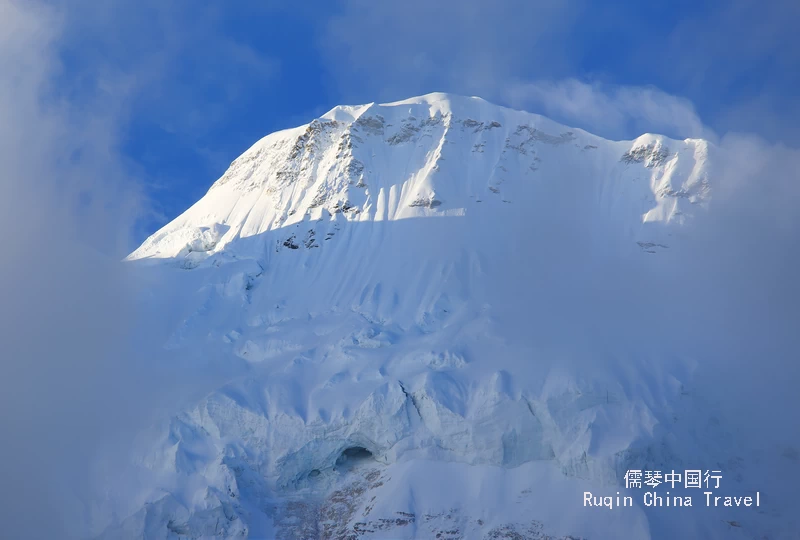
From there, we climbed another 500 meters on foot to Chonggu Temple entrance.
The morning sun lit up Mt. Chenrezig (仙乃日6032m) in gold. It felt like the mountain was calling.
We stood still, surrounded by silence, awe, and snow-capped serenity.
1) Riding into the Meadows: Journey to Luorong Grassland
From Zhaguanbeng Station, we had to walked 500m to the real entrance – Chonggu Temple entrance (冲古寺大门). At the entrance, we faced two choices: hike the 6.7 kilometers to Luorong Grassland (洛绒牛场 ) or hop on an eco-cart.
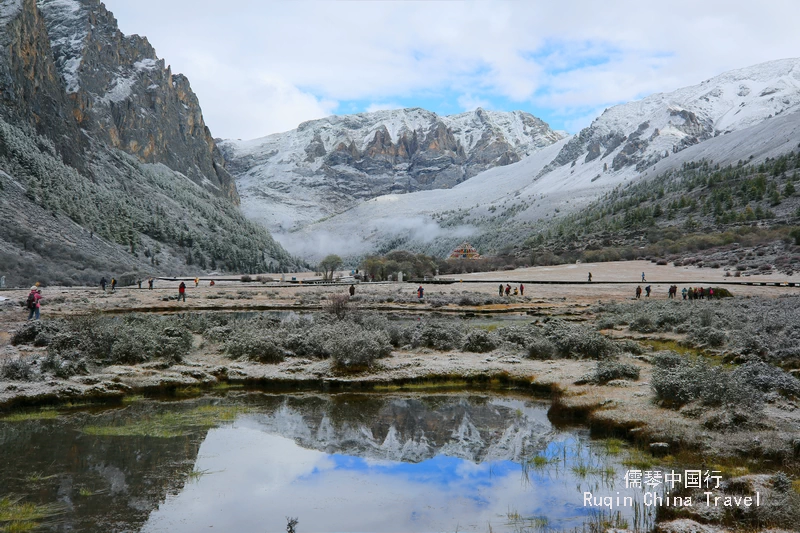
We chose the cart. It zipped along the winding mountain road, giving us time to breathe in the views. It took 20min for the cart. Single 40 yuan, return 70 yuan.
Next to us, the Gongga River shimmered silver as it rushed through the valley. Alpine meadows stretched endlessly, dotted with grazing yaks. Snowy ridges glistened in the distance. The scenery felt unreal—like a hidden corner of paradise.
After about 20 minutes, we arrived at Luorong Grassland (4,180m). The wide open meadow spread out beneath the sacred peaks.
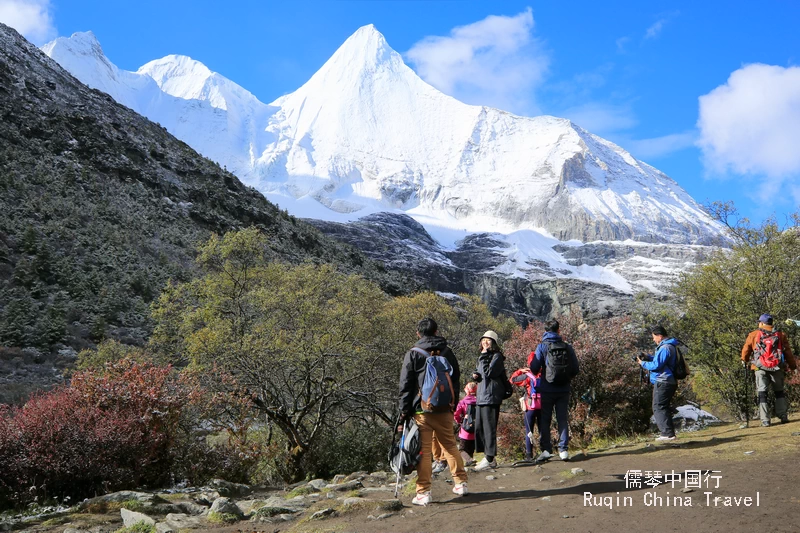
Here, most visitors pause, rest, and soak in the silence. But we were restless. We wanted more.
So we decided to continue, setting our sights on Milk Lake (牛奶海) at 4,600m. The trek would take five to six hours. Above us, Mt. Jambeyang (央迈勇5958m) towered, sharp and majestic.
It felt as though Daocheng Yading was revealing its true heart, step by step.
2) The Climb to Milk Lake ( 5km and 3-4 hours)
The trail to Milk Lake in Yading had tested every bit of my endurance. It was steep, rocky, and uneven. The higher we climbed, the thinner the air became. Every breath felt heavier than the last.
Still, I had kept going. The sight of Mt. Jambeyang ( 央迈勇), its icy peak slicing into the clouds, gave me strength. The mountain looked both fierce and divine—like a silent guardian of Daocheng Yading.
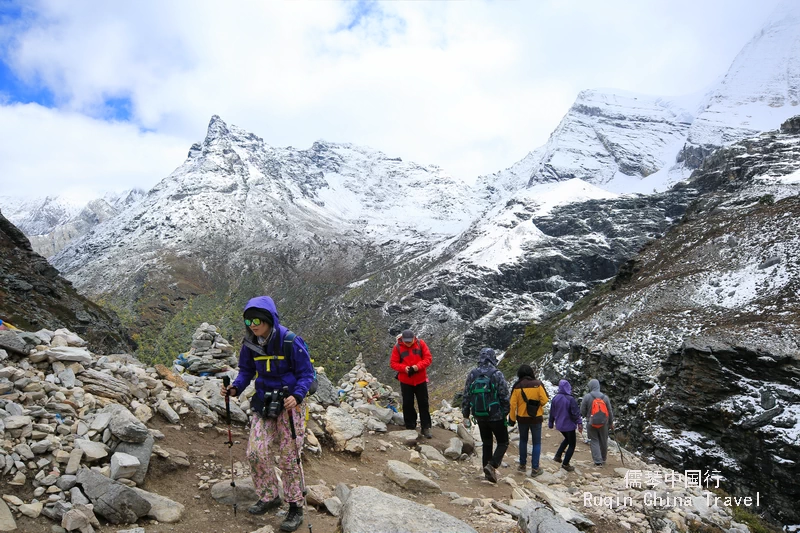
At first, the path wound through golden meadows, where prayer flags fluttered in the wind. Then, as we ascended, the landscape had shifted. The grass gave way to loose stones and patches of snow.
Next, we met a small group riding mules, their bells echoing softly in the thin air. I envied their pace but also felt proud of every step I’d taken.
The climb grew harder, yet the beauty around us deepened. Each turn revealed another breathtaking view—snow peaks, turquoise streams, and endless sky.
It felt as if we had entered another world, untouched and eternal.
When Milk Lake finally appeared ahead, shimmering like glass beneath the peaks, I knew the struggle had been worth it.
3) Reaching Milk Lake: A Dream at the Roof of Yading
At last, after hours of climbing, we reached Milk Lake (牛奶海 4600m)—the hidden jewel of Yading.
The sight stopped me in my tracks. The deep blue water shimmered quietly beneath a crown of snow and rock. The air was thin, crisp, and still. For a moment, everything felt sacred.
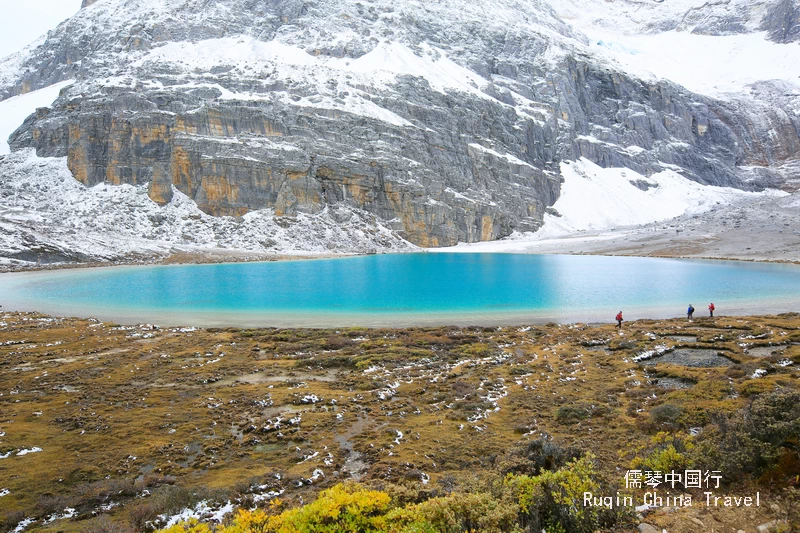
It’s said that in summer, the lake reflects seven colors under the sun, earning the name Seven-Colored Lake. But today, wrapped in clouds and silence, its calm blue surface felt perfect—pure and timeless.
We found a flat rock by the water and sat down to rest. Out came our snacks—biscuits, chocolate, and a bit of dried beef. Every bite felt earned.
Meanwhile, the wind picked up, whispering across the lake. Clouds drifted low over Mt. Jambeyang ( 央迈勇), hiding and revealing its icy peak.
Next, we debated whether to push on to Five-Color Lake, just an hour farther up. However, the weather here changes fast.
So, after one last, lingering look at Milk Lake, we decided to turn back toward Luorong Grassland before dusk.
4) Farewell Beneath the Sacred Peaks
The descent from Milk Lake felt far easier than the climb. My legs were tired but light, and the air seemed a little thicker. Within two hours, we were back at Luorong Grassland, surrounded by color and sunlight.
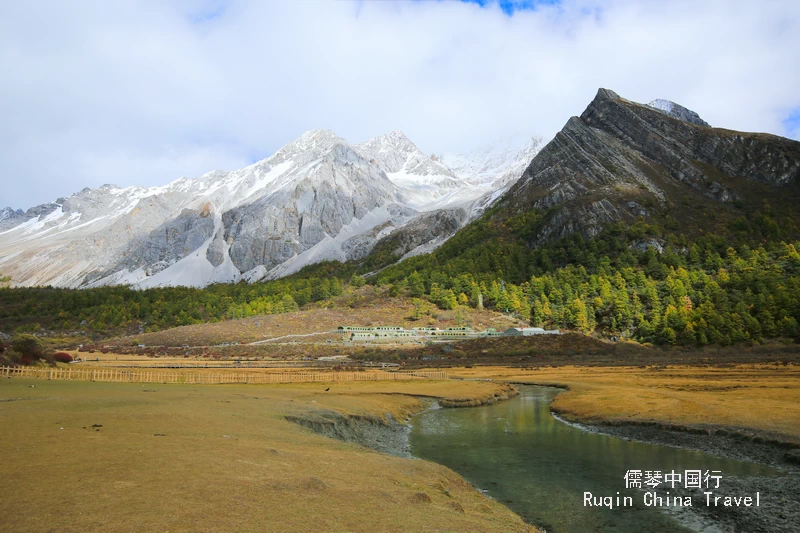
Earlier that morning, frost had veiled everything in white. Now, under the afternoon sun, the meadows glowed gold and green. Streams sparkled. Prayer flags danced in the breeze. For the first time, we could truly take in the valley’s quiet beauty.
Next, instead of heading straight back, we decided to walk the short 1.5-kilometer trail to Pearl Lake (珍珠海). Though our feet ached, we couldn’t resist. The trail wound gently through forests and meadows until the lake appeared—a perfect mirror reflecting Mt. Chenrezig ( 仙乃日), now softened by mist. The sight was ethereal, almost dreamlike.
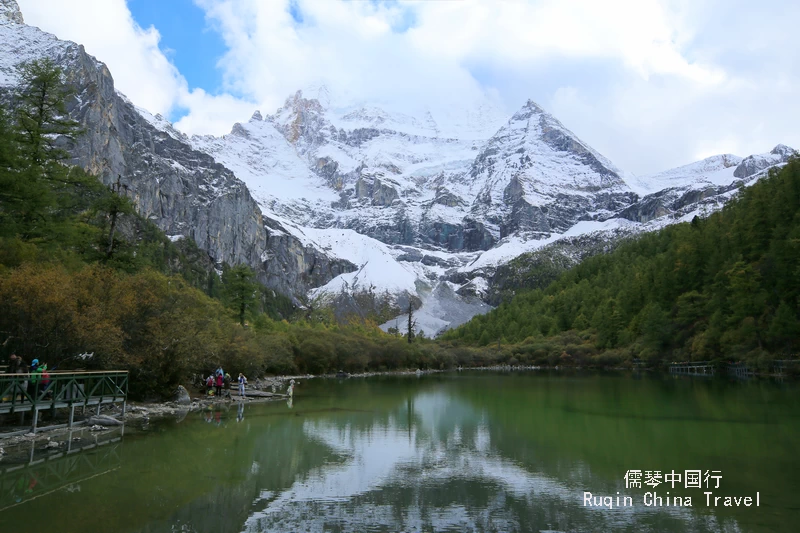
As we sat by the water, the world fell silent. Only the wind moved, carrying the scent of pine and snow.
Later, we boarded the last shuttle back toward Shangri-la Town. The setting sun brushed the peaks of Mt. Chenrezig and Mt. Chana Dorje (夏洛多吉5958m) with gold. Shadows stretched across the valley, wrapping Daocheng Yading in calm.
That moment felt like a quiet goodbye.
The day had ended, but Yading’s serenity lingered in my heart. For travelers seeking peace amid untouched grandeur, Daocheng Yading is not just a destination—it’s a sacred reminder of how still and beautiful the world can be.
3. My Essential Daocheng Yading Travel Tips
After days in Yading, I’ve learned one truth — beauty here comes with altitude, and preparation is everything.
First, pack smart. You’ll need an oxygen canister, sunscreen, trekking poles, and a thermos (you can refill hot water at rest stations).
Next, dress wisely. Bring a windproof, waterproof jacket, a fleece layer, a sun hat, and sunglasses. Comfortable hiking shoes are a must — the trails can be rocky and slick.
For altitude sickness, prevention matters. Start taking Rhodiola early, move slowly, and keep oxygen handy. You can buy cans inside the park for about 50 RMB. A bit of glucose and ibuprofen also helps.
Food is another challenge. There are no restaurants inside Daocheng Yading, so pack self-heating meals, chocolate, or energy snacks. And if it rains, those anti-slip shoes will save you from trouble.
When it comes to photography, don’t miss Luorong Grassland, Milk Lake, and Chonggu Meadow — each offers postcard-worthy views.
Time management is key. For the long route, reach Luorong Grassland before 10 a.m., or you won’t make it to the summit. Shorter routes are perfect for relaxed afternoon visits.
Finally, respect your limits. The “King Kong Route” is beautiful but tough — take your time. Horse rentals are limited and stop before the steepest climb.
Daocheng Yading rewards those who prepare — with clear skies, sacred peaks, and moments you’ll never forget.
As our journey through Daocheng Yading came to an end, I felt both exhausted and deeply at peace. The thin air, the endless sky, the sacred peaks — everything here had a quiet power that words can barely touch.
Each turn of the trail had revealed something new: golden meadows, crystal lakes, and that feeling of standing at the edge of the world.
Traveling in Yading reminded me why we explore — not just to see, but to feel. To be humbled by nature’s vastness, and to rediscover something still and pure within ourselves.
When we finally left, the mountains faded in the rearview mirror, yet their calm stayed with me.
So if you ever find yourself longing for silence, for something true and untouched — come to Daocheng Yading. It may take your breath away, but it will give you something far greater in return.
About the Author
Ruqin is the founder of Ruqintravel.com and has spent more than four decades working in China’s travel industry. Drawing on hands-on experience in cities like Beijing and Hangzhou, he personally researches and updates each guide to help international travelers navigate China with confidence.
Further Reading
Ya’an, Sichuan: Maps, Best Things to Do and Travel Tips
Moxi Town, Sichuan: Maps, Best Things to Do and Travel Tips
Hailuogou Glacier Park: Map, Best Things to Do and Travel Tips
Kangding: Map, Routes, City Walks, and Travel Tips
Xinduqiao: Map, Scenic & Driving Routes, Must-See Spots and Tips
Danba, Sichuan: Map, Scenic Routes, Highlights and Tips
Litang: Map, Scenic Routes, Top Attractions & Travel Tips
Yading: A Journey to Inner Peace
Deqin: Map, Scenic Routes, Highlights and Travel Tips
Shangri-La, Yunnan: Map, Scenic Routes, Highlights and Tips
How to Visit Mount Emei: Tickets, Transport, Routes, Hotels & Tips
How to Visit Leshan Giant Buddha from Chengdu
How to Visit Mount Qingcheng: Transportation, Highlights & Tips