
Written and updated by Ruqin
Last updated: October 20, 2026
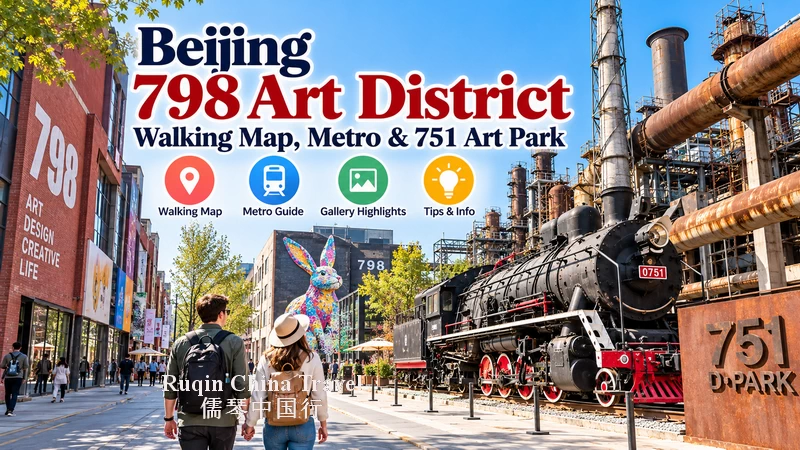
Beijing 798 Art District (798艺术区) is one of the city’s most interesting places to explore contemporary art, converted factories, and creative shops.
However, many first-time visitors concentrate on 798 and overlook the neighboring 751 D·PARK (751时尚设计广场).
The two areas are close enough to explore on the same walk.
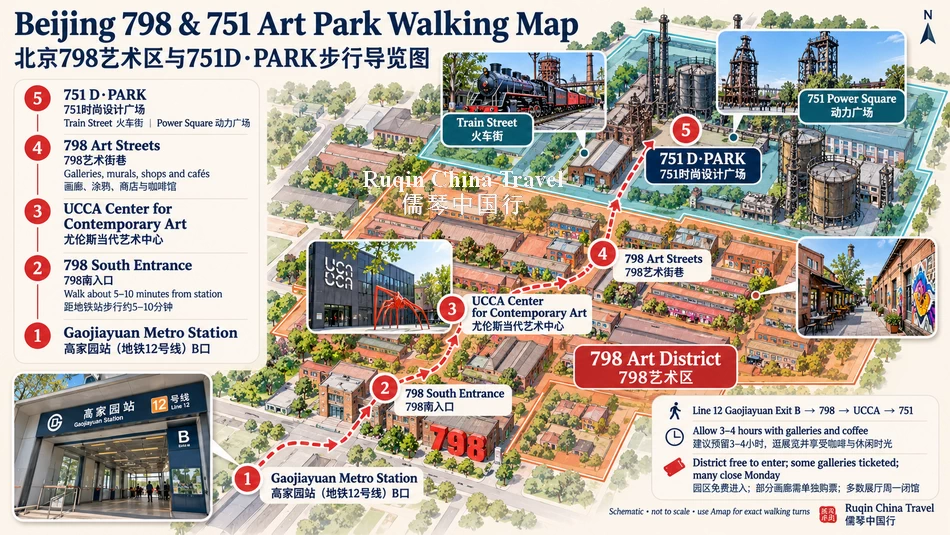
Beijing 798 Art District and 751 Park Walking Map
The map above shows a practical route beginning at Gaojiayuan Metro Station, continuing through 798, and finishing in the industrial heritage area of 751.
1. How to Get There: Metro Line 12 and Line 14
Getting to 798 Art District (798艺术区) and the neighboring 751 D·PARK (751时尚设计广场) is now easier than before, thanks to Beijing Subway Line 12.
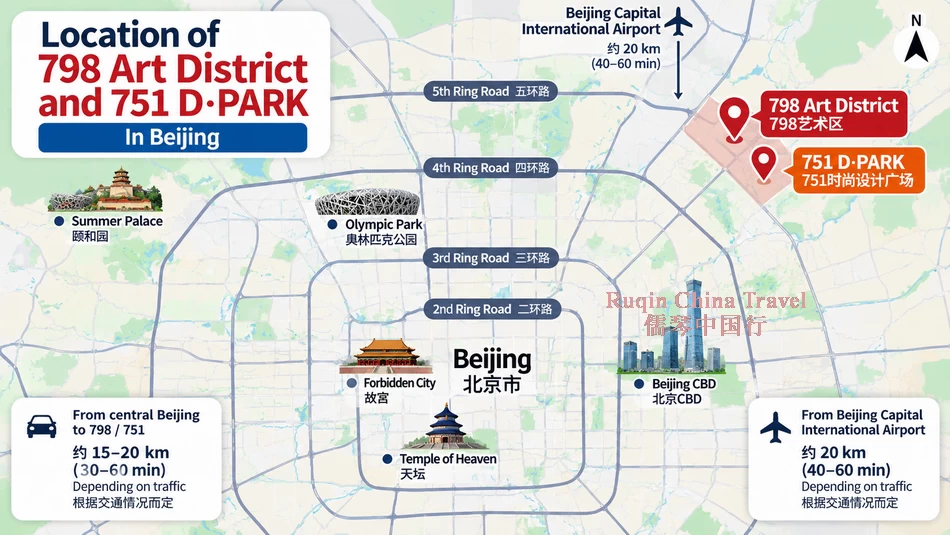
Location Map of 798 Art District and 751 D·PARK
Both attractions are in the Dashanzi area of Chaoyang District, northeast of central Beijing. They are close enough to explore on foot during the same visit, so you do not need separate transport arrangements.
Option 1: Metro Line 12 to Gaojiayuan Station (Recommended)
For most visitors, I recommend taking Subway Line 12 to Gaojiayuan Station (高家园站), Exit B.
From Exit B, follow Jiuxianqiao Road toward the southern entrance of the 798–751 art district. The walk to the entrance takes approximately 5–10 minutes, depending on your pace.
Once inside, you can explore 798’s galleries, murals, cafés, and old factory buildings before continuing north toward 751 D·PARK.
This is usually the most convenient public transport option because you can reach the district without taking an additional bus or taxi.
Important: Gaojiayuan Station currently serves Line 12. Although it is planned as an interchange with Line 14, the Line 14 platforms are not yet open for passenger transfers. Do not plan to change between Lines 12 and 14 at Gaojiayuan.
Option 2: Metro Line 14 to Jiangtai Station
If you are already traveling on Subway Line 14, you can get off at Jiangtai Station (将台站), Exit C.
From there, take a short taxi or DiDi ride to 798 Art District. This is generally easier than finding a connecting bus, especially if you are unfamiliar with the neighborhood.
You can also walk, but the distance is longer than from Gaojiayuan Station. Allow approximately 20–30 minutes, depending on your destination within the district.
For visitors planning to explore both 798 and 751 D·PARK, I would still choose Line 12 whenever the metro connections are convenient.
Option 3: Taxi or DiDi
A taxi or DiDi is another practical choice, particularly for families, senior travelers, or visitors who prefer to avoid metro transfers.
From central Beijing, the journey generally takes around 30–60 minutes, depending on traffic and your starting point.
You can show the driver either of these destinations:
- 798 Art District: 北京798艺术区
- 751 D·PARK: 北京751时尚设计广场
If you want to visit both areas, I recommend starting at 798 Art District and continuing on foot to 751 D·PARK.
Ruqin’s Practical Tip
For a first visit, my preferred route is simple: Metro Line 12 → Gaojiayuan Station (Exit B) → 798 Art District → 751 D·PARK.
Use Amap (高德地图) to find the exact entrance and walking route. The 798–751 complex covers a large area, and the nearest entrance is not necessarily the closest to the gallery or attraction you want to visit.
If you are mainly interested in UCCA Center for Contemporary Art, start in 798. If industrial photography, old machinery, and Train Street interest you more, allow extra time for 751 D·PARK.
2. Tickets, Opening Hours and Practical Tips for 798 Art District and 751 D·PARK
One of the best things about visiting 798 Art District (798艺术区) and 751 D·PARK (751艺术区) is that you do not need a ticket to explore the outdoor areas.
Both art districts are free to enter, and no advance reservation is required for general access. You can walk through the streets, admire the industrial architecture, photograph outdoor artworks, and explore the public spaces at your own pace.
However, individual museums, galleries, and special exhibitions have their own admission rules and opening hours.
Admission Tickets and Reservations
- 798 Art District and 751 D·PARK: Free admission to the general outdoor areas.
- Art galleries and exhibitions: Some are free, while others charge admission.
- Major art venues: Places such as the UCCA Center for Contemporary Art (尤伦斯当代艺术中心), Meet You Museum (遇见博物馆), and M WOODS (木木美术馆) may charge admission depending on the exhibition.
- Advance reservations: Not required for entering the districts themselves. However, certain exhibitions may require advance booking through their official websites or WeChat mini-programs.
I recommend checking the exhibition you want to see before leaving your hotel. Admission prices and reservation arrangements can change when a new exhibition opens.
Opening Hours
Although the outdoor streets and public spaces are generally accessible throughout the year, the galleries and businesses follow their own schedules.
| Place | Typical Opening Hours |
|---|---|
| 798 Art District and 751 D·PARK outdoor areas | Generally accessible 24 hours |
| Art galleries and exhibition spaces | Usually 10:00 AM–6:00 PM or 11:00 AM–7:00 PM |
| Museums and major art centres | Vary by venue; Monday closures are common |
| Cafés and restaurants | Vary by business; some remain open until around 10:30 PM |
Avoid Mondays if visiting exhibitions is your main purpose. Many museums and galleries close on Mondays, although you can still walk around the districts and enjoy the outdoor architecture.
For the best experience, I suggest arriving around 10:30 or 11:00 AM, when more galleries, shops, and cafés are beginning to open.
How Much Time Should You Allow?
Allow at least 2–3 hours for a casual walk through 798 Art District.
If you also want to explore 751 D·PARK, visit a major exhibition, stop for coffee, and take photographs, I recommend setting aside half a day.
The two districts are next to each other, making them easy to combine in one visit.
Ruqin’s Practical Tips
Wear comfortable walking shoes. The combined art districts cover a large area, with long outdoor streets and former industrial buildings.
Check exhibition schedules before visiting. Do not assume that every gallery is open simply because the district is accessible.
Visit 751 D·PARK for industrial photography. Its preserved factory structures, large steel pipes, old machinery, and historic locomotive offer a different experience from the galleries and street art of 798.
Bring a light jacket in cooler months. Much of your visit will be outdoors, and Beijing can be windy in autumn and winter.
Use the Chinese destination names when navigating. Search for 798艺术区 or 751 D·PARK in Amap (高德地图) or show the names to your taxi driver.
Location: Jiuxianqiao area, Chaoyang District, Beijing (北京市朝阳区酒仙桥地区). The 798 Art District is commonly listed at No. 2 Jiuxianqiao Road (酒仙桥路2号), while 751 D·PARK occupies the adjoining former industrial complex.
For first-time visitors, my suggestion is simple: start with the galleries and outdoor artworks of 798, then continue into 751 D·PARK to explore its industrial heritage. This gives you a good introduction to both sides of Beijing’s contemporary art scene without rushing.
3. Recommended 798–751 Walking Route
1) Start at Gaojiayuan Metro Station
Take Beijing Subway Line 12 to Gaojiayuan Station (高家园站).
Use Exit B and walk toward the southern entrance of the 798·751 district. Amap identifies the South 1 Gate as approximately 420 metres from Exit B.
Allow around 5–10 minutes to reach the entrance, then more time to walk to your chosen gallery.
One important detail: Gaojiayuan’s Line 12 platforms are operating, but the planned Line 14 interchange at this station has not opened. Do not plan a Line 14 transfer here.
2) Visit UCCA Center for Contemporary Art
I’ve learned not to chase famous names here. Yes, places like the UCCA Center for Contemporary Art or White Space Beijing are worth visiting—but some of my favorite moments came from small, quiet galleries I almost skipped.
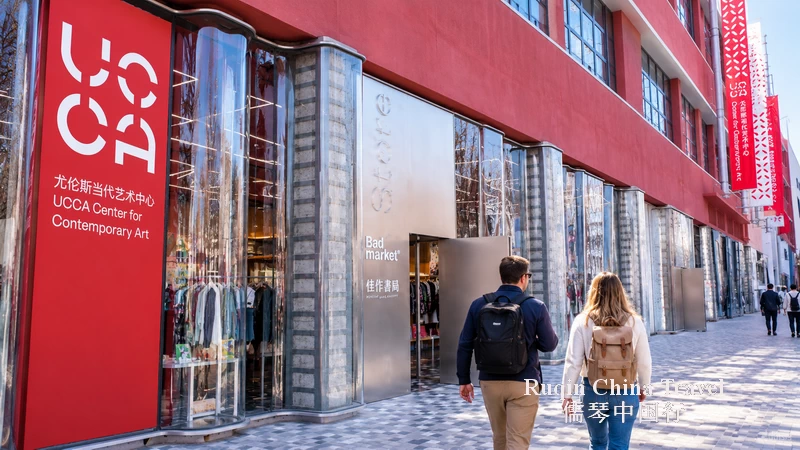
Visit UCCA Center for Contemporary Art
UCCA (尤伦斯当代艺术中心) is one of the best-known institutions in the district.
Its exhibitions change throughout the year, so check what is on before buying a ticket.

Cafe shop at UCCA
Regular hours are Tuesday–Sunday, 10:00 AM–7:00 PM, with last entry at 6:30 PM. It is normally closed Mondays.
As of October 19, 2026, Carsten Höller: Two is scheduled to continue until January 31, 2027.
3) Explore the Main 798 Art Streets

After UCCA, continue through the internal streets of 798.
Look for former factory buildings, outdoor sculptures, wall paintings, small galleries, independent design shops, and cafés.

You do not need to enter every gallery. Choose one or two exhibitions that interest you, then spend time walking around the industrial buildings.
I recommend arriving after 10:30 AM if indoor galleries are a priority.
4) Continue to 751 D·PARK
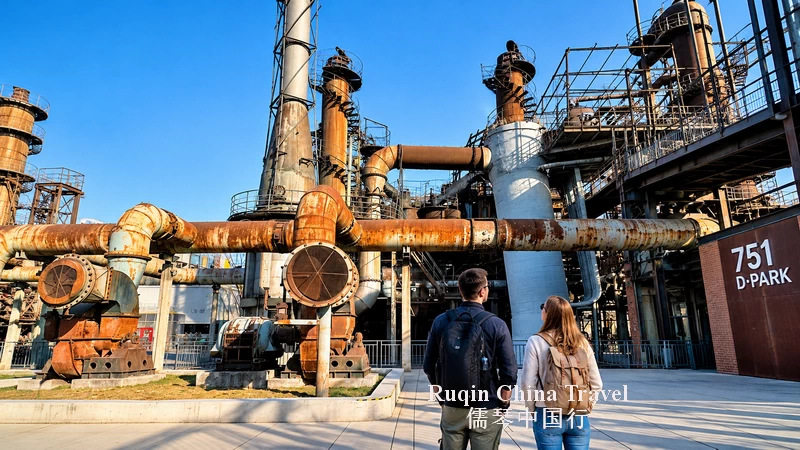
Visit 751 D·PARK
Continue into the neighboring 751 D·PARK area.
Unlike 798, which is strongly associated with contemporary art galleries, 751 is particularly interesting for its industrial structures and design-related activities.
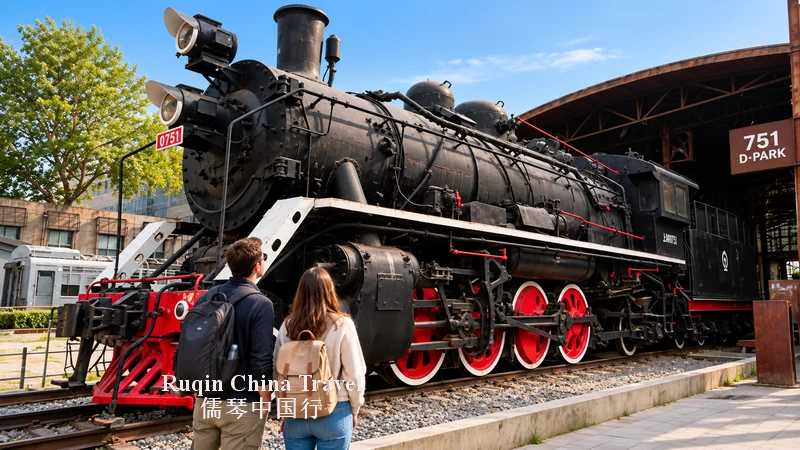
The preserved locomotive displays at 751
Look for Train Street (火车街), preserved locomotive displays, former industrial pipelines, and Power Square (动力广场).
These features make 751 a good place for photography, even when there is no exhibition you particularly want to see.
Ruqin’s Practical Tip
Allow three to four hours for the complete walk, including one major exhibition and a coffee break.
If you are visiting on a Monday, the outdoor streets remain worth exploring, but UCCA and many other indoor galleries are normally closed.
Wear comfortable walking shoes. The district is extensive, and some old factory entrances may have steps or uneven surfaces.
For exact walking directions, use Amap (高德地图) and search for 798艺术区, UCCA尤伦斯当代艺术中心, or 751动力广场.
About the Author
Ruqin is the founder of Ruqintravel.com and has spent more than four decades working in China’s travel industry. Drawing on hands-on experience in cities like Beijing and Hangzhou, he personally researches and updates each guide to help international travelers navigate China with confidence.
Further Reading
Wanshou Temple (Beijing Art Musuem): All You Need to Know
Beijing Van Gogh Star Art Museum: Tickets, Map & Guide
Beijing’s Former Legation Quarter Travel Guide (All You Need to Know)
Beijing Ceramic Art Museum – Your Ultimate Guide