
Words by Ruqin · September 19, 2026
Ciqikou Ancient Town is one of Chongqing’s best-known historic districts. It is also one of the easiest places to misunderstand.
The main pedestrian street can feel crowded and commercial, especially on weekends. Yet Ciqikou covers more than one souvenir lane. Side alleys, old courtyards, hillside paths, newer cultural spaces, and the Jialing River waterfront give the area more variety than many short visits reveal.
For most first-time visitors, Ciqikou is worth two to three hours. Arrive early on a weekday, leave the main shopping street when it becomes busy, and explore the quieter lanes before finishing near the river.
Ciqikou at a Glance
| Item | Practical information |
|---|---|
| Chinese name | 磁器口古镇 |
| District | Shapingba District |
| Nearest metro | Ciqikou Station on Line 1 |
| General admission | The open ancient-town area is normally free |
| Time needed | Two to three hours |
| Best time | Weekday morning |
| Main difficulty | Crowds, slopes, steps, and polished stone paving |
| Good for | Street photography, snacks, old lanes, and local urban history |
| Less suitable for | Travelers seeking a quiet, untouched historic village |
Individual temples, performances, exhibitions, and commercial attractions may keep separate hours or charge admission. Check their own notices before visiting.
Is Ciqikou Really an Ancient Town?
Ciqikou developed beside the Jialing River as a trading settlement and river port. Its older names included Baiyanchang and Longyin Town. The present name is associated with the area’s history of producing and transporting porcelain.
The district later became known as “Little Chongqing.” Its lanes, slopes, shops, temples, courtyards, and river access reflect the physical character of an older Chongqing settlement.
However, visitors should keep their expectations realistic. Ciqikou is not a preserved village isolated from modern life. It is a popular urban attraction with renovated buildings, snack shops, souvenirs, performances, cafés, and substantial tourism development.
You will find genuine historical layers, but you will also find loud sales pitches and repeated products. Both are part of the present-day experience.
How to Reach Ciqikou by Metro
Take Chongqing Rail Transit Line 1 to Ciqikou Station (磁器口站). Leave through Exit 1.
From Exit 1, the main entrance to the ancient town, known as Jinrong Gate (金蓉门), is about 260–320 metres away. The walk normally takes around five minutes.
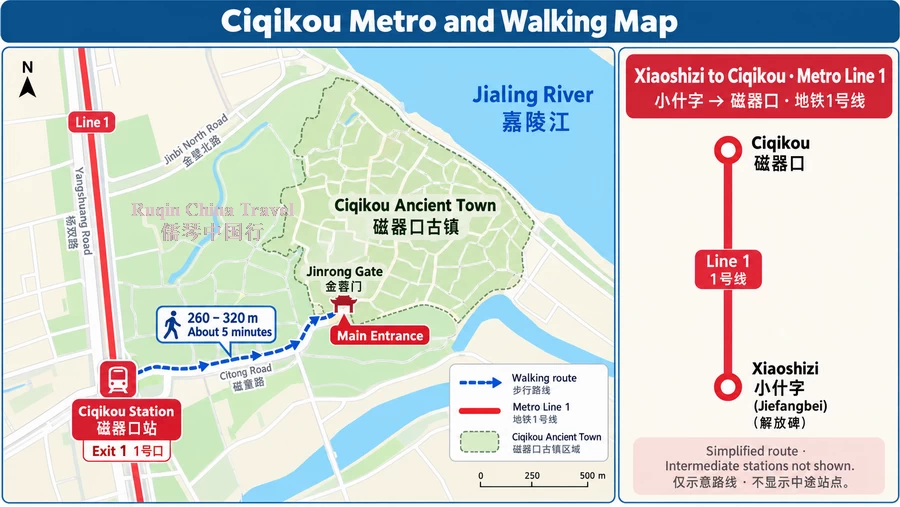
Ciqikou Ancient Town Metro and Walk Map
After leaving the station, continue straight along Citong Road (磁童路) in the direction of the Jialing River. The route is straightforward and requires very few turns.
Before entering the town, save these names on your phone:
- 磁器口古镇 — Ciqikou Ancient Town
- 磁器口地铁站1号口 — Ciqikou Metro Station, Exit 1
- 金蓉门 — Jinrong Gate, the main entrance
- 磁器口后街 — Ciqikou Back Street
- 磁器口码头 — Ciqikou Wharf
The return walk may feel less obvious if you finish near the river or leave through another part of the ancient town. Check your route before climbing back toward the metro station.
The Best Time to Visit
Weekday Morning
A weekday morning offers the most comfortable visit. Streets are cooler in summer, photography is easier, and tour groups are less likely to fill the narrow main lane.
Arriving before most shops open has one disadvantage: the town may feel quiet, and some snack stalls, courtyards, or exhibitions may still be closed. A sensible compromise is to arrive around the beginning of the normal business morning rather than at dawn.
Weekend and Holiday Visits
Weekends can become busy from late morning onward. During national holidays, the main pedestrian routes may become extremely crowded.
If a holiday is your only option, arrive early and explore side streets first. Do not enter with a tight schedule that requires you to leave at an exact minute.
Evening
Ciqikou has evening lighting, restaurants, and entertainment, but it is not necessary to remain until dark. Some old lanes become quieter while commercial areas stay active.
An evening visit can work if you are staying in Shapingba. It is less efficient if you plan to return across the city to Jiefangbei after a long day.
A Practical Walking Route Through Ciqikou
The best way to explore Ciqikou is to enter through Jinrong Gate (金蓉门) rather than beginning on the busiest section of the main street. This route leads through quieter lanes, historic courtyards, Baolun Temple, the back street, and finally the Jialing River.
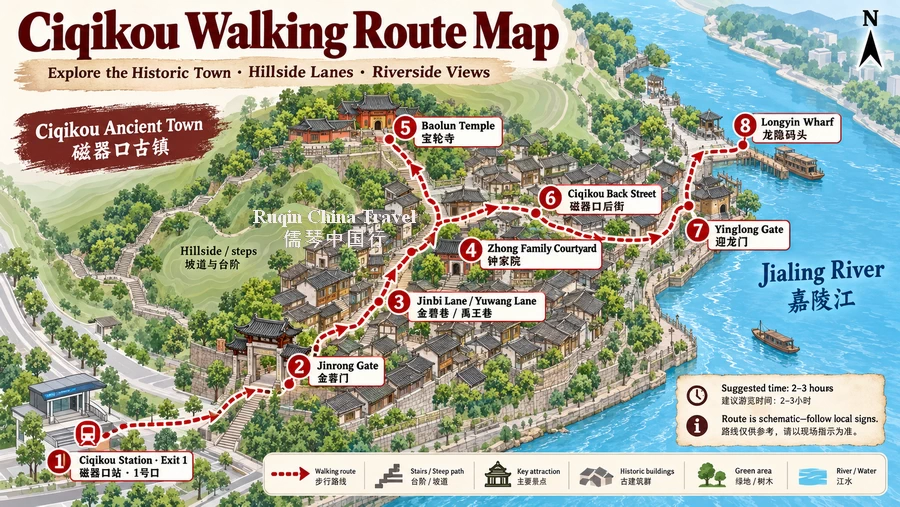
Ciqikou Ancient Town Walking Map
It also avoids unnecessary backtracking. Allow two to three hours, depending on crowds, photography stops, and whether you enter the temple or small museums.
Start at Jinrong Gate
Take Metro Line 1 to Ciqikou Station, leave through Exit 1, and walk along Citong Road. Jinrong Gate is only a few minutes from the station.
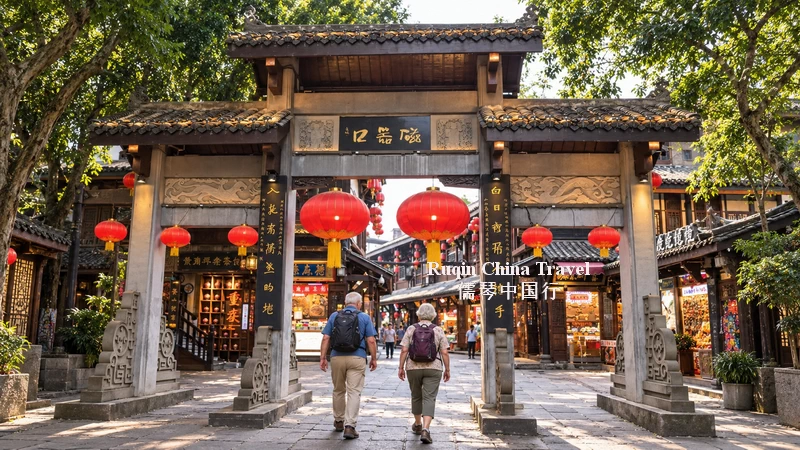
Start at Jinrong Gate
The gate once served as an entrance to the back-street area. It is generally calmer than the traditional southern approach, especially in the morning.
The large gateway, grey-brick walls, and red lanterns also make this a useful photography stop. Morning light is softer, while the lanterns create a different atmosphere after dark. However, lighting times and crowd levels vary by season.
Walk Through Jinbi Lane and Yuwang Lane
After entering Jinrong Gate, continue into Jinbi Lane (金碧巷) or Yuwang Lane (禹王巷). These smaller lanes provide a gentler introduction to Ciqikou than the main commercial street.
Look for stone paving, stairways, traditional façades, red lanterns, and glimpses of the town’s hillside layout. Some buildings are restored, while others still contain ordinary homes and small businesses.
Do not treat every alley as a public attraction. Respect residential entrances and follow marked pedestrian routes when a lane becomes unclear.
Stop at Zhong Family Courtyard
Zhong Family Courtyard (钟家院) was built in 1880 under the direction of Zhong Yunting (钟云亭), who procured goods for the Qing imperial court. It is one of Chongqing’s better-preserved traditional courtyard residences.
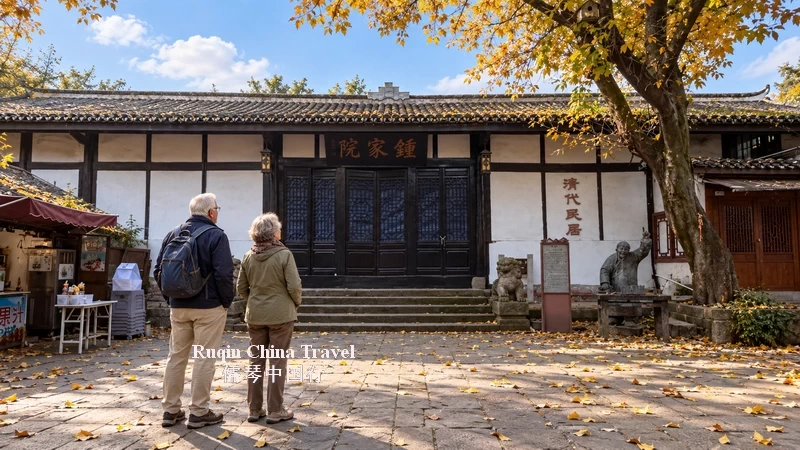
Zhong Family Courtyard
The building combines the enclosed layout of a northern Chinese siheyuan with the timber-frame construction commonly found in southern China. In 2016, it was included in Chongqing’s first group of recognized outstanding historic buildings.
You can find it at No. 17, Huangjueping First Lane, Ciqikou (磁器口黄桷坪一巷17号).
However, Zhong Family Courtyard is currently closed for restoration, and no reopening date has been announced. You can still pass the area while exploring the quieter lanes, but do not plan your route around an interior visit. Check its latest opening status before setting out.
Continue to Baolun Temple
From the quieter lanes, continue uphill to Baolun Temple (宝轮寺). The temple stands below Baiyan Mountain and faces the Jialing River. Its history is said to extend back more than a thousand years.
According to local tradition, the deposed Ming emperor Zhu Yunwen (朱允炆) took refuge here after Zhu Di (朱棣) seized the throne. The temple later became known as Longyin Temple (龙隐寺), while Ciqikou was once called Longyin Town. Treat this as a historical legend rather than a fully confirmed account.

Baolun Temple
The temple’s most important surviving building is the Mahavira Hall (大雄宝殿), completed in 1432 during the Ming dynasty. It is regarded as the oldest surviving wooden building in central Chongqing. In 2000, the site was included in Chongqing’s first group of protected cultural relics.
Baolun Temple usually opens from 7:30 a.m. to 6:00 p.m., with last entry around 5:00 p.m. On the first and fifteenth days of the lunar month, it may open as early as 6:30 a.m. Admission is free, and no ticket is normally required.
The approach includes slopes and steps, so wear shoes with a good grip and take your time. Opening hours can change for religious activities, maintenance, or crowd control. Check the notice at the entrance before climbing further.
Explore Ciqikou Back Street
After leaving the temple, continue into Ciqikou Back Street (磁器口后街). This area is wider and generally easier to navigate than the narrowest historic lanes.
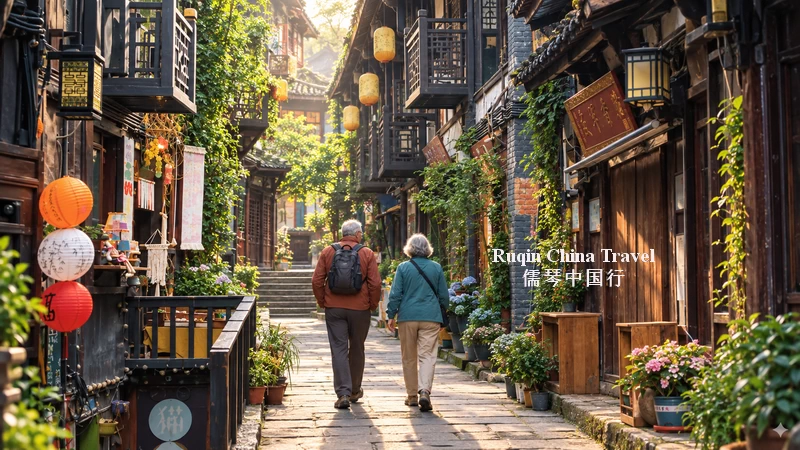
Explore one of the side lanes off the Back Street in Ciqikou
You will find reconstructed architecture, cafés, cultural displays, small museums, shops, and sections inspired by Chongqing’s traditional stilted houses, or diaojiaolou (吊脚楼).
The back street is more modern than the older lanes. It should not be mistaken for an untouched historic quarter. However, it offers more space, easier rest stops, and better access for visitors who find the old stone stairways difficult.
Parts of the back-street area have ramps, escalators, and lifts. Still, step-free connections may change, and not every attraction is accessible. Travelers with limited mobility should confirm the easiest route at the visitor centre.
Finish at Yinglong Gate and Longyin Wharf
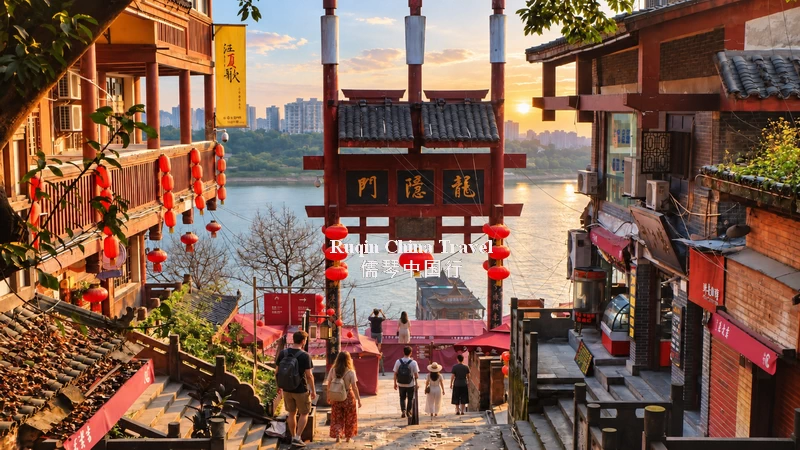
Continue toward the riverside through Yinglong Gate (迎龙门), which may also be identified locally as Longyin Gate (龙隐门). This side of Ciqikou recalls the town’s former role as a river port.
Finish at Yinglong Gate and Longyin Wharf
Finish near Longyin Wharf (龙隐码头) or the stilt-house square beside the Jialing River. The riverside gives the route a natural ending and helps explain why Ciqikou developed here.
Late afternoon usually provides more comfortable light for photographs. However, riverfront access can be affected by weather, water levels, construction, and temporary controls.
Remember that the river lies below parts of the town. Returning to the metro may require an uphill walk, so check the route before you become tired.
Suggested Route at a Glance
Ciqikou Station Exit 1 → Jinrong Gate → Jinbi Lane or Yuwang Lane → Zhong Family Courtyard → Baolun Temple → Ciqikou Back Street → Yinglong Gate → Longyin Wharf
This route concentrates on the quieter lanes and back-street area before reaching the river. It does not avoid every crowd, but it reduces the amount of time spent on the busiest commercial section.
An Evening Alternative
If you prefer evening lighting, enter through Jinrong Gate in the late afternoon. Walk through the back street before continuing toward the river after the lanterns are illuminated.
The lanes may become quieter later in the evening, although restaurants and popular photography areas can remain busy. Do not depend on every indoor passage, lift, exhibition, or shop staying open late.
If you have more time, you could add the Chongqing 1949 (重庆1949) performance. Treat it as a separate ticketed activity and check the performance schedule, duration, and entrance location in advance.
Food Along the Route
Ciqikou is a useful place to sample small portions rather than planning one large meal immediately.
Popular local choices include:
- Chen mahua (陈麻花) — crisp twisted fried dough
- Suanlafen (酸辣粉) — hot-and-sour sweet-potato noodles
- Mao xue wang (毛血旺) — a spicy dish containing duck blood and assorted ingredients
- Chicken giblets (鸡杂) cooked with pickled chillies
- Youcha (油茶) — a savory rice-based breakfast with crisp fried noodles
The main street often has the greatest choice but also the most aggressive promotion. Side lanes may provide a calmer meal, although lower foot traffic does not automatically mean better quality or lower prices.
Check the menu before sitting down. Do not enter a restaurant simply because someone outside is calling to passing visitors.
Practical Tips for This Walk
- Wear flat shoes with good grip. Ciqikou has polished stone paving, slopes, and many steps.
- Arrive before 9:00 a.m. if avoiding crowds matters more than finding every shop open.
- Avoid weekend afternoons and major public holidays when possible.
- Explore the side lanes, but respect private homes and closed passages.
- Carry water and keep your bag light.
- Treat the riverfront as optional if rain, heat, or limited mobility makes the descent difficult.
- Confirm accessibility facilities on arrival rather than assuming every lift or escalator is operating.
- Check the route back to Ciqikou Station before leaving the upper part of the town.
Crowds, Stairs, and Accessibility
Ciqikou is a hillside district. Stone paving, slopes, thresholds, and stairways are part of its character.
Travelers with limited mobility can still visit part of the area, but the complete walking route may not be realistic. The main commercial approaches are easier than some older alleys and the descent toward the river.
A practical accessible visit should focus on:
- The broadest entrance route
- A short section of the main street
- Newer back-street public areas
- Clearly marked step-free facilities
- A planned vehicle pickup point
Wheelchair users should confirm the current accessible route with the visitor service centre. Recent rain can make smooth stone paving slippery for everyone.
Families should avoid letting children run ahead in crowded lanes. Strollers can be awkward on steps and during peak periods.
What to Bring
Keep the visit light. You may be climbing, squeezing through busy lanes, and carrying food purchases.
Bring:
- Comfortable shoes with reliable grip
- Water
- A compact umbrella or rain jacket
- Sun protection in warm weather
- A small bag with secure closures
- Mobile payment and some backup cash
- A screenshot of the metro station and hotel address
Large suitcases are unsuitable for Ciqikou. Leave luggage at your hotel or an established storage facility before visiting.
How to Combine Ciqikou With Another Area
Ciqikou pairs naturally with Shapingba rather than eastern Yuzhong.
After the ancient town, you could continue to a shopping centre or restaurant near central Shapingba. This creates a relaxed western-Chongqing day without crossing the city repeatedly.
Ciqikou can also be combined with another Line 1 destination. However, Jiefangbei, Hongya Cave, and Chaotianmen lie much farther east. Do not assume you can visit all of them comfortably in half a day.
For a first visit, Ciqikou in the morning and central Yuzhong in the late afternoon is possible. Leave a generous transport break and keep the evening plan simple.
Ruqin’s Practical Advice
Visit Ciqikou if you enjoy old streets, food stalls, hillside neighborhoods, and the history of ordinary commercial life. Skip it if you have only one day in Chongqing or strongly dislike crowded, commercial heritage districts.
A weekday morning is the best compromise. Spend a short time on the main shopping street, then explore the side lanes and back street. Continue to the river only if your energy, weather, and mobility allow.
Ciqikou is not an untouched ancient town. It is a historic Chongqing neighborhood that has adapted to mass tourism. The visit becomes more rewarding once you accept both sides of it.
More Chongqing Travel Guides
Chongqing Travel Guide: Map, Top Attractions, City Walks and Tips
Where to Stay in Chongqing: Best Areas for First-Time Visitors
How to Book Chongqing Attraction Tickets: All You Need to Know
Yangtze River Cableway in Chongqing: Tickets, Terminals and Queues
Getting Around Chongqing: Metro, Taxis and Walking in a Vertical City
How to Visit Jiefangbei in Chongqing: Shopping, Food & Night Guide
How to Visit Hongya Cave in Chongqing: Night Views & Food Guide
The Best Chongqing Tour Itinerary