Words by Ruqin · September 16, 2026
Choosing a hotel in Chongqing is not simply a matter of finding a central address. The city’s rivers, hills, bridges, tunnels, and stacked roads can turn a short distance on a map into a tiring journey.
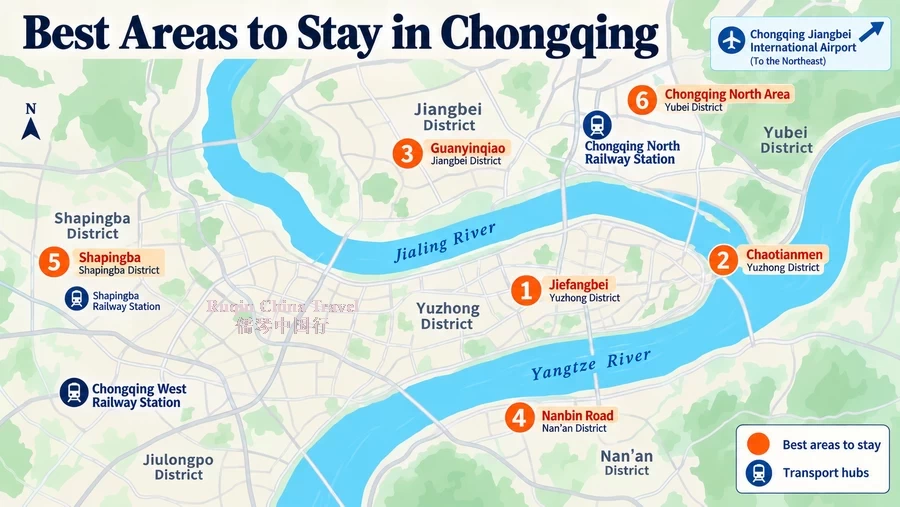
Chongqing Best Areas to Stay Map
For most first-time visitors, the best base is Jiefangbei in Yuzhong District. It offers the easiest combination of metro access, restaurants, evening activity, and proximity to central sights. However, Guanyinqiao, Chaotianmen, Nanbin Road, and Shapingba can be better choices for particular travelers.
The important point is to choose a hotel by its entrance, elevation, and nearest metro station—not only by the straight-line distance from an attraction.
Quick Comparison of Chongqing’s Best Areas
| Area | Best for | Main advantage | Main drawback |
|---|---|---|---|
| Jiefangbei (Yuzhong District) | First-time visitors and short stays | Central sights, food, and metro access | Crowded and tourist-oriented |
| Chaotianmen (Yuzhong District) | River views and Raffles City | Dramatic location at the river confluence | Traffic and longer walks than expected |
| Guanyinqiao (Jiangbei District) | Shopping, nightlife, and a more local atmosphere | Lively commercial district with Line 3 | Across the river from Yuzhong’s main sights |
| Nanbin Road (Nan’an District) | Skyline views and quieter evenings | Views across the Yangtze toward Yuzhong | Less convenient for walking to central attractions |
| Shapingba (Shapingba District) | Budget stays, longer visits, and rail connections | Good transport and everyday services | Farther from Hongya Cave and Chaotianmen |
| Chongqing North area (Yubei District ) | Early trains or a one-night stop | Convenient for railway departures | Weak sightseeing base |
Jiefangbei: The Easiest Choice for a First Visit
Jiefangbei is the most practical base if you have two or three days in Chongqing and want to see the main central attractions. Liberation Monument, Bayi Food Street, Shibati, Hongya Cave, and parts of the old Yuzhong streets are within the same broad district.

Jiefangbei Area
The area is served by several nearby stations. Linjiangmen is on Line 2, Jiaochangkou connects Lines 1 and 2, and Xiaoshizi connects Lines 1 and 6. The most useful station depends on your hotel’s exact entrance.
This is an important distinction. A hotel described as being “near Jiefangbei” may sit downhill, behind a large commercial building, or on a road reached by stairs. Check the walking route from the metro exit to the hotel before booking.
Who Should Stay Here?
Jiefangbei suits:
- First-time visitors
- Travelers with only two or three nights
- People who enjoy exploring restaurants after dark
- Visitors who want several sights within one general area
- Travelers who prefer international or upper-midrange hotels
The main disadvantages are crowds, traffic, and noise. Streets around popular sights can remain busy well into the evening. A hotel facing a pedestrian street, elevated road, or busy food street may not be ideal for light sleepers.
Ask for a room away from lifts and major roads. Do not assume that a high floor will always be quiet, as rooftop bars and late-night commercial activity can also produce noise.
Chaotianmen: Best for River Views and Raffles City
Chaotianmen stands at the eastern end of the Yuzhong Peninsula, near the meeting point of the Yangtze and Jialing rivers. The area’s best-known landmark is Raffles City Chongqing, which contains shops, restaurants, residences, and hotels.
This location works well if river views and modern architecture are priorities. Line 1 serves Chaotianmen Station, while Xiaoshizi is useful for the western side of the area.
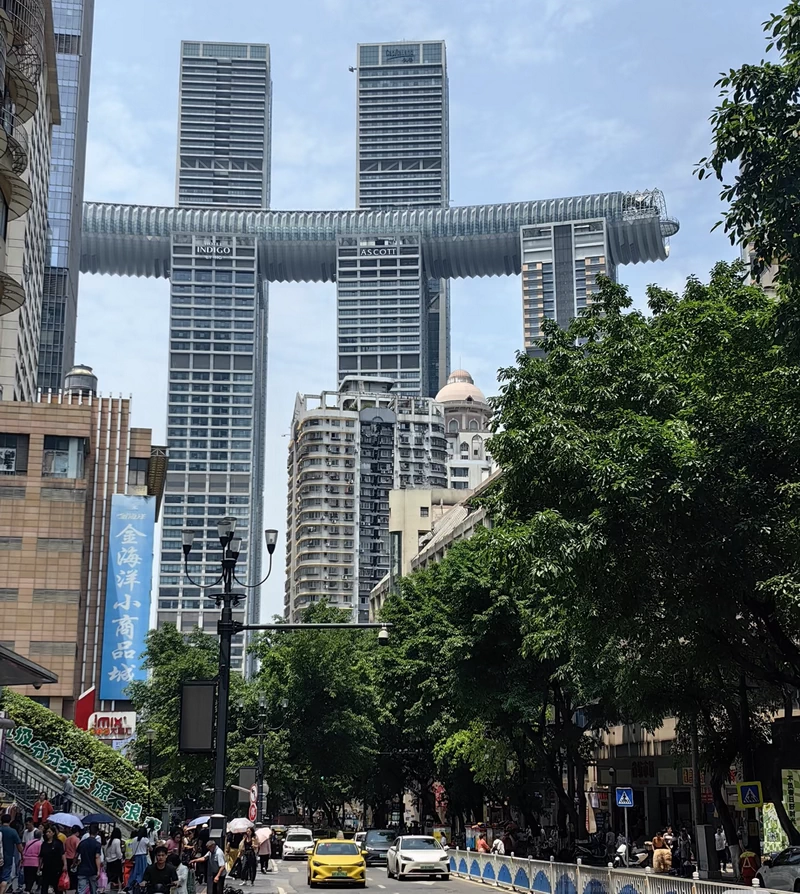
Chaotianmen: Best for River Views and Raffles City
Chaotianmen looks very close to Hongya Cave and Jiefangbei on a flat map. In practice, construction, multilane roads, shopping complexes, slopes, and different street levels can complicate the walk.
Road traffic is another consideration. During busy evenings, public holidays, and major events, taxis and ride-hailing vehicles may move slowly near the riverfront. If you stay here, confirm that the hotel has a clear vehicle entrance and note which level drivers should use.
Choose Chaotianmen for a modern hotel, river views, or direct access to Raffles City. Choose Jiefangbei instead if easy street-level dining and flexible sightseeing matter more.
Guanyinqiao: Better for Shopping and Local City Life
Guanyinqiao is a major commercial district in Jiangbei, north of the Jialing River. It has large shopping centres, restaurants, entertainment venues, and busy pedestrian areas. The neighborhood feels more like an active urban centre than a sightseeing quarter.

GuanYinQiao Pedestrian Street in Jiangbei District
Guanyinqiao Station is on Line 3. The line provides useful connections, but reaching Yuzhong’s main sights normally requires a train journey, transfer, taxi, or river crossing.
This area is a good choice for travelers staying four nights or longer. It also suits visitors interested in shopping, nightlife, contemporary neighborhoods, and restaurants used by local residents.
Guanyinqiao is less suitable if you want to walk out of your hotel and immediately reach Hongya Cave, Jiefangbei, or Shibati. The river is a real barrier. A hotel may appear less than two kilometres from Yuzhong in a straight line while the actual road journey is considerably longer.
On weekend evenings, entertainment streets can become noisy. Check recent room reviews for sound insulation rather than relying only on a hotel’s star rating.
Nanbin Road: Best for Views Across the Yangtze
Nanbin Road runs along the southern bank of the Yangtze River. From parts of the road, you can look toward the illuminated Yuzhong skyline, bridges, and the buildings around Chaotianmen.
This area offers a calmer base than central Jiefangbei. It can work well for couples, repeat visitors, and travelers who value a river view more than immediate access to attractions.

Nanbin Road (南滨路) in Nan’an District
However, “across the river” does not mean “a short walk.” Bridges, road approaches, elevation changes, and limited pedestrian routes can make journeys indirect. You will probably use the metro, taxis, or ride-hailing more frequently.
Line 3 serves Nanping, while Line 6 is useful for locations closer to Shangxinjie, Longmenhao, and the southern cableway terminal. The right station depends heavily on the property’s position.
Before booking a river-view room, ask what the view actually faces. Some rooms may overlook another building, a construction area, or only a narrow section of the river. It is sensible to confirm whether the advertised view is guaranteed for your room category.
Shapingba: A Practical Choice for Budget and Longer Stays
Shapingba is a large western district with universities, shopping centres, railway connections, restaurants, and more ordinary residential life. Accommodation can offer better value than comparable rooms around Jiefangbei.
The district is connected to the rail network, including Line 1 and other interchange services. It is convenient for Ciqikou and useful for travelers using Shapingba Railway Station.

Ciqikou Ancient Town (磁器口古镇) in Shapingba District
The compromise is travel time. Hongya Cave, Chaotianmen, and the eastern end of Yuzhong are not nearby. Returning to your hotel for an afternoon rest may be inconvenient.
Shapingba makes sense if your stay is longer, your budget is important, or western Chongqing fits your itinerary. For a first visit of only two nights, the money saved may not compensate for the additional journeys.
Staying Near Chongqing North Railway Station
A hotel near Chongqing North Railway Station is useful when you have an early departure, a late arrival, or a brief overnight connection. It is not the best general sightseeing base.
The station complex has north and south squares, and the correct access point depends on your train and current station arrangements. Never tell a driver only “Chongqing North.” Show the full Chinese station name and the departure information from your ticket.
If your train leaves at a comfortable time, staying in Jiefangbei and taking a taxi or metro may give you a more enjoyable evening. If the departure is very early, a nearby hotel reduces stress.
Allow extra time for finding the correct entrance, completing security checks, and reaching the waiting hall. Large Chinese railway stations should not be approached like small city-centre terminals.
How to Check a Chongqing Hotel Location Properly
A booking platform’s distance figure is not enough. Use the following checks before paying.
1. Find the Exact Entrance
Search for the hotel’s Chinese name and full address. Confirm where vehicles stop and whether reception is reached directly from the street.
Some Chongqing hotels occupy upper floors of mixed-use towers. The lobby may be inside a shopping centre, office building, or apartment complex.
2. Check the Route from the Metro Exit
Identify the nearest station and proposed exit. Then examine the complete walking route.
Look for stairs, elevated roads, tunnels, steep slopes, and large buildings between the exit and hotel. A 600-metre level walk is reasonable; a 600-metre climb with luggage is not.
3. Read Recent Reviews for Practical Problems
Concentrate on comments about:
- Street and corridor noise
- Cigarette smells
- Lift waiting times
- Air-conditioning control
- Vehicle access
- English-speaking assistance
- Construction nearby
- The difficulty of finding reception
Treat a single review cautiously. Repeated comments from different recent guests are more useful.
4. Contact the Hotel Before Arrival
Ask the hotel to confirm that it can register an international guest using your passport. Hotels normally handle accommodation registration for their guests, but it is still sensible to confirm directly, especially with small inns, apartment-style properties, and privately operated homestays.
Also request the hotel’s Chinese name, address, telephone number, and recommended taxi drop-off point. Save these details offline.
What Matters More Than a Skyline View
Chongqing’s river and city views are attractive, but they should not be the only reason to choose a room. Weather can be hazy, cloudy, or rainy, and a high-floor view may be less impressive than booking photographs suggest.
For most travelers, these practical features matter more:
- A metro station within a genuinely manageable walk
- A clear taxi or ride-hailing pickup point
- Reliable air conditioning
- Good sound insulation
- A staffed reception desk
- Lifts that serve the entrance and guest floors
- Breakfast or late-night food nearby
- Flexible cancellation if the location proves unsuitable
Families should check room occupancy rules and whether connecting rooms are guaranteed or merely requested. Travelers with limited mobility should ask about steps between the road, lobby, lift, and room. “Wheelchair accessible” does not always describe the surrounding streets.
Ruqin’s Practical Advice
For a first visit of two or three nights, stay near Jiefangbei, preferably within a straightforward walk of Jiaochangkou, Linjiangmen, or Xiaoshizi Station. This will keep the main central sights, food streets, and transport options reasonably close.
Choose Chaotianmen for a modern riverfront stay, Guanyinqiao for shopping and nightlife, Nanbin Road for skyline views, or Shapingba for better value and a longer visit. Stay near Chongqing North only when a railway departure makes the location genuinely useful.
Most importantly, inspect the final 500 metres between the station and the hotel. In Chongqing, that short section often matters more than the distance shown on the booking page.
More Chongqing Travel Guides
Chongqing Travel Guide: Map, Top Attractions, City Walks and Tips
Yangtze River Cableway Chongqing: Tickets and Terminals
Getting Around Chongqing: Metro, Taxis and Walking in a Vertical City
How to Visit Jiefangbei in Chongqing: Shopping, Food & Night Guide
How to Visit Hongya Cave in Chongqing: Night Views & Food Guide
The Best Chongqing Tour Itinerary
How to Book Chongqing Attraction Tickets: All You Need to Know