
Written and updated by Ruqin
October 18, 2026
November can be a good time to visit Zhangjiajie. Summer humidity has eased, the National Day holiday crowds have passed, and cooler temperatures make long walks more comfortable.
However, November is not reliably warm, sunny or empty. Mountain weather changes quickly. Fog may cover the viewpoints, cold rain can make paths uncomfortable, and queues still form at popular transport points.
The best approach is to allow two or three sightseeing days, stay flexible, and pack for conditions colder than the forecast for Zhangjiajie city suggests.
What Is Zhangjiajie Weather Like in November?
November in Zhangjiajie is cool and changeable rather than steadily cold. Visitors should prepare for damp mornings, occasional rain, fog and noticeable temperature differences between the city and the mountains.
The 2025 daily record is a useful example. Based on the figures below, Zhangjiajie city had an average daily high of approximately 18.8°C and an average low of about 8.2°C. The temperature ranged from 2°C to 24°C during the month.
This differs from the broader climate averages because one year cannot represent a typical November. It also should not be treated as a forecast for November 2026.
What the November 2025 Record Shows
November 2025 began with a damp period. Rain occurred on 11 days, with most rainy days falling during the first ten days of the month. Fog was also common, particularly in the morning.
Conditions improved around the middle of the month, when several afternoons reached 22–24°C. A sharp cold spell followed on November 17–19, when overnight temperatures fell to 3–4°C and the daytime high dropped as low as 9°C.
The final week was mainly foggy in the morning and sunny later. Daytime temperatures again reached 19–24°C, but early mornings remained cold.
This wide variation is typical of the planning problem in Zhangjiajie. A traveler may need gloves at breakfast and remove two layers by early afternoon.
Zhangjiajie Daily Weather in November 2025
The figures below refer to Zhangjiajie city. Yuanjiajie, Tianzi Mountain and Tianmen Mountain may feel considerably colder because of elevation, wind and cloud cover.
| Date | Weather | Low–high | Date | Weather | Low–high |
|---|---|---|---|---|---|
| Nov 1 | Fog, then overcast | 14–20°C | Nov 16 | Fog, then light rain | 8–24°C |
| Nov 2 | Overcast, then light rain | 13–21°C | Nov 17 | Overcast | 3–12°C |
| Nov 3 | Light rain | 12–16°C | Nov 18 | Overcast, then clear | 3–9°C |
| Nov 4 | Fog, then clear | 10–20°C | Nov 19 | Fog, then partly cloudy | 4–16°C |
| Nov 5 | Fog, then light rain | 13–20°C | Nov 20 | Overcast, then clear | 5–20°C |
| Nov 6 | Overcast, then light rain | 14–15°C | Nov 21 | Fog, then clear | 4–20°C |
| Nov 7 | Overcast, then light rain | 14–17°C | Nov 22 | Overcast, then light rain | 9–18°C |
| Nov 8 | Light rain, then moderate rain | 13–16°C | Nov 23 | Light rain, then partly cloudy | 7–12°C |
| Nov 9 | Moderate rain, then light rain | 11–13°C | Nov 24 | Fog, then clear | 5–22°C |
| Nov 10 | Light rain, then partly cloudy | 11–14°C | Nov 25 | Fog, then clear | 4–19°C |
| Nov 11 | Overcast | 10–18°C | Nov 26 | Fog, then clear | 2–22°C |
| Nov 12 | Overcast, then partly cloudy | 11–19°C | Nov 27 | Fog, then clear | 4–21°C |
| Nov 13 | Fog, then clear | 9–23°C | Nov 28 | Clear | 4–23°C |
| Nov 14 | Clear | 8–22°C | Nov 29 | Clear | 5–24°C |
| Nov 15 | Fog, then clear | 9–24°C | Nov 30 | Fog, then clear | 6–23°C |
Do Not Use the City Temperature for the Mountaintops
The table does not mean that visitors can expect 20°C on Tianzi Mountain whenever Zhangjiajie city reaches that temperature.
Mountain viewpoints are more exposed. Wind, mist and long periods of standing in cableway or shuttle queues can make the upper scenic areas feel much colder. Temperatures can also change quickly when clouds move across the peaks.
Rather than depending on a fixed “mountain temperature difference,” check the current forecast and ask your hotel about conditions at Yuanjiajie and Tianzi Mountain that morning.
Rain, Fog and Visibility
The 2025 record also shows why a daily weather symbol can be misleading. Several days began with fog but later became sunny. A foggy morning did not always mean poor visibility for the entire day.
However, fog in Zhangjiajie city does not tell you exactly what is happening on the mountaintops. Yuanjiajie may remain inside cloud while Wulingyuan is already bright, or the upper viewpoints may clear before the valley does.
If Yuanjiajie and Tianzi Mountain are your priorities, keep their day flexible. Use Golden Whip Stream, Ten-Mile Gallery or Yellow Dragon Cave when the upper viewpoints remain hidden.
Expect Shorter Sightseeing Days
On November 1, 2025, sunrise was around 6:51 a.m. and sunset around 5:53 p.m. By November 30, sunrise was around 7:13 a.m. and sunset around 5:40 p.m.
This reduced the available daylight by roughly 35 minutes over the month. More importantly, the useful sightseeing period can feel even shorter when fog, cloud or mountain shadows arrive in the afternoon.
Begin the main park route early, but confirm the final sightseeing-bus, elevator and cableway times. Do not plan a long side trail late in the day.
How to Prepare for November 2026
Use the 2025 table to understand how variable November can be, not to predict the weather on the same dates in 2026.
Check the official forecast again three to five days before arrival, then review the hourly forecast within 24–48 hours. Pack for three possibilities: a mild sunny afternoon, a cold wet morning and a sudden temperature drop.
For most travelers, the safest combination is a quick-drying base layer, a fleece or light insulated jacket, and a waterproof outer shell. Add light gloves, warm socks and shoes with reliable grip for the upper mountains.
Will Fog Ruin a November Visit?
Fog is common in Zhangjiajie during November, especially in Wulingyuan, Yuanjiajie and Tianmen Mountain. Frequent cloud and rain, combined with large differences in elevation, can produce dense mist between the valleys and sandstone peaks.
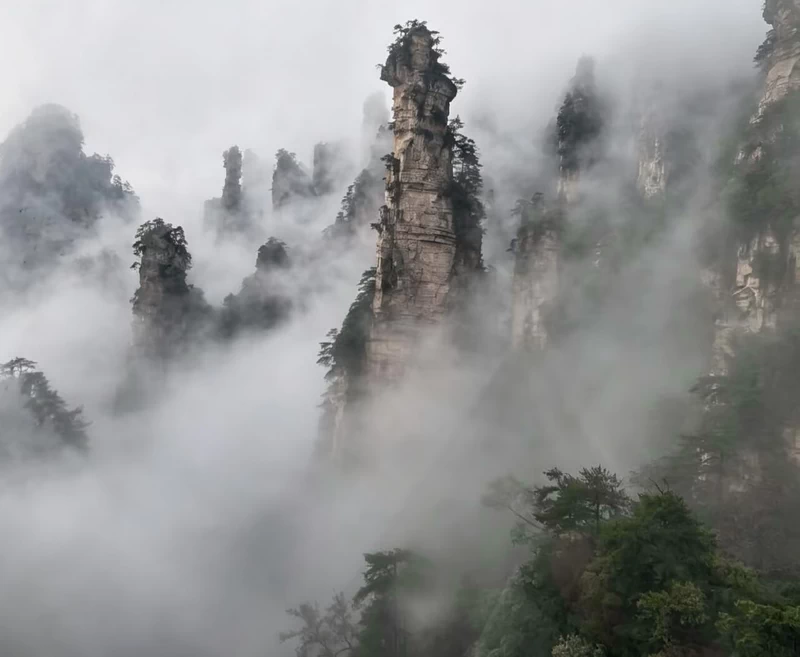
The foggy Tianzi Mountain viewded from the Cableway
Visibility sometimes drops sharply after rain. In particularly dense fog, you may see little beyond the nearest trees and railings. At other times, the cloud moves through the forest and reveals the pillars for a few minutes before hiding them again.
This does not necessarily ruin the visit. Moving mist can create layers between the sandstone formations and produce the cloud-sea scenery associated with Zhangjiajie. For photography, partial cloud is often more interesting than either completely clear skies or solid white fog.
Morning Fog May Lift Later
Fog often feels thickest during the early morning after rain. It may remain around the valleys and upper viewpoints through the first part of the day, particularly before about 10:00 a.m.
Visibility frequently improves toward midday as temperatures rise. However, this is a weather pattern rather than a guarantee. On damp, windless days, the upper mountains may stay inside cloud for much longer.
Do not assume that entering at the earliest possible time will always provide the clearest view. Early entry helps with crowds, but a slightly later visit may offer better visibility after a foggy night.
Ask your hotel or park staff about conditions at the actual viewpoint, not only the weather in Zhangjiajie city. Wulingyuan may look clear while Yuanjiajie remains covered by cloud.
Choose Your Timing According to What You Want to See
If you hope to photograph clouds moving between the peaks, the morning after rain can be promising. A clearing forecast and light air movement provide better possibilities than continuous rain or a completely overcast day.
If your priority is a clear panorama of the sandstone pillars, wait until visibility improves before committing to Yuanjiajie or Tianzi Mountain. Use the early morning for breakfast, ticket checks or a lower-level attraction rather than rushing directly to a viewpoint hidden in fog.
Remember that a “cloud sea” cannot be scheduled. Rain followed by clearing may create suitable conditions, but it may also leave the entire mountain inside thick cloud.
Fog Can Affect Scenic Transport
Cableways, glass walkways and the Grand Canyon Glass Bridge do not automatically close whenever it is foggy. However, strong wind, very poor visibility, ice or other unsafe conditions may lead to temporary controls or closures.
Check official announcements before leaving your hotel. Confirm the operating status of:
- Tianzi Mountain Cableway
- Bailong Elevator
- Tianmen Mountain Cableway and cliff paths
- Tianmen Mountain glass walkways
- Zhangjiajie Grand Canyon Glass Bridge
- Scenic-area sightseeing buses
A temporary closure can alter the whole route. Do not replace a closed cableway with a long staircase descent unless everyone understands the distance, conditions and physical difficulty.
Have a Lower-Level Alternative Ready
If the mountaintops remain hidden, switch to Golden Whip Stream, Ten-Mile Gallery or Yellow Dragon Cave.
Golden Whip Stream can still be atmospheric in mist because the path follows the valley beneath the cliffs. Ten-Mile Gallery also depends less on a wide panorama than Yuanjiajie or Tianzi Mountain.
Yellow Dragon Cave provides more shelter, although its floors and steps can be damp. None of these options should be used during dangerous rainfall or when the scenic area restricts access.
Dress for Cold, Damp Conditions
Fog and wind can make the upper mountains feel colder than the city forecast suggests. Even when Zhangjiajie city is mild, waiting on an exposed platform or at a cableway station can become uncomfortable.
Wear a wind-resistant jacket over a fleece or light insulated layer. Choose shoes with reliable grip, as stone paths and metal surfaces become slippery when damp.
A lightweight rain jacket is more practical than an umbrella on crowded or windy mountain paths. Carry a small cloth for your camera or phone lens, because fine droplets can quickly blur photographs.
Fog should not make you cancel a November trip. Allow enough time to change the order of your attractions, use the clearest period for the upper viewpoints and keep one lower-level route ready for poor visibility.
Where to See Autumn Colours in Zhangjiajie in November
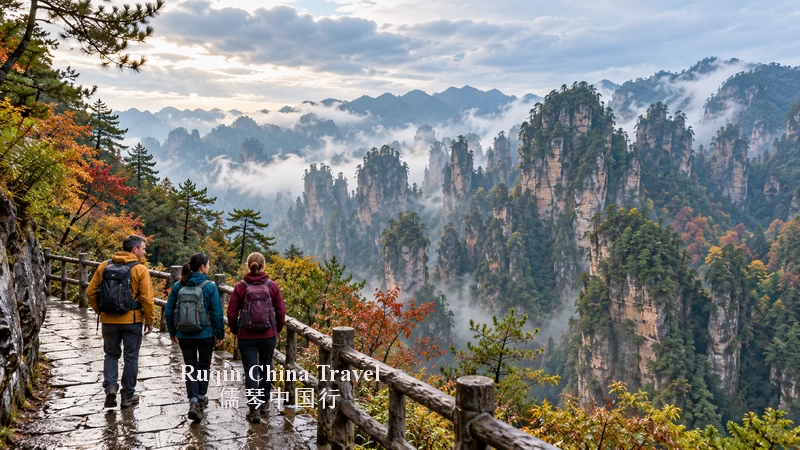
November is one of the better times to see autumn colour in Zhangjiajie. The usual viewing period runs from roughly mid-to-late October until mid-to-late November, although timing varies with elevation, temperature, rain and wind.
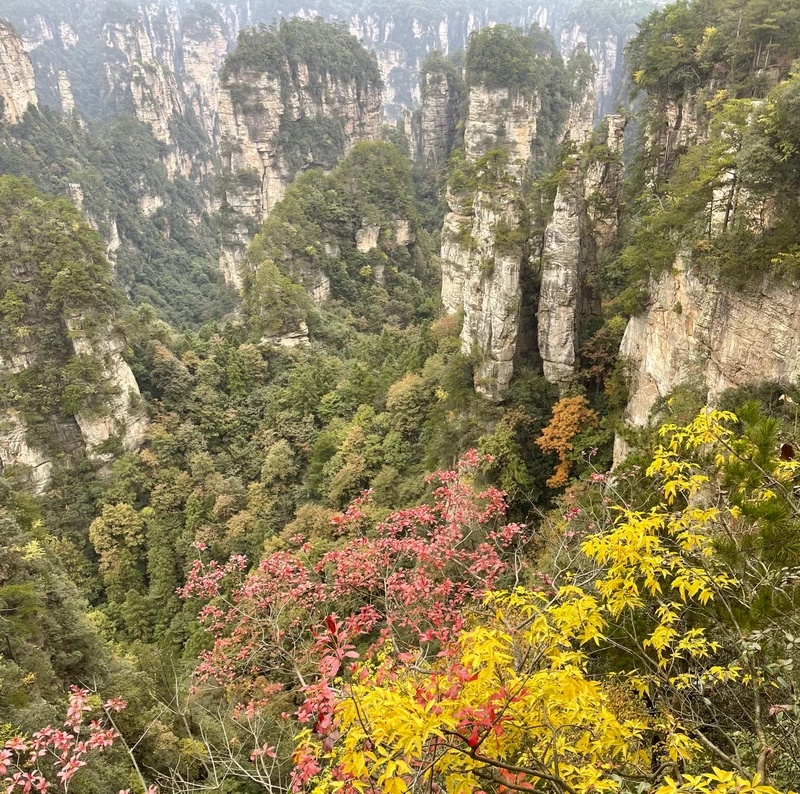
Autumn Colours in Zhangjiajie
Do not expect every mountain to turn completely red. Much of Zhangjiajie’s vegetation remains evergreen. The characteristic November landscape is a mixture of green forest, yellow leaves, red maples and russet Chinese tallow trees set among the grey sandstone pillars.
That mixture can be more attractive than a single block of colour. After rain, low cloud may move between the peaks while the autumn trees remain visible on the nearer slopes.
Tianzi Mountain
Tianzi Mountain is one of the strongest choices for broad autumn views. Red maples, Chinese tallow trees and other deciduous vegetation appear among the evergreen forest below the principal viewpoints.
The higher elevation means that colours may develop earlier here than in the lower valleys. Wide views are important, so visit during the clearest available weather window.
Morning mist can add depth to photographs, but dense fog may hide the entire peak forest. Do not arrive early solely for the mist without checking current visibility.
Golden Whip Stream
Golden Whip Stream offers a different type of autumn scenery. Instead of looking across distant peaks, you walk below cliffs and trees along the valley floor.
Fallen leaves, yellow foliage and patches of red appear beside the stream. This makes Golden Whip Stream a useful choice when upper-mountain visibility is poor.
The full trail is about 7.5 kilometres, but you do not need to complete it. A shorter out-and-back walk allows you to enjoy the forest without committing to a long one-way route.
Wet leaves and smooth paving can be slippery. Wear shoes with good grip, especially after rain.
Yangjiajie
Yangjiajie can offer a quieter combination of sandstone walls and autumn forest. Its colour is often strongest from late October into November, depending on that year’s weather.
However, “quieter” does not mean easy. Some routes include steep steps, narrow paths and physically demanding sections. Check the exact route before adding Yangjiajie to an already full day.
For most first-time visitors, Yangjiajie works best as an optional addition rather than a replacement for Yuanjiajie and Tianzi Mountain.
Tianmen Mountain
The Tianmen Mountain cableway provides a useful view of how autumn develops at different elevations. Forest colour may change gradually as the cable car climbs from Zhangjiajie city toward the mountaintop.
The upper circuit can offer wide views of mixed autumn forest during November. In some years, colour continues into late November or early December, but this should not be treated as a fixed annual schedule.
Tianmen Mountain also feels colder and more exposed than the city. Fog can hide the slopes, while strong wind or unsafe conditions may affect cableway and walking-route operations.
When Is the Best Time?
For the widest choice of locations, early to mid-November is generally the safest period. Tianzi Mountain and other higher areas may already show strong colour, while the lower valleys are beginning to change.
Later November can still be attractive, particularly along lower routes and on warmer slopes. However, a cold spell or several windy days may remove many leaves quickly.
Autumn colour is therefore easier to plan as a general period than as a particular date. Check recent local photographs shortly before arrival, making sure they show the location and date.
What to Wear for Autumn Viewing
Do not let a mild city forecast determine your mountain clothing. Upper areas can feel much colder because of elevation, wind, mist and long outdoor queues.
Bring a fleece or light insulated jacket beneath a wind-resistant outer layer. A thin down jacket may be useful during a cold spell, particularly for early morning visits.
Carry a lightweight rain jacket rather than relying only on an umbrella. Rain is possible in November, and wet stone, fallen leaves and steps require shoes with reliable grip.
Rain does not always spoil the autumn scenery. Clearing conditions after rain may produce moving cloud around the peaks. However, cloud-sea views are never guaranteed, so keep the upper-mountain day flexible.
Are the Crowds Smaller in November?
November usually avoids the extreme pressure associated with China’s summer holidays and the National Day holiday in early October.
Nevertheless, smaller seasonal crowds do not mean empty attractions. Zhangjiajie concentrates visitors at a limited number of elevators, cableways, shuttle stops and famous viewpoints.
The Bailong Elevator, Yuanjiajie and Tianzi Mountain can still develop long queues, particularly on clear days. When the weather improves after several cloudy days, many visitors may choose the same route.
Weekends can also feel busier than weekdays. Group tours often arrive in waves, so a quiet path may suddenly become crowded when several sightseeing buses unload.
Reserve an early entry period when practical. However, do not assume that the earliest hour always has the best view. Low cloud may remain over the peaks in the morning and lift later.
A sensible November plan balances crowd avoidance with visibility. Ask your hotel or park staff about current conditions before committing to a route.
A Flexible Three-Day November Plan
Three days provide useful protection against uncertain visibility and shorter daylight.
Day 1: Yuanjiajie and Tianzi Mountain
Use the clearest day for the main upper-mountain circuit.
From Wulingyuan East Gate, one practical route is to take the sightseeing bus to the Tianzi Mountain Cableway, ride up, visit selected Tianzi Mountain viewpoints and continue by upper-mountain bus to Yuanjiajie.
After Yuanjiajie, descend by the Bailong Elevator and return to the East Gate by sightseeing bus. The route direction can be reversed if queues, maintenance or visibility favour the other option.
Allow six to eight hours. November days are shorter, so avoid adding every small viewpoint simply because it appears on a map.
Day 2: Tianmen Mountain
Tianmen Mountain is close to Zhangjiajie city rather than Wulingyuan. Stay in the city the previous night if you want a simpler morning.
Choose this day based on the best remaining visibility. Confirm your ticket route, entry period and current operation of the cableway, mountain road and escalators.
Tianmen Mountain can feel considerably colder than the city. Carry gloves and a warm layer even if the streets near the lower cableway station feel mild.
Do not combine Tianmen Mountain with an evening train unless you have a generous buffer. Queues, route controls and transport delays can make the finish time difficult to predict.
Day 3: A Weather-Resistant Alternative
Use a cloudy or lightly rainy day for Golden Whip Stream, Ten-Mile Gallery or Yellow Dragon Cave.
Golden Whip Stream offers a forest and valley experience below the high viewpoints. You can walk part of the trail and return the same way instead of completing the full route.
Ten-Mile Gallery is another lower-level option. Its sightseeing tram can reduce walking, although the visit still includes outdoor sections.
Yellow Dragon Cave offers more protection from the weather, but it is not an effortless indoor attraction. Expect damp surfaces, steps and a substantial visitor route.
Two Days Instead of Three
If you have only two sightseeing days, prioritize Zhangjiajie National Forest Park.
Use the better-weather day for Yuanjiajie and Tianzi Mountain. On the second day, choose between Tianmen Mountain and the lower valley attractions.
Choose Tianmen Mountain if visibility is reasonable and cableways do not worry you. Choose Golden Whip Stream and Ten-Mile Gallery if the upper mountains are hidden, your legs need a quieter day, or you prefer forest walks.
Do not force the Grand Canyon Glass Bridge into a short itinerary simply because it is famous. It is a separate attraction east of Wulingyuan and requires additional road travel.
What to Wear in November
Layering works better than one heavy coat.
Start with a quick-drying base layer. Add a fleece, light insulated jacket or warm sweater. Finish with a wind-resistant and water-resistant outer layer.
A practical November packing list includes:
- A waterproof jacket with a hood
- A fleece or light insulated jacket
- Long trousers
- Shoes with slip-resistant soles
- Warm socks
- Light gloves
- A scarf or neck warmer
- A compact umbrella for town
- Tissues and a small towel
- A waterproof cover for your daypack
- A portable charger
- Your original passport
An umbrella can be awkward on crowded mountain paths and in windy conditions. A hooded jacket is usually more convenient inside the scenic areas.
Avoid carrying a large, heavy backpack. You will repeatedly board buses, enter queues and walk through security checks.
Shorter Daylight Changes the Schedule
November requires more realistic time planning than summer.
Park transport and sightseeing facilities may finish earlier, adjust their schedules or enter maintenance periods as the season changes. Do not depend on an old summer timetable.
Begin early enough to complete the main route before late afternoon. Leave a margin for passport checks, security, toilets, transfers and queues.
Ask staff about the last bus, cableway or elevator service before starting a side route. Missing a final connection can leave you facing a long walk or a complicated return.
Carry a charged phone, but also save screenshots of the route and Chinese attraction names. Mobile reception can weaken in mountain valleys.
Where to Stay in November
Stay in Wulingyuan if you plan consecutive days inside Zhangjiajie National Forest Park. A hotel near the East Gate reduces morning transport and makes it easier to ask about current park conditions.
Stay in Zhangjiajie city for Tianmen Mountain or an early flight or train. The lower Tianmen Mountain cableway station, airport and urban transport connections are in or near the city area.
Changing hotels once can be worthwhile during a three-day visit. For example, spend two nights in Wulingyuan for the national park, then move to Zhangjiajie city before Tianmen Mountain and departure.
Check whether the room has reliable heating. Small guesthouses and older hotels may feel damp during a cold spell even when the outdoor temperature does not appear extreme.
Seasonal Closures and Maintenance
November is not automatically a closure month. However, scenic transport can stop temporarily because of wind, maintenance, inspection or unsafe conditions.
Cableways and elevators require periodic maintenance. A closure can change the entire route because Zhangjiajie’s upper and lower roads operate as separate transport systems.
Check official scenic-area notices before arrival and again the evening before each visit. Confirm:
- Tianzi Mountain Cableway operation
- Bailong Elevator operation
- Yangjiajie Cableway operation
- Current park-bus routes
- Tianmen Mountain ticket routes
- Last entry and final transport times
- Weather or geological-hazard warnings
If one major facility closes, do not improvise a long staircase route unless everyone understands the distance and physical difficulty.
Ruqin’s Practical Advice
November is a reasonable time to visit Zhangjiajie, especially if you prefer cooler walking conditions and fewer holiday crowds. It is not a guarantee of clear skies, autumn colour or empty viewpoints.
Allow three days if the sandstone scenery is a major reason for your journey. Keep Yuanjiajie, Tianzi Mountain and Tianmen Mountain flexible until the short-range forecast becomes clearer.
Pack layers, begin early and expect the upper mountains to feel colder than Zhangjiajie city. Most importantly, do not judge the entire trip by one foggy morning. Use the best available weather window rather than waiting for a perfect forecast.
Further Reading
Zhangjiajie National Forest Park: East Gate Route Map & Travel Tips
Zhangjiajie in Rain and Fog: How to Plan Your Visit
Where to Stay in Zhangjiajie: City or Wulingyuan?
Zhangjiajie for Senior Travelers: An Easier Two-Day Park Route
Zhangjiajie Luggage Storage: A Practical Arrival and Departure Guide
Zhangjiajie With or Without a Guide: A Practical Comparison