
Written by Ruqin
August 08. 2026
Walking Into a Chinese Temple: A Traveler’s First Encounter with Buddhism
When I travel with foreign visitors in China, there is one type of place where their voices often become quieter.
It is the Buddhist temple.
Whether we visit Lingyin Temple (灵隐寺) in Hangzhou, White Horse Temple (白马寺) in Luoyang, or Yonghe Temple (雍和宫) in Beijing, I often notice the same change. After passing through the temple gate, visitors naturally slow down. They look around, listen to the bells, and begin to observe the details around them.
Then they often turn to me and ask:
“How is Chinese Buddhism different from Buddhism in India?”
“How should I visit a Chinese temple?”
These are very good questions.
A Buddhist temple is not only a religious place. For travelers, it is also a window into Chinese history, architecture, art, and the way Chinese people have understood life for more than two thousand years.
You do not need to be a Buddhist to appreciate a temple.
You only need to walk in with curiosity and respect.
How Buddhism Came to China: The Story of White Horse Temple
Buddhism began in ancient India around the 6th to 5th century BC. Its founder was Siddhartha Gautama, who later became known as the Buddha.
The exact date when Buddhism arrived in China is still debated among historians. However, most scholars believe it entered China around the late 1st century BC to the middle of the 1st century AD, during the Han Dynasty.
There is a famous story about how Buddhism officially entered China.
According to tradition, Emperor Ming of the Eastern Han Dynasty once dreamed of a golden figure shining in the sky. Curious about this figure, he sent envoys westward to seek Buddhist teachings.
The envoys traveled to the ancient region of Tianzhu, the Chinese name for India, and returned with Buddhist scriptures and images. They also brought two Indian monks back to China.
In AD 68, Emperor Ming built a temple in Luoyang for these monks. Because the white horses that carried the Buddhist scriptures were also kept there, the temple became known as White Horse Temple (白马寺).
Today, White Horse Temple is often considered the first Buddhist temple in China.
Nearly two thousand years later, it still stands outside Luoyang.
When you walk through its gates, you are not only visiting an old temple. You are stepping into the beginning of a long cultural journey that changed China forever.
How Chinese Buddhism Became Different
When Buddhism arrived in China, it did not remain exactly the same as it was in India.
It entered a society that already had deep traditions, including Confucian ideas about family and social responsibility, as well as Daoist ideas about nature and harmony.
Over many centuries, Buddhism and Chinese culture continued to influence each other.
The result was a form of Buddhism that became distinctly Chinese.
One important difference is the relationship with everyday life.
Some early Buddhist traditions emphasized leaving worldly concerns behind and seeking spiritual liberation. Chinese Buddhism, however, gradually became more connected with family, society, daily ethics, and community life.
It absorbed ideas from Confucianism and Daoism, then developed its own character.
This is why Chinese Buddhist temples often feel different from temples in India or Southeast Asia.
The architecture, statues, rituals, and atmosphere all carry Chinese cultural influences.
If you travel across China, you will also discover that Buddhism has different forms in different regions.
Han Buddhism (汉传佛教)
Most Buddhist temples in eastern and central China belong to Han Buddhism.
These temples usually have symmetrical courtyards, wooden halls, gray tiles, yellow walls, and a clear central axis.
Places such as Lingyin Temple (灵隐寺) in Hangzhou and White Horse Temple (白马寺) in Luoyang are good examples.
Tibetan Buddhism (藏传佛教)
In Tibet and some areas of western China, you will find Tibetan Buddhism.
The temples often feature white walls, golden roofs, colorful prayer flags, and a very different visual atmosphere.
The Potala Palace (布达拉宫) in Lhasa is perhaps the most famous example.
Theravada Buddhism (南传佛教)
In Yunnan, especially around Xishuangbanna, you can see Theravada Buddhism.
The temples have a stronger connection with Southeast Asian Buddhist traditions, with golden decorations, pointed roofs, and tropical surroundings.
So, when you travel through China, you are not seeing only one Buddhism.
You are seeing different cultural expressions of the same tradition.
How to Read a Chinese Buddhist Temple
Many foreign visitors enter a Chinese temple and immediately notice one thing:
There is a strong sense of order.
Traditional Han Buddhist temples usually follow a clear layout. Most face south and develop along a north-south central axis.
When you enter from the front and walk northward, you are almost reading a story page by page.
Each hall has its own meaning.
The Mountain Gate (山门)
The first entrance is called the Mountain Gate (山门).
Although many temples today are not located deep in mountains, the traditional name remains because many early temples were built among forests and mountains.
The gate often has three openings, symbolizing the “Three Gates of Liberation” in Buddhist thought.
Inside, you usually see two powerful guardian figures called Vajra Warriors (金刚力士). They protect the temple and represent strength against negative forces.
When visitors pass through this gate, many people naturally lower their voices.
That change of atmosphere is part of the temple experience.
The Bell and Drum Towers (钟楼、鼓楼)
After entering, you often see the bell tower and drum tower on both sides.
The sounds of bells in the morning and drums in the evening once helped organize monastic life.
The famous expression “morning bells and evening drums” (晨钟暮鼓) describes not only a daily schedule but also a peaceful rhythm of life.
The Hall of Heavenly Kings (天王殿)
The next important building is usually the Hall of Heavenly Kings (天王殿).
Inside, you often find a smiling statue of Maitreya Buddha (弥勒佛).
With a large belly and a cheerful expression, this figure represents openness, happiness, and tolerance.
Behind Maitreya stands Skanda Bodhisattva (韦驮菩萨), while the Four Heavenly Kings stand on both sides.
Each Heavenly King protects one direction of the world.
The Mahavira Hall (大雄宝殿)
The most important building in a Chinese Buddhist temple is usually the Mahavira Hall (大雄宝殿).
“Mahavira” is a translation of a Sanskrit title referring to the Buddha’s great spiritual power.
This is the main hall of the temple.
Inside, you may see different arrangements of Buddha statues.
Some temples display Shakyamuni Buddha (释迦牟尼佛) alone. Others show the Three Buddhas representing different times or the Three Bodies of Buddha.
You may also see the Eighteen Arhats (十八罗汉) standing nearby.
When you enter this hall, the outside noise seems to disappear. The light becomes softer, incense fills the air, and many visitors naturally become quiet.
Even people who are not religious often feel a sense of calm.
Beyond the Main Hall
Behind the Mahavira Hall, many temples have a Dharma Hall (法堂) or Scripture Library (藏经楼).
Some also have special halls dedicated to different Buddhist figures, such as Guanyin Hall (观音殿) or Ksitigarbha Hall (地藏殿).
The side buildings often include halls connected with temple history and Buddhist traditions.
A temple is not just a collection of buildings.
The entire layout tells a story.
How to Visit a Buddhist Temple Respectfully
Chinese Buddhist temples welcome visitors, whether they are believers or simply travelers interested in culture.
However, a few simple habits will make your visit more comfortable and respectful.
First, dress appropriately.
You do not need formal clothing, but avoid entering temples wearing very revealing clothes such as sleeveless shirts, very short pants, or slippers.
When entering halls, many visitors also remove hats as a sign of respect.
Second, pay attention to your footsteps.
Do not step directly on the threshold. Step over it.
Inside the halls, keep your voice low. Avoid loud conversations, jokes, or behavior that may disturb worshippers.
Third, observe quietly.
If you wish, you may place your hands together and bow slightly in front of a Buddha statue.
You do not need to kneel or copy religious practices if you are not familiar with them.
Sincerity and respect are enough.
Also remember that monks’ living areas are usually private. Do not enter without permission.
If you meet a monk, you may greet them with “Amituofo” (阿弥陀佛), a common Buddhist expression.
Finally, avoid smoking, drinking alcohol, or eating meat inside temple areas.
Small gestures show respect for the place and the people who visit it.
Why Buddhist Temples Matter for Travelers
Many foreign visitors ask me:
“I am not Buddhist. Is there any reason for me to visit a Buddhist temple?”
My answer is always yes.
A temple is not only a place of belief.
It is also a place where travelers can slow down.
China’s cities can be busy. The streets are full of traffic, voices, advertisements, and movement.
However, once you walk through a temple gate, the atmosphere changes.
Ancient trees rise above the courtyard. The sound of the city becomes distant. Sunlight passes through wooden windows and falls softly on old statues.
You do not need to pray.
You do not need to make a wish.
Sometimes, simply sitting quietly for a few minutes is enough.
That is the gift a temple offers travelers.
It gives you a place where you do not have to hurry.
Chinese Buddhist temples are also part of China’s relationship with nature.
Ancient temples hidden in mountains, Buddhist caves carved into cliffs, and statues created in stone are not separate from the landscape.
They are part of the landscape.
Chinese people placed their beliefs, artistic imagination, and understanding of nature into wood, stone, and mountains.
When you visit a temple, you are also visiting a way of seeing the world.
Where to Experience Chinese Buddhism in China
If you want to experience Chinese Buddhism during your travels, several places are especially meaningful.
Beijing: Yonghe Temple (雍和宫) and Fayuan Temple (法源寺)
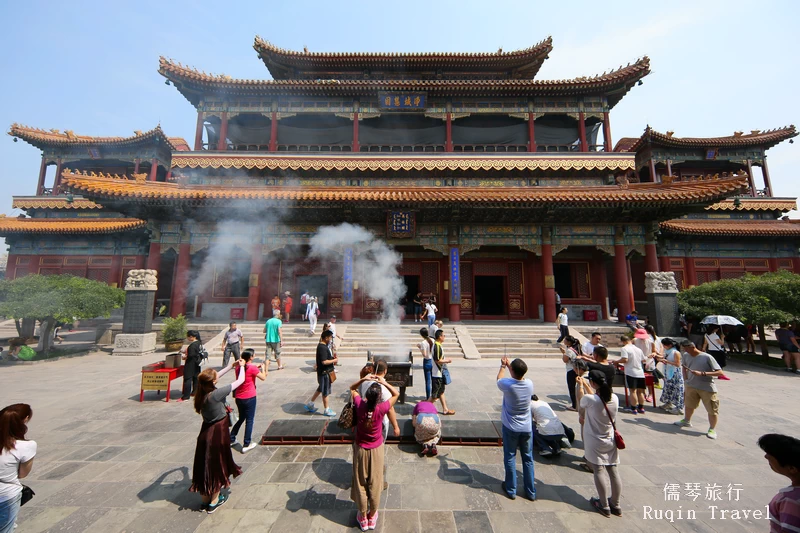
In Beijing, Yonghe Temple (雍和宫) is one of the most famous Buddhist temples.
Although it is a Tibetan Buddhist temple, it has become an important cultural landmark in the city.
Its halls, incense, and religious atmosphere attract visitors from around the world.
For a deeper look at Han Buddhism, Fayuan Temple (法源寺) is one of Beijing’s oldest Buddhist temples.
Hangzhou: Lingyin Temple (灵隐寺)
Located beside mountains and forests, Lingyin Temple is one of China’s most famous Buddhist temples.
Its peaceful surroundings make it a perfect place to experience the connection between Buddhism and nature.
Nearby Feilai Peak (飞来峰) also contains impressive Buddhist stone carvings.
Luoyang: White Horse Temple (白马寺) and Longmen Grottoes (龙门石窟)
Luoyang is one of the best destinations for understanding early Chinese Buddhism.
White Horse Temple connects you with the arrival of Buddhism in China.
The nearby Longmen Grottoes show how Buddhist art transformed Chinese stone carving.
Thousands of statues carved into cliffs tell a story of faith, art, and history.
Shanxi: Mount Wutai (五台山)
Mount Wutai is one of the Four Sacred Buddhist Mountains of China.
The mountain combines temples, forests, and traditional pilgrimage culture.
Many visitors come not only to see buildings but also to experience the peaceful mountain environment.
Sichuan: Mount Emei (峨眉山)
Mount Emei is another famous Buddhist mountain.
The temples are surrounded by forests, clouds, and dramatic landscapes.
The journey itself becomes part of the experience.
Anhui: Mount Jiuhua (九华山)
Mount Jiuhua is especially associated with Ksitigarbha Bodhisattva (地藏菩萨).
The mountain’s temples and quiet paths attract visitors looking for a deeper cultural experience.
Final Thoughts: A Temple Is Not Only a Place of Worship
You do not need to become a Buddhist to understand a Chinese Buddhist temple.
You only need to slow down and observe.
When you stand in a temple courtyard and watch sunlight move across old walls, when you hear wind passing through ancient trees, or when you sit beside a mountain temple and listen to distant bells, you are already experiencing something important.
Buddhism in China is not only found in scriptures.
It is also found in architecture, art, mountains, gardens, and everyday culture.
A Chinese temple is not just a sightseeing stop.
It is a place where history, nature, and human thoughts meet.
So, the next time you enter a Buddhist temple in China, do not rush to find the “main attraction.”
Find a quiet corner.
Stand there for a while.
Watch the light change.
Listen to the silence.
Sometimes, that quiet moment becomes the most memorable part of your journey.
Ruqin is the founder of Ruqintravel.com and has spent more than four decades working in China’s travel industry. Drawing on hands-on experience in cities like Beijing and Hangzhou, he personally researches and updates each guide to help international travelers navigate China with confidence.
Further Reading
Understanding Laozi: A Foreigner’s Guide to His Philosophy and Taoism
How to Understand Mencius: A Foreigner’s Guide to His Philosophy
Confucius Philosophy – A Foreigner’s Guide to Confucianism
Feng Shui – A Foreigner’s Guide – Ruqin China Travel
Chinese Zodiac Signs: Understanding the Meaning Behind the 12 Animals