
Words and Photos by Ruqin
Walked on August 29, 2026
Quick Walk Overview
Start: Ciqikou Station Line 7, Exit A, or Chongwenmen Station Line 2, Exit H
End: Xianyukou Street, near Qianmen Street
Distance: Approx. 2 km from Ciqikou; slightly shorter from Chongwenmen
Walking Time: Approx. 1–2 hours with photo stops
West Xinglong Street itself: Approx. 700 metres
Best Time: Late afternoon into early evening
Surface: Flat sidewalks and paved streets
Crowd Level: Usually moderate; busier around commuting hours and on weekends
Walk Direction: East → west
I walked West Xinglong Street ( also known as Xixinglong Jie ) on a Saturday afternoon in late August, starting from Ciqikou and finishing at Xianyukou near Qianmen. It is an easy central Beijing walk, but what I like about it is the change in pace: I began among the traffic and shops of Chongwenmen, then gradually moved into a much smaller street lined with trees, cafés, restaurants, bars and entrances to the Caochang hutongs.
West Xinglong Street is only about 700 metres long, so this is not a walk I would rush. Late afternoon worked particularly well for me. By the time I reached the street, the sun was already lower, shadows were stretching across the pavement, and the red lanterns were beginning to come on.
Why I Walked This Route
I had passed West Xinglong Street many times before, usually on my way somewhere else. Sometimes I was heading toward Qianmen; on other occasions I was going into the Caochang hutongs immediately south of the street.
For a while, parts of West Xinglong Street were being renovated. Restaurants, cafés and other storefronts were still taking shape, so I kept telling myself I would return when the street felt more settled.
That was the main reason for this walk.

West Xinglong Street Walking Route Map, Beijing
I also wanted to see how the street worked as a photo walk in late-afternoon light. Qianmen can become very busy, and I was looking for a route where I could slow down without going far out of my way. West Xinglong Street turned out to be useful for exactly that.
Most visitors coming from Qianmen will naturally enter West Xinglong Street from the west and walk east. I did the opposite, starting from Ciqikou and walking west toward Qianmen. Either direction works, but I liked finishing in Xianyukou, where I could continue directly into the Qianmen area.
Step-by-Step Walking Route
Step 1: Ciqikou Station → East Xinglong Street
Distance: Approx. 500 metres
Walking Time: Approx. 8–10 minutes
At around 5:30 pm, I came out of Ciqikou Station Line 7 through Exit A and turned north along Chongwenmen Outer Street.
This first part of the walk feels very different from West Xinglong Street. Chongwenmen is busy and commercial, with a steady stream of pedestrians, bicycles and delivery riders.
As I approached the intersection with East Xinglong Street, quite a few people were waiting at the lights. It was getting close to the evening rush, and delivery riders were particularly noticeable—some weaving through the traffic, others using a few spare minutes to sit and rest beside their bikes.

Chongwenmen street life, pedestrians at the crossing, or delivery riders during the late-afternoon rush.
Because it was Saturday, the atmosphere was not entirely about commuting. Near the shopping centres I saw parents spending time outside with their children, which softened what is otherwise a fairly busy city intersection.
Step 2: Turn Left onto East Xinglong Street
At the junction, turn left and walk west along East Xinglong Street.
Distance: Approx. 600 metres
Walking Time: Approx. 10–15 minutes
East Xinglong Street runs west from Chongwenmen Outer Street until it meets West Xinglong Street. The two streets share the Xinglong name, associated with the Xinglong Temple that once stood in this area during the Qing dynasty.
Today, East Xinglong Street feels more like an everyday neighbourhood commercial street. Restaurants, small shops and services line the road, and local residents come and go as part of their normal routines.

East Xinglong Street storefronts and everyday neighbourhood activity
I did not spend too long photographing this section. For me, it worked mainly as the approach to West Xinglong Street, although the transition itself is worth noticing. The farther west I walked, the more the scale of the surroundings began to change.
Add photo(s): East Xinglong Street storefronts or everyday neighbourhood activity.
Step 3: Enter West Xinglong Street
At the western end of East Xinglong Street, continue straight onto West Xinglong Street.
At the eastern end of West Xinglong Street is the Central Gifts and Cultural Relics Management Center. The centre displays gifts and related cultural objects connected with China’s diplomatic activities.

The Central Gifts and Cultural Relics Management Center
Admission arrangements may change, so I recommend checking the centre’s current reservation requirements and opening information before making it part of your walk.
From here, continue west into West Xinglong Street.
Step 4: Slow Down for the Late-Afternoon Light
West Xinglong Street length: Approx. 700 metres
Walking Time: Approx. 15 minutes without stops; allow 45–60 minutes or more for photography, cafés and side streets.
This was where the walk really began for me.
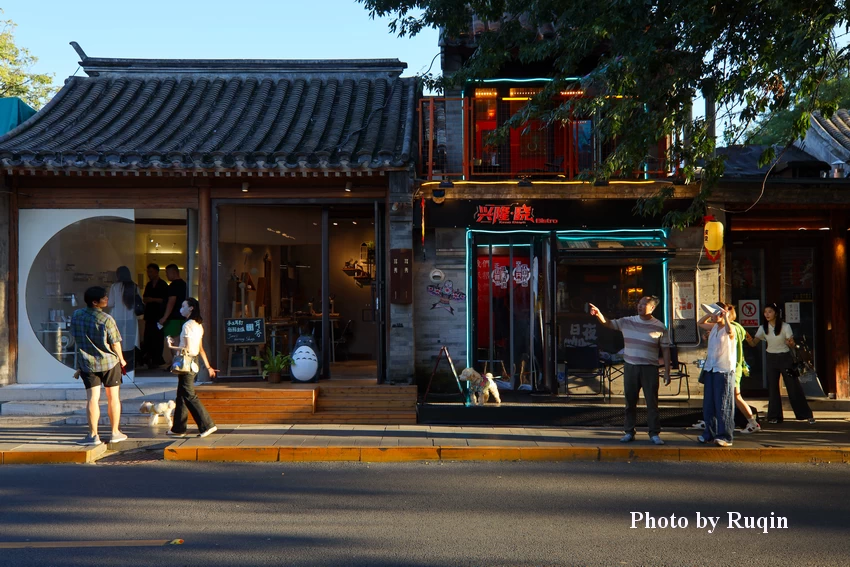
When I entered West Xinglong Street, the late-afternoon sun was coming through the trees at an angle. Mature scholar trees reached over parts of the road, breaking the sunlight into smaller patches across the pavement and building façades.
The shadows were becoming longer, but it was still bright enough to photograph without the street feeling dark. Red lanterns had already been switched on, so for a while I had both natural evening light and the warmer lantern light in the same scene.

Late-afternoon sunlight filtering through the trees onto West Xinglong Street.
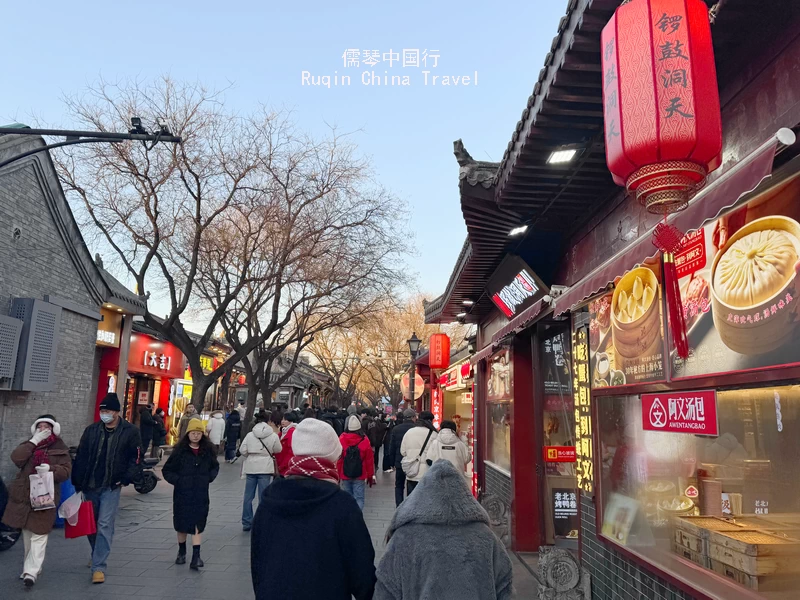
I noticed quite a few young people taking photos here. Some stood beneath the trees waiting for a clear background; others photographed each other beside shopfronts or under the lanterns.

Young visitors taking photos on West Xinglong Street in the late-afternoon light.
It did not feel like an organised photo spot. People simply stopped where the light looked good, took a few pictures, then continued walking. I found that rhythm much easier to photograph than the constant pedestrian flow on Qianmen Street.
Step 5: Cafés, Restaurants and Street Life
Continue west slowly.
One reason I like West Xinglong Street is that the street still works on two levels. There are newer cafés, bars and carefully designed storefronts, but there is also ordinary neighbourhood life spilling out from the surrounding hutongs.

Visitors chatting on sidewalk seating along West Xinglong Street.
I saw people sitting outside talking and resting while younger visitors moved between cafés and shops with their phones and cameras. The two groups were not separated into different areas. They occupied the same street.

People sitting outside a café, restaurant or bar.
That mix is more interesting to me than a street that has been completely turned over to tourism.
Step 6: 十 TIAO and the Newer Side of West Xinglong Street
One of the more noticeable additions to the street is 十条 TIAO, the cocktail bar at Mandarin Oriental Qianmen. Its address: No.40, West Xinglong Street. Business Hours: 6:00 pm–1:00 or 2:00 am.
Its presence reflects the newer side of the neighbourhood: contemporary hospitality and design placed very close to old hutong lanes and long-established residential streets.
Even if I am not stopping for a drink, this part of West Xinglong Street is useful photographically. The façades, lighting, lanterns and people entering restaurants create more layers as evening approaches.

Exterior of TIAO on West Xinglong Street.
If you plan to visit a particular bar or restaurant rather than simply photograph the street, check its current opening hours before coming.
Step 7: DRINKER Coffee Bistro and Small Streetfront Details
Continue west and look closely at the smaller storefronts.
DRINKER Coffee Bistro caught my attention because it does not have a large or imposing frontage. There were wooden seats and woven cushions outside, with greenery partly screening the shop from the street.
This is the kind of place that suits the pace of West Xinglong Street. You can stop for coffee or something light, but you can also simply photograph the small details—the chairs, signs, trees, windows and people sitting outside.

Exterior of DRINKER Coffee Bistro.
There are plenty of other food choices along and around the street. Not everything is a fashionable café or bar. You can still find more familiar Beijing food, including noodles, jianbing and hotpot.

Traditional Beijing restaurant storefronts.
That variety matters. It keeps the street from feeling like a single-purpose dining or nightlife district.
Step 8: Look for the Street While It Is Still Changing
I also passed Arome Manpo (馥郁满铺), a Chinese fragrance and skincare brand preparing a storefront on West Xinglong Street when I walked here.

Arome Manpo storefront as seen during the August 2026 walk.
It was not yet open during my August 2026 visit.
I actually like recording places at this stage. A street is never really “finished.” Shops arrive, façades change and businesses disappear. Photographing these in-between moments gives me a record of how a Beijing neighbourhood looked on one particular walk.
Step 9: Detour into the Caochang Hutongs
If you have another hour or two, this is where I would leave West Xinglong Street temporarily and explore some of the Caochang hutongs immediately to the south.
You do not need to walk every lane.
I usually choose one or two and see where the street activity takes me. The atmosphere changes quickly once you move away from the main street. Residents still live here, and the lanes feel much more domestic.

Residential street life inside one of the Caochang hutongs
On this walk, that contrast was especially clear. A few minutes earlier I had been photographing stylish storefronts; then I was back among hutong homes and neighbours sitting outside.
That quick shift is one of the things I still enjoy about walking this part of Beijing.
If you want to explore these lanes in more detail, see my separate guide to the Caochang Hutongs.
Step 10: Continue West toward Xianyukou
Return to West Xinglong Street and continue walking west.
There is a public toilet toward the western end of the street, which is useful to know if you are continuing into Qianmen for another hour or two.

A public toilet toward the western end of the stree
West Xinglong Street eventually leads naturally into Xianyukou Street. There is no complicated navigation here—just keep walking west.
Step 11: West Xinglong Street → Xianyukou Street
Once I reached Xianyukou, the character of the walk changed again.
Xianyukou is another historic street connected directly with the Qianmen area, and there is much more foot traffic as you approach Qianmen Street.

Xianyukou Street
On this visit, I also stopped at the historic Tianleyuan Theatre on Xianyukou Street. I have written about that visit separately in my field report, Inside Tianleyuan Theatre on Xianyukou Street in Beijing.
From Xianyukou, you can finish the walk or continue west to Qianmen Street.
What the Area Feels Like Right Now
When I walked West Xinglong Street in late August 2026, it felt much more settled than on my earlier visits.
The renovations had brought in new restaurants, cafés, bars and carefully designed storefronts, but I did not feel that the street had completely lost its connection with the surrounding neighbourhood. The Caochang hutongs are only a few steps away, and local residential life remains visible.

The shadows were becoming longer on West Xinglong Street
The biggest contrast is with nearby Qianmen Street. Qianmen draws much heavier visitor traffic and has the feel of a major sightseeing area. West Xinglong Street is smaller and easier to walk slowly.

Late afternoon was particularly comfortable for photography. I liked the combination of angled sunlight, tree shadows and lanterns gradually becoming brighter as daylight faded. If photography is your main reason for coming, I would choose this transition period rather than the middle of the day.
Practical Tips
- Allow more time than the distance suggests. West Xinglong Street is short, but I would give it at least 45–60 minutes if you want to photograph it properly.
- Come in late afternoon. The lower sun worked well for me, especially where it filtered through the roadside trees.
- Expect a busier approach from Chongwenmen. The first part of this route crosses a commercial district and can be noticeably busier around the evening commute.
- Start from Qianmen for an easier variation. If you are already sightseeing around Qianmen or Xianyukou, simply enter West Xinglong Street from its western end and walk east.
- Add the Caochang hutongs if you have time. They provide a useful contrast to the renovated main street and can easily add another one or two hours.
- Wear normal comfortable walking shoes. The route is flat and straightforward; no special footwear is needed.
- Use the public toilet before continuing into Qianmen. There is one toward the western end of West Xinglong Street.
- Check before visiting specific venues. Museum reservations, hotel facilities, restaurant hours and bar opening times can change.
Who This Walk Is Best For
I would recommend this walk if you are already visiting Qianmen but want to see something quieter nearby.
It also works well for street photographers who enjoy people, storefronts, changing light and the transition between renovated commercial spaces and lived-in hutong neighbourhoods. You do not need to be interested in major historical sights to enjoy it.
For a first visit to Beijing, I would not replace Qianmen with West Xinglong Street. I would combine them. Walk Qianmen, turn into Xianyukou, then use West Xinglong Street and the Caochang hutongs to see how quickly the atmosphere can change within a few blocks.
Seasonal Notes
Late August gave me warm weather and a gradual change in temperature toward evening rather than an immediate cool-down. The tree cover helped, and the lower sun became much more pleasant for photography as the afternoon progressed.
In summer, I would avoid making the middle of the day the main photography period. In autumn, the same east–west route should work especially well when the light is lower and the air is clearer, although sunset times will of course be earlier.
Keep Exploring Beijing
Caochang Hutong in Beijing: Maps, Routes, Top Sights & Tips
Sanlihe Park Beijing: Map, Highlights and Travel Tips
Xianyukou Street, Beijing: What to Eat, Shop & See Before You Go
Qianmen Street Beijing: Map, Food, Shopping & Local Tips