Written and updated by Ruqin
Last updated: May 22, 2026
Guilin Travel Guide: Welcome to a dreamscape where misty peaks and jade rivers create nature’s most poetic masterpiece. Nestled in southern China, Guilin is a place where every mountain and stream whispers the timeless elegance of Chinese landscape art.
Picture this: fishermen gliding on bamboo rafts, cormorants poised in stillness, the Li River winding through limestone hills like silk. Ancient poets praised it as “mountains like jade hairpins, rivers like emerald belts”—and today, this living ink painting is yours to explore.
2. Guilin Travel Guide: Best Time to Visit Guilin
If you’re planning a trip to Guilin, let me share a secret. Understanding the rhythm of its seasons—the way this land “breathes”—will completely transform your journey. Guilin isn’t just a destination; she’s like a gentle, poetic woman from the East, dressed in flowing robes of mist and sunlight. Each season gives her a new look. But no matter when you arrive, she welcomes you with quiet grace.
1) Spring (March–May): Misty Dreams Begin
First comes spring. Nature wakes up, and so does the Li River. Temperatures climb slowly—from 15°C in March to 25°C by May. The air carries the scent of wet earth and blooming flowers.
I remember walking by the riverside one April morning. A soft drizzle fell as mountains peeked in and out of the mist. The whole scene looked like an ink painting come to life. Bring a light jacket and an umbrella. And don’t rush—these foggy, dreamlike moments are some of Guilin’s most magical.
2) Summer (June–August): Lush, Alive, and Full of Rainbows
Then comes summer. Guilin becomes vibrant and alive. Temperatures hover around 28°C, sometimes hitting above 30°C in July and August. This is when the Li River is fullest, and the green mountains almost glow under the sunlight.
Yes, you’ll likely get caught in a sudden afternoon shower. I did, more than once. But that rain? It’s refreshing. It passes quickly. And afterward, the whole landscape feels washed clean and sparkling. Just wear breathable clothes and keep a small umbrella handy.
3) Autumn (September–November): A Perfect Time to Wander
Next comes my favorite time—autumn. September starts off warm at around 26°C, and by November, it cools down to about 18°C. The sky is clear, the air crisp, and the city is filled with the scent of blooming osmanthus.
I once wandered the back alleys of Guilin’s old neighborhoods in late October. The golden scent of sweet osmanthus followed me like a whisper. Everything felt calm, balanced, just right. If you love hiking, biking, or photography, this is your season.
4) Winter (December–February): Quiet Beauty
Finally, winter arrives. The average temperature drops to around 9°C. Some days dip below freezing, though snow is rare. But Guilin in winter has its own charm. The crowds disappear. The river slows. And the mountains take on a soft, ink-brushed elegance.
I remember sitting on a stone bench in a quiet village in January, sipping hot tea. A light fog curled around the hills like silk. It was peaceful—almost meditative.
So, When Is the Best Time to Visit Guilin?
Top Choice: September to November
This is the golden window. Perfect weather, fewer rains, and crisp mountain air. Whether you’re floating down the Li River or hiking among the karst hills, everything just feels right.
Runner-Up: April to May
Yes, spring brings drizzle. But that’s what gives Guilin its poetic soul. The rain adds softness to every scene. And with fewer crowds, it’s easier to slip into the quiet rhythm of local life.
A Few Personal Tips
Rain is part of the experience.
Guilin gets around 1887 mm of rain annually. It’s most frequent from April to June. But don’t worry—it rarely rains all day. Bring a light raincoat and you’ll be fine.
Humidity stays high.
Average humidity is about 76%, higher in summer. Pack breathable clothes and stay hydrated.
Every season offers something special.
Want misty mountains? Choose spring. Love lush greens? Go in summer. Prefer clear skies and osmanthus scents? Autumn’s your friend. Craving peace and quiet? Winter is deeply soulful.
2. Where to Stay in Guilin: A Local’s Guide to the City’s Four Main Districts
In this Guilin Travel Guide, let me help you find the perfect base for your stay. Guilin isn’t a city with just one center—it’s a collection of vibrant districts, each with its own charm, pace, and personality.

Guilin Map: Key Districts, Train Station and Airport ( Google Maps source)
From poetic riverside walks to buzzing food streets and quiet green parks, where you stay can shape how you experience this stunning landscape. On my own journey, I explored four core districts—and each one offered something unforgettable.
1) Xiufeng District 秀峰区– Where History Beats at the Heart of the City
I started in Xiufeng District (秀峰区). Honestly, if it’s your first time in Guilin, this is the place to begin. Xiufeng is Guilin’s core—where ancient stories and modern life intertwine like the roots of an old tree.
By day, I strolled along the Two Rivers and Four Lakes scenic area (两江四湖景区). At night, the city lit up around me—Rong Lake and Shan Lake sparkling like a dream. I lost track of time walking under lantern-lit bridges, their reflections rippling gently beneath my feet.

Zhengyang Pedestrian Street in Xiufeng District, Guilin
Right nearby, Zhengyang Pedestrian Street (正阳步行街) buzzed with life. The smell of grilled skewers drifted from food stalls, locals laughed over hot bowls of rice noodles, and tiny shops spilled out onto cobblestone alleys. Meanwhile, East-West Alley (东西巷) felt like stepping back into a storybook—historic façades, tiny courtyards, and quiet teahouses.
And then there’s Jingjiang Princes’ City (靖江王), a Ming Dynasty palace complex. I climbed Solitary Beauty Peak (独秀峰) behind it one morning. From the top, the entire city unfolded below me, wrapped in mist and mountains. It was unforgettable.
Where to stay in Xiufeng:
- Around the lakes: for stunning views and quiet mornings
- Near Zhengyang Street: for nightlife, food, and shopping
- By the Prince City: if you love being wrapped in history
Perfect for: First-time visitors, night owls, history buffs, and anyone who loves being in the heart of it all.
2) Diecai District 叠彩区– For Nature, Peace, and Postcard Views
Next, I drifted north to Diecai District (叠彩区). This district felt like a painted scroll come to life. The pace slowed, and suddenly I could breathe deeper.
Diecai Hill (叠彩山) was my favorite sunrise spot. I climbed it early one morning—fog still lingering over rooftops, the Li River shimmering below. From the top, Guilin looked soft, delicate, and impossibly green.

Mulong Lake (木龙湖) in Diecai District, Guilin
Mulong Lake (木龙湖) charmed me with its blend of nature and Song Dynasty vibes. Stone bridges, arched gateways, and water so calm it looked like glass. And of course, Reed Flute Cave (芦笛岩)—oh, the colors! It’s called Nature’s Art Palace for a reason. Inside, the limestone formations glow under shifting lights, like walking through a dream.
One afternoon, I wandered into Yushan Park (虞山公园), and found locals practicing tai chi among centuries-old trees. That’s the kind of slow beauty Diecai offers.
Transport tip:
Guilin North Railway Station is here, making it super convenient if you’re arriving or leaving by high-speed train.
Where to stay in Diecai:
- Near Diecai Hill: for morning hikes and clean air
- Along Zhongshan North Road: for easy transport and local eats
- Close to the North Station: great for early trains or quick connections
Perfect for: Nature lovers, photographers, and anyone seeking a quiet, scenic escape with easy access to the rest of the city.
3) Xiangshan District 象山区– Where Symbols and Street Life Collide
Then came Xiangshan District (象山区), home of Elephant Trunk Hill (象鼻山) —Guilin’s postcard icon. I couldn’t stop staring the first time I saw it. A giant stone “elephant” dipping its trunk into the river, framed by lush green and sparkling water. It’s cliché, yes—but breathtaking nonetheless.
But Xiangshan is more than famous views. It’s where Guilin feels most real. Locals chat at noodle stalls, scooters zip past markets, and the rhythm of life beats loud and fast.
In spring, I wandered through Nanxi Hill Park (南溪山公园), stunned by the cherry blossoms. One petal fell on my camera lens as I stood beneath a tree. A perfect moment.

Wayao Village (瓦窑小镇) in Xiangshan District, Guilin
Later, I explored Wayao Village (瓦窑小镇), where I watched artisans crafting traditional wares with steady, practiced hands. Time moved slowly there.
And when hunger struck? Wenming Road Food Street (文明路美食街) was waiting. I had the best rice noodles of my life there—hand-pulled, steaming, with sour beans and chili oil.
Transport tip:
Guilin Railway Station and Guilin South Stations are both in Xiangshan District, as is the long-distance bus station—ideal if you’re heading to Yangshuo.
Where to stay in Xiangshan:
- By Binjiang Road: for close-up views of Elephant Trunk Hill
- Near the train stations: for convenience and easy transfers
- Around Yinding Road (银锭路): for budget stays and unbeatable local eats
Perfect for: Budget travelers, street food lovers, and anyone wanting a taste of local life.
4) Qixing District 七星区– Modern, Youthful, and Full of Surprises
Finally, I ended up in Qixing District (七星区)—Guilin’s youngest-feeling district. Here, college campuses, high-rises, and leafy parks live side by side. It’s modern, yes—but with just enough old soul to keep things interesting.
I spent a full day in Seven Star Park (七星公园)—easily the largest in Guilin. There’s a zoo, a cave, hiking trails, even a small lake. But the real gem? Camel Hill (骆驼山), a natural rock formation shaped just like its name. It’s quirky, but oddly majestic.
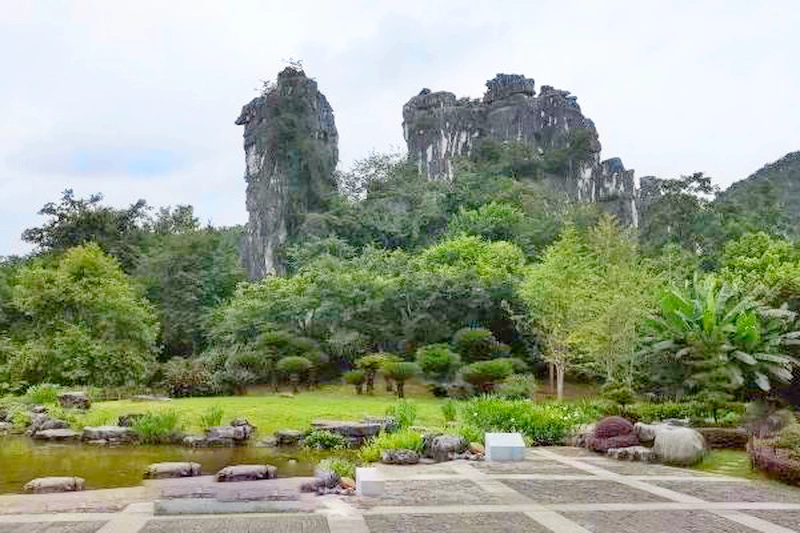
Seven Star Park (七星公园) in Qixing District
I also wandered through Guilin University of Technology (桂林理工大学(屏风校区)). Students lounged under trees with books, couples strolled through gardens, and I felt like I’d stepped into a campus movie scene.
Later, I biked over to Wanda Plaza (高新万达广场), a sleek shopping and dining district. Great for a rainy afternoon. Clean cafes, local fashion, and a great place to people-watch.
And don’t miss Chuanshan Park (穿山公园) at sunset. The view from Tashan (塔山) is golden—literally.
Transport tip:
This area’s close to Guilin Railway Station and well-connected by bus and bike-share.
Where to stay in Qixing:
- Near Seven Star Park: for nature and peace
- Around the universities: affordable food, youthful vibe
- Near Wanda Plaza: for comfort and modern convenience
Perfect for: Young travelers, families, and anyone who enjoys a mix of nature and city comforts.
My Final Tips on Where to Stay in Guilin
Choosing where to stay in Guilin isn’t just about beds and breakfast. It’s about the version of Guilin you want to meet.
- First-timer? Go for Xiufeng. You’ll be close to everything.
- Tight budget? Try Xiangshan for affordable stays and great eats.
- Crave calm and green? Choose Diecai or Qixing.
- Love photography? Diecai and Xiangshan offer unbeatable backdrops.
- Catching a train? Stay near Guilin North (Diecai) or Guilin Station and Guilin South Station (Xiangshan).
When I look back, each district gave me something different. A view. A moment. A meal I’ll never forget.
No matter where you stay, your own Guilin story will begin just outside your door.
3. How I Got to Guilin: Planes, Trains, and the First Breath of Misty Air
In this part of my Guilin Travel Guide, I want to share how to get to Guilin—the very first step of your journey into its poetic landscape. Whether you’re arriving by plane or train, the moment you step into this misty mountain city, you’ll feel like you’ve crossed into another world. And the best part? Getting here is easier than you might think.
1) Flying into Guilin: My First Glimpse from the Sky
I still remember looking out the plane window as we descended toward Guilin Liangjiang International Airport (桂林两江国际机场). The karst peaks began to rise from the land like silent guardians, their tips peeking through a sea of clouds. I couldn’t believe places like this existed outside of paintings.

Guilin Liangjiang International Airport (桂林两江国际机场)
The airport is about 28 kilometers west of the city center. It took me around 45 minutes to reach downtown, though traffic can sometimes stretch it to an hour.
There are a few ways to get into town:
First, I tried the airport shuttle bus. For just 20–25 RMB, it dropped me off right near my hotel. The ride was smooth, the views out the window already hinting at what was to come. You’ll find the ticket booth right outside the arrivals area—it’s well marked and easy to follow.
Another time, I took a taxi. It cost around 100 RMB and was worth every cent after a long flight. No hauling bags, no waiting. Just straight to my guesthouse, door to door. Just be sure to choose an official, metered taxi.
More recently, I booked a Didi (China’s Uber) through the app. It was clean, comfortable, and cost about 80–100 RMB. The driver even played soft music as we cruised into the city through early evening light.
No matter which way you choose, that first ride is special. The city seems to unfold slowly as you arrive—rivers, peaks, old stone bridges—all waiting quietly.
2) Taking the Train: Which Station to Choose?
Traveling China by train is something I always recommend. It’s efficient, scenic, and surprisingly relaxing. Guilin has four main train stations, each with its own strengths.
Guilin Station 桂林站 (Guilin Zhan): My Go-To Favorite
This is the station I use most often. It’s the oldest and most central. Located in Xiangshan District, it’s ideal if you’re staying downtown.

Guilin Station 桂林站
From here, it’s a short 5-10 minute taxi ride to many hotels. You can also hop on one of the many city buses. Or, if your luggage’s light, just walk—it’s that close.
This station serves both high-speed and regular trains. I’ve taken trips from here to Yangshuo, Nanning, even Guangzhou.
Guilin North Station 桂林北站 (Guilin Bei Zhan): For Speed and Reach
If you’re coming from far—like Beijing, Shanghai, Chengdu, or Shenzhen—you’ll likely arrive here. It’s Guilin’s major high-speed rail hub, located in Diecai District.

Guilin North Station 桂林北站
It’s modern, well-organized, and has everything from cafés to luggage lockers. From here, I usually take a taxi (25–35 RMB) or bus (like routes 1, 32, or 100) into the city. The ride takes about 30 minutes.
It’s especially convenient if you’re staying in the north or need to catch an early train the next day.
Guilin West Station 桂林西站 (Guilin Xi Zhan): New and Slightly Remote
This one’s a bit further out, in Lingchuan County (桂林市灵川县定江镇). I arrived here once from Guiyang on a quieter train. It serves some high-speed routes, mostly from the southwest.
It’s not the most convenient if you’re staying downtown, but it works. A taxi will cost about 40–50 RMB and take around 40 minutes. Or you can take bus 22 or 303, then transfer to a taxi.
Guilin South Station 桂林南站 (Guilin Nan Zhan): Mostly for Freight
I’ll be honest—I’ve never had to use this station. It mainly handles cargo, not passengers. Unless you’ve been rerouted, you probably won’t need to go here.
My Arrival Tips for a Smooth Start
- Best for convenience? Guilin Station. It’s central and easy to navigate.
- Best for high-speed trains? Guilin North Station has the most options.
- Flying internationally or from another province? Liangjiang Airport is your gateway.
- Booking train tickets? Use the official 12306 app or a reliable third-party service. And always book in advance, especially during holidays.
- Getting around locally? Download the Didi app for easy rides, and keep some cash handy just in case.
- Show the hotel name in Chinese. Drivers might not speak English, and a screenshot can save you a lot of time.
Whether you glide in by high-speed train or descend through clouds into the airport, how to get to Guilin is simpler than you’d think. The city is well-connected, welcoming, and ready the moment you arrive. And once you’re here? Well, that’s when the real beauty begins.
4. Getting Around Guilin: How I Explored the City Like a Local
Now that we’ve covered how to get to Guilin, let me take you a step further in this Guilin Travel Guide—how to get around in Guilin once you arrive. Honestly, exploring Guilin is part of the joy. The city may be famous for its mountains and rivers, but its charm is also in the little things: the ride past an old bridge, the sudden glimpse of a karst peak from a bus window, the quiet curve of a riverside road on a scooter.
I spent days wandering around, using every kind of transportation—from packed buses to peaceful bike rides. Here’s what I learned, and how you can move like a local too.
1) Buses – The City’s Arteries and a Window into Daily Life
If you’re like me and enjoy watching city life unfold from a window, you’ll love Guilin’s bus system. It’s surprisingly well-connected, incredibly cheap, and easy to use—1 to 2 RMB per ride. Most buses run from 6:30 AM to 10:30 PM, which gave me plenty of time to explore.
First, I downloaded the “Guilin Gongjiao” app (Guilin Bus). It shows live arrival times, nearby routes, and stops. Total lifesaver.
One morning, I took the Sightseeing Line 1—a great intro for first-timers. It connected some of the top sights, like Elephant Trunk Hill and Seven Star Park, and gave me a scenic loop through the city.
I also rode the double-decker sightseeing bus during my first afternoon. Sitting on the top level, breeze in my hair, the Li River glinting in the sun—it was better than any tour.
A few tips:
- Have coins or a transit card, or use Alipay/WeChat to scan and pay.
- Buses get crowded during rush hours (7:30–9:00 AM, 5:00–7:00 PM). I usually traveled between those times for a more peaceful ride.
- Always check the final stop to make sure you’re going the right direction—trust me, I learned that the hard way!
2) Taxis – Easy, Reliable, and Good for Short Trips
Sometimes, I just wanted a direct ride. Especially on rainy days, or when I was carrying my camera gear. That’s when Guilin’s blue and yellow taxis came in handy.
The starting fare is 8 RMB for the first 2 kilometers, then 1.8 RMB per kilometer after that. At night (after 11 PM), the base fare jumps to 9 RMB.
Taxis were everywhere—especially near major attractions and hotels. I hailed a few right off the street, but there are also official taxi stands and a hotline (0773-3810222) if you want to call ahead.
What I loved:
- Door-to-door comfort
- No need to worry about route planning
- Most drivers knew the city like the back of their hand
One tip: Keep your destination written in Chinese on your phone. It avoids confusion and gets you moving faster.
3) Ride-Hailing Apps – My Favorite Way to Travel in Guilin
By far, my go-to for getting around in Guilin was Didi, China’s version of Uber. I also tried Caocao (eco-friendly cars) and T3, which is known for reliable service. All apps are available in English, and the prices were always clear before booking.
For me, this was the most comfortable and modern option. I could call a car from anywhere, even late at night, and never had to explain where I was going. The app handled it all.
What I liked most:
- Real-time updates and driver info
- Cleaner cars and quieter rides
- No language barrier—just drop the pin and go
At Guilin airport and train stations, there are designated pickup zones for Didi. Just follow the signs or ask a staff member for help.
Tip: During holidays or rainy weather, rides get booked fast. I recommend reserving early during busy times.
These were some of the most scenic and useful routes I used to hop between famous spots:
1) Elephant Trunk Hill ↔ Seven Star Park
- Routes: Bus 2, 16, or 23
- Ride time: About 15–20 minutes
- Why I loved it: Crosses the Li River with beautiful views along the bridge
2) Diecai Hill ↔ Zhengyang Pedestrian Street
- Routes: Bus 1, 18, or 99
- Ride time: 10–15 minutes
- When to go: Try it in the evening when the pedestrian street lights up with music and street food
3) Reed Flute Cave ↔ Two Rivers Four Lakes
- Routes: Bus 3 or 213
- Ride time: 25–30 minutes
- Tip: Set aside half a day for this. Reed Flute Cave is further out and worth taking your time
4) Jingjiang Princes’ City ↔ Seven Star Park
- Routes: Bus 14 or 30
- Ride time: 20 minutes
- Highlight: This line cuts through the old city, offering glimpses of traditional homes and tiled rooftops
Final Travel Tips from the Road
- Daytime plan? Combine buses with bike-share apps for quiet riverside paths
- Night travel? Opt for Didi or taxi—more comfortable and safer
- Rainy day or busy season? Go digital—book rides in advance with the app
- Traveling with friends? Sometimes ride-hailing is cheaper per person than buses or taxis
Getting around Guilin was one of my favorite parts of the trip. Each ride showed me a new face of the city—its rhythm, its people, its hidden corners.
5. My One-Day Guilin City Walk: A Journey Through Mountains, Water, and Time
In this part of my Guilin Travel Guide, I’ll share one of my favorite ways to truly feel the city—a Guilin City Walk that flows naturally from west to east, with no backtracking and no rush. It’s a full day that blends caves, mountains, old streets, and night lights. If you only have one day in Guilin, this is how I’d spend it.

One-Day Guilin City Walk Map (Baidu Map source)
Morning: Caves, Peaks, and Guilin’s First Light
First Stop: Reed Flute Cave (芦笛岩)
Recommended time: 8:30 – 9:45
Address: No. 1 Ludi Road, Xiufeng District, Guilin 桂林市秀峰区芦笛路1号
Entrance fee: 90 RMB
I started my morning at Reed Flute Cave (芦笛岩), a place locals call “The Palace of Natural Art.” Arriving early was magical—the air was cool, the crowds hadn’t come yet, and the cave’s silence wrapped around me like a dream.

Reed Flute Cave (芦笛岩)
Inside, the stalactites shimmered in rainbow light. Every curve of stone felt alive, like a frozen waterfall. The reflections in the underground pools looked so perfect they almost fooled my eyes.
Tips: Go for the first guided tour; it’s quieter and more intimate; the cave stays around 18°C, so bring a light jacket.
Second Stop: Diecai Hill (叠彩山)
Recommended time: 10:00 – 11:30
Address: No. 2 Longzhu Road, Diecai District, Guilin 桂林市叠彩区龙珠路2号
Entrance fee: 35 RMB
Getting there: About 15 minutes by taxi from Reed Flute Cave (~15 RMB)
Next, I headed to Diecai Hill—a short, steep climb that rewards you with one of Guilin’s best panoramic views. Standing on Mingyue Peak, I watched the Li River winding through the city like a silk ribbon. The limestone hills framed everything like brushstrokes in a painting.
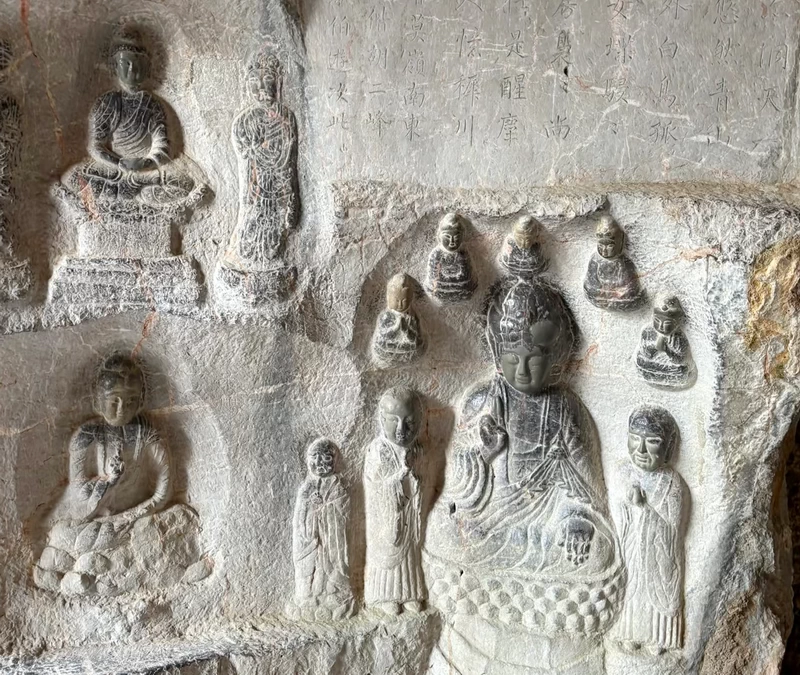
Stone Carvings at the caves in Diecai Hill
The city looked peaceful from above, and for a moment, time stopped.
💡 Tips: Enter from the Diecai Gate and exit through the Xianhe Gate—it’s an easier route; The top offers a perfect 360° photo spot for your Guilin memories.
Late Morning: History and the City’s Icon
Fourth Stop: Jingjiang Princes’ City & Solitary Beauty Peak (靖江王城·独秀峰)
Recommended time: 13:30 – 15:00
Address: No. 1 Wangcheng Road, Xiufeng District, Guilin 桂林市秀峰区王城路1号
Entrance fee: 100 RMB (includes Solitary Beauty Peak)
Getting there: 8-minute walk from Zhengyang Street
After lunch, I strolled toward Jingjiang Princes’ City—a Ming Dynasty royal residence that still whispers history. Inside its walls, centuries-old trees shaded quiet courtyards. I climbed Solitary Beauty Peak, where the famous line “Guilin’s scenery is the best under heaven” is carved into the rock.

Solitary Beauty Peak
From the summit, the city unfolded below me again, ancient and modern all at once. Bells chimed faintly in the distance—it felt timeless.
Tips: Don’t miss the 500-year-old banyan trees inside the grounds; The steps up Solitary Beauty Peak are steep—go slow and steady.
Afternoon Food and Flavor at Zhengyang Pedestrian Street
Third Stop: Zhengyang Pedestrian Street (正阳步行街)
Recommended time: 11:45 – 13:15
Address: Zhengyang Road, Xiufeng District, Guilin 桂林市秀峰区正阳路
Getting there: 10 minutes by taxi from Diecai Hill (~10 RMB)
After the climb, I was ready to eat! Zhengyang Street was calling with sizzling aromas and laughter spilling from every corner. I followed my nose to Chongshan Rice Noodles, a beloved local spot, and had a steaming bowl of Guilin rice noodles topped with sour beans and chili oil.
Then I grabbed a Little Red Hat Glutinous Rice Cake—soft, sweet, and sticky in the best way. I wandered down to Old Salt Street where vendors sold crispy tofu, grilled squid, and handmade candies.
Tips: Head to the mid-section food court for the widest selection. Try to eat before 12:30 or after 1:00 to skip the lunch rush.
Late Afternoon: History and the City’s Icon
Fifth Stop: Elephant Trunk Hill (象鼻山)
Recommended time: 15:15 – 16:30
Address: No. 1 Minzhu Road, Xiangshan District, Guilin 桂林市象山区民主路1号
Entrance fee: 55 RMB
Getting there: 15-minute walk from Jingjiang Princes’ City
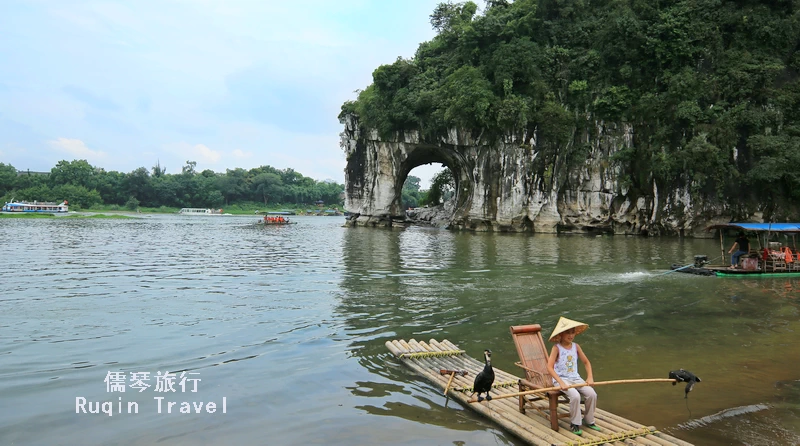
Elephant Trunk Hill (象鼻山)
Then, the moment every traveler waits for—the real-life Elephant Trunk Hill. I’d seen it in textbooks, but standing before it was something else entirely. The great limestone “elephant” seemed to dip its trunk gracefully into the Li River, calm and eternal.
As the afternoon sun hit the water, the reflection shimmered like liquid gold. I lingered on the riverside, soaking it in.
Tips: Enter through Gate 1—it’s the closest viewpoint; the light after 3 PM is perfect for photos.
Evening: Culture, Coffee, and a City of Lights
Sixth Stop: East-West Alley Historic District (东西巷)
Recommended time: 16:45 – 18:30
Address: East side of Zhengyang Road, Xiufeng District, Guilin 东西巷
Entrance fee: Free
Getting there: 20-minute walk from Elephant Trunk Hill, with lovely river views along the way
As dusk fell, I wandered into East-West Alley. The cobblestone streets glowed under red lanterns, and the air filled with the scent of sweet osmanthus. Old stone houses stood beside boutique cafés and souvenir shops—it was the perfect blend of old and new.
I ducked into a quiet café for a latte and watched as night slowly wrapped the city in light.
Tips: This is the best place for souvenirs—look for Guilin’s “Three Treasures”: chili sauce, fermented tofu, and Sanhua rice wine; Stop for a coffee or tea as the sky darkens; the view is pure poetry.
Seventh Stop: Two Rivers and Four Lakes Night Cruise (两江四湖夜游)
Recommended time: 19:00 – 20:30
Boarding point: Wenchang Bridge Pier, Xiangshan District, Guilin
Ticket price: 210 RMB
Getting there: 10-minute walk from East-West Alley
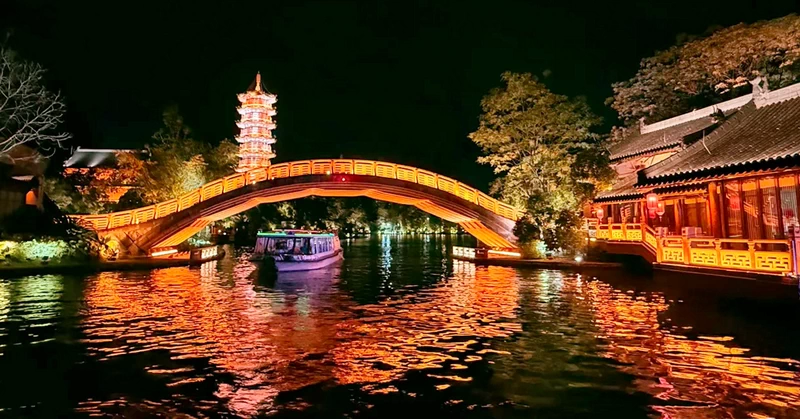
Two Rivers and Four Lakes Night Cruise
To end the day, I joined the Two Rivers and Four Lakes Night Cruise. As the boat glided through the glowing water, bridges shimmered above like jeweled ribbons. The reflections of the Sun and Moon Pagodas danced on the lake surface, golden and silver under the moonlight.
The air was soft, the city quiet except for the hum of the boat. It felt like a living painting—one I’ll never forget.
Tips: Arrive 30 minutes early to exchange your ticket. Sit on the right side of the boat for the best photo angles.
When I finally stepped off the pier, Guilin was glowing behind me—reflections flickering, peaks silhouetted against the night.
That day, walking through the city felt like tracing a poem: caves to hills, palaces to pagodas, sunlight to lantern light. And that’s the beauty of a Guilin City Walk—every step tells part of the story.
6. Guilin–Yangshuo Classic 2-Day Journey: Sailing Through China’s Most Beautiful Scenery
In this part of my Guilin Travel Guide, I’ll take you on one of the most unforgettable experiences I’ve ever had — a two-day trip from Guilin to Yangshuo.

Guilin–Yangshuo Classic 2-Day Journey Map (Google Maps source)
If Guilin is the opening chapter of a mountain-and-river poem, then Yangshuo is its most lyrical verse. This journey lets you float through nature’s masterpiece — where green peaks, misty rivers, and timeless villages blend into a dream.
Overview
Trip Length: 2 days, 1 night
Transport: Li River cruise + local transport
Stay: Near Yangshuo West Street
Highlights: Li River cruise, West Street vibes, Yulong River rafting, Xingping Ancient Town
Day One: The Li River Cruise & The Charm of West Street
1) Morning – Cruising the Li River, the Floating Ink Painting
Time: 8:30 – 13:30
Departure Pier: Zhujiang Wharf 竹江码头 or Mopanshan Wharf 磨盘山码头, Guilin
Ticket: Three-star boat: ~215 RMB / Four-star: ~360 RMB
I still remember standing on the deck that morning, as the Li River unfurled before me like a scroll of ink and jade. The 83-kilometer stretch from Guilin to Yangshuo is pure magic — towering peaks mirrored in calm water, fishermen on bamboo rafts, and villages tucked between green folds of land.

The Li River Cruise
When we passed Nine Horses Fresco Hill (九马画山), I tried to spot all nine horses in the cliff’s patterns. I found seven — close enough, I hoped, for a bit of good luck! Later, the boat slowed near Huangbu Reflection (黄布倒影), where the mountains shimmered perfectly in the still river — it’s the exact view printed on China’s 20 RMB note.
Tips:
- A simple lunch is included, but I packed fruit and snacks too.
- If possible, choose a window seat for better views.
- On deck, hold your camera tight — the wind and water can surprise you!
2) Afternoon – Strolling Yangshuo’s West Street
Time: 14:00 – 17:00
Location: West Street, Yangshuo County
Getting there: After docking at Yangshuo Wharf, walk 15 minutes or take an electric shuttle (5 RMB).
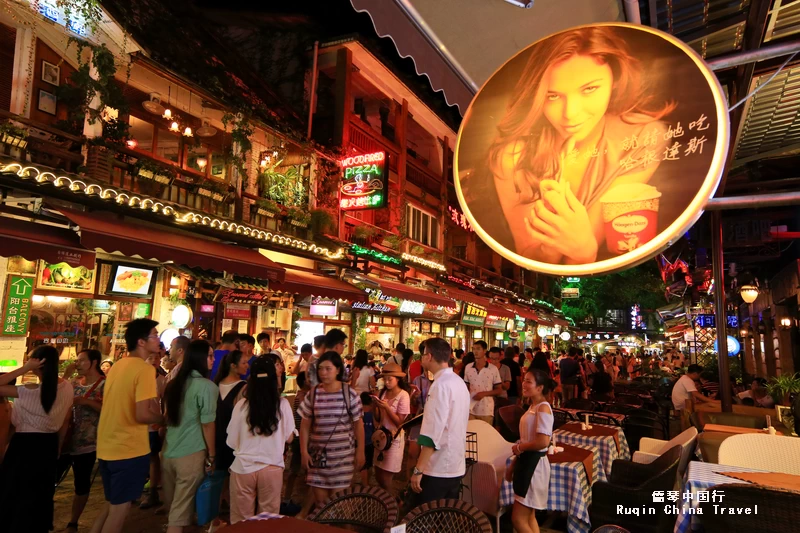
Yangshuo’s West Street
After the cruise, the rhythm of Yangshuo felt completely different — lively, colorful, and full of laughter. West Street is a charming maze of cobblestones, lined with cafés, bars, and tiny shops selling everything from handmade fans to silver jewelry. I sipped an iced coffee and watched street musicians play under fluttering red lanterns.
There was a warmth here — travelers from around the world mixing with locals, exchanging smiles over bowls of noodles.
Tips:
- Visit in the afternoon for a quieter vibe before the nightlife begins.
- Don’t miss Yangshuo Beer Fish, a local specialty cooked in river water and beer — surprisingly delicious!
3) Where I Stayed
Staying near West Street made everything easy. I wanted a balance between comfort and atmosphere, and found it here.
- 💰 Budget: Huamanlou Youth Hostel (~80 RMB/bed)
- 💰 Mid-range: Bilian Riverside Hotel (~400 RMB/night)
- 💰 Boutique: Secret Garden Hotel (~300 RMB/night, lovely courtyards and flowers everywhere)
4) Dinner in Yangshuo
Time: 18:00 – 20:00
Recommended Restaurants:
- Master Fu Beer Fish 大师傅啤酒鱼: The classic! Spicy, rich, and unforgettable.
- Rosewood Café 玫瑰木餐厅: Cozy spot mixing Western comfort and local charm.
- Shouzi Rice Noodles 瘦子米粉 : Perfect for a simple, late-night bite.
I dined on a terrace by the river, lanterns flickering on the water. The air smelled of lime and smoke, laughter echoed from nearby bars.
4) Evening – Impression Liu Sanjie (刘三姐)
Time: 20:00 – 21:10
Ticket: 198–688 RMB
Directed by: Zhang Yimou

Impression Liu Sanjie (刘三姐)
That night, I watched Impression Liu Sanjie (印象刘三姐), an outdoor performance staged right on the Li River. Hundreds of local performers moved across the illuminated water, their songs echoing between the mountains. The reflections, the music, the mist — it was mesmerizing.
Tips:
- Book tickets in advance; higher seats have the best panoramic view.
- Bring a light jacket — evenings can get cool near the river.
Day Two: Countryside, Rivers, and an Ancient Town
1) Morning – Biking the Ten-Mile Gallery
Time: 8:30 – 11:30
Bike rental: 20 RMB/day (bicycle), 50 RMB/day (e-bike)
The next morning, I set off on a bike, following the Ten-Mile Gallery (十里画廊)— one of the most scenic routes in Yangshuo. The road wound past rice paddies, bamboo groves, and tiny villages. The air was sweet, the mountains hazy in the distance.
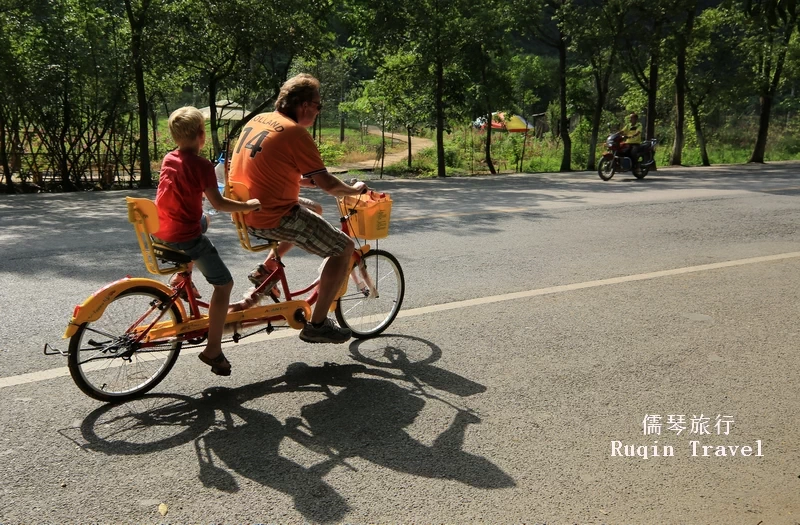
I set off on a bike, following the Ten-Mile Gallery (十里画廊)
I stopped at Butterfly Spring (蝴蝶泉), where a giant butterfly sculpture stands over the cliffs, and then continued to Big Banyan Tree (大榕树), said to be over 1,400 years old — it was used in the classic film Liu Sanjie.
Finally, I reached Moon Hill (月亮山), a mountain with a natural arch that looks like a rising moon. I hiked partway up, resting under the trees while villagers sold fresh mango juice at the base.
Tips:
- Start early to avoid the sun.
- Bring water and sunscreen.
- The best view of Moon Hill is actually from the roadside café opposite it.
2) Midday – Rafting on the Yulong River
Time: 12:00 – 14:30
Pier: Jinlong Bridge or Yulong Bridge
Ticket: 180–400 RMB per raft (two people)
After biking, I switched from wheels to water. The Yulong River bamboo raft (遇龙河人工竹筏漂流) was pure serenity — just me, a boatman, and the sound of the river. He steered us with a long bamboo pole, gliding past green mountains reflected in the water.
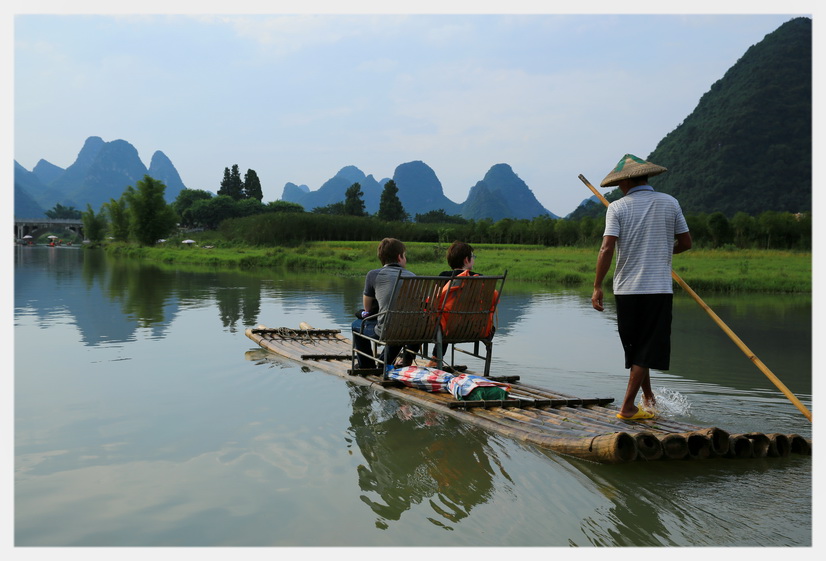
Yulong River bamboo raft
When the raft slid down small dams, we bounced and laughed. The air smelled of wildflowers. It felt both peaceful and alive.
Tips:
- The upper section (Jinlong Bridge → Jiuxian) is the most beautiful.
- A small tip (20–50 RMB) often gets you stories and songs from the raftman.
- Use a waterproof bag for phones and cameras.
3) Afternoon – Xingping Ancient Town
Time: 15:00 – 17:30
Getting there: From Yangshuo Bus Station, take a local bus (~10 RMB, 40 minutes).
If Yangshuo is charming, Xingping (兴坪古镇) is timeless. The narrow stone streets and gray-tiled houses felt untouched by time. I wandered slowly, stopping at small teahouses and chatting with locals who still make hand-pulled noodles by the door.
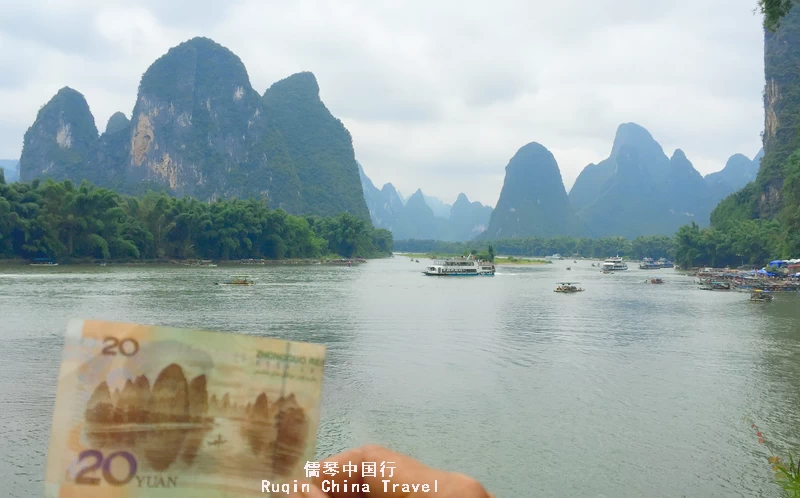
I took the classic photo at the 20 RMB note viewpoint
I climbed Laocai Hill (老寨山), a steep but rewarding hike, and saw the Li River curve gracefully below — the view that has inspired poets for centuries. And yes, I took the classic photo at the 20 RMB note viewpoint (20元人民币背景观景台)!
Tips:
- Local photographers offer instant prints for ~10 RMB.
- Xingping is quieter and more authentic than West Street.
- Bring good shoes — the old stones can be slippery.
4) Evening – Back to Guilin
Time: 18:30 – 20:00
Options:
- Direct bus from Yangshuo Bus Station to Guilin (~30 RMB, 1.5 hrs)
- Shared car (~50 RMB/person)
Tips:
- The last bus leaves around 21:00.
- Arrive at the station early to buy tickets, especially on weekends.
Trip Budget (Per Person)
Budget Trip (¥800–1000):
- Transport: ¥300 (includes cruise)
- Lodging: ¥100
- Tickets: ¥250
- Meals: ¥150
- Extras: ¥100
Comfort Trip (¥1200–1500):
- Transport: ¥450 (four-star cruise)
- Lodging: ¥300
- Tickets: ¥400
- Meals: ¥250
- Extras: ¥200
Before You Go
Must-Haves:
- Sunscreen, hat, sunglasses
- Comfortable shoes and sandals for rafting
- Power bank, camera, waterproof bag
- Some cash (rural areas may not take mobile payments)
Practical Tips:
- Book in advance: Cruise and hotels sell out fast.
- Check the weather: Rainy days make the river muddy.
- Learn a few Chinese words: “Xiexie” (thank you) goes a long way.
- Haggle gently: 30–50% off souvenirs is normal.
Best Seasons:
- Spring & Autumn (Mar–May, Sep–Nov): Pleasant weather, crystal-clear river scenes.
- Summer (Jun–Aug): Lush scenery but hot and humid.
- Winter (Dec–Feb): Quiet, with misty and poetic charm.
When I think back on this two-day journey, I can still hear the river’s murmur and see the soft silhouettes of karst peaks fading into mist.
From Guilin’s grand river bends to Yangshuo’s sleepy fields, this trip wasn’t just sightseeing — it was stepping into a living landscape painting.
And that’s the magic every traveler discovers when following this Guilin Travel Guide — beauty that doesn’t just stay in your camera, but lingers in your heart.
7. Guilin to Longji Terraces: 2 Days of Curves, Culture, and Cloud-Kissed Mornings
Dear traveler,
If the Li River whispers poetry in every bend, then Longji sings it aloud with every curve of its mountains. In this chapter of my Guilin Travel Guide, I invite you to follow me beyond the rivers to a hidden world of terraced fields and ancient village life.

Guilin to Longji Terraces Travel Map ( Google Maps source)
This two-day trip to Longji Rice Terraces opened my eyes to one of the most beautiful and harmonious landscapes I’ve ever seen — where the earth flows like waves, and culture lives in every stone path and shared smile.
Trip at a Glance
Duration: 2 days, 1 night
Transport: Tourist bus + scenic shuttle
Stay: Traditional stilt houses in Ping’an Village 平安寨 or Dazhai Village (大寨村)
Highlights: Longji Rice Terraces, Zhuang & Yao ethnic villages, stilt house stays, sunrise and sea of clouds
Day One: Into the Heart of the Terraces
1) Morning – From Guilin to the Mountains
Departure: 8:00 AM
Pickup: Guilin Xiangjiang Hotel or Guilin Railway Station
Bus fare: 50 RMB
Travel time: Around 2.5 hours
The drive to Longsheng was like unrolling a ribbon through the clouds. The road twisted along mountainsides, each turn revealing new layers of forest and valley. I sat by the window, camera in hand, heart wide open.
Villages of the Zhuang people peeked through the trees — wooden houses perched on hillsides, smoke curling from chimneys. And then, the first glimpse of the terraces. They weren’t massive at first — just gentle curves lining a slope — but I knew we were getting close.
Tips:
- Take motion sickness pills if you’re sensitive — the curves are no joke.
- Choose a window seat for the best views.
- Buses usually provide bottled water.
2) Late Morning – Arrive at Longji Scenic Area
Time: 11:00 – 12:30
Location: Longji Terrace Tourist Center
Ticket: 80 RMB (includes shuttle bus)
At the entrance, I bought my ticket and stored my bigger bag at the tourist center. I only packed what I needed for the night — everything else felt too heavy for mountain paths.
I also spent a few minutes studying the map. There are several villages within the scenic area: Ping’an Zhuang Village, Tiantou Village, and Jinkeng (Dazhai). Each has its own vibe and views. I chose to start with Ping’an.
3) Lunch – Flavors of the Zhuang Kitchen
Time: 12:30 – 13:30
Restaurant: “Taste of Longji” near the entrance
I sat down to my first Zhuang-style meal with a rumbling stomach and a big smile. The star dish? Bamboo tube rice — sticky rice mixed with sausage and mushrooms, roasted in a bamboo stalk. The smoky bamboo scent made every bite magical.
I also tried Longji native chicken, stewed with mountain herbs. And a bowl of wild vegetable soup — light, earthy, and comforting.
Must try:
- Bamboo rice
- Mountain chicken
- Fresh wild greens
4) Afternoon – Exploring Ping’an Village and the Terraces
Time: 13:30 – 17:30
Shuttle ride: 20 minutes from the visitor center
From the shuttle drop-off, I walked uphill toward Ping’an Village (平安寨), a Zhuang settlement with houses clinging to the mountainside. The air was cooler here, and the only sounds were birds, footsteps on stone, and the occasional call from a chicken.
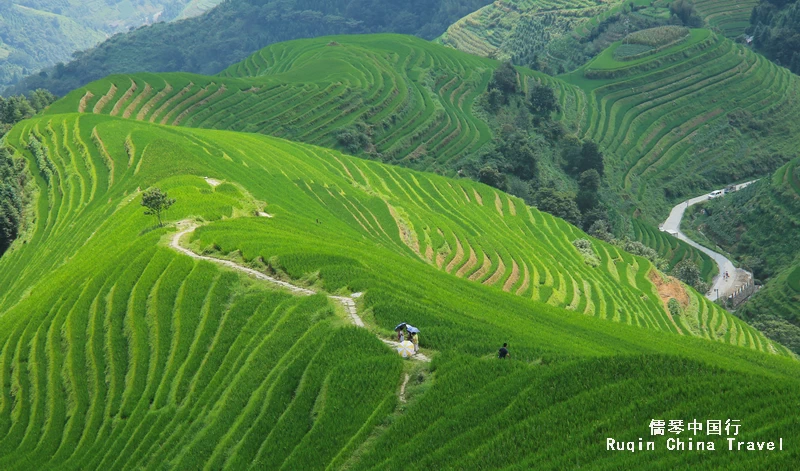
“Nine Dragons and Five Tigers” at Ping’an Village
I hiked to the famous viewpoint “Seven Stars with the Moon.” From above, seven small hilltops circled a single round paddy. It looked like a constellation carved into the earth.
A short walk farther brought me to “Nine Dragons and Five Tigers”, where long ridgelines curve like dragons resting on the mountain, with five hills rising like guardians.
Tips:
- Wear anti-slip hiking shoes — the stone paths get slick when wet.
- Hire a local guide (about 50 RMB). Mine shared legends I’d never have heard otherwise.
- Best light for photos? Between 3 and 5 PM.
5) Evening – Sleeping in a Wooden Dream
🛏 My Stay: “Seven Stars View Guesthouse” (~200 RMB/night) in Ping’an
Other great options:
- Comfort stay: “Yunjing Lodge” in Tiantou (~300 RMB)
The stilt house creaked gently as I walked in, but the room was cozy and warm. I opened the window — terraces stretched across the valley, catching the last golden light. No TV. No city noise. Just a soft breeze, a view to lose yourself in, and the promise of sunrise.
6) Dinner – Homemade, Shared, and Special
Time: 18:30 – 20:00
Where: At the guesthouse with the host family
Dinner was shared around a wooden table, with dishes placed one by one by the smiling host. The highlight? A glass of homemade glutinous rice wine, sweet and warming. We chatted by the fire pit about village life, rice harvests, and ghosts of the mountain.
That night, I fell asleep to the sound of crickets and mountain wind.
Day Two: Misty Mornings and a Thousand Steps
1) Early Morning – Sunrise Over the Terraces
Time: 5:00 – 7:00 (varies by season)
Best Viewpoints:
- “Nine Dragons and Five Tigers” (Ping’an)
- “West Hill with the Moon” (Tiantou Village)
I woke up before dawn, wrapped in a thick jacket, and climbed in the dark. My flashlight flickered against mossy stones. Then, at the top — silence, mist, and slowly, the sky began to glow.
Clouds drifted through the valleys. Light kissed the water-filled terraces. The world shimmered in silver and gold. It was one of the most peaceful mornings of my life.
Tips:
- Dress warmly — it gets cold pre-dawn.
- Use a headlamp or flashlight for the climb.
- Some guesthouses offer take-away breakfast.
2) Breakfast – Country Simplicity
Time: 7:30 – 8:30
Where: Guesthouse kitchen
Breakfast was simple and nourishing: sweet potato porridge, fresh farm eggs, and glutinous rice cakes dusted with crushed peanuts. A cup of warm soy milk finished it perfectly.
3) Mid-Morning – Jinkeng Dazhai & Red Yao Culture
Time: 9:00 – 12:30
Shuttle ride: 30 minutes to Jinkeng
Next, I visited Jinkeng Dazhai (金坑大寨), home to the Red Yao people. The terraces here are taller, grander, more dramatic. They call it the “thousand-layer ladder to the sky.”

I walked to the upper platforms — or you can take a cable car (55 RMB one way, 100 RMB round trip). The views from the top were breathtaking — endless waves of golden rice in autumn, or mirrored water in spring.
I also saw a Red Yao long-hair show (extra fee) 红瑶族女子长发表演. The women, dressed in traditional red and black, unwrapped their floor-length hair and twisted it into high, elegant buns. Each strand seemed to hold a story.
Tips:
- Ask before taking photos.
- Buy local handicrafts — beautiful hand-embroidered scarves and bags.
- The trails here are steeper — take it slow.
4) Lunch – With the Yao People
Time: 12:30 – 13:30
Restaurant: “Sister Yao’s Country Kitchen”
Lunch was full of strong mountain flavors — smoked pork, wild vegetable omelet, and a hot bowl of Yao-style oil tea, made with fried rice and peanuts in savory broth.
5) Afternoon – Back to Guilin
Departure: 14:00
Arrival in Guilin: Around 16:30
Drop-off: Guilin Railway Station or Xiangjiang Hotel
Tips:
- Arrive at the shuttle point 30 minutes early.
- Double-check your bags.
- Rest on the ride — your legs will thank you!
💰 Trip Budget (Per Person)
Budget Trip (¥500–700):
- Transport: ¥150
- Lodging: ¥150
- Tickets: ¥80
- Food: ¥120
- Extras: ¥50
Comfort Trip (¥800–1000):
- Transport (w/ cable car): ¥200
- Lodging (view room): ¥300
- Tickets: ¥80
- Food: ¥200
- Extras: ¥100
Essential Packing & Tips
Must-Bring:
- Anti-slip hiking shoes
- Backpack (avoid rolling suitcases)
- Layers for warmth
- Rain gear and sunscreen
- Small cash (no ATMs up there)
Best Seasons:
- May–June: Terraces filled with water, like mirrors
- July–Sept: Green and lush
- Sept–Oct: Golden harvest — absolutely stunning
Extra Advice:
- Store large luggage in Guilin
- Respect local customs
- Never litter — this land is sacred
- Learn a greeting in Zhuang or Yao — locals love it!
This Guilin Travel Guide wouldn’t be complete without the Longji experience. The terraces aren’t just a beautiful sight — they’re living history, shaped by hands, hearts, and hope across generations.
As I stood at the edge of the viewpoint, mist curling through the hills, I didn’t just see beauty — I felt it. Come with an open heart. Leave with stories that stay with you, long after the mountains fade from view.
8. Guilin Travel Guide: A Foodie’s Journey Through Mountains, Rice Noodles, and Local Secrets
If Guilin’s landscapes dazzle your eyes, its food will steal your heart. In this warm and savory chapter of my Guilin Travel Guide, let me take you on a delicious journey — one bite at a time. From the first spoonful of rice noodles in the morning to the last taste of field-grown fish at night, here’s what to eat in Guilin and why I kept going back for more.
1) Guilin Rice Noodles 桂林米粉
Soft, springy, and soul-soothing. It’s not just a dish — it’s a way of life.
The lu shui (卤水, spiced broth) is the heart. It’s brewed with pork bones, luo han guo, and secret herbs. Locals prefer it dry-mixed — stir the noodles with toppings like crispy soybeans, pickled beans, peanuts, scallions, then sip the broth last.

Guilin Rice Noodles 桂林米粉
Try at: 老东江米粉 (Laodongjiang, Longyin Road) or 崇善米粉 (Chongshan, near Zhengyang Street)
Say “多点卤水” for extra flavor!
2) Lipu Steamed Pork with Taro 荔浦扣肉
Rich yet never greasy. Sliced pork belly alternates with soft Lipu taro, steamed until melt-in-mouth tender. The secret? A spoonful of Guilin fermented tofu.
Perfect for autumn feasts or winter warmth.3
3. Yangshuo Beer Fish 阳朔啤酒鱼
Fresh carp from the Li River, flash-fried and simmered in local beer, garlic, and chilies. Crisp skin, juicy meat, and the aroma of tea oil.
Try in: West Street, Yangshuo
Choose your fish by weight and spice level.
4) Stuffed Snails 桂林田螺酿
A true kung fu dish. Snail meat is minced with pork, herbs, and chili, then stuffed back into the shell and braised.
Suck out the flavor or pick with a skewer. Best enjoyed with a cold beer on a warm evening.
5) Gongcheng Oil Tea 恭城油茶
Bitter, nutty, spicy — and addictive. “Beaten,” not brewed, this tea is made with ginger, garlic, tea leaves, and peanuts.
Locals sip it with puffed rice, sticky rice cakes, and sweet snacks.
Try at: 唐姐油茶店 (Tangjie Oil Tea Shop)
6) Quanzhou Sour Blood Duck 全州醋血鸭
Dark, rich, and punchy. Duck stewed with vinegar and duck blood might sound wild, but it’s deeply satisfying. Sour, spicy, and utterly unique.
Best enjoyed in cooler weather with ginger or bitter melon to balance the richness.
7) Songhua Candy 松花糖
Light, sweet, and melt-in-your-mouth. Named for its pollen-like texture and color, this historic candy is a must-try souvenir.
Buy in: Lingui’s Liangjiang Town — look for vacuum packs to take home.
8) Hehua Fish 禾花鱼
Rice-fed and field-raised, this small fish tastes clean and delicate. Eat it steamed, braised, or deep-fried until crackling.
My tip: Try it in a hot pot on a chilly evening — pure comfort.
Where to Eat:
- Zhengyang Pedestrian Street 正阳步行街: endless snacks & noodle shops
- East-West Alley 东西巷: traditional restaurants with classic ambiance
- West Street, Yangshuo 阳朔西街: local meets global flavors
- Local night stalls 大排档: for grilled fish, stir-fried rice noodles, and stuffed snails
Final Tips:
- Guilin rice noodles + Sanhua Liquor 三花酒 = perfect pairing
- Can’t handle spice? Say “不要辣” (bù yào là)
- Ask what’s fresh — veggies and fish vary by season
- Peanut allergy? Ask first — many dishes include them
From that first bite of 米粉 at sunrise to the last snail shell clinking in your bowl at midnight, every meal in Guilin tells a story. And lucky for you — it’s a story you can taste.
As my journey through misty peaks and glittering rivers comes to an end, I realize Guilin is more than a destination — it’s a feeling. Every sunrise over the Li River, every bowl of rice noodles, and every smile from a local leaves a trace on your heart.
This Guilin Travel Guide isn’t just a map of places; it’s an invitation to slow down, breathe deeply, and let nature’s poetry surround you. Whether you come for the mountains, the food, or the peace, Guilin will welcome you — and you’ll never quite want to leave.
About the Author
Ruqin is the founder of Ruqintravel.com and has spent more than four decades working in China’s travel industry. Drawing on hands-on experience in cities like Beijing and Hangzhou, he personally researches and updates each guide to help international travelers navigate China with confidence.
Further Reading
10 Best Things to Do in Guilin for First-Time Visitors
Top Tourist Scams in Guilin: How to Avoid Them and Stay Safe
Top 10 Things to Do in Guilin at Night – Your Complete Guide
How to Plan a Li River Cruise in Guilin – Your Complete Guide
Bamboo Rafting on Yulong River in Yangshuo – Your Complete Guide
How to Book Guilin Attraction Tickets: All You Need to Know
Must-Try Local Foods in Guilin – A Visitor’s Guide
Best Time to Visit Guilin – A Visitor’s Guide
How to Visit Guilin: Your Complete Guide