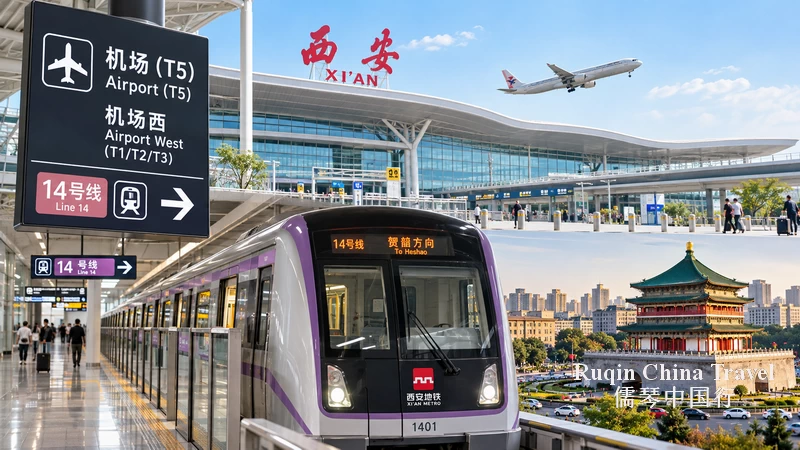
This is one of the most logical first-time routes I design. You land in Xi’an, travel east by high-speed rail to Luoyang, and finish in Beijing — following both geography and history in a straight, efficient line.
It’s a journey through layers of imperial China: early dynasties in Xi’an, Buddhist heritage in Luoyang, and Ming–Qing grandeur in Beijing. The high-speed train network connects these cities seamlessly, so the experience feels continuous rather than fragmented.
Route Overview
Route: Xi’an → Luoyang → Beijing
Duration: 8 Days
Best For: First-time visitors who want depth without overcomplicating logistics
Travel Style: Independent with optional guided days
Pace: Balanced — full days, but not rushed
Who This Is Perfect For
- Travelers comfortable navigating metro systems
- Visitors who enjoy exploring independently but appreciate optional expert insight at key historical sites
- Those who prefer trains over domestic flights
Consider Adding a Guide If:
- You want deeper historical interpretation at major sites
- You prefer someone to handle ticketing and navigation in Mandarin
- You have limited time and want to move efficiently
Most travelers do very well combining independent travel with one or two focused guided days.
Why This Route Works
Geographically, this corridor is direct and efficient. The high-speed rail line links these cities in short, manageable segments, minimizing travel fatigue.
Historically, the sequence also unfolds naturally:
- Xi’an: cradle of early imperial China
- Luoyang: Buddhist art and dynastic transition
- Beijing: imperial capital of later dynasties
You move forward chronologically as well as geographically, which makes the journey feel coherent rather than random.
Transport Strategy (Big Picture)
Between Cities:
High-speed trains (G or D class).
- Xi’an → Luoyang: approximately 1.5 hours
- Luoyang → Beijing: approximately 3.5–4 hours
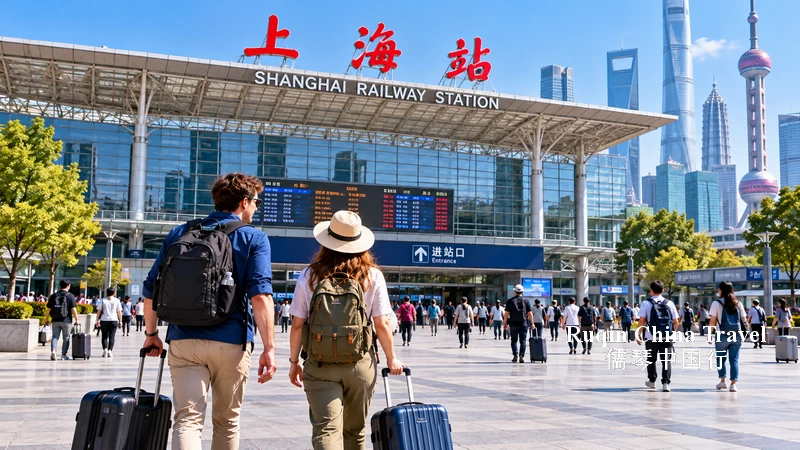
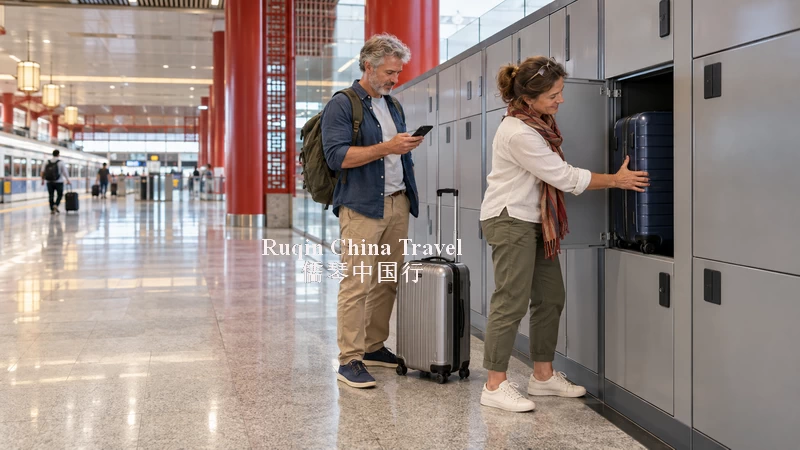
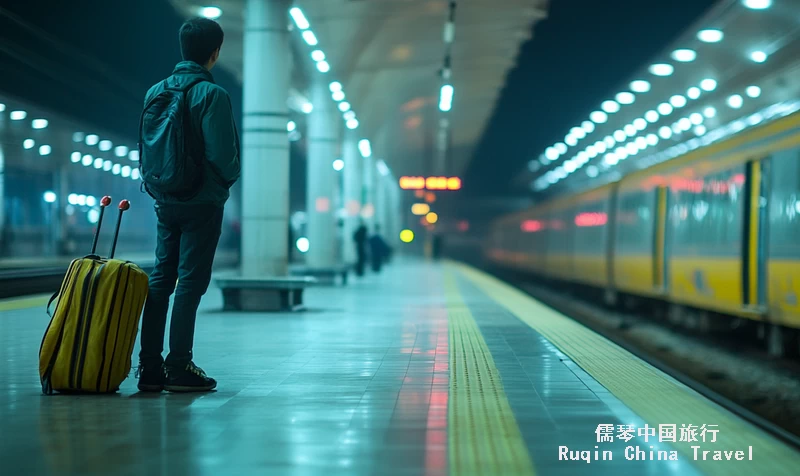
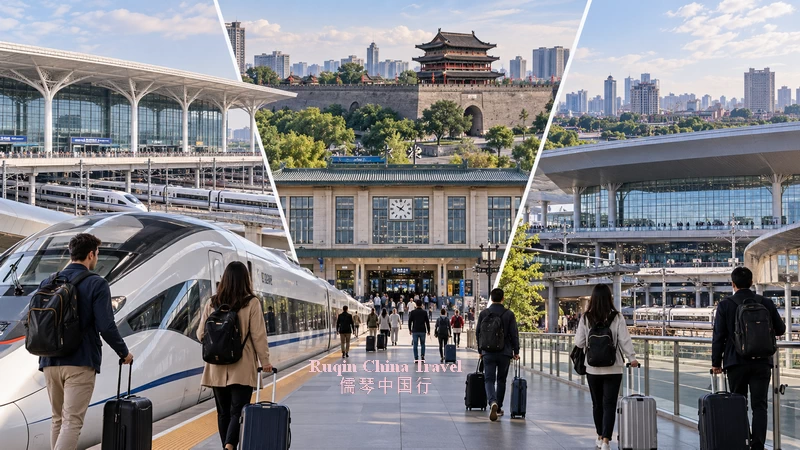
Stations are large, airport-style facilities with security checks, clear signage, and organized boarding. English signage is standard in major cities. Arriving 45–60 minutes before departure is usually sufficient.
Within Cities:
- Xi’an and Beijing have extensive metro systems with English signage and color-coded lines.
- Luoyang’s metro network is smaller but straightforward.
- Taxis and ride-hailing apps are reliable and affordable.
Having translation apps on your phone is essential. Communication usually works through text input or voice translation when needed.
Day-by-Day Itinerary
Day 1 – Arrive in Xi’an
Snapshot
Arrival day. Light exploration.
After landing, transfer to your hotel and take time to settle in. Depending on arrival time, a relaxed walk around your neighborhood is ideal. The area near the Bell Tower is particularly convenient for first-time visitors, with pedestrian streets and easy dining options.
This first evening is about orientation — getting familiar with your surroundings and adjusting to the pace before diving into major historical sites.
Day 2 – Terracotta Army & Xi’an Old City
Snapshot
Full sightseeing day. Moderate walking.
Begin with the Terracotta Army, located about an hour from the city. The excavation halls are vast and impressive, revealing thousands of life-sized warriors guarding Emperor Qin’s tomb. Allow time to walk through all three main pits and the exhibition hall to understand the archaeological process behind the discovery.
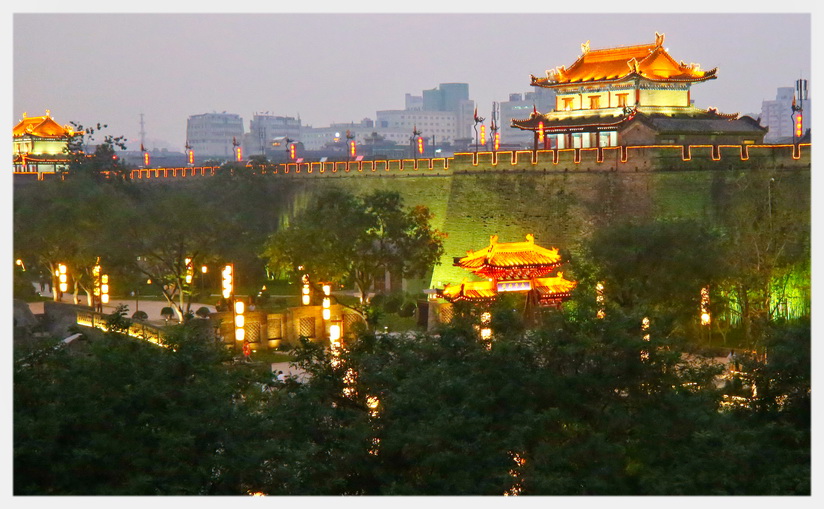
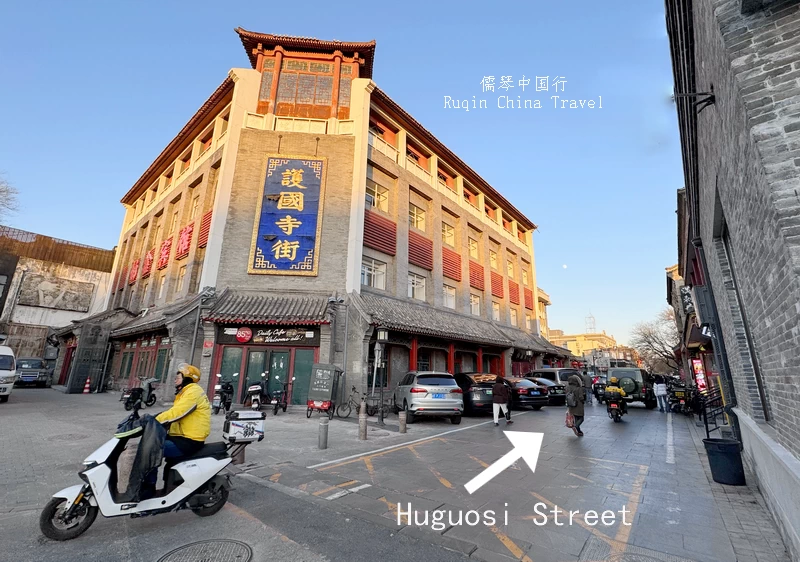
Return to the city in the afternoon to explore the Xi’an City Wall. Walking or cycling along the wall gives you a clear sense of the old capital’s scale and structure. Later, stroll through the Muslim Quarter near the Xi’an Bell Tower, where traditional snacks and local street life create a lively contrast to the morning’s archaeological focus.
Grouping these experiences creates a full picture of Xi’an — ancient imperial power in the morning, living city culture in the evening.
Day 3 – Xi’an to Luoyang & Longmen Grottoes
Snapshot
Morning train. Afternoon cultural site.
Take a morning high-speed train from Xi’an North to Luoyang Longmen Station. The ride is short and smooth, making this an easy transfer day.
In the afternoon, visit the Longmen Grottoes. Carved into limestone cliffs along the Yi River, the grottoes contain thousands of Buddhist statues ranging from small carvings to monumental figures. Walking the riverside path allows you to see how Buddhist art evolved over centuries.
Scheduling the grottoes immediately after arrival works well because they are located near the high-speed station, keeping travel time efficient.
Day 4 – Shaolin Temple & Luoyang Heritage
Snapshot
Day trip with moderate walking.
In the morning, travel to the Shaolin Temple, located at the foot of Mount Song. Known as the birthplace of Chan (Zen) Buddhism and Chinese martial arts, the temple complex includes halls, courtyards, and the Pagoda Forest — a remarkable collection of ancient brick stupas. If timing aligns, you may see a martial arts demonstration.
Return to Luoyang in the afternoon. If time permits, visit the White Horse Temple, often regarded as China’s first Buddhist temple. Its peaceful courtyards provide a quieter complement to the more visited Shaolin complex.
This day balances philosophical Buddhism and martial tradition, two strands deeply connected in Chinese culture.
Day 5 – Luoyang to Beijing
Snapshot
Longer train journey. Light activity.
Take a morning high-speed train to Beijing West Railway Station. The journey takes about 3.5–4 hours, so the afternoon is best kept flexible.
After hotel check-in, explore your neighborhood on foot. If you’re staying near the central districts, you might walk through local hutong lanes or visit a nearby park. This light exploration helps you adjust to Beijing’s larger scale without overloading the day.
Day 6 – Tiananmen & the Forbidden City
Snapshot
Full historical day. Steady walking.
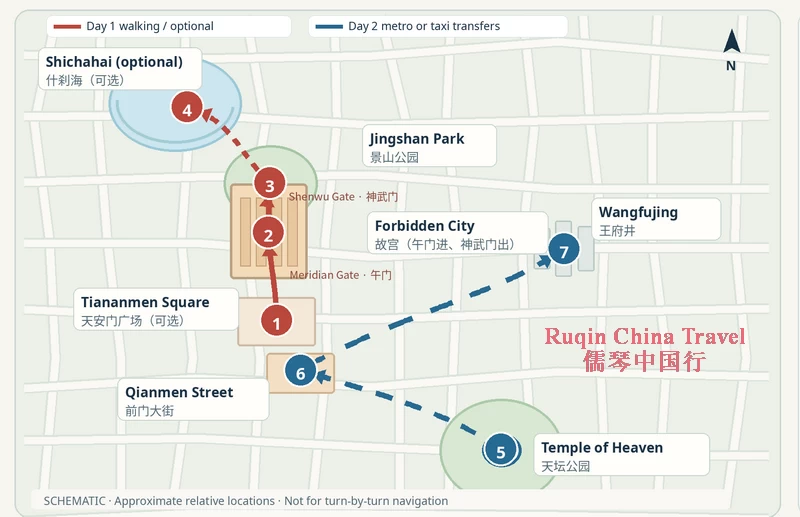
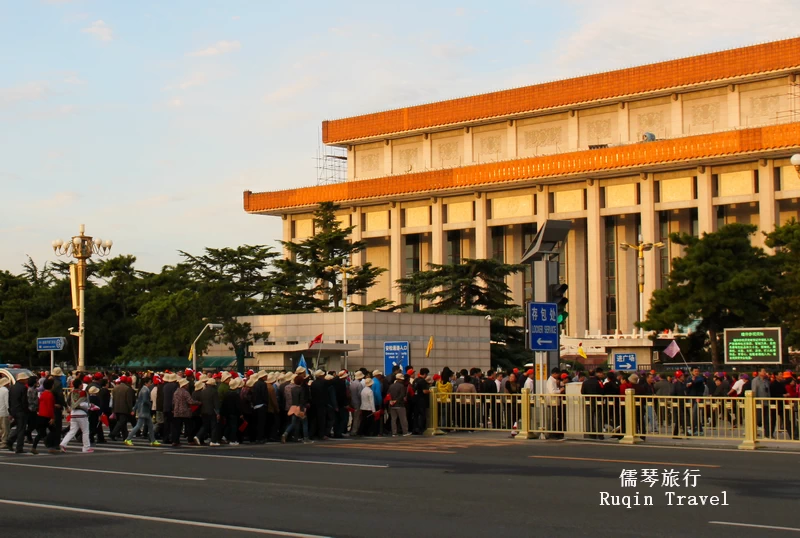
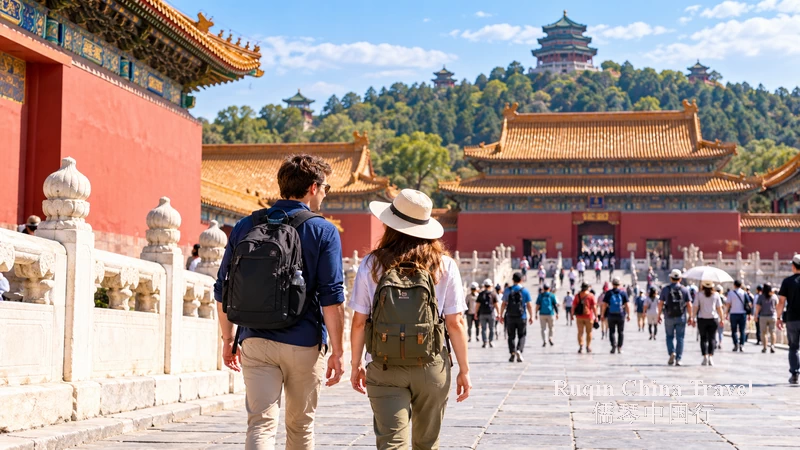
Start at Tiananmen Square before entering the Forbidden City. Walking through the successive gates and grand halls reveals the spatial logic of imperial authority — everything aligned on a strict north–south axis.
After exiting the northern gate, climb Jingshan Park for a panoramic view over the palace rooftops. The perspective helps you grasp the enormous scale of the complex. Later, consider exploring nearby hutong alleys to see traditional courtyard residences that contrast with imperial architecture.
Placing these sites together creates a cohesive understanding of Beijing’s political and ceremonial heart.
Day 7 – The Great Wall
Snapshot
Half to full day excursion.
Visit the Mutianyu Great Wall, one of the best-preserved sections accessible from Beijing. The restored watchtowers and sweeping mountain views make it both historically significant and visually dramatic.
You can hike between towers for a more immersive experience or use the cable car to reduce physical strain. Allow unhurried time to walk along the wall and appreciate its scale and engineering — this is not just a monument but a military system stretching across varied terrain.
After returning to Beijing, keep the evening relaxed.
Day 8 – Departure
Transfer to the airport or onward train station. Allow generous travel time, as Beijing’s transport distances can be substantial depending on your departure point.
Practical Notes on Independent Travel
- High-speed rail is efficient, punctual, and clearly organized.
- Metro systems in major cities are modern and English-labeled.
- Ride-hailing services simplify city transfers.
- Translation apps bridge most communication gaps.
Some people may hesitate to assist due to language comfort levels, but help is usually available if you ask politely and patiently.
Closing Notes from Ruqin
This itinerary works year-round. Spring and autumn offer the most comfortable walking weather. Summer brings heat and higher visitor numbers, especially in Beijing. Winter is quieter, with fewer crowds and a different atmosphere around historical sites.
What I like most about this route is its clarity. You experience foundational chapters of Chinese history without rushing across the country. The train journeys are short enough to feel connected, and each city builds logically on the previous one.
Further Reading
14-Day China Itinerary: Hong Kong to Beijing (First-Time Grand Scenic Route)
10–12 Day China Itinerary: Shanghai, Chongqing, Xi’an & Beijing (First-Time Visitors, Fast-Paced)
The Best China Tour Itinerary for First-time Visitors
Questions About Planning Your Trip to China
If you still have questions after reading the guides, you’re very welcome to write to me. If something feels unclear — or you’d simply like a second opinion — I’m happy to help.
Just use the short form below and tell me a little about your plan.
There’s no fee for a simple question. No pressure — just a practical reply based on real experience here in China.
If I’m traveling, replies may take a little time. Thank you for your patience.
We respect your privacy. Your details will never be shared or used for marketing.