
Written by Ruqin
August 06, 2026
When I guide foreign visitors around Beijing, I often suggest something simple: walk the city from south to north.
Do not rush from one attraction to another. Do not only take photos at famous landmarks. Instead, follow one historic line that has shaped Beijing for more than 700 years — the Beijing Central Axis.
This 7.8-km long north-south line connects ancient gates, royal buildings, temples, gardens, and everyday neighborhoods. It tells the story of how Chinese people imagined a capital city and how architecture could create a relationship between people, space, and nature.
In July 2024, the Beijing Central Axis was officially added to the UNESCO World Heritage List. However, for me, it has never been only a heritage site. It is a living part of Beijing.
What Is the Beijing Central Axis?
The Beijing Central Axis is an imaginary line running from Yongdingmen Gate in the south to the Bell and Drum Towers in the north.
It stretches about 7.8 kilometers through the heart of Beijing. Along this route, you can find some of the city’s most important landmarks:
- Yongdingmen Gate
- Temple of Heaven
- Tianqiao area
- Zhengyangmen Gate
- Tiananmen Square
- Forbidden City
- Jingshan Park
- Bell and Drum Towers
The idea of a central axis developed during the Yuan Dynasty and was later expanded during the Ming and Qing dynasties.
For centuries, Beijing grew around this line. The city’s most important buildings followed its direction, creating a strong sense of order and balance.
However, the beauty of the Central Axis is not only about symmetry. It is about the feeling you experience while walking through different spaces.
The city slowly changes around you. Wide squares become narrow streets. Imperial buildings become local neighborhoods. Formal spaces become places where ordinary people live.
Starting from Yongdingmen: The Beginning of the Story
I usually recommend starting the walk from Yongdingmen in the south.
Standing in front of the restored gate tower, you can feel the quiet dignity of old Beijing. The gray roof tiles and red walls look especially beautiful under the clear northern sky.
On both sides of the Central Axis, you can find two important places connected with traditional Chinese beliefs about nature and society.
To the east stands the Temple of Heaven, where emperors once performed ceremonies to pray for good harvests. Its famous Hall of Prayer for Good Harvests, with its blue roof and golden details, represents the connection between heaven and human life.
To the west stands the Temple of Agriculture, where emperors honored farming and the importance of food production.
For ancient Chinese people, the relationship between humans and nature was very important. These two sites show how deeply agriculture, seasons, and the natural world influenced Chinese civilization.
One of my American guests once stood at Yongdingmen, looked toward the north, and said:
“I feel like I’m standing at the beginning of a story.”
I think he described it perfectly.
The Central Axis is not just a road. It is a story that has continued for centuries.
Walking North: The Rhythm of Beijing’s Design
From Yongdingmen, continue north toward Qianmen.
Today, Qianmen Street is lively and colorful. Shops, restaurants, and visitors fill the area. However, behind the modern atmosphere, you can still feel the historical structure of old Beijing.
Soon, Zhengyangmen appears in front of you.
For centuries, this gate protected the inner city of Beijing. It was one of the most important entrances to the imperial capital.
If you have time, I recommend visiting the Zhengyangmen Gate Tower. From above, you can better understand the idea of the Central Axis. The city opens in both directions, stretching south toward Yongdingmen and north toward the Forbidden City.
When you walk this route slowly, you will notice something interesting.
The buildings rise and fall. Open spaces become enclosed spaces. Streets become courtyards. The city creates a rhythm.
The famous Chinese architect Liang Sicheng once compared Beijing’s Central Axis to a beautiful piece of music. He believed that the arrangement of buildings created a visual rhythm, like different sections of a symphony.
You do not need to remember this theory.
Just walk.
Look around. Feel how the space changes.
That is the best way to understand Beijing.
Tiananmen Square: The Heart of the Axis
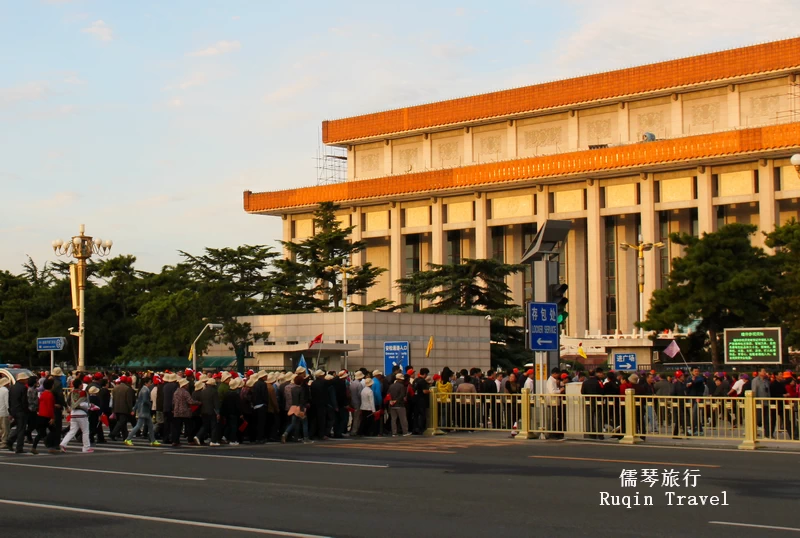
As you continue north, you arrive at Tiananmen Square.
Here, the Central Axis becomes wider and more impressive.
The square creates a huge open space between important buildings. The Monument to the People’s Heroes stands in the center, while the National Museum of China and the Great Hall of the People stand on both sides.
The scale is powerful, but the design is also carefully balanced.
Then you pass through Tiananmen Gate and enter the historic heart of imperial Beijing.
At this point, many foreign visitors slow down.
The red walls become taller. The spaces become more controlled. The atmosphere becomes quieter.
Ahead is the Forbidden City.
The Forbidden City: Order, Symmetry, and Space
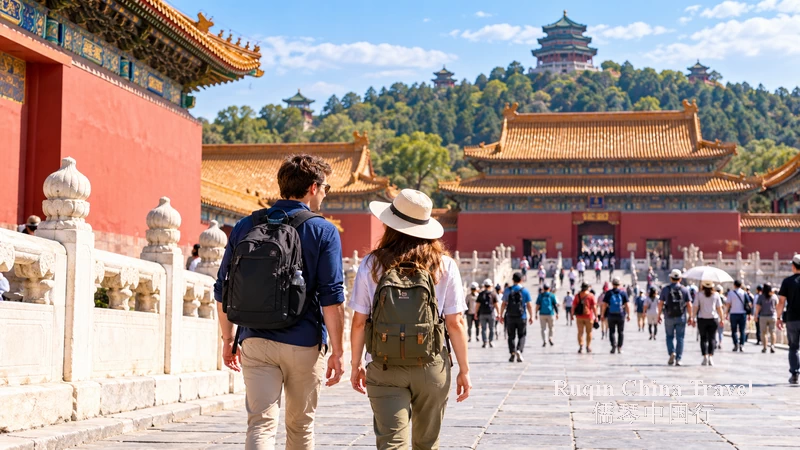
The Forbidden City is the most famous section of the Beijing Central Axis.
Many visitors focus on the beautiful roofs, paintings, and decorations. However, I often encourage them to look at the overall design.
The Forbidden City follows a strict north-south arrangement. Important buildings stand along the central line, while smaller buildings are placed symmetrically on both sides.
The main halls — the Hall of Supreme Harmony, Hall of Central Harmony, and Hall of Preserving Harmony — gradually become more formal and impressive as you move forward.
This design reflects traditional Chinese ideas about order and harmony.
My German friend Hannah once stood in front of the Hall of Supreme Harmony and shared an interesting observation:
“In Europe, castles were often built for defense. Here, palaces were built to express order.”
I think she noticed something important.
The Forbidden City was not only a place where emperors lived. It was also a carefully designed space that expressed how people understood society, nature, and relationships.
The architecture communicates without words.
Jingshan Park: The Best View of the Central Axis
After visiting the Forbidden City, I always recommend going to Jingshan Park.
Climb to the top of Wanchun Pavilion, and you will see one of the best views in Beijing.
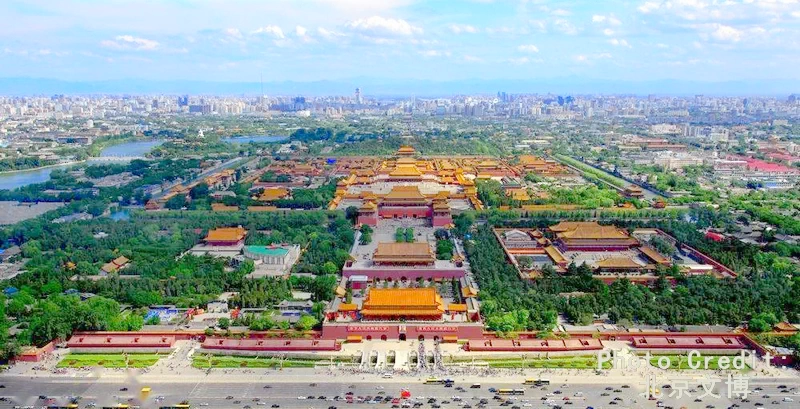
Looking south, the entire Central Axis opens before you.
The golden roofs of the Forbidden City spread below. Beyond them, you can see the direction toward Tiananmen Square and Zhengyangmen.
Looking north, the Bell and Drum Towers stand quietly in the distance.
This is the moment when many travelers understand Beijing’s design.
A map cannot fully explain it.
A photograph cannot fully show it.
You need to stand there and see how the city connects.
The Northern End: From Royal Beijing to Everyday Life
The Bell and Drum Towers mark the northern end of the Central Axis.
During the Yuan, Ming, and Qing dynasties, they played an important role in daily life. The Drum Tower announced the time during the day, while the Bell Tower marked the hours.
They helped organize the rhythm of the entire city.
However, today this area shows another side of Beijing.
Walk down from the towers, and you enter the world of hutongs.
You will smell traditional snacks. You will hear bicycle bells. You may see local residents chatting outside their homes.
Here, the Central Axis leaves behind imperial history and returns to ordinary life.
This is what makes it special.
It is not a frozen monument. It is a living connection between the past and the present.
How to Experience Beijing’s Central Axis
For first-time visitors, I suggest spending at least half a day exploring the Central Axis.
You do not need to complete every section on foot. The full route is long, and Beijing’s summer heat can be challenging.
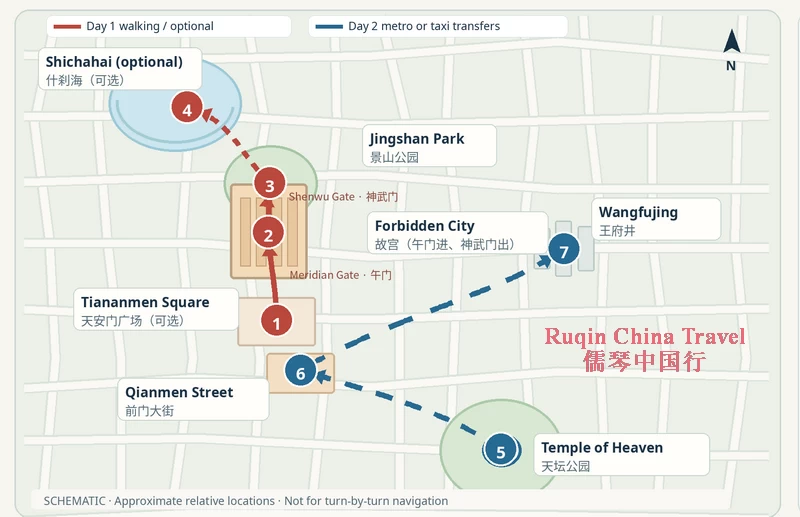
A comfortable route is:
- Start at Yongdingmen or Qianmen
- Walk through Tiananmen Square
- Visit the Forbidden City
- Climb Jingshan Park for the view
- Finish near the Bell and Drum Towers
Along the way, slow down.
Look at the direction of the streets. Notice the relationship between buildings and open spaces. Pay attention to how old architecture and modern life exist together.
The Central Axis teaches you something important about Chinese cities.
A city is not only made of buildings. It also carries memories, values, and ways of thinking.
A Living Line Through Beijing’s History
After guiding many foreign visitors along the Beijing Central Axis, I still enjoy walking this route.
In spring, young leaves appear on both sides of the road. In autumn, golden ginkgo leaves cover the streets near the old buildings.
The scenery changes, but the feeling remains.
This line connects more than famous landmarks. It connects different moments of Chinese history.
For more than 700 years, people have walked here — emperors, craftsmen, soldiers, merchants, and ordinary families.
Today, travelers from around the world continue the journey.
So, when you visit Beijing, do not only collect famous attractions.
Choose a quiet morning. Start walking from south to north. Follow the rhythm of the city.
You may discover that the most beautiful view of Beijing is not found at one single place.
It is found along the line that connects them all.
Ruqin is the founder of Ruqintravel.com and has spent more than four decades working in China’s travel industry. Drawing on hands-on experience in cities like Beijing and Hangzhou, he personally researches and updates each guide to help international travelers navigate China with confidence.
Further Reading
The Architecture of Siheyuan and Hutongs in Beijing
Feng Shui – A Foreigner’s Guide – Ruqin China Travel
Chinese Zodiac Signs: Understanding the Meaning Behind the 12 Animals
Traditional Chinese Festivals: Understanding China Through Its Celebrations
Traditional Chinese Clothing: Understanding the Beauty Behind the Fabrics
Chinese Red Envelope Tradition: A Cultural Guide for Foreigners